

The United Nations Office at Geneva
Multimedia Newsroom
UN appeals for $35 billion to help record world’s ‘most vulnerable and fragile’ in 2021
A record 235 million people will need humanitarian assistance and protection next year, a near- 40 per cent increase on 2020 which is “almost entirely from COVID-19”, the UN’s emergency relief chief said on Tuesday.
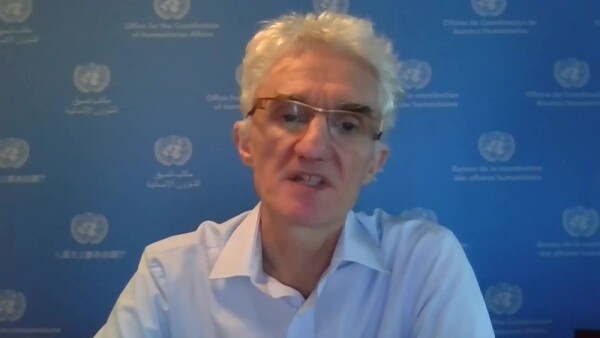
Citing the “carnage” caused by the pandemic before appealing for $35 billion, Mark Lowcock told journalists that the global health crisis had created impacted dramatically people already reeling from conflict, record levels of displacement, climate change shocks. He said that “multiple” famines are looming.
The situation is “desperate” for millions and has left the UN and partners “overwhelmed”, he cautioned.
“The picture we are presenting is the bleakest and darkest perspective on humanitarian needs in the period ahead that we have ever set out. That is a reflection of the fact that the COVID pandemic has wreaked carnage across the whole of the most fragile and vulnerable countries on the planet.”
Speaking via video link at a press conference in Geneva, Mr. Lowcock added that “we thought that nearly 170 million people in the world would need humanitarian assistance this year. Coming into 2021, we think that’s going to be 235 million…the increase arises almost entirely because of COVID-19.”
Echoing Mr. Lowcock’s call for global solidarity, UN Secretary-General António Guterres urged the world to “stand with people in their darkest hour of need”, as the global pandemic continues to worsen.
Although the humanitarian system had delivered “food, medicines, shelter, education and other essentials to tens of millions of people “the crisis is far from over”, the UN chief insisted in a statement.
This year’s Global Humanitarian Overview (GHO) sets out plans “to reach 160 million of the most vulnerable people in 56 countries and most plans, if they are fully financed, will cost $35 billion”, Mr. Lowcock said.
He noted that while richer countries had invested some $10 trillion in staving off economic disaster from the COVID-induced slump and could now see “light at the end of the tunnel…the same is not true in the poorest countries”.
The COVID-19 crisis had plunged millions into poverty “and sent humanitarian needs skyrocketing,” Mr. Lowcock explained, adding that aid funding was needed to “stave off famine, fight poverty, and keep children vaccinated and in school”.
Cash will also be used from the UN’s Central Emergency Relief Fund (CERF) to tackle rising violence against women and girls linked to the pandemic, Mr. Lowcock said.
He also highlighted how climate change and rising global temperatures had further contributed to the bleak outlook for humanitarian needs in 2021, their impact being “most acute in the countries which have also got the biggest humanitarian problems. Indeed, eight of the 10 countries most vulnerable to the effects of climate change are ones where humanitarian agencies have got a huge amount of work to do already.”
Conflicts new and old had also contributed to increased needs, the UN relief chief continued, pointing to “new spikes of conflict in places that were previously more peaceful. We’ve seen that obviously recently in Nagorno-Karabakh, we’ve seen it in northern Mozambique, we’ve seen it in the Western Sahara and at the moment obviously, tragically, we’re seeing in northern Ethiopia.”
Sadly, these flare-ups “haven’t replaced conflicts which have been resolved and calmed down in other places”, Mr. Lowcock continued. “In fact, things are just as bad now in the biggest humanitarian settings driven by conflict as they were when we spoke to you a year ago.”
He added: “We’re overwhelmed with problems, as you know, but just the scale of the need and the scale of crisis is such that these efforts to anticipate things make things a little bit better than they would otherwise have been, but they still leave us with a terrible, desperate situation.”
In addition to providing the means to help communities in crisis, Mr. Lowcock underscored the UN appeal’s focus on preventive action.
This included a cash injection for the World Health Organization (WHO) in February at the outset of the coronavirus pandemic, to ensure that poorer countries received protective equipment to tackle COVID-19.
Similarly, tens of thousands of potential flood victims in Bangladesh also received “support and cash” help in good time so that they could protect their belongings and livelihoods.
“What we ended up with there was a much cheaper, more effective response as well as one that dramatically reducing human suffering than we would have had than if we’d done the traditional thing - waiting until floods arrive,” Mr. Lowcock insisted.
The concept of “nipping problems in the bud” and acting on them before they become critical was “increasingly well-established now”, he maintained.
Nonetheless, the UN emergency relief chief underscored that the scale of the challenges facing humanitarians next year are massive – and growing. “If we get through 2021 without major famines that will be a significant achievement,” he said. “You know, the red lights are flashing and the alarm bells are ringing.”
- Exterior wide shot, Palais des Nations flag alley, nations’ flags flying, a cloudy day.
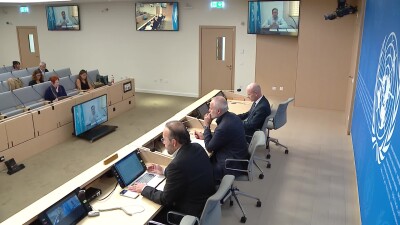
- Wide shot, podium with speakers to rear in a near-empty Room XIV in line with COVID-19 distancing measures, Palais des Nations.
- SOUNDBITE (English) — Mark Lowcock, United Nations Under-Secretary-General for Humanitarian Affairs and Emergency Relief Coordinator: “The picture we are presenting is the bleakest and darkest perspective on humanitarian needs in the period ahead that we have ever set out, I think and that is a reflection of the fact that the COVID pandemic has wreaked carnage across the whole of the most fragile and vulnerable countries on the planet.”
- Medium shot, podium with speakers, using listening devices, Room XIV, Palais des Nations.
- SOUNDBITE (English) — Mark Lowcock, United Nations Under-Secretary-General for Humanitarian Affairs and Emergency Relief Coordinator: “We thought that nearly 170 million people in the world would need humanitarian assistance this year. Coming into 2021, we think that’s going to be 235 million. That’s a 40 per cent increase and the increase arises almost entirely because of COVID-19.”
- Medium shot, journalist writing on tablet, Room XIV, Palais des Nations.
- SOUNDBITE (English) — Mark Lowcock, United Nations Under-Secretary-General for Humanitarian Affairs and Emergency Relief Coordinator: “We are in the GHO setting out plans to reach 160 million of the most vulnerable people in 56 countries and most plans, if they are fully financed, will cost $35 billion.”
- Medium shot, TV camera in foreground and podium with speakers to rear, Room XIV, Palais des Nations.
- SOUNDBITE (English) — Mark Lowcock, United Nations Under-Secretary-General for Humanitarian Affairs and Emergency Relief Coordinator: “The impact of that is most acute in the countries which have also got the biggest humanitarian problems. Indeed, eight of the 10 countries most vulnerable to the effects of climate change are ones where humanitarian agencies have got a huge amount of work to do already.”
- Medium shot, UN staff member typing on laptop and using listening device, Room XIV, Palais des Nations.
- SOUNDBITE (English) — Mark Lowcock, United Nations Under-Secretary-General for Humanitarian Affairs and Emergency Relief Coordinator: “Unfortunately during 2020 we’ve seen new spikes of conflict in places that were previously more peaceful. We’ve seen that obviously recently in Nagorno-Karabakh, we’ve seen it in northern Mozambique, we’ve seen it in the Western Sahara and at the moment obviously, tragically, we’re seeing in in northern Ethiopia. They haven’t replaced conflicts which have been resolved and calmed down in other places; in fact, things are just as bad now in the biggest humanitarian settings driven by conflict as they were when we spoke to you a year ago.”
- Wide shot, near-empty Room XIV in line with COVID-19 distancing measures, Palais des Nations.
- SOUNDBITE (English) — Mark Lowcock, United Nations Under-Secretary-General for Humanitarian Affairs and Emergency Relief Coordinator: “We’re overwhelmed with problems, as you know, but just the scale of the need and the scale of crisis is such that these efforts to anticipate things make things a little bit better than they would otherwise have been, but they still leave us with a terrible, desperate situation.”
- Medium shot, back of journalist’s head in foreground with TV screen to rear showing Mark Lowcock and OCHA spokesperson Jens Laerke, Room XIV, Palais des Nations.
- SOUNDBITE (English) — Mark Lowcock, United Nations Under-Secretary-General for Humanitarian Affairs and Emergency Relief Coordinator: “If we get through 2021 without major famines that will be a significant achievement; you know, the red lights are flashing and the alarm bells are ringing.”
- Medium-wide shot, podium with speakers, Room XIV, Palais des Nations.
- Close-up, UN staff member following press conference, wearing mask and headphones, Room XIV, Palais des Nations.
- Medium shot, podium with speakers conferring and TV screen showing Mark Lowcock, Room XIV, Palais des Nations.
Similar Stories
1
12
1
1
Press Conferences , Images | UNOG
Closing Press Conference following the Sixth Consultative Meeting on Enhancing Coordination of Peace Initiatives and Efforts in Sudan

2
17
1
2
Edited News , Press Conferences | OCHA , WMO
Two UN agencies teamed up on Wednesday to issue an appeal for immediate assistance to help communities already being impacted by the strongest El Niño on record.

3
16
2
2
B-roll , Conferences , Edited News | UNITED NATIONS , UNOG
Sixth Consultative Meeting on Enhancing Coordination of Peace Initiatives and Efforts for Sudan
1
1
1
Press Conferences | CITES
Wildlife trade and conservation policy discussions at the 81st meeting of the CITES Standing Committee (SC81)

1
1
1
Edited News | UNICEF , WHO , UNHCR
Yemen war continues to force families from homes amid hunger and disease
More than 250,000 people have now fled renewed fighting in Yemen, the UN said on Tuesday, citing particular concern for those sheltering in the southwestern city of Taiz and the wider governorate, where access is “essentially blocked”.
1
1
1
Press Conferences | UNHCR , UNCTAD , WMO , OCHA , UNICEF , WHO
UNHCR Hungary’s 1956 Refugee Crisis: 70 Years On, UNCTAD World Investment Forum 2026, Doha, WMO Greenhouse Gas Bulletin and Climate Update for COP31, OCHA Afghanistan: Malnutrition, Girls’ Education and Recovery, UNICEF Yemen: Child Malnutrition and Unsafe Water in Taiz, WHO Inequalities in Noncommunicable Diseases and Risk Factors

1
1
1
Press Conferences | UNHCR
End of UNHCR's 77th Annual Executive Committee (ExCom) meeting week

1
1
1
Edited News | UNICEF
A little over one year since a ceasefire agreement was announced between Hamas fighters and Israel, more than 340 children have been reported killed and hundreds more injured, the UN Children’s Fund, UNICEF, said on Friday.

1
1
1
Press Conferences | UNICEF , IOM , UNHCR
UN Special Assistant to the Personal Envoy Office (SUDAN): Peace Initiatives and Efforts in Sudan; UNICEF: Dire situation of children in Gaza; IOM: Damaged Homes and Energy Attacks Risk Displacing Ukrainians for this winter; UNHCR: update on EXCOM week

1
1
1
Press Conferences | IOM , UNDRR
UN stresses importance of household preparedness for disaster risk reduction.

1
1
1
Edited News | UNICEF , IFRC
Six weeks after Nepal’s deadly flooding disaster, communities are still struggling to rebuild their lives, but they will need sustained help as global warming increases the risk of another Himalayan catastrophe, the UN Children’s Fund (UNICEF) said on Friday.

1
1
1
Statements , Press Conferences | OHCHR