

The United Nations Office at Geneva
Multimedia Newsroom
Amid rising needs, UN relief chief condemns '$1 billion-a-day' cost of war in Middle East
The UN’s emergency relief chief on Wednesday condemned the “$1 billion-a-day” cost of the war roiling the Middle East, at a time of severe cuts to the global body’s humanitarian work in emergencies and “soaring” needs.
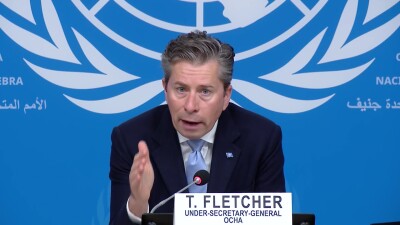
“We're seeing the consequences spread faster than we can respond,” warned the Under-Secretary-General for the Coordination of Humanitarian Affairs, Tom Fletcher.
Speaking in Geneva, he highlighted that a $23 billion appeal announced last December to help 87 million of the world’s most vulnerable people remains around two-thirds underfunded.
“We still need over $14 billion now to deliver this plan, and this is at a time when conflict in the Middle East is costing $1 billion a day,” he said. “Even just $1 billion would allow us to save millions of lives. So, the choice is there: are we going to close this gap?”
Mr. Fletcher insisted that without additional support, “millions of people will die”, in a call to donors to deliver on their pledges quickly: “We need those who have more funds available to get those funds moving fast towards this plan in the first half of the year, not the second half, to allow us to deliver where support is most needed.”
While the number of people in need of assistance globally far outnumbers the 87 million identified in the “hyper-prioritized plan” unveiled at the end of last year, Mr. Fletcher explained that these were the people “in greatest need”.
The plan involves some 2,000 humanitarian organizations of which 60 per cent are local partners and organizations. In January, the initiative made it possible for more than seven million people facing the most severe needs to receive lifesaving support, “in the most hard-to-reach places across 17 of our operations”, he said, stressing the need to support crises in Haiti, the Democratic Republic of the Congo and Sudan.
“In Sudan alone, we reached almost two million people in January, despite the security and logistics challenges we face. Imagine delivering that same result every month this year,” he said.
Given the scale of continuing needs, the UN aid chief highlighted the launch of a global appeal to fund the shortfall and save “one life at a time: 87 million lives.” To date, it has received $60 million from foundations, corporations and individual donors. “We cannot rely on governments alone,” Mr. Fletcher noted.
Turning to the ongoing war across the Middle East, now into its twelfth day, Mr. Fletcher expressed deep concerns about the shipping near-standstill on the Strait of Hormuz, which carries around 20 per cent of the world’s oil. “I'm really worried about food costs, energy costs…fertilizer costs,” he said. “I'm worried that actually further escalation will damage other supply routes. All of this has a direct impact on our humanitarian supplies, including going to areas of key need in sub-Saharan Africa.”
The use of drones in the conflict is also an indication that “the world has decided that it's far more interested in spending enormous amounts of money developing these increasingly deadly weapons than it is on saving lives”, Mr. Fletcher maintained.
ends
UN relief chief presser - Tom Fletcher
TRT: 2’36”
SOURCE: UNTV CH
RESTRICTIONS: NONE
LANGUAGE: ENGLISH / NATS
ASPECT RATIO: 16:9
DATELINE: 11 MARCH 2026 GENEVA, SWITZERLAND
Speakers:
- Tom Fletcher, Under-Secretary-General for the coordination of Humanitarian Affairs, head of OCHA
SHOTLIST
- Exterior wide, UN Geneva flag alley.
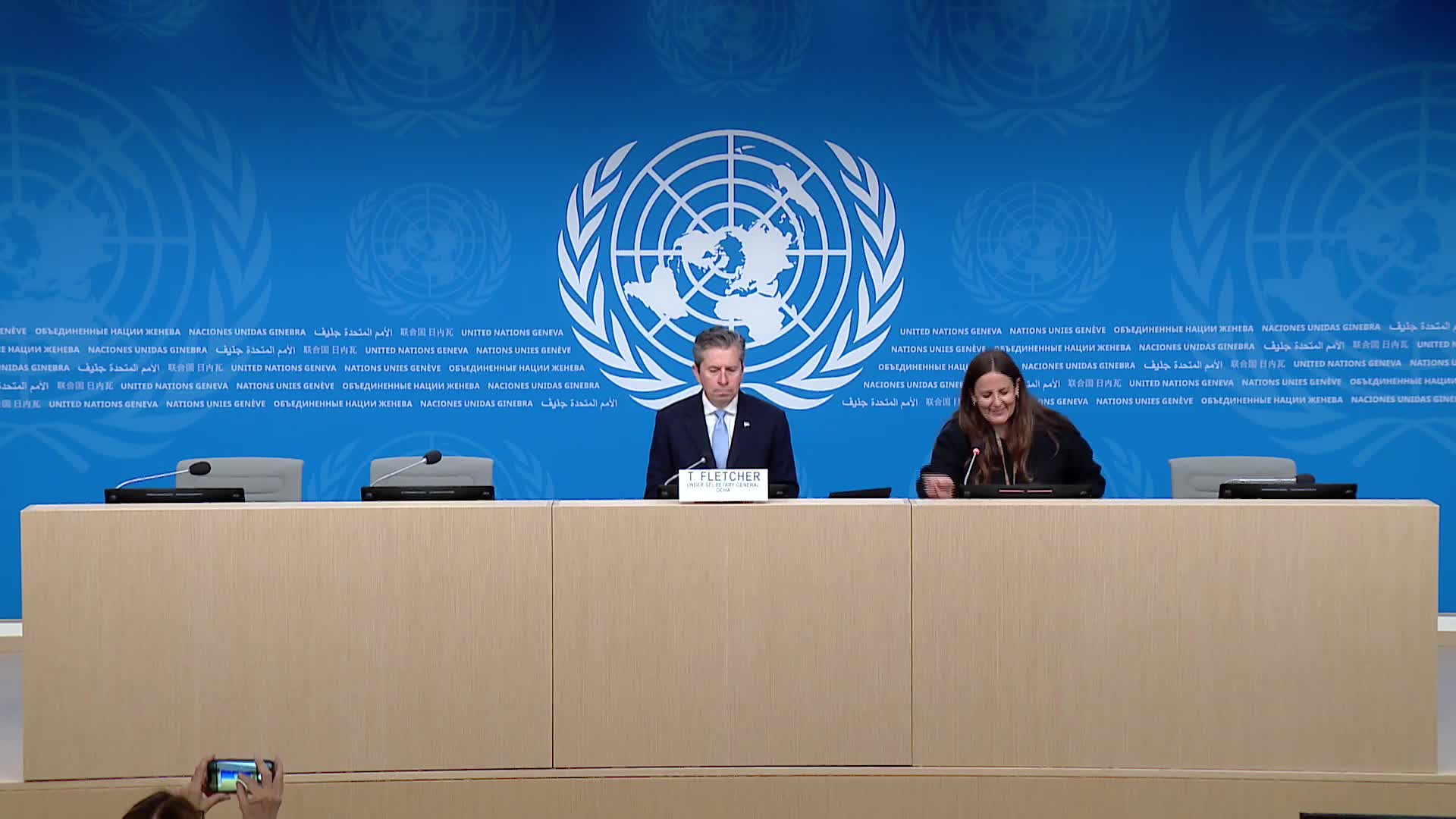
- Wide, UN Geneva Press room, podium speakers.
- SOUNDBITE (English) – Tom Fletcher UN emergency relief chief: “We're living through a moment right now of grave peril. Across the Middle East, we're seeing these crises escalate rapidly and increasingly collide in dangerous ways. We're seeing violence reverberate across borders. Displacement, economic shocks, soaring humanitarian needs. And we're seeing the consequences spread faster than we can respond.”
- Wide, podium.
- SOUNDBITE (English) – Tom Fletcher UN emergency relief chief: “On the Strait of Hormuz I'm really worried about food costs, energy costs, as you say, fertilizer costs. I'm worried that actually further escalation will damage other supply routes. All of this has a direct impact on our humanitarian supplies, including going to areas of key need in sub-Saharan Africa.”
- Wide, podium speakers, journalists.
- SOUNDBITE (English) – Tom Fletcher UN emergency relief chief: “I'm really worried about drones, in particular. I think the world has decided that it's far more interested in spending enormous amounts of money developing these increasingly deadly weapons than it is on saving lives.”
- Medium, journalist.
- SOUNDBITE (English) – Tom Fletcher UN emergency relief chief: “We still need over $14 billion now to deliver this plan, and this is at a time when conflict in the Middle East is costing $1 billion a day. Listen to that number and feel the shame that I feel that we're spending $1 billion a day on this war. Even just $1 billion would allow us to save millions of lives. So, the choice is there: are we going to close this gap?”
- Wide, TV journalists, control booths.
- SOUNDBITE (English) – Tom Fletcher UN emergency relief chief: “Without additional support, millions of people will die. So, we need those who've made those pledges to deliver that disbursement quickly. We need those who have more funds available to get those funds moving fast towards this plan in the first half of the year, not the second half, to allow us to deliver where support is most needed.”
- Medium wide, journalists, participants.
- SOUNDBITE (English) – Tom Fletcher UN emergency relief chief: “We cannot rely on governments alone. So, now we need to reach out beyond to civil society, to business and to the public, most importantly. To date, we have $60 million already raised from foundations, corporations, individual donors, but today we launch a global public campaign to close the remaining gap. One life at a time; 87 million lives.”
- Medium-wide, podium, journalists, photographer.
Similar Stories
1
12
1
1
Press Conferences , Images | UNOG
Closing Press Conference following the Sixth Consultative Meeting on Enhancing Coordination of Peace Initiatives and Efforts in Sudan

2
17
1
2
Edited News , Press Conferences | OCHA , WMO
Two UN agencies teamed up on Wednesday to issue an appeal for immediate assistance to help communities already being impacted by the strongest El Niño on record.
3
16
2
2
B-roll , Conferences , Edited News | UNITED NATIONS , UNOG
Sixth Consultative Meeting on Enhancing Coordination of Peace Initiatives and Efforts for Sudan
1
1
1
Press Conferences | CITES
Wildlife trade and conservation policy discussions at the 81st meeting of the CITES Standing Committee (SC81)

1
1
1
Edited News | UNICEF , WHO , UNHCR
Yemen war continues to force families from homes amid hunger and disease
More than 250,000 people have now fled renewed fighting in Yemen, the UN said on Tuesday, citing particular concern for those sheltering in the southwestern city of Taiz and the wider governorate, where access is “essentially blocked”.
1
1
1
Press Conferences | UNHCR , UNCTAD , WMO , OCHA , UNICEF , WHO
UNHCR Hungary’s 1956 Refugee Crisis: 70 Years On, UNCTAD World Investment Forum 2026, Doha, WMO Greenhouse Gas Bulletin and Climate Update for COP31, OCHA Afghanistan: Malnutrition, Girls’ Education and Recovery, UNICEF Yemen: Child Malnutrition and Unsafe Water in Taiz, WHO Inequalities in Noncommunicable Diseases and Risk Factors
1
1
1
Press Conferences | UNHCR
End of UNHCR's 77th Annual Executive Committee (ExCom) meeting week

1
1
1
Edited News | UNICEF
A little over one year since a ceasefire agreement was announced between Hamas fighters and Israel, more than 340 children have been reported killed and hundreds more injured, the UN Children’s Fund, UNICEF, said on Friday.
1
1
1
Press Conferences | UNICEF , IOM , UNHCR
UN Special Assistant to the Personal Envoy Office (SUDAN): Peace Initiatives and Efforts in Sudan; UNICEF: Dire situation of children in Gaza; IOM: Damaged Homes and Energy Attacks Risk Displacing Ukrainians for this winter; UNHCR: update on EXCOM week

1
1
1
Press Conferences | IOM , UNDRR
UN stresses importance of household preparedness for disaster risk reduction.

1
1
1
Edited News | UNICEF , IFRC
Six weeks after Nepal’s deadly flooding disaster, communities are still struggling to rebuild their lives, but they will need sustained help as global warming increases the risk of another Himalayan catastrophe, the UN Children’s Fund (UNICEF) said on Friday.

1
1
1
Statements , Press Conferences | OHCHR