

The United Nations Office at Geneva
Multimedia Newsroom
We're not planning to leave Gaza at all, says UN’s top aid official
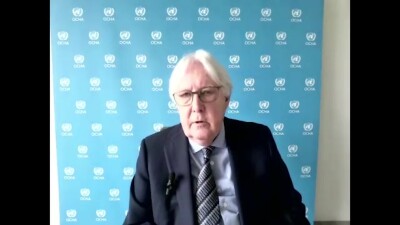
UN aid teams and partner organizations remain deeply committed to delivering lifesaving supplies into Gaza, despite the increasing dangers of working there, the Organization’s top aid official said on Wednesday.
Responding to media reports that the UN had warned that the aid effort may have to stop unless the security situation and coordination with the Israeli military improved, Emergency Relief Coordinator Martin Griffiths denied that any “ultimatum” had been given.
“We continue, as we have done for these many, many months to negotiate with the Israeli authorities and others with a lot of help, by the way, from the US, as you know, to get the right conditions to allow it to be delivered safely and securely,” he told UN News.
“So we're not running away from Gaza, at all, but what is true now - and I think that's the basis for this story - is of course that we are particularly concerned about the security situation in Gaza, and it is becoming more and more difficult to operate.”
The UN relief chief’s comments follow the publication on Tuesday of the latest dire assessment of food insecurity in Gaza, which highlighted the “high risk” of famine across the whole Gaza Strip “as long as conflict continues and humanitarian access is restricted”.
“Aid can make a difference, that's why we need to get all these crossings open,” Mr. Griffiths said. “That’s why we need safety and security, that's why we need the pier to restart and get that aid off the beach if that can be done too. We need all hands on deck for this…We'll keep on at it. But we fail them daily every time we're not able to get aid through to the people who need it.”
“The problem is a political one, that's the real effort, that must be the focus of all our efforts. And indeed, one of the interesting aspects of the Middle East is that there is a lot of political diplomacy, a lot of mediation going on. By the way, I wish we could see that elsewhere, like in Sudan, but we need to see it bring results.”
After almost nine months of war sparked by Hamas-led terror attacks and hostage-taking in Israel, UN aid agencies continue to report ongoing strikes across Gaza by the Israeli military, resulting in civilian casualties, massive forced displacement and the destruction of houses and other public services.
In its latest update, the UN agency for Palestinian refugees, UNRWA, reported “especially intense” airstrikes in central Gaza in recent days, particularly in Bureij, Maghazi and Nuseirat refugee camps and eastern Deir Al Balah.
Meanwhile, the Israeli military’s ground offensive “continues to expand”, UNRWA noted, particularly in the southern regions of Gaza City and eastern Rafah, causing further suffering and further “destabilizing” humanitarian aid flows.
In addition to the war in Gaza, deadly violence has continued unabated against Palestinians in the West Bank, while a renewed escalation between Israel and Hezbollah militants across the frontier with Lebanon prompted a warning from the UN Secretary-General that one false move could trigger a catastrophe for the whole region and beyond.
“The problem is a political one, that's the real effort, that must be the focus of all our efforts,” Mr. Griffiths insisted. “It's not about whether the UN aid agencies are ready, it's about whether the world is going to pitch in to stop this going south.”
He added: “Indeed, one of the interesting aspects of the Middle East is that there is a lot of political diplomacy, a lot of mediation going on. By the way, I wish we could see that elsewhere, like in Sudan, but we need to see it bring results.”
Beyond Gaza, Mr. Griffiths defended the Organization’s role in providing help to people in emergencies around the world.
“We delivered aid to 144 million people last year, that's two-thirds of what we hoped to reach at a time when funding was problematic,” he said. “The aid agencies are doing an extraordinary job, and in particular within a global aid agency, the frontline deliverers.”
As staggering as the number of people receiving assistance is, many tens of millions more remain beyond the UN’s reach, for lack of funding.
“The disparity between the amount of money, you know, more than $2 trillion a year spent on war and the amount of money spent on humanitarian aid for peace-making is an astonishing disparity. And it's a shameful one.”
He added: “We have to get rid of the notion that investing more than $2 trillion in war is a way of getting security in this world - it is not the way to secure this world. The way to secure this world is through people in general to their neighbors being kind to their neighbors too.
Reflecting on his four decades working “on the edges of war zones” and in the diplomatic corridors of power, UK national Mr. Griffiths insisted on the need for radical reform on the global humanitarian system, given the rising needs and protracted emergencies.
Changes may yet come, he noted, pointing to the fact that the “UN and civil society, host governments across the world and regional organizations” should “start looking at the fact that power is being redistributed in this world today. And maybe that's not a bad thing either…We need to do this all at the behest of the people in those communities not what we think is best, but what they know is best.”
This point was made clear to the veteran humanitarian in Sudan where he met representatives from civil society organizations manning emergency treatment rooms “on those front lines, back in Khartoum, across the country. They don't go away, they are the standard I think, for all of us to be able to say, ‘Yes, this (work) is definitely worth it.”
Just days before he steps down as UN Emergency Relief Coordinator – a role UN insiders concede is among the most punishing in the UN system, given its constant travel and media attention – Mr. Griffiths rejected the “incredibly self-indulgent” suggestion that he might slow down in Geneva, where he and his family have lived for years.
He also remained coy about the possible identity of his future successor, who sits at the head of the UN Office for the Coordination of Humanitarian Affairs, OCHA – although he offered one piece of advice: “I believe this fundamentally from my, life, one life saved - one life saved - makes it worthwhile. And I am amazed by the resilience of communities. And I am amazed by the courage of aid workers.”
ends
STORY: Martin Griffiths Emergency Relief Chief Interview
SOURCE: UNTV CH
LENGTH: 3’20”
LANGUAGE: ENGLISH / NATS
ASPECT RATIO: 16:9
RESTRICTIONS: NONE
DATELINE: 26 JUNE 2024 GENEVA, SWITZERLAND
SHOTLIST
1. Exterior wide, UN Geneva flag alley.
2. SOUNDBITE (English) – Martin Griffiths, UN Emergency Relief Coordinator: “My response is very clear, it’s not an ultimatum. We continue, as we have done for these many, many months to negotiate with the Israeli authorities and others with a lot of help, by the way, from the US, as you know, to get the right conditions to allow it to be delivered safely and securely. So we're not running away from Gaza, at all, but what is true now - and I think that's the basis for this story - is of course that we are particularly concerned about the security situation in Gaza, and it is becoming more and more difficult to operate.”
3. Wide, UN Geneva flag alley.
4. SOUNDBITE (English) – Martin Griffiths, UN Emergency Relief Coordinator: “Aid can make a difference. That's why we need to get all these crossings open, that's why we need safety and security, that's why we need the pier to restart and get that aid off the beach if that can be done too. We need all hands on deck for this.”
5. Medium-wide, UN flag alley and Palais des Nations.
6. SOUNDBITE (English) – Martin Griffiths, UN Emergency Relief Coordinator: “We'll keep on at it. But we fail them daily every time we're not able to get aid through to the people who need it.”
7. Medium-wide, UN Geneva flag alley, Palais des Nations.
8. SOUNDBITE (English) – Martin Griffiths, UN Emergency Relief Coordinator: “The problem is a political one, that's the real effort, that must be the focus of all our efforts. And indeed, one of the interesting aspects of the Middle East is that there is a lot of political diplomacy, a lot of mediation going on. By the way, I wish we could see that elsewhere, like in Sudan, but we need to see it bring results.”
9. Medium, UN Geneva flag alley.
10. SOUNDBITE (English) – Martin Griffiths, UN Emergency Relief Coordinator: “But it's not about whether the UN aid agencies are ready, it's about whether the world is going to pitch in to stop this going south.”
11. Wide, UN Geneva flag alley facing broken chair sculpture.
12. SOUNDBITE (English) – Martin Griffiths, UN Emergency Relief Coordinator: “We delivered aid to 144 million people last year, that's two-thirds of what we hoped to reach at a time when funding was problematic. The aid agencies - and it goes back to the point I was making earlier about Gaza - the aid agencies are doing an extraordinary job, and in particular within a global aid agency, the frontline deliverers.”
13. Medium-wide, UN Geneva flag alley.
14. SOUNDBITE (English) – Martin Griffiths, UN Emergency Relief Coordinator: “I had the privilege of meeting representatives from the emergency rooms; the Sudanese civil society organizations from across the country, by the way, came out to visit to brief and who then went back and are still working on those front lines back in Khartoum, across the country. They don't go away, they are, you know, they are the standard I think, for all of us to be able to say, yes, this is definitely worth it.”
15. Medium-wide, UN Geneva flag alley.
16. SOUNDBITE (English) – Martin Griffiths, UN Emergency Relief Coordinator: “I believe this fundamentally from my, life, one life saved - one life saved - makes it worthwhile. And I am amazed by the resilience of communities. And I am amazed by the courage of aid workers.”
17. Medium-close, UN Geneva flag alley.
18. SOUNDBITE (English) – Martin Griffiths, UN Emergency Relief Coordinator: “The disparity between the amount of money, you know, more than $2 trillion a year spent on war and the amount of money spent on humanitarian aid for peace-making is an astonishing disparity. And it's a shameful one.”
We're not running away from Gaza - at all, says UN’s top aid official
UN aid teams and partner organizations remain deeply committed to delivering lifesaving aid into Gaza, despite the many and dangerous obstacles workers continue to encounter, the Organization’s top aid official said on Wednesday.
Similar Stories

1
1
1
Edited News | UNICEF
A little over one year since a ceasefire agreement was announced between Hamas fighters and Israel, more than 340 children have been reported killed and hundreds more injured, the UN Children’s Fund, UNICEF, said on Friday.

1
1
1
Edited News | UNICEF , IFRC
Six weeks after Nepal’s deadly flooding disaster, communities are still struggling to rebuild their lives, but they will need sustained help as global warming increases the risk of another Himalayan catastrophe, the UN Children’s Fund (UNICEF) said on Friday.

1
1
1
Edited News | WHO
In suspected Russia plague death, testing and monitoring underway – WHO
The death of a lab worker in Russia’s Siberia region has sparked concerns about plague being the cause, the UN World Health Organization (WHO) said on Tuesday, adding that it was following the situation closely.

1
1
Edited News | OHCHR , UNOG
UN Human Rights Chief Volker Türk on Friday provided and oral update to the 63rd session of the Human rights Council on Ukraine.

1
1
1
Edited News | OHCHR , UNOG
UN Human Rights Chief Volker Türk on Friday provided and oral update to the 63rd session of the Human rights Council on the human rights situation in Haiti.

1
1
1
Edited News | WHO
Repeated delays in bringing lifesaving medicines, prosthetics and more from Israel into Gaza risk having devastating consequences on Palestinians who urgently need them in the wartorn enclave, the UN World Health Organization (WHO) said on Friday. “A truck full of non-priority supplies or the right supplies arriving too late, doesn't save lives. That's the question that actually matters," said Dr Reinhilde Van De Weerdt, WHO Representative in the OPT.

1
1
1
Edited News | WHO
DRC: Early access to care and oxygen decisive for Ebola patients’ survival – WHO
In the Democratic Republic of the Congo (DRC), health workers fighting the country’s largest-ever Ebola outbreak are struggling to overcome critical challenges to patient care, the UN World Health Organization (WHO) warned on Tuesday.

1
1
1
Edited News | OCHA , UN
Civilians in Iran are continuing to feel the consequences of months of conflict and military escalation, the UN’s top official in the country has said, as loss of life, damage to civilian infrastructure and mounting economic pressures leave many facing continued uncertainty.

1
1
1
Edited News | WHO , UNICEF
Aid agencies in Yemen highlighted the growing hunger emergency sparked by renewed fighting between Houthi opposition forces and Government troops, after mobile health clinics reported that hundreds of children displaced by the violence are suffering from the most deadly form of malnutrition.
1
1
1
Edited News | UNHCR
Displacement on the rise in Yemen as fighting continues - UNHCR
As hostilities worsen in Yemen, more people have been fleeing their homes, further intensifying the humanitarian crisis within the region, the UN Refugee Agency (UNHCR) warned on Tuesday.
1
1
1
Edited News | IOM , OHCHR , UNFPA , UNOG , UNHCR , WHO
Yemen’s humanitarian crisis growing by the hour amid spike in displacement
Yemenis displaced by renewed fighting have described fleeing for their lives amid shelling and gunfire, aid agencies reported on Friday, while highlighting the dramatic increase in humanitarian needs in the country and in Djibouti, where thousands have sought shelter.
1
1
1
Edited News | OHCHR , UNOG
The UN Human Rights Office issued on Friday a report documenting a shocking pattern of sexual violence amid Russia’s full-scale armed attack on Ukraine.