

The United Nations Office at Geneva
Multimedia Newsroom
Press Conferences | OHCHR , OCHA , WHO , UNOG , UNITED NATIONS , WFP , UNECE
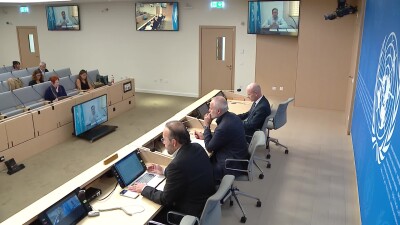
Bi-weekly Press Briefing 24 September 2021
Human Rights Council update
Rolando Gomez, for the Human Rights Council, said that the Council had concluded its interactive dialogue with the Commission of Inquiry on Burundi. The Council was currently holding an interactive dialogue on an oral update by the High Commissioner for Human Rights, Michelle Bachelet, on the human rights situation in Belarus. In the afternoon, the Council would hear the presentation of a report by three members of the Independent Fact-Finding Mission on Venezuela, followed by an interactive dialogue. Later today, the Council would hear an oral update by the High Commissioner on civilian casualties in the Syrian Arab Republic. Over 70 States, as well as double that number of non-governmental organizations, were expected to participate in the Council’s general debate on country situations, which was scheduled to start this afternoon and continue next Monday, September 27. Five panel discussions were scheduled for the week of September 27 through October 1, including reports discussing inclusion of a gender perspective, and the rights of indigenous peoples.
The Council’s complaint procedure would hold a private meeting from 5 p.m. today.
Side events, as well as informal consultations on draft resolutions, were available on the Council’s schedule page. A draft resolution on Afghanistan, led by the European Union, was among those listed.
Coronavirus disease (COVID-19)
Margaret Harris and Dr Janet Diaz, head of clinical care, for the World Health Organization, said that the WHO was updating its clinical care guidance to include the drugs casirivimab and imdevimab (produced by Regeneron) for treatment for non-severe COVID-19 patients who were at highest risk of hospitalization. Dr. Diaz said that the recommendations had been made because the data showed that treatment with the drugs, which were two monoclonal antibodies given together, led to fewer hospitalizations for patients with non-severe COVID-19. There was also a reduction in mortality in patients with several and critical COVID-19, among other effects.
In response to questions, Dr. Diaz acknowledged that there was limited availability of the monoclonal antibodies, and the cost was high of the treatment. WHO was working with the company to address the price, and equitable access to the treatment. In response to questions about the production process for the drugs, she said there were bottlenecks, but WHO had a process to ease regulatory process, deferring further questions to a colleague with greater expertise on the topic. The largest trial had been in the United Kingdom population regarding patients with severe COVID-19; trials on mild and moderate outpatients had been conducted by the Regeneron company.
In response to questions, Ms. Harris noted that nominations for Director-General had indeed closed last night, and said that the standard procedure would be followed. Reporters would be informed when a list of candidates was available.
She added that in the afternoon of Monday, September 27, there would be a press conference in Lyon with the Director-General as well as the French Minister of Health including other participants, on the occasion of the ground-breaking ceremony for the WHO Academy.
Floods in Sudan
Jens Laerke for the United Nations Office for the Coordination of Humanitarian Affairs said that more than 300,000 people across Sudan had been affected by heavy rains and flooding. Public infrastructure had been damaged, bridges had collapsed, roads had been cut off, and farmland had been inundated, leaving thousands homeless and sheltering in schools and public buildings. More than 88,000 people had received food assistance, and nearly 72,000 people had been reached with shelter support and non-food items. However, relief stocks urgently needed to be replenished. The Humanitarian Response Plan for Sudan required 1.9 billion in 2021, but it was currently only 25 per cent funded.
In response to questions, Mr. Laerke said there had been no confirmed reports of loss of life, also noting that this year was less bad than last year’s “catastrophic” floods.
Drought in Angola
Thomson Phiri of the World Food Programme said that more than 1.3 million people in the three south-western provinces of Cunene, Huila and Namibe were facing severe hunger right now due to the worst drought in four decades. The region was highly dependent on agriculture, and had been suffering from the devastating effects of climate change. 114,000 children under the age of five were suffering or likely to suffer from acute malnutrition in the next 12 months, with serious effects on their physical and mental development. The World Food Programme had started working with provincial authorities of Huila and Cunene to strengthen the treatment and prevention of acute malnutrition. WFP’s plan was to expand activities to other drought-affected areas, and was calling for US$ 6.3 million for the period from October 2021 to May 2022.
In response to questions, Mr. Phiri said the drought was affecting mostly south-western Angola, and northern border regions near Namibia were not as severely affected. The WFP considered the situation to be due to climate change. The south-western part of Angola was heavily dependent on rain-fed agriculture, and when there was no rain, it was a disaster. It was a textbook definition of a climate disaster.
UNHCR Nansen refugee award
Shabia Mantoo, for the United Nations Refugee Agency (UNHCR), reminded reporters that the winner of UNHCR’s Nansen refugee award would be made public on Wednesday, September 29 at 9 a.m. Geneva time. In preparation, UNHCR would hold a virtual press briefing on Monday, September 27 at 10:30 to announce, under embargo, the winner of the award. The laureate would attend the event and be available for interviews.
Meeting of the Parties to the Water Convention
Jean Rodriguez for the United Nations Economic Commission for Europe announced that over 100 countries would gather next week from September 29 to October 1 for the ninth session of the Meeting of the Parties to the Water Convention. The parties would discuss transboundary water cooperation worldwide, among other issues. Shared water resources supported the livelihoods of more than 3 billion people. In a world increasingly impacted by the effects of climate change, with projections indicating that by 2050, at least 3.6 billion people globally will live in water-stressed conditions, preserving and managing these shared waters in a cooperative manner was crucial to achieve sustainable development, peace and stability, said Mr. Rodriguez.
A high-level segment on September 29 would be dedicated to water and peace, an increasingly important topic that had been discussed at the Security Council in recent years. At a ministerial roundtable on September 28, ministers from The Gambia, Guinea Bissau, Mauritania, and Senegal were scheduled to adopt a ministerial declaration on a shared aquifer, which would establish a permanent organ for cooperative management.
In response to questions, Mr. Rodriguez said journalists would receive the list of participants, which would include notes about which participants would be present in person. The meetings, in a hybrid format, would take place in Room IIXX at the Palais des Nations, and would follow the current COVID-19 restrictions.
WTO Public Forum
Fernando Puchol of the World Trade Organization said that the WTO's Public Forum would be taking place next week, Tuesday through Friday. The forum, entitled "Trade Beyond COVID-19: Building Resilience", would look at the effects of the pandemic on trade and how the multilateral trading system could help build resilience to the COVID-19 pandemic and future crises. The opening plenary debate would be held on Tuesday, 28 September at 1 p.m. Geneva time. Participants would include Cyril Ramaphosa, President of the Republic of South Africa, as well as the leadership of Oxfam International, the WHO, UNCTAD, the UN Global Compact, and the Chief Operating Officer of the BionTech company, Dr. Sierk Poetting. Mr. Puchol reminded reporters of pre-registration requirements for the press, which included COVID-19 certificates or tests; reporters had to email pressbriefing@wto.org with their name and the media outlet they were working for.
In response to a question, Mr. Puchol said that the list of participants was being finalized, and when released would specify who would participate virtually, and who would participate in person.
Haitian repatriation
In response to questions, Shabia Mantoo, for the United Nations Refugee Agency (UNHCR), said that a news comment had been issued last Tuesday, September 21 on conditions and expulsions at the U.S.-Mexican border. UNHCR continued its advocacy on the situation, but had a limited presence inside Haiti. UNHCR was monitoring developments, and coordinating with other UN agencies on the overall protection response.
Announcements
Michele Zaccheo, Chief of the TV and Radio Section at the United Nations Information Service (UNIS) in Geneva announced on behalf of UNCTAD that a report on assistance to the Palestinian people would be issued on Tuesday, September 28. Embargoed materials were available via UNCTAD’s virtual newsroom, and on Monday, September 27, an embargoed press conference would be held at 2:30 p.m.
UNCTAD would also release its Digital Economy Report 2021 on Wednesday, September 29. Embargoed materials were also available for that report, and there would be an embargoed hybrid press conference on Tuesday, September 28 at 3:30 p.m.
Sunday, September 26 would be the International Day for the Total Elimination of Nuclear Weapons.
The Committee on the Rights of the Child would close its 88th session this afternoon and adopt its concluding observations on Poland, the Czech Republic, Eswatini, and Switzerland.
The Committee on Enforced Disappearances would also close its 21st session this afternoon, adopting its concluding observations on Brazil, Panama, Spain, and France.
On Monday, September 27, the Committee on Economic, Social and Cultural Rights would open its session, during which it would review the reports of Kuwait, Azerbaijan, Bosnia and Herzegovina, Bolivia, and Nicaragua. The review of the report of Bahrain had been postponed.
The Committee on Migrant Workers would also open its next session on Monday, September 27, to review the reports of Rwanda and Azerbaijan.
Similar Stories
1
1
1
Press Conferences | UN WOMEN , WFP , WHO
UN WOMEN: Sudan Women and girls one year after the fall of El Fasher; increasing drone attacks across the country; WFP: DRC - Ebola spreads to eighth DRC province as WFP delivers food, builds treatment centres and keeps supplies moving; WHO - Update on Ebola (Bundibugyo Virus Disease)
1
12
1
1
Press Conferences , Images | UNOG
Closing Press Conference following the Sixth Consultative Meeting on Enhancing Coordination of Peace Initiatives and Efforts in Sudan

2
17
1
2
Edited News , Press Conferences , Images | OCHA , WMO
Two UN agencies teamed up on Wednesday to issue an appeal for immediate assistance to help communities already being impacted by the strongest El Niño on record.
1
1
1
Press Conferences | CITES
Wildlife trade and conservation policy discussions at the 81st meeting of the CITES Standing Committee (SC81)
1
1
1
Press Conferences | UNHCR , UNCTAD , WMO , OCHA , UNICEF , WHO
UNHCR Hungary’s 1956 Refugee Crisis: 70 Years On, UNCTAD World Investment Forum 2026, Doha, WMO Greenhouse Gas Bulletin and Climate Update for COP31, OCHA Afghanistan: Malnutrition, Girls’ Education and Recovery, UNICEF Yemen: Child Malnutrition and Unsafe Water in Taiz, WHO Inequalities in Noncommunicable Diseases and Risk Factors

1
1
1
Press Conferences | UNHCR
End of UNHCR's 77th Annual Executive Committee (ExCom) meeting week

1
1
1
Press Conferences | UNICEF , IOM , UNHCR
UN Special Assistant to the Personal Envoy Office (SUDAN): Peace Initiatives and Efforts in Sudan; UNICEF: Dire situation of children in Gaza; IOM: Damaged Homes and Energy Attacks Risk Displacing Ukrainians for this winter; UNHCR: update on EXCOM week

1
1
1
Press Conferences | IOM , UNDRR
UN stresses importance of household preparedness for disaster risk reduction.

1
1
1
Statements , Press Conferences | OHCHR

1
1
1
Press Conferences | UNHCR , UNICEF , IFRC , OHCHR , UN WOMEN , IOM , OCHA , WHO
UNHCR – ExCom Meeting, UNICEF – Nepal Recovery, IFRC – Flash Floods, WHO – Mental Health, IOM – South Sudan Floods, OCHA – DRC Humanitarian aid, UNHCR – Sahel Displacement, UNICEF – Yemen Update, IOM – Gaza Shelter, UN Women – Gaza Women, OHCHR – Arrests and detentions of Syrians by Israeli force

2
1
2
Press Conferences | UNCTAD
Presentation of the Trade and Developement Report 2026
Embargoed until 9 October 2026 at 11 a.m. (Geneva Time)
UNCTAD: UNCTAD’s flagship report finds that governments increasingly use industrial, trade, financial and technology policies to pursue economic and national security objectives. Market access and the ability to move into higher-value activities now depend more heavily on technology, finance and geopolitics.

1
1
1
Press Conferences | UPU
Release of the State of the Postal Sector Report 2026