

The United Nations Office at Geneva
Multimedia Newsroom
Edited News | OHCHR , UNOG , UNITED NATIONS
International Challenges And Cooperation #MultilateralistMatters
World’s problems must be tackled together, say UN and EU from shores of Lake Geneva
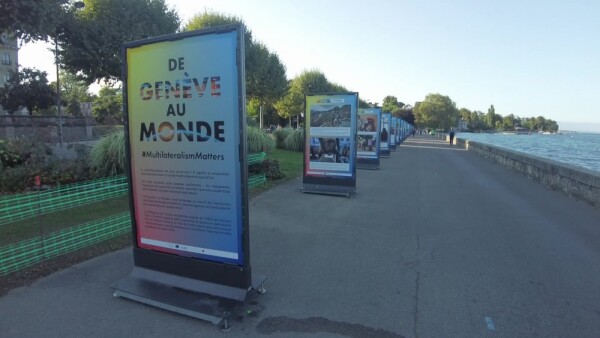
Cooperation between countries - multilateralism – is the only way to respond to global challenges in the 21st century, the United Nations (UN) and the European Union (EU) have declared, at the launch of a new exhibition in Geneva, showcasing the significance and relevance of international solidarity.
“The issues we are talking about from climate to pandemics are what people care about today. And most people understand you can only try to tackle these global issues via cooperation,” said Lotte Knudsen, EU Ambassador to the UN in Geneva, who opened the exhibition, From Geneva to the World - #MultilateralismMatters. “It doesn't mean there are immediate results, but you certainly cannot solve them on your own by closing your borders, or just dealing with one country at a time.”
Highlighting how the global upheaval caused by the COVID-19 crisis in the last 18 months had “amply demonstrated the need for collective action and solidarity”, Ambassador Knudsen maintained that international cooperation should have “a positive impact on people's lives” in all areas.
These included in the humanitarian sphere and human rights, climate change and the environment, health, refugees and migration, all issues that are showcased in a large-format, informative photographic series that illustrates the scope of the work undertaken by international institutions in the Swiss city, on behalf of global citizens.
The lakeside exhibition at Quai Wilson is hosted by the EU Delegation of the European Union to the United Nations Office in Geneva, in partnership with the UN and the City of Geneva. It was unveiled on Monday 6 September and runs for a month.
“We have to learn the lessons of COVID, which was an unprecedented crisis which probably no one could handle perfectly,” said Ambassador Knudsen, who added that there “is no alternative” to ensuring that multilateralism “delivers results” to people in today’s interconnected world.
“We must now draw the conclusions and see what we need to do in terms of improving health systems, in terms of creating better access to health systems across the world, strengthening health systems and of course ensure that should anything similar ever happen, we will be better prepared.”
Echoing that message, UN High Commissioner for Human Rights, Michelle Bachelet, said that the challenge post-COVID was “not only about how we in a coordinated way respond to threats, but also on how we can seize better common opportunities. And that is linked to how we want to build back better…because we don't want to come back to normality, a normality (in which) COVID-19 impacted us so terribly.”
Geneva was well-placed to help achieve a more positive outcome for everyone, the UN rights chief maintained, as the city was “very well known internationally as a multilateral centre for multilateral action and promotion, respect and realisation of human rights. And of course, our Office supports that as well by setting human rights standards, but also looking worldwide how the implementation of those human rights standards are being developed and achieved.”
Among the more than 30 international organizations whose work is displayed, the UN World Intellectual Property Organization (WIPO) exhibit illustrates its mission to use intellectual property (IP) as a powerful catalyst for jobs, growth and sustainable development, for each of its 193 Member States.
“We need to build back better, and part of building back better means that we need to have a more inclusive, diverse system,” said WIPO Director-General, Daren Tang.
Asked about pressing global problems that required multilateral action, Mr. Tang pointed to climate change and the recent devastating floods in Europe, Asia and North America. “We really, really need to get a grip on that. If we look at what is happening in the world in the last few months, every part of the world, Germany - so near here - China, and the US. Climate change we can have all so, we really need to get to grips with that.”
The WIPO Director-General also insisted on the importance of explaining the positive, transformative value of multilateralism whose values are based on a rules and rights-based framework, to a broader public.
“We need to go out there and better connect with people and engage with people, especially young people,” he said. “They don’t know about what we do at the UN, they don’t know what we do at the UN specialised agencies. So, I think this is a good opportunity now to use social media, to change the way we talk about the UN, to change the way we talk about IP. At WIPO, we have a big push towards talking about IP that is a much more down-to-earth, relatable manner, so that people understand that IP is not something just for specialists, but something to help them use IP to guide us to market, to bring their creations and their innovations alive.”
In comments highlighting the need for greater international solidarity towards refugees and other vulnerable minorities impacted by the COVID-19 socio-economic crisis, Deputy High Commissioner for Refugees Kelly Clements insisted that “it's very clear, the world is not okay. There are a large number of people that were already in need and now are even in greater need. You see the socio-economic impacts. You see that the most vulnerable have been impacted, perhaps even more so than they were already in need. So, here's an opportunity, one on inclusion: make sure that everyone is vaccinated; not just the citizens of a country, but also the refugees and migrants and others that find themselves in that country.”
There were precedents for this kind of collaborative approach in Jordan and Lebanon, Ms. Clements maintained, “two countries that have been huge hosts for refugee populations over many decades, by the way, not just since the Syrian crisis began a decade ago”.
They had worked together “to find solutions so that people, refugees who have stayed very close to their homes in Syria, are able to go home safely and in dignity, but also to be able to provide support to those host communities”.
Visiting the exhibition with her baby, bystander Caroline expressed the hope that multilateralism in future would be robust enough to withstand the inflammatory political rhetoric that has been a feature of the COVID crisis.
“What's important most to me is that borders remain open after the times, after last year, after the pandemic, I saw many borders close,” she said. “I saw a lot of conversations become tougher between countries, within countries. And what I worry about is that borders remain open for her to discover the world in all its beauty.”
Another visitor, Florian, said that greater resources were needed to produce positive change: “I would say we are not doing enough because there is always a problem and the lack of it is a lack of resources.”
The UN alone couldn’t be expected to solve all the world’s complex challenges, he added. “They do the best they do of it, but I think in general, it's not only a case of the United Nations. I think it's with all society worldwide. We have to do an effort. And the United Nations is only one step to move on and to go ahead for these things.”
ends
STORY: International Challenges & Cooperation – #MultilateralismMatters, Geneva
TRT: 6’03”
SOURCE: UNTV CH
RESTRICTIONS: NONE
LANGUAGE: ENGLISH
ASPECT RATIO: 16:9
DATELINE: 17 Sept 2021, GENEVA, SWITZERLAND
SHOTLIST
- Close-up of one of the panels from the #MultilateralismMatters on the shores of Lake Geneva.
- Medium of the exhibition.
- SOUNDBITE (English): Lotte Knudsen, EU Ambassador to the UN in Geneva and other international organizations in Geneva: “The issues we are talking about from climate to pandemics are what people care about today. And most people understand you can only try to tackle these global issues via cooperation. It doesn't mean there are immediate results, but you certainly cannot solve them on your own by closing your borders, or just dealing with one country at a time.”
- Wide of people attending the event by Lake Geneva; water fountain visible to rear.
- SOUNDBITE (English): Lotte Knudsen, EU Ambassador to the UN in Geneva and other international organizations in Geneva: “We have to learn the lessons of COVID, which was an unprecedented crisis which probably no one could handle perfectly. We must now draw the conclusions and see what we need to do in terms of improving health systems, in terms of creating better access to health systems across the world, strengthening health systems and of course ensure that should anything similar ever happen, we will be better prepared.”
- Close-up de-zoom of a panel from the exhibition.
- SOUNBITE (English): UN High Commissioner for Human Rights, Michelle Bachelet: “So, this is not only about how we in a coordinated way respond to threats, but also on how we can seize better common opportunities. And that is linked to how we want to build back better this world, because we don't want to come back to normality, a normality that made… that COVID-19 impacted us so terribly.”
- Close-up, panning, of a panel from the exhibition.
- SOUNBITE (English): United Nations High Commissioner for Human Rights, Michelle Bachelet: “Geneva is, well, very well known internationally as a multilateral centre for multilateral action and promotion, respect and realisation of human rights. And of course, our Office supports that as well by setting human rights standards, but also looking worldwide how the implementation of those human rights standards are being developed and achieved.”
- Close-up of a panel from the exhibition.
- SOUNDBITE (English): World Intellectual Property Organization (WIPO) Director-General, Daren Tang: “We need to build back better, and part of building back better means that we need to have a more inclusive, diverse system. Beyond that, I think the big challenge is climate change. We really, really need to get a grip on that. If we look at what is happening in the world in the last few months, every part of the world, Germany - so near here - China, and the US. Climate change we can have all so, we really need to get to grips with that.”
- Close shot, zooming in, of an exhibition panel.
- SOUNDBITE (English): WIPO Director General, Daren Tang: “We need to go out there and better connect with people and engage with people, especially young people. They don’t know about what we do at the UN, they don’t know what we do at the UN specialised agencies. So, I think this is a good opportunity now to use social media, to change the way we talk about the UN, to change the way we talk about IP. At WIPO, we have a big push towards talking about IP that is a much more down-to-earth, relatable manner, so that people understand that IP is not something just for specialists, but something to help them use IP to guide us to market, to bring their creations and their innovations alive.”
- Wide shot of podium speaker, participants and water fountain to rear.
- Close-up, zooming in on exhibition panel.
- SOUNDBITE (English): Deputy High Commissioner for Refugees Kelly Clements: “It's very clear, the world is not okay. There are a large number of people that were already in need and now are even in greater need. You see the socio-economic impacts. You see that the most vulnerable have been impacted, perhaps even more so than they were already in need. So, here's an opportunity, one on inclusion: make sure that everyone is vaccinated; not just the citizens of a country, but also the refugees and migrants and others that find themselves in that country.”
- Close-up, de-zoom of an exhibition panel.
- SOUNDBITE (English): Deputy High Commissioner for Refugees Kelly Clements: “What we see in Jordan and Lebanon, two countries that have been huge hosts for refugee populations over many decades, by the way, not just since the Syrian crisis began a decade ago, is the ability to be able to come together; one, to find solutions so that people, refugees who have stayed very close to their homes in Syria, are able to go home safely and in dignity, but also to be able to provide support to those host communities.”
- Medium of people passing alongside the exhibition, water fountain to rear.
- SOUNDBITE (English): onlooker Caroline holding baby: “What's important most to me is that borders remain open after the times, after last year, after the pandemic, I saw many borders close. I saw a lot of conversations become tougher between countries, within countries. And what I worry about is that borders remain open for her to discover the world in all its beauty.”
- Wide shot, travelling, of the exhibition and the lake.
- SOUNDBITE (English): bystander Florian: “I would say we are not doing enough because there is always a problem and the lack of it is a lack of resources of it. And they do the best they do of it, but I think in general, it's not only a case of the United Nations. I think it's with all society worldwide. We have to do an effort. And the United Nations is only one step to move on and to go ahead for these things.”
- Wide of the women’s choir Tao Mousso that accompanied the opening ceremony.
- Medium of the choir’s lead singer holding microphone.
- Medium of an exhibition panel which reads “From Geneva To The World”.
- Wide shot of event.
Similar Stories
1
1
1
Edited News | OCHA , UNICEF , WFP
Aid agencies warned on Friday of the fast-developing humanitarian emergency inside Taiz City in Yemen, which has been encircled by de facto Houthi forces fighting government troops along the country’s west coast.

2
17
1
2
Edited News , Press Conferences , Images | OCHA , WMO
Two UN agencies teamed up on Wednesday to issue an appeal for immediate assistance to help communities already being impacted by the strongest El Niño on record.

3
16
2
2
Edited News , B-roll , Conferences , Images | UNITED NATIONS , UNOG
Sixth Consultative Meeting on Enhancing Coordination of Peace Initiatives and Efforts for Sudan

1
1
1
Edited News | UNICEF , WHO , UNHCR
Yemen war continues to force families from homes amid hunger and disease
More than 250,000 people have now fled renewed fighting in Yemen, the UN said on Tuesday, citing particular concern for those sheltering in the southwestern city of Taiz and the wider governorate, where access is “essentially blocked”.

1
1
1
Edited News | UNICEF
A little over one year since a ceasefire agreement was announced between Hamas fighters and Israel, more than 340 children have been reported killed and hundreds more injured, the UN Children’s Fund, UNICEF, said on Friday.

1
1
1
Edited News | UNICEF , IFRC
Six weeks after Nepal’s deadly flooding disaster, communities are still struggling to rebuild their lives, but they will need sustained help as global warming increases the risk of another Himalayan catastrophe, the UN Children’s Fund (UNICEF) said on Friday.

1
1
1
Edited News | WHO
In suspected Russia plague death, testing and monitoring underway – WHO
The death of a lab worker in Russia’s Siberia region has sparked concerns about plague being the cause, the UN World Health Organization (WHO) said on Tuesday, adding that it was following the situation closely.

1
1
Edited News | OHCHR , UNOG
UN Human Rights Chief Volker Türk on Friday provided and oral update to the 63rd session of the Human rights Council on Ukraine.

1
1
1
Edited News | OHCHR , UNOG
UN Human Rights Chief Volker Türk on Friday provided and oral update to the 63rd session of the Human rights Council on the human rights situation in Haiti.

1
1
1
Edited News | WHO
Repeated delays in bringing lifesaving medicines, prosthetics and more from Israel into Gaza risk having devastating consequences on Palestinians who urgently need them in the wartorn enclave, the UN World Health Organization (WHO) said on Friday. “A truck full of non-priority supplies or the right supplies arriving too late, doesn't save lives. That's the question that actually matters," said Dr Reinhilde Van De Weerdt, WHO Representative in the OPT.

1
1
1
Edited News | WHO
DRC: Early access to care and oxygen decisive for Ebola patients’ survival – WHO
In the Democratic Republic of the Congo (DRC), health workers fighting the country’s largest-ever Ebola outbreak are struggling to overcome critical challenges to patient care, the UN World Health Organization (WHO) warned on Tuesday.

1
1
1
Edited News | OCHA , UN
Civilians in Iran are continuing to feel the consequences of months of conflict and military escalation, the UN’s top official in the country has said, as loss of life, damage to civilian infrastructure and mounting economic pressures leave many facing continued uncertainty.