

The United Nations Office at Geneva
Multimedia Newsroom
Press Conferences | OHCHR , UNHCR , OCHA , WHO , UNOG
_UNOG Bi-weekly press briefing 28 May 2021
Displacement from Goma
Jens Laerke, for the Office for the Coordination of Humanitarian Affairs (OCHA), said that thousands of residents from Goma in the eastern Democratic Republic of the Congo were displaced and on the move after an order from the authorities to evacuate areas that were at risk by further volcanic eruptions of Mount Nyiragongo. It was not known exactly how many have now left the city, but approximately 400,000 people were potentially affected by the evacuation order.
The first eruption on 22 May killed over 30 people and the Goma Volcanological Observatory had warned that the risk of a new eruption was real. Strong tremors had continued on 27 May, one of them of magnitude 4.9 on the Richter scale. The humanitarian focus had up till now been on people directly affected by the volcanic eruption and neighbourhoods in Goma without access to water, but with mass displacement of people, the operational focus was widening, and new assessments would take place today in Sake, Rutshuru and other relocation areas.
Mr. Laerke informed that OCHA had reinforced its presence in Goma with an eight-person team to support the response led by the local authorities. The crisis was happening against a backdrop of already high needs in North Kivu. Forty-four per cent of the five million internally displaced persons in the DRC were in North Kivu, where 33 per cent of the population was also severely food insecure. In a response to a question, Mr. Laerke said that OCHA would conduct assessments at the evacuation locations today.
Babar Baloch, for the United Nations Refugee Agency (UNHCR), added that some 4,000 people had arrived from the DRC to Rwanda. More were expected as Goma was being evacuated, and the UNHCR was working with the Rwandan authorities at local and national levels and commended Rwanda for keeping its borders open and taking care of people in need.
Abductions in Tigray
Responding to questions, Babar Baloch, for the United Nations Refugee Agency (UNHCR), said that UNHCR had received disturbing reports of soldiers entering a number of temporary accommodations for the displaced in Shire and taking away several hundreds of youth - internally displaced Ethiopians who had been sheltering there. The situation was dramatic and distressing, not only for the relatives of the missing, but for all the displaced in Shire. It was critical that all combatants recognize the humanitarian character and sanctity of the displacement sites in Shire and elsewhere, stressed Mr. Baloch.
Conduct of the elections in Nicaragua
Marta Hurtado, for the Office of the High Commissioner for Human Rights (OHCHR), said that the OHCHR was deeply concerned that Nicaragua's chances of holding free and genuine elections on 7 November were diminishing as a result of measures taken by authorities against political parties, candidates and independent journalists, which further restricted the civic and democratic space. Ms. Hurtado reminded that in February, the Human Rights Council had mandated the Office to closely monitor human rights during the electoral process in Nicaragua, and the OHCHR had witnessed troubling developments in recent weeks.
On 4 May, the country’s National Assembly, aligned with the ruling party, had passed an electoral reform that disregarded the demands of the opposition, civil society and the international community by not incorporating safeguards to guarantee the impartiality of electoral authorities. Under this reform, the authorities had in recent weeks dissolved two political parties using arguments that were contrary to international norms and standards, and without due process. On 19 May, the authorities had announced they had initiated a criminal investigation of one of the main presidential candidates, Cristiana Chamorro, for alleged money laundering through the Violeta Barrios de Chamorro Foundation. The National Police had also intensified its actions to restrict the movements of other opposition leaders.
OHCHR called on the Nicaraguan Government to cease the harassment of members of the opposition and journalists and to fully ensure the enjoyment of the freedoms of information and expression, assembly, association, as well as the right to political participation.
OHCHR briefing note is here.
Answering a question, Ms. Hurtado added that that there were several layers of prohibition against freedom of expression and assembly. OHCHR asked the authorities to allow it access to the country so that it could closely follow developments there.
Political turmoil in Samoa
Marta Hurtado, for the Office of the High Commissioner for Human Rights (OHCHR), voiced concern by challenges to the rule of law in Samoa following the 9 April elections. OHCHR urged that the rule of law and democratic institutions in Samoa be respected and protected, and in particular the key role played by an independent judiciary. Samoan judges had to be able to undertake their functions without pressure, interference or personal attacks from any quarter.
Samoa was a party to the International Covenant on Civil and Political Rights since 2008 and had thus committed itself to safeguard access to justice and the independence of the judiciary. The fact that the court’s decisions were being challenged went against the rule of law and separation of powers. Ms. Hurtado shared the concern about the situation getting worse.
Full briefing note is here.
Situation in the Occupied Palestinian Territories
In a response to a question, Jens Laerke, for the Office for the Coordination of Humanitarian Affairs (OCHA), explained that a flash appeal for USD 95 million had been launched, primarily for Gaza, but also for the West Bank and East Jerusalem. The Humanitarian Coordinator had spoken about the psycho-social impact on affected people, especially children. The needs were quite high.
Fadéla Chaib, for the World Health Organization (WHO), added that the WHO had requested immediate access for medical and humanitarian staff to the Gaza Strip. WHO was working to support the Palestinian health system, and was calling for support from the international community in that regard. During the latest fighting, some 30 health facilities had been damaged, with dozens of health workers injured. The COVID-19 testing laboratory in Gaza had resumed its work, which was good news.
Ms. Chaib said that the WHO was launching an appeal for USD seven million over the next six months for treating traumas, mental health services, etc. Ms. Chaib added that there were some 600 medical referrals had been affected by the closure of the crossings due to the escalation. A discussion on the health situation in the OPT at the World Health Assembly had taken place on 26 May, informed Ms. Chaib; the full text of the adopted decision was publicly available.
World Health Assembly
Fadéla Chaib, for the World Health Organization (WHO), reminded that the daily journal was published on the WHO website. Today the WHA would address global action on patient safety, immunization agenda, global strategy and plan of action on intellectual property, among other issues. From 1 to 2 p.m., there would be a briefing on preventing sexual exploitation and abuse – from policy to practice. Discussions would continue on strengthening the response to the current pandemic and being better prepared for future pandemics.
Ms. Chaib said that the WHO was reviewing the report on the origin of the virus. Based on that, the technical team which had conducted the first assessment would propose next steps, to be presented to the Director-General. Further studies would be needed in a range of areas, as already stated by Dr. Tedros.
Forty years since the first AIDS case – new report by UNAIDS
Sophie Barton-Knott, for UNAIDS, said that, as the world was preparing to mark the 40th anniversary of the first reported cases of AIDS on 5 June, UNAIDS would release a new report outlining latest data and trends in the global and regional HIV epidemics. The report would detail the main challenges still to overcome to end AIDS as a public health threat by 2030 and outline a roadmap for the coming five years. The launch would take place on 3 June at 4 p.m., during a virtual press conference featuring Winnie Byanyima, Executive Director of UNAIDS, one of the world’s leading AIDS researchers Quarraisha Abdool Karim, Matthew Kavanagh, Director of the Global Health Policy & Politics Initiative at O'Neill Institute, and a young person affected by HIV.
The release of the report was timed just days before countries are set to adopt a bold new Political Declaration on AIDS at the United Nations General Assembly High-Level Meeting on AIDS, to be held in New York and virtually on 8-10 June.
Geneva announcements
Jens Laerke, for the Office for the Coordination of Humanitarian Affairs (OCHA), informed that on 2 June at 11 a.m. there would be a virtual press conference to launch the new edition of the World Employment and Social Outlook: Trends 2021 (WESO Trends), which looked at the effects of the COVID-19 pandemic on the global labour market and the prospects for recovery. The report was under embargo until 1 p.m. the same day. Speakers at the event would be Guy Ryder, ILO Director-General, and Richard Samans, Director, ILO Research Department.
On 1 June 2021 at 11 a.m., UN Information Service would host a ceremony in the Ariana Park to mark the International Day of UN Peacekeepers. The theme for this year’s commemoration was “The Road to Lasting Peace: Leveraging the Power of Youth for Peace and Security”. The ceremony would be shown live on UN Geneva Facebook page.
The Conference on Disarmament would hold on 1 June a public plenary meeting devoted to a debate on item 3 of the Agenda - prevention of an arms race in outer space.
The Committee on the Rights of the Child was concluding today at noon the review of the report of Tunisia.
Similar Stories
1
1
1
Press Conferences | UN WOMEN , WFP , WHO
UN WOMEN: Sudan Women and girls one year after the fall of El Fasher; increasing drone attacks across the country; WFP: DRC - Ebola spreads to eighth DRC province as WFP delivers food, builds treatment centres and keeps supplies moving; WHO - Update on Ebola (Bundibugyo Virus Disease)
1
12
1
1
Press Conferences , Images | UNOG
Closing Press Conference following the Sixth Consultative Meeting on Enhancing Coordination of Peace Initiatives and Efforts in Sudan

2
17
1
2
Edited News , Press Conferences , Images | OCHA , WMO
Two UN agencies teamed up on Wednesday to issue an appeal for immediate assistance to help communities already being impacted by the strongest El Niño on record.
1
1
1
Press Conferences | CITES
Wildlife trade and conservation policy discussions at the 81st meeting of the CITES Standing Committee (SC81)
1
1
1
Press Conferences | UNHCR , UNCTAD , WMO , OCHA , UNICEF , WHO
UNHCR Hungary’s 1956 Refugee Crisis: 70 Years On, UNCTAD World Investment Forum 2026, Doha, WMO Greenhouse Gas Bulletin and Climate Update for COP31, OCHA Afghanistan: Malnutrition, Girls’ Education and Recovery, UNICEF Yemen: Child Malnutrition and Unsafe Water in Taiz, WHO Inequalities in Noncommunicable Diseases and Risk Factors
1
1
1
Press Conferences | UNHCR
End of UNHCR's 77th Annual Executive Committee (ExCom) meeting week
1
1
1
Press Conferences | UNICEF , IOM , UNHCR
UN Special Assistant to the Personal Envoy Office (SUDAN): Peace Initiatives and Efforts in Sudan; UNICEF: Dire situation of children in Gaza; IOM: Damaged Homes and Energy Attacks Risk Displacing Ukrainians for this winter; UNHCR: update on EXCOM week

1
1
1
Press Conferences | IOM , UNDRR
UN stresses importance of household preparedness for disaster risk reduction.
1
1
1
Statements , Press Conferences | OHCHR
1
1
1
Press Conferences | UNHCR , UNICEF , IFRC , OHCHR , UN WOMEN , IOM , OCHA , WHO
UNHCR – ExCom Meeting, UNICEF – Nepal Recovery, IFRC – Flash Floods, WHO – Mental Health, IOM – South Sudan Floods, OCHA – DRC Humanitarian aid, UNHCR – Sahel Displacement, UNICEF – Yemen Update, IOM – Gaza Shelter, UN Women – Gaza Women, OHCHR – Arrests and detentions of Syrians by Israeli force
2
1
2
Press Conferences | UNCTAD
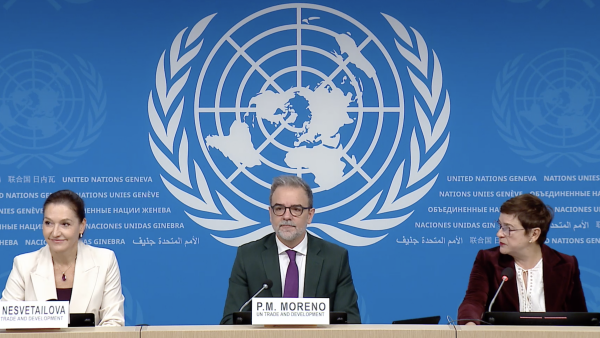
Presentation of the Trade and Developement Report 2026
Embargoed until 9 October 2026 at 11 a.m. (Geneva Time)
UNCTAD: UNCTAD’s flagship report finds that governments increasingly use industrial, trade, financial and technology policies to pursue economic and national security objectives. Market access and the ability to move into higher-value activities now depend more heavily on technology, finance and geopolitics.
1
1
1
Press Conferences | UPU
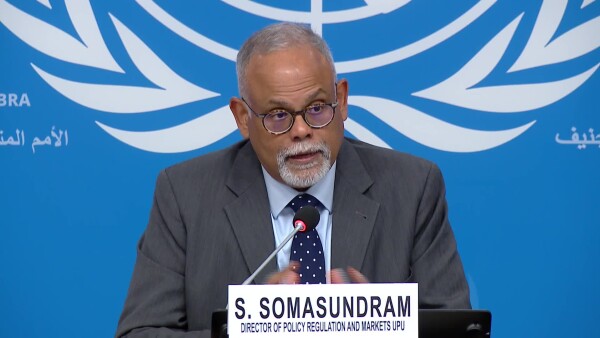
Release of the State of the Postal Sector Report 2026