

The United Nations Office at Geneva
Multimedia Newsroom
Press Conferences | OHCHR , UNOG , UNITED NATIONS , WFP , IOM
UNOG Bi-weekly press briefing 12 January 2021
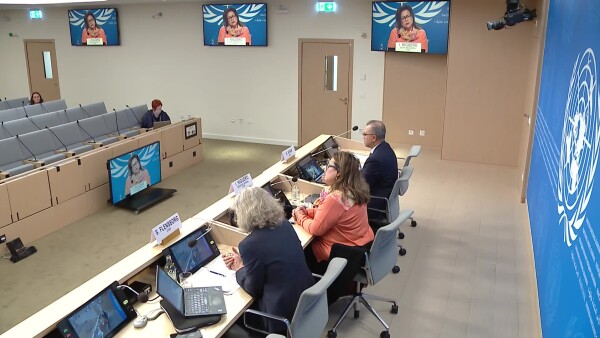
Rhéal LeBlanc, Chief of the Press and External Relations Section of the United Nations Information Service (UNIS), chaired the hybrid briefing, attended by the spokespersons and representatives of the International Labour Organization, the World Food Programme, the Office of the High Commissioner for Human Rights, and Unitaid.
Food security situation in southern Madagascar
Lola Castro, Regional director for Southern Africa and Indian Ocean States for the World Food Programme (WFP), said three consecutive years of drought coupled with a sharp recession triggered by the COVID-19 pandemic had left a third of the population in Southern Madagascar struggling to put food on the table. There was no let up on the worsening drought conditions in 2021 and a poor harvest in 2020 meant communities had few resources to fall back on and many had had to leave their homes in search of food and work. Some 1.35 million people were projected to be food insecure — 35 per cent of the region’s population. The figure was nearly double what it was in the same period last year. While recognizing that donors had been supportive over the years and thanking them for their support, WFP urgently needed US$35 million to fund lifesaving food and cash distributions and malnutrition treatment programmes. This also included emergency school feeding for 150,000 children.
Responding to questions, Ms. Castro said WFP had worked with communities to increase their resilience in the face of climatic shocks. It did so by building irrigation channels, for instance, and considering the key role played by women in ensuring families’ food security. This was a complex endeavour which required long-term financial engagements.
Peru: Police used unnecessary and excessive force during protests
Elizabeth Throssell, for the Office of the High Commissioner for Human Rights (OHCHR), said police in Peru had used unnecessary and excessive force when faced with mass protests between 9 and 15 November 2020, according to a UN Human Rights Office report published today that stressed the failure of security forces to comply with international human rights norms and standards. The report was the product of a Human Rights Office mission to Lima from 17 to 22 November, at the invitation of the Peruvian Government, to gather information regarding alleged human rights violations committed during protests challenging the legitimacy of the interim president, as well as expressing other causes of social discontent. Among its main findings, the report noted that police officers did not distinguish between peaceful protesters, who were in the majority, and a minority who were alleged to have acted violently.
A full press release is available here. The full report can be accessed here.
Ms. Throssell, in response to journalists’ questions, said there had been cooperation on the part of the Government. It was critical that investigations thoroughly address not only what happened in November, but more broadly allegations that police had not abided by international standards.
Launch of world’s first long-acting medicines centre at University of Liverpool
Hervé Verhoosel, for Unitaid, said Unitaid was launching today a new research Centre at the University of Liverpool. Established as part of a US$40 million international research consortium, primarily funded by Unitaid, the University of Liverpool’s Centre of Excellence for Long-acting Therapeutics (CELT) would be the first of its kind in the world. By repurposing existing medicines into slow-release formulations, where drug effectiveness can be sustained over several months, “long-acting” technology had already been successfully implemented in the fields of contraception and schizophrenia. It now had the potential to improve the outcomes for treatment and prevention of deadly diseases such as HIV, malaria, Hepatitis C and tuberculosis, which particularly impacted low- and middle-income countries.
Geneva announcements
Rhéal LeBlanc, for the United Nations Information Service (UNIS), said the Libyan Political Dialogue Forum (LPDF)’s Advisory Committee would be meeting this week at the Palais des Nations, from 13 to 16 January 2021. The Committee was recently established to discuss outstanding issues related to the selection mechanism of a unified executive and to put forward concrete and practical recommendations upon which the LDFP plenary shall decide. The national elections date of December 24, 2021 remained a sine qua non for the United Nations Support Mission in Libya (UNSMIL), a guiding principle and unrenounceable goal. In this sense, the Committee’s mandate would be strictly time-bound. The 18 members of the Committee represented a broad geographical and political diversity and included the participation of women, youth and cultural components. The first meeting on Wednesday morning would begin at 9.30 a.m., with opening remarks by Acting Special Representative of the Secretary-General Stephanie Williams.
The first public meeting of the 2021 session of the Conference on Disarmament would take place next Tuesday, 19 January, at 10 a.m. and would be a virtual meeting. The first part of the session would take place until the 26 March and begin under the presidency of Belgium. The other presidencies for this year session would be : Brazil, Bulgaria, Cameroon, Canada and Chile. The second part of the session would take place from 10 May to 25 June and the third part from 26 July to 10 September.
The Committee on the Rights of the Child would open next Monday, 18 January, at noon, its 85th session — a virtual one during which, given the current COVID-19 situation, it would not review any country report.
On behalf of the Human Rights Council (HRC), Mr. LeBlanc added that the HRC would hold an organizational meeting today at 3 p.m. to select the country rapporteurs for its Universal Periodic Reviews taking place in 2021. The meeting would also continue the discussion on the election of the Council President (from the Asia-Pacific Group) and the 4th Vice-President (from the Eastern European Group) for 2021
Responding to a question on the Secretary-General’s intentions regarding a second mandate, Mr. LeBlanc said the Secretary-General had conveyed to the President of the General Assembly and the President of the Security Council that he was available to serve a second term as Secretary-General of the United Nations, if that were the will of the Member States.
Rosalind Yarde, for the International Labour Organization (ILO), said that, on 21 January, the ILO would be kicking off the International Year for the Elimination of Child Labour following on from a resolution that was adopted by the UN General Assembly in 2019. Almost 100 million children had been removed from child labour over the last two decades, bringing numbers down from 246 million in 2000 to 152 million in 2016. Nevertheless, progress across regions was imbalanced and challenges remained with younger age groups. This was being aggravated by the COVID-19 pandemic.
Similar Stories
1
1
1
Press Conferences | WMO , UNHCR , WHO , ILO
WMO: Greenhouse Gas Bulletin; UNHCR: As attacks intensify UNHCR urges support for war ravaged Ukrainians; WHO: Clinical trials in DRC: vaccines and beyond; ILO: New global and regional estimates on domestic work, informality and working conditions
1
1
1
Press Conferences | UN WOMEN , WFP , WHO
UN WOMEN: Sudan Women and girls one year after the fall of El Fasher; increasing drone attacks across the country; WFP: DRC - Ebola spreads to eighth DRC province as WFP delivers food, builds treatment centres and keeps supplies moving; WHO - Update on Ebola (Bundibugyo Virus Disease)
1
12
1
1
Press Conferences , Images | UNOG
Closing Press Conference following the Sixth Consultative Meeting on Enhancing Coordination of Peace Initiatives and Efforts in Sudan

2
17
1
2
Edited News , Press Conferences , Images | OCHA , WMO
Two UN agencies teamed up on Wednesday to issue an appeal for immediate assistance to help communities already being impacted by the strongest El Niño on record.
1
1
1
Press Conferences | CITES
Wildlife trade and conservation policy discussions at the 81st meeting of the CITES Standing Committee (SC81)
1
1
1
Press Conferences | UNHCR , UNCTAD , WMO , OCHA , UNICEF , WHO
UNHCR Hungary’s 1956 Refugee Crisis: 70 Years On, UNCTAD World Investment Forum 2026, Doha, WMO Greenhouse Gas Bulletin and Climate Update for COP31, OCHA Afghanistan: Malnutrition, Girls’ Education and Recovery, UNICEF Yemen: Child Malnutrition and Unsafe Water in Taiz, WHO Inequalities in Noncommunicable Diseases and Risk Factors

1
1
1
Press Conferences | UNHCR
End of UNHCR's 77th Annual Executive Committee (ExCom) meeting week

1
1
1
Press Conferences | UNICEF , IOM , UNHCR
UN Special Assistant to the Personal Envoy Office (SUDAN): Peace Initiatives and Efforts in Sudan; UNICEF: Dire situation of children in Gaza; IOM: Damaged Homes and Energy Attacks Risk Displacing Ukrainians for this winter; UNHCR: update on EXCOM week

1
1
1
Press Conferences | IOM , UNDRR
UN stresses importance of household preparedness for disaster risk reduction.

1
1
1
Statements , Press Conferences | OHCHR

1
1
1
Press Conferences | UNHCR , UNICEF , IFRC , OHCHR , UN WOMEN , IOM , OCHA , WHO
UNHCR – ExCom Meeting, UNICEF – Nepal Recovery, IFRC – Flash Floods, WHO – Mental Health, IOM – South Sudan Floods, OCHA – DRC Humanitarian aid, UNHCR – Sahel Displacement, UNICEF – Yemen Update, IOM – Gaza Shelter, UN Women – Gaza Women, OHCHR – Arrests and detentions of Syrians by Israeli force

2
1
2
Press Conferences | UNCTAD
Presentation of the Trade and Developement Report 2026
Embargoed until 9 October 2026 at 11 a.m. (Geneva Time)
UNCTAD: UNCTAD’s flagship report finds that governments increasingly use industrial, trade, financial and technology policies to pursue economic and national security objectives. Market access and the ability to move into higher-value activities now depend more heavily on technology, finance and geopolitics.