

The United Nations Office at Geneva
Multimedia Newsroom
Displacement on the rise in Yemen as fighting continues - UNHCR
As hostilities worsen in Yemen, more people have been fleeing their homes, further intensifying the humanitarian crisis within the region, the UN Refugee Agency (UNHCR) warned on Tuesday.
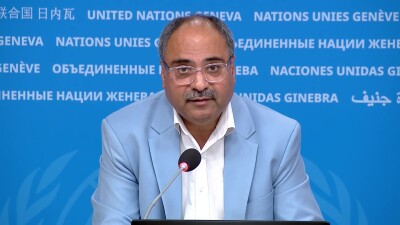
“Fighting in Yemen is expanding across multiple front lines, triggering a rapidly growing displacement crisis and driving more than 130,000 people to flee their homes since the beginning of September,” UNHCR spokesperson Babar Baloch told reporters in Geneva.
The mass displacement follows the Iran-backed Houthi fighters’ rapid advance down Yemen’s western coast to the Bab el-Mandeb Strait in recent weeks and clashes between Saudi-backed Yemeni Government forces.
The city of Taiz in south-western Yemen remains the epicentre of the crisis, Mr. Baloch said, accounting for more than 60 per cent of overall displacement.
“Many families remaining within the governorate itself [are] unable to move to safer locations due to fighting, blocked roads or lack of transportation fuel,” he said.
Displacement is also being reported from Al Jawf, Marib and Hudaydah governorates. According to UNHCR, the vast majority of those displaced are women and children, and many have already been forced to flee several times.
Before the recent escalation, more than 5.2 million people were already internally displaced inside Yemen, which has seen more than a decade of conflict and economic collapse. The UNHCR spokesperson said at least 22 million people – over half of the country’s population – are estimated to require humanitarian assistance. Yemen has also been hosting some 65,000 refugees and asylum seekers, mainly from Somalia and Ethiopia.
Mr. Baloch stressed that more Yemenis are now becoming refugees, as civilians fleeing clashes across the Gulf of Aden continue to arrive in Djibouti. More than 3,000 have arrived so far, while hundreds more have landed in neighbouring Somaliland and Puntland. The number of new refugee arrivals in Djibouti has already surpassed the total number of Yemenis arriving in recent years.
More than 10,000 arrivals are expected in Djibouti, Mr. Baloch explained, as sea conditions are forecasted to improve by mid-October, which could enable further crossings.
UNHCR’s Djibouti operation is only 15 per cent funded, while in Yemen in 2026, the agency has received only $34 million of the $194 million required even before the latest escalation.
-Ends -
STORY Yemen displacement update - UNHCR
TRT: 2:16’’
SOURCE: UNTV CH
RESTRICTIONS: NONE
LANGUAGE: ENGLISH/NATS
ASPECT RATIO: 16:9
DATELINE: 22 SEPTEMBER 2026 GENEVA, SWITZERLAND
1. Exterior wide shot: Palais des Nations, Flag Alley.
2. Wide reverse shot: Speakers at the podium of the press conference; speakers on screens; journalist sin the Press room.
3. SOUNDBITE (English) – Babar Baloch, spokesperson, UN Refugee Agency (UNHCR): “Fighting in Yemen is expanding across multiple front lines, triggering a rapidly growing displacement crisis and driving more than 130,000 people to flee their homes since the beginning of September.”
4. Medium reverse shot: Speakers at the podium of the press conference; speakers on screens.
5. SOUNDBITE (English) – Babar Baloch, spokesperson, UN Refugee Agency (UNHCR): “Taiz remains the epicentre of the crisis, accounting for more than 60 per cent of overall displacement, with many families remaining within the governorate itself, unable to move to safer locations due to fighting, blocked roads or lack of transportation fuel.”
6. Wide reverse shot: Speakers at the podium of the press conference; speaker on screens; journalists in the Press room.
7. SOUNDBITE (English) – Babar Baloch, spokesperson, UN Refugee Agency (UNHCR): “It is estimated that more than 22 million people require humanitarian assistance, including the internally displaced people. And also, Yemen has been hosting some 65,000 refugees and asylum seekers, mainly from Somalia and Ethiopia.”
8. Wide shot: Journalists in the Press room; speaker on screens.
9. SOUNDBITE (English) – Babar Baloch, spokesperson, UN Refugee Agency (UNHCR): “Yemeni refugees continue to arrive daily. More than 3,000 have so far arrived in Djibouti, where UNHCR is working with authorities and partners to assist the arrivals. Hundreds have landed in Somaliland and Puntland.”
10. Medium shot: Journalists in the Press room.
11. SOUNDBITE (English) – Babar Baloch, spokesperson, UN Refugee Agency (UNHCR): “UNHCR and partners are planning for more than 10,000 arrivals in Djibouti, with sea conditions expected to improve by mid-October, potentially enabling further crossings.”
12. Various shots: Journalists in the Press room.
Similar Stories

2
17
1
2
Edited News , Press Conferences | OCHA , WMO
Two UN agencies teamed up on Wednesday to issue an appeal for immediate assistance to help communities already being impacted by the strongest El Niño on record.

3
16
2
2
B-roll , Conferences , Edited News | UNITED NATIONS , UNOG
Sixth Consultative Meeting on Enhancing Coordination of Peace Initiatives and Efforts for Sudan

1
1
1
Edited News | UNICEF , WHO , UNHCR
Yemen war continues to force families from homes amid hunger and disease
More than 250,000 people have now fled renewed fighting in Yemen, the UN said on Tuesday, citing particular concern for those sheltering in the southwestern city of Taiz and the wider governorate, where access is “essentially blocked”.

1
1
1
Edited News | UNICEF
A little over one year since a ceasefire agreement was announced between Hamas fighters and Israel, more than 340 children have been reported killed and hundreds more injured, the UN Children’s Fund, UNICEF, said on Friday.

1
1
1
Edited News | UNICEF , IFRC
Six weeks after Nepal’s deadly flooding disaster, communities are still struggling to rebuild their lives, but they will need sustained help as global warming increases the risk of another Himalayan catastrophe, the UN Children’s Fund (UNICEF) said on Friday.

1
1
1
Edited News | WHO
In suspected Russia plague death, testing and monitoring underway – WHO
The death of a lab worker in Russia’s Siberia region has sparked concerns about plague being the cause, the UN World Health Organization (WHO) said on Tuesday, adding that it was following the situation closely.

1
1
Edited News | OHCHR , UNOG
UN Human Rights Chief Volker Türk on Friday provided and oral update to the 63rd session of the Human rights Council on Ukraine.

1
1
1
Edited News | OHCHR , UNOG
UN Human Rights Chief Volker Türk on Friday provided and oral update to the 63rd session of the Human rights Council on the human rights situation in Haiti.

1
1
1
Edited News | WHO
Repeated delays in bringing lifesaving medicines, prosthetics and more from Israel into Gaza risk having devastating consequences on Palestinians who urgently need them in the wartorn enclave, the UN World Health Organization (WHO) said on Friday. “A truck full of non-priority supplies or the right supplies arriving too late, doesn't save lives. That's the question that actually matters," said Dr Reinhilde Van De Weerdt, WHO Representative in the OPT.

1
1
1
Edited News | WHO
DRC: Early access to care and oxygen decisive for Ebola patients’ survival – WHO
In the Democratic Republic of the Congo (DRC), health workers fighting the country’s largest-ever Ebola outbreak are struggling to overcome critical challenges to patient care, the UN World Health Organization (WHO) warned on Tuesday.

1
1
1
Edited News | OCHA , UN
Civilians in Iran are continuing to feel the consequences of months of conflict and military escalation, the UN’s top official in the country has said, as loss of life, damage to civilian infrastructure and mounting economic pressures leave many facing continued uncertainty.
1
1
1
Edited News | WHO , UNICEF
Aid agencies in Yemen highlighted the growing hunger emergency sparked by renewed fighting between Houthi opposition forces and Government troops, after mobile health clinics reported that hundreds of children displaced by the violence are suffering from the most deadly form of malnutrition.