

The United Nations Office at Geneva
Multimedia Newsroom
In Gaza, women-headed households face ‘impossible choices’ to survive
In war-torn Gaza, a growing number of women-headed households face “impossible decisions” every day, amid ongoing Israeli airstrikes and still-scarce resources, UN humanitarians said on Tuesday.
According to new data from UN Women, nearly one in four households in Gaza is reportedly headed by a woman, an estimated 86,290 families. “This is double the pre-October 2023 rate and follows the widespread killings of Palestinians,” said Sofia Calltorp, Chief of Humanitarian Action at the agency.
The update comes 11 months after a ceasefire agreement was reached between Hamas fighters and Israel. It has not halted ongoing exchanges of fire and the killing of 246 Palestinian women and girls by Israeli air bombardment and military ground operations in Gaza. “This is equivalent to six women and girls killed every week between October 2025 and 28 July 2026,” Ms. Calltorp said.
Across the enclave today, access to food, drinking water, hygiene supplies and essential services remains “severely limited”, the UN official told journalists in Geneva.
“There are restrictions on humanitarian access, insecurity and continued Israeli bombardment,” she explained. “Women heading households are every day forced to make impossible decisions on how to allocate scarce resources, how to access assistance and simply ensure the survival of those in their care.”
Among victims are 18-year-old Raghad Ashour, “killed in an Israeli strike on her way to her 11th grade high school exam in Gaza City”, Ms. Calltorp said. “Thirty-one-year-old Dina Almadhoun was killed in a strike in Gaza City; a six-year-old girl was killed in a helicopter strike on an encampment for displaced families in the Mawasi area of Khan Younis.”
The overall reported casualty toll since the ceasefire agreement is 1,303 fatalities and 4,336 injuries, according to Gazan health authorities cited by the UN aid coordination office, OCHA.
UN Women’s analysis also showed that women who head households are more likely to lack shelter, food and money than male-headed households. “They are also more likely to be displaced or have their home destroyed,” Ms. Calltorp stressed.
As a result of the war, sparked by Hamas-led terror attacks in Israel in October 2023, most of Gaza’s population of around 2.1 million people remains displaced today.
Palestinians are confined to less than 40 per cent of the Gaza Strip as Israeli authorities continue to restrict access to areas beyond what are known as the “Yellow” and “Orange” lines. More than half of the population (58 per cent) faces critical or catastrophic shelter needs, according to the UN aid coordination office, OCHA, which said that when the “Yellow Line” was established following the ceasefire, it covered around 53 per cent of the Gaza Strip.
These restrictions later expanded, leaving around two-thirds of Gaza either inaccessible or subject to severe access restrictions, with civilians confined to crowded and unsafe areas.
ends
Story: Gaza update – UN Women
SOURCE: UNTV CH
RESTRICTIONS: NONE
LANGUAGE: ENGLISH / NATS
ASPECT RATIO: 16:9
Duration: 3’09”
DATELINE: 8 September 2026 - GENEVA, SWITZERLAND and May 2026 GAZA – AL-MAWASI
Geneva Press briefing
Speakers:
- UN WOMEN - Sofia Calltorp, Chief of Humanitarian Action
SHOTLIST
- Exterior medium shot: UN flag alley.
- Wide shot of Press Room, podium speaker.
- SOUNDBITE (English) UN WOMEN - Sofia Calltorp, Chief of Humanitarian Action: “We have been speaking to widows and to women whose husbands are missing, detained, severely injured, forcibly displaced, or whose fate remains unknown. And we found a horrific amount of collective heartbreak.”
- Wide, Press Room.
- SOUNDBITE (English) UN WOMEN - Sofia Calltorp, Chief of Humanitarian Action: “Access to food, to safe water, to hygiene supplies and essential services is severely limited. There are restrictions on humanitarian access, insecurity and continued Israeli bombardment. Women heading households are every day forced to make impossible decisions on how to allocate scarce resources, how to access assistance and simply ensure the survival of those in their care.”
- Wide, Press Room, external speaker on TV screen.
- SOUNDBITE (English) UN WOMEN - Sofia Calltorp, Chief of Humanitarian Action: “Two hundred and forty-six Palestinian women and girls have been killed by Israeli air bombardment and military ground operations in Gaza since the ceasefire agreement came into effect in October 2025. This is equivalent to six women and girls killed every week between October 2025 and 28 July 2026.”
- Wide, podium speaker, external speaker on TV screen.
- SOUNDBITE (English) UN WOMEN - Sofia Calltorp, Chief of Humanitarian Action: “Eighteen-year-old Raghad Ashour was killed in an Israeli strike on her way to her 11th grade high school exam in Gaza City; 31-year-old Dina Almadhoun was killed in a strike in Gaza City. A six-year-old girl was killed in a helicopter strike on an encampment for displaced families in the Mawasi area of Khan Younis.”
- Wide, Press Room.
- SOUNDBITE (English) UN WOMEN - Sofia Calltorp, Chief of Humanitarian Action: “UN Women data show that women who head households are more likely to be deprived of shelter, of food and finances than male-headed households. They are also more likely to be displaced or have their home destroyed.”
- Medium, journalist.
- Medium, participant.
- Medium, journalist.
- Medium, woman washing clothes by hand in Al-Mawasi, Gaza (please credit UN Women).
- Wide, a young woman holding a baby receives some aid supplies (please credit UN Women).
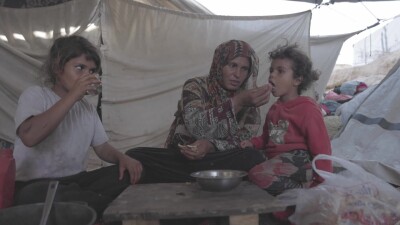
- Medium-wide, a mother feeds her daughter in a tent(please credit UN Women).
- Close, a woman helping a girl with homework in a tent. (please credit UN Women).
- Close, a woman helping a girl with homework. (please credit UN Women).
Similar Stories

2
17
1
2
Edited News , Press Conferences | OCHA , WMO
Two UN agencies teamed up on Wednesday to issue an appeal for immediate assistance to help communities already being impacted by the strongest El Niño on record.

3
16
2
2
B-roll , Conferences , Edited News | UNITED NATIONS , UNOG
Sixth Consultative Meeting on Enhancing Coordination of Peace Initiatives and Efforts for Sudan

1
1
1
Edited News | UNICEF , WHO , UNHCR
Yemen war continues to force families from homes amid hunger and disease
More than 250,000 people have now fled renewed fighting in Yemen, the UN said on Tuesday, citing particular concern for those sheltering in the southwestern city of Taiz and the wider governorate, where access is “essentially blocked”.

1
1
1
Edited News | UNICEF
A little over one year since a ceasefire agreement was announced between Hamas fighters and Israel, more than 340 children have been reported killed and hundreds more injured, the UN Children’s Fund, UNICEF, said on Friday.

1
1
1
Edited News | UNICEF , IFRC
Six weeks after Nepal’s deadly flooding disaster, communities are still struggling to rebuild their lives, but they will need sustained help as global warming increases the risk of another Himalayan catastrophe, the UN Children’s Fund (UNICEF) said on Friday.

1
1
1
Edited News | WHO
In suspected Russia plague death, testing and monitoring underway – WHO
The death of a lab worker in Russia’s Siberia region has sparked concerns about plague being the cause, the UN World Health Organization (WHO) said on Tuesday, adding that it was following the situation closely.

1
1
Edited News | OHCHR , UNOG
UN Human Rights Chief Volker Türk on Friday provided and oral update to the 63rd session of the Human rights Council on Ukraine.

1
1
1
Edited News | OHCHR , UNOG
UN Human Rights Chief Volker Türk on Friday provided and oral update to the 63rd session of the Human rights Council on the human rights situation in Haiti.

1
1
1
Edited News | WHO
Repeated delays in bringing lifesaving medicines, prosthetics and more from Israel into Gaza risk having devastating consequences on Palestinians who urgently need them in the wartorn enclave, the UN World Health Organization (WHO) said on Friday. “A truck full of non-priority supplies or the right supplies arriving too late, doesn't save lives. That's the question that actually matters," said Dr Reinhilde Van De Weerdt, WHO Representative in the OPT.

1
1
1
Edited News | WHO
DRC: Early access to care and oxygen decisive for Ebola patients’ survival – WHO
In the Democratic Republic of the Congo (DRC), health workers fighting the country’s largest-ever Ebola outbreak are struggling to overcome critical challenges to patient care, the UN World Health Organization (WHO) warned on Tuesday.

1
1
1
Edited News | OCHA , UN
Civilians in Iran are continuing to feel the consequences of months of conflict and military escalation, the UN’s top official in the country has said, as loss of life, damage to civilian infrastructure and mounting economic pressures leave many facing continued uncertainty.
1
1
1
Edited News | WHO , UNICEF
Aid agencies in Yemen highlighted the growing hunger emergency sparked by renewed fighting between Houthi opposition forces and Government troops, after mobile health clinics reported that hundreds of children displaced by the violence are suffering from the most deadly form of malnutrition.