

The United Nations Office at Geneva
Multimedia Newsroom
Press Conferences , Edited News | UNECE
UNECE Press Conference - Critical Minerals: myths and realities
Middle East war: After oil and gas crunch, concerns grow over vital raw minerals
The shipping crisis in the Strait of Hormuz caused by war in the Middle East has exposed a new threat: a looming shortage of strategic minerals that drive economies all over the world - and a race by countries to obtain them.
Until war erupted on 28 February with the Israeli-US bombing of Iran and counterstrikes across Gulf States, a wide range of key minerals and related products was available, according to the UN Economic Commission for Europe (UNECE).
But as the conflict goes on, the pressure has increased to obtain these same raw materials, to ensure the continuing production of everything from semiconductors to solar panels.
The result has been higher prices on commodities markets and a potential pivot to new production sites where there’s less geopolitical uncertainty.
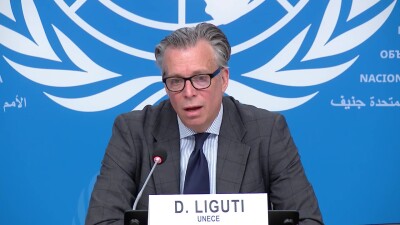
“The impact of the Gulf War, it is not only in the energy market, it's been impacting some sub-products coming from oil” such as sulphur, helium and naphtha - said Dario Liguti, Director of UNECE’s Sustainable Energy Division. All are byproducts of oil refining and used in a wide range of manufacturing applications, from fertilizers to insecticides, plastics and matches, along with cooling and semiconductor production. Naptha is another byproduct of oil refining and a key building block of the chemicals industry.
“The first reaction besides of course the increase in prices will be industries lowering their use and therefore lowering their production…whether it's solar panels, whether it's magnets, whether it's batteries, et cetera, going forward,” Mr. Liguti maintained.
Before the war, a full 30 per cent of the world's production of sulphur - which is used in metals processing - transited through the Strait of Hormuz. But that was when some 140 ships per day transited the crucial trade waterway. Today, shipping is at a virtual standstill, following attacks on vessels and an ongoing stand-off between Iran and the US over use of the strait.
If the conflict situation continues, shortages in key minerals “will become evident”, the UNECE official continued, forcing industry “to lower their production” of critical minerals used in renewable energy equipment and digital technology. “Therefore over time, that will have an increasing impact on prices first…and then secondly on the availability of that equipment.”
Today, industries that relied on supplies from the Strait of Hormuz “are using their existing stocks and they're using the reserves and they're ramping up production elsewhere”, Mr. Liguti said.
He highlighted a “drive from many Member States around the world to secure those minerals” which will result in countries increasingly building “strategic stocks…to avoid a similar disruption in future.
“So far, the situation is being felt in some regional markets, particularly in South Asia and Southeast Asia, where there is a lot of refining and processing going on of these initial commodities. But over time, the geographical scope will become larger.”
In addition to the massive human cost of the war, the UNECE official noted how the oil and natural gas crisis also threatens to undermine the global shift to green energy sources.
“You can see how a crisis which is fundamentally focused on the on the old traditional fossil fuels sector, how that that impacts as well the new energy, the new renewable energy, and the transition that we have been undertaking and we actually need to accelerate, as you know, as we are falling behind in the Paris 2030 targets”.
ends
STORY: Critical minerals crunch - UNECE
TRT: 2’59”
SOURCE: UNTV CH
RESTRICTIONS: NONE
LANGUAGE: ENGLISH, NATS
ASPECT RATIO: 16:9
DATELINE: 23 APRIL 2026, GENEVA, SWITZERLAND
SHOTLIST
Speaker:
- Dario Liguti, Director, Sustainable Energy Division, UNECE
- Exterior wide shot, United Nations flag flying.
- Wide shot of panel at press briefing.
- SOUNDBITE: (ENGLISH): Dario Liguti, Director, Sustainable Energy Division, UNECE: “The impact of the Gulf War, it is not only is in the energy market, it's been impacting as well some sub-products coming from oil, and you mentioned sulphur correctly, but helium as well, and then naphtha, which are byproducts of the oil refining and are used in different processes.”
- Medium-wide, podium speakers, TV screen showing speaker.
- SOUNDBITE: (ENGLISH): Dario Liguti, Director, Sustainable Energy Division, UNECE: “If the situation – if the conflict situation - continues, the shortages will become evident and will force industries to lower their production of certain technologies, you know, and particularly critical minerals for renewable energy equipment, for example, digital technologies, for that purpose as well. And therefore over time, that will have an increasing impact on prices first of this equipment and then secondly on the availability of that equipment if the conflict continues.”
- Wide, podium speakers, journalists.
- SOUNDBITE: (ENGLISH): Dario Liguti, Director, Sustainable Energy Division, UNECE: “The first reaction besides of course the increase in prices will be industries lowering their use and therefore lowering their production of whether it's solar panels, whether it's magnets, whether it's batteries, et cetera, going forward.”
- Wide, Press room, participants.
- SOUNDBITE: (ENGLISH): Dario Liguti, Director, Sustainable Energy Division, UNECE: “What I can tell you is there is a drive from many Member States around the world to secure those minerals, and we will see increasingly Member States building strategic stocks of those minerals to avoid going into the future or facing into the future this sort of situation.”
- Wide shot of panel, photographer.
- SOUNDBITE: (ENGLISH): Dario Liguti, Director, Sustainable Energy Division, UNECE: “So far, the situation is being felt in some regional markets, particularly in South Asia and Southeast Asia, where there is a lot of refining and processing going on of these initial commodities. But over time, the geographical scope will become larger.”
- Wide, Press room, screens showing speaker.
- SOUNDBITE: (ENGLISH): Dario Liguti, Director, Sustainable Energy Division, UNECE: “So you can see how a crisis which is fundamentally focused on the old traditional fossil fuels sector, how that that impacts as well the new energy, the new renewable energy, and the transition that we have been undertaking and we actually need to accelerate, as you know, as we are falling behind in the Paris 2030 targets”.
- Medium, photographer
- Medium, journalist.
- Medium, journalist.
Similar Stories
1
1
1
Press Conferences | IOM , UNDRR
UN stresses importance of household preparedness for disaster risk reduction.

1
1
1
Edited News | UNICEF , IFRC
Six weeks after Nepal’s deadly flooding disaster, communities are still struggling to rebuild their lives, but they will need sustained help as global warming increases the risk of another Himalayan catastrophe, the UN Children’s Fund (UNICEF) said on Friday.

1
1
1
Statements , Press Conferences | OHCHR
1
1
1
Press Conferences | UNHCR , UNICEF , IFRC , OHCHR , UN WOMEN , IOM , OCHA , WHO
UNHCR – ExCom Meeting, UNICEF – Nepal Recovery, IFRC – Flash Floods, WHO – Mental Health, IOM – South Sudan Floods, OCHA – DRC Humanitarian aid, UNHCR – Sahel Displacement, UNICEF – Yemen Update, IOM – Gaza Shelter, UN Women – Gaza Women, OHCHR – Arrests and detentions of Syrians by Israeli force
2
1
2
Press Conferences | UNCTAD
Presentation of the Trade and Developement Report 2026
Embargoed until 9 October 2026 at 11 a.m. (Geneva Time)
UNCTAD: UNCTAD’s flagship report finds that governments increasingly use industrial, trade, financial and technology policies to pursue economic and national security objectives. Market access and the ability to move into higher-value activities now depend more heavily on technology, finance and geopolitics.
1
1
1
Press Conferences | UPU
Release of the State of the Postal Sector Report 2026

1
1
1
Edited News | WHO
In suspected Russia plague death, testing and monitoring underway – WHO
The death of a lab worker in Russia’s Siberia region has sparked concerns about plague being the cause, the UN World Health Organization (WHO) said on Tuesday, adding that it was following the situation closely.
1
1
1
Press Conferences | IOM , ITU , UNECE , UNICEF , WHO , WMO
UNICEF: Ebola, DRC - children orphans or separating them from parents and caregivers; IOM: Humanitarian needs in Djibouti amid arrivals from Yemen and increased migrant movements; WHO: Darfur, scale of health needs far exceeds available resources; WMO co-sponsored Global Heat Forum, Bangkok, monthly Global Seasonal Climate Update; UNECE: UN Forum of Mayors; ITU Plenipotentiary Conference 2026; WHO: child and adolescent obesity guidelines and new global roadmap to tackle pregnancy hypertension, a leading cause of maternal mortality

1
1
Edited News | OHCHR , UNOG
UN Human Rights Chief Volker Türk on Friday provided and oral update to the 63rd session of the Human rights Council on Ukraine.

1
1
1
Edited News | OHCHR , UNOG
UN Human Rights Chief Volker Türk on Friday provided and oral update to the 63rd session of the Human rights Council on the human rights situation in Haiti.

1
1
1
Edited News | WHO
Repeated delays in bringing lifesaving medicines, prosthetics and more from Israel into Gaza risk having devastating consequences on Palestinians who urgently need them in the wartorn enclave, the UN World Health Organization (WHO) said on Friday. “A truck full of non-priority supplies or the right supplies arriving too late, doesn't save lives. That's the question that actually matters," said Dr Reinhilde Van De Weerdt, WHO Representative in the OPT.
1
1
1
Press Conferences | OCHA , UN WOMEN , UNHCR , WFP , WHO , WTO , UNEP
OCHA – $160M CERF allocation to 12 underfunded crises; UNHCR – 5.8M refugee children remain out of school amid funding cuts; UN Women – Middle East escalation and food security among women/girls; WHO – Gaza supplies and overall situation; WFP – Yemen food insecurity and impact on global hunger ; UNEP - First International Conference of the Global Framework on Chemicals in Geneva | 16-20 November 2026