

The United Nations Office at Geneva
Multimedia Newsroom
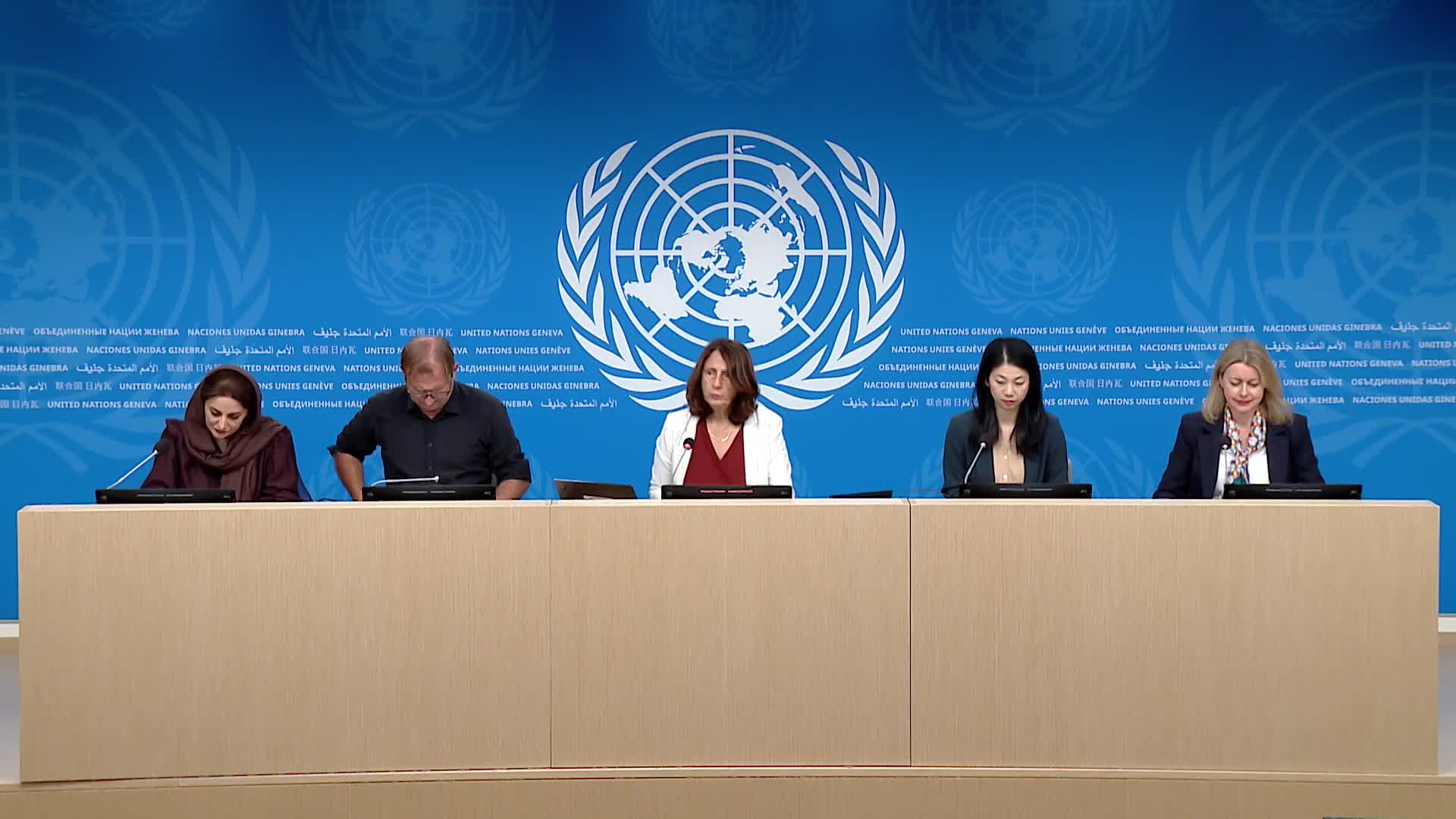
UN GENEVA PRESS BRIEFING
6 February 2026
New Israeli operations and settlement plans in the occupied West Bank
Thameen Al-Kheetan, for the Office of the High Commissioner for Human Rights (OHCHR), stated that a series of new Israeli operations and settlement plans in the occupied West Bank, including East Jerusalem, risked seriously undermining the viability of a Palestinian state and the realisation of the Palestinians’ right to self-determination. On 12 January, Israeli security forces had launched a campaign in occupied East Jerusalem, including at least two major operations targeting two Palestinian communities. In the Shu’fat refugee camp, they had raided dozens of homes and shops, detained at least 25 Palestinians, confiscated goods, and seized ten private vehicles. In another large-scale operation, targeting Kafr Aqab neighbourhood and the boundaries of Qalandiya refugee camp, Israeli security forces had reportedly demolished 70 Palestinian structures. This appeared to be in preparation for major settlement projects in the area.
Since 23 January, the Israeli authorities had also issued eviction orders to 22 Palestinian homes in the Muslim Quarter of Jerusalem's Old City and in Al-Bustan and Batn Al Hawa areas of Silwan. This followed a series of similar notices over the past two months affecting hundreds of Palestinians who remained at risk of forced displacement in the larger area of Silwan. The unlawful deportation or transfer of a population living under occupation was a war crime, and, under specific circumstances, might constitute a crime against humanity. This was added to the forced displacement of tens of thousands of Palestinians across the occupied West Bank since the previous year, including during Israel’s militarized operation named “Iron Wall” a year before, which targeted three refugee camps. Over 32,000 people who had been forcibly displaced from the camps of Jenin, Tulkarem and Nur Shams were still unable to go back home.
Meanwhile, the killing of Palestinians continued with generalized impunity. Since 7 October 2023, as of 5 February 2026, OHCHR verified that Israeli forces and settlers had killed 1,054 Palestinians in the occupied West Bank including East Jerusalem. Twelve had been killed inside Israel. During the same period, 62 Israelis had also been reportedly killed in Palestinian attacks or in armed clashes, both in the West Bank and in Israel. UN Human Rights Chief Volker Türk said that accountability and justice had to be achieved, for all the victims of unlawful killings and other human rights violations. States had to act immediately to stop the aggressive Israeli expansion of illegal settlements in the occupied West Bank, including East Jerusalem. Further expansion of settlements would only entrench the racial segregation against the Palestinian people and slow the realization of their right to self-determination.
Responding to questions from the media, Mr. Al-Kheetan said that there should be a way to challenge these decisions in courts. However, more often than not, challenges raised in courts did not lead to the protection of plaintiffs’ rights. It had been almost a year since the start of an Israeli militarized campaign in three refugee camps in the West Bank, displacing over 32,000 Palestinians, most of whom had not been able to return to their homes. The situation for the Palestinians living in the West Bank, including East Jerusalem, was worsening, and the OHCHR continued to shed light on what was happening, report on the situation to the Human Rights Council, the Security Council, and the General Assembly. It was up to the Member States and the international community at large to take action. The occupation had to end, stressed Mr. Al-Kheetan, and all settlements had to be evacuated.
Lebanon
Answering a question, Thameen Al-Kheetan, for the Office of the High Commissioner for Human Rights (OHCHR), said that if allegations were proven true of the usage of prohibited chemical substances by Israeli air force on agricultural lands in south Lebanon and Syria, this would be in contravention of international law. Alessandra Vellucci, for the United Nations Information Service (UNIS), quoted the UN Spokesperson, who said that the UN was aware of reports that the substance dropped over areas near the Blue Line on 1 February is herbicide. The use of herbicides raised questions about the effects on local agricultural lands, and how this might impact the return of civilians to their homes and livelihoods in the long-term. UN reminded the parties of their obligations under international humanitarian law and other possible legal frameworks. Any activity by the IDF north of the Blue Line was a violation of resolution 1701. UNIFIL would continue to be in contact with the Lebanese authorities on this matter.
Global regulation on autonomous driving systems
Jovana Miočinović, for the United Nations Economic Commission for Europe (UNECE), informed about a draft global regulation on Automated Driving Systems (ADS) that would allow deployment of autonomous vehicles on public roads. This regulation came after ten years of technological maturation and regulatory developments, as well as two years of intensive consultations and drafting. It established uniform safety provisions and a harmonized methodology for validating vehicles equipped with ADS, anchored in a safety case approach and robust research and development processes. The adoption of this draft UN regulation demonstrated the global relevance of UN-led regulatory platforms. Ms. Miočinović stressed that harmonized vehicle rules developed at UNECE were essential to avoid fragmented national approaches and also maximize economies of scale, and to support safety, market access and innovation in the automotive industry. By working globally, UNECE provided clarity to the industry and confidence to consumers.
The formal adoption was expected in June 2026, said Ms. Miočinović in response to a question. A growing number of countries from around the world had been actively involved in finalizing the regulation. The negotiations had taken a long time given the complexity of the issue.
88th annual session of UNECE’s Inland Transport Committee
Jovana Miočinović, for the United Nations Economic Commission for Europe (UNECE), informed that UNECE’s Inland Transport Committee (ITC), the main UN regulatory body for inland transport, brought together all UN Member States and oversaw more than 60 international legal instruments covering vehicle regulations, transport of dangerous goods, border facilitation, infrastructure networks, and multimodal transport.
The focus of its 88th annual session, which would take place at the Palais des Nations from 17 to 20 February, would be on driving innovation for the future of inland transport, namely accelerating the responsible integration of innovative technologies in inland transport and promoting efficiency and interoperability across borders and sectors. More than 20 ministers from all regions of the world, alongside senior government officials, heads of international organizations, and leaders from industry and civil society, were going to discuss strategic priorities and consider a wide range of policy, governance and technical issues shaping the future of inland transport across road, rail, inland waterways and intermodal systems. Ms. Miočinović also informed that, as part of the High-level Segment on 18 February, from 1 to 1:30 pm, participants would be able to witness a live demonstration showcasing how next-generation intelligent transport systems could protect cyclists and improve the safety of vulnerable road users.
Finally, she informed that Brazil had just acceded to the UNECE-serviced Customs Convention on the International Transport of Goods under Cover of TIR Carnets, which governed the global customs transit system for road and multimodal transport of goods. Brazil’s accession marked a fundamental step for the customs and regional trade integration in South America. It was estimated that the Bioceanic corridor could move more than 8.6 million tons of products annually, with an economic impact of more than USD 3 billion in key productive sectors, such as agriculture, pulp, meatpacking and mining. Improved connectivity thanks to the corridor was expected to reduce freight transport costs by 30-40 percent and shipping times by up to 15 days. More details are available here.
Announcements
On a question related to the meeting of the World Health Organization (WHO) Executive Board, Tarik Jašarević, for the WHO, said that the Board was just starting the discussion on item 29, which was being streamed live.
On behalf of the Human Rights Council (HRC), Alessandra Vellucci stated that the Council would hold an organizational meeting on its upcoming 61st session on 9 February. Council members would adopt the programme of work and hear from States on their initiatives for this 61st session. The same day, after the organizational meeting, the HRC would hear an oral update by the UN High Commissioner for Human Rights, Volker Türk, on the situation in and around El Fasher, in Sudan.
On 10 February at 9:30 am, UN Trade and Development was going to hold a press conference to present its Least Developed Countries Report 2026 - Are services the new path to structural transformation? Speakers would be Rebeca Grynspan, UN Trade and Development Secretary-General; Junior Davis, Director ad interim for Africa, LDCs and special programmes; and Matfobhi Riba, Economic Affairs Officer.
Ms. Vellucci, for the UN Information Service (UNIS), informed that the Committee on the Elimination of Discrimination against Women was reviewing today the report of the Netherlands.
The Committee on Economic, Social and Cultural Rights would open on 9 February at 12:30, its 79th session, during which it would review the reports of Kenya, Uruguay, Georgia, and Australia.
The Conference on Disarmament was holding this morning a public plenary meeting in Tempus, under the presidency of Mongolia.
Finally, Ms. Vellucci informed that the Secretary-General was in Milan for the opening of the Winter Olympic Games, where he would meet with new President of the International Olympics Committee, and his video message would be played at the opening ceremony.
***
ANNOUNCEMENTS
- UNECE, Jovana Miocinovic
- UN announces a global regulation on autonomous driving (news presentation) 88th session of the Inland Transport Committee (announcement)
- UNIS on behalf of HRC
TOPICS
- OHCHR, Thameen Al-Kheetan
- New Israeli operations and settlement plans in the occupied West Bank
Similar Stories
Press Conferences | UNCTAD
Presentation of the Trade and Developement Report 2026
Embargoed until 9 October 2026 at 11 a.m. (Geneva Time)
1
1
1
Press Conferences | UPU
Release of the State of the Postal Sector Report 2026
1
1
1
Press Conferences | IOM , ITU , UNECE , UNICEF , WHO , WMO
UNICEF: Ebola, DRC - children orphans or separating them from parents and caregivers; IOM: Humanitarian needs in Djibouti amid arrivals from Yemen and increased migrant movements; WHO: Darfur, scale of health needs far exceeds available resources; WMO co-sponsored Global Heat Forum, Bangkok, monthly Global Seasonal Climate Update; UNECE: UN Forum of Mayors; ITU Plenipotentiary Conference 2026; WHO: child and adolescent obesity guidelines and new global roadmap to tackle pregnancy hypertension, a leading cause of maternal mortality
1
1
1
Press Conferences | OCHA , UN WOMEN , UNHCR , WFP , WHO , WTO , UNEP
OCHA – $160M CERF allocation to 12 underfunded crises; UNHCR – 5.8M refugee children remain out of school amid funding cuts; UN Women – Middle East escalation and food security among women/girls; WHO – Gaza supplies and overall situation; WFP – Yemen food insecurity and impact on global hunger ; UNEP - First International Conference of the Global Framework on Chemicals in Geneva | 16-20 November 2026
1
1
1
Press Conferences | UNHCR , WHO
Yemen's health system nears collapse amid conflict, causing rising casualties and medicine shortages.
1
1
1
Press Conferences | HRC
Update by the Expert Mechanism to Advance Racial Justice and Equality in Law Enforcement
1
1
1
Press Conferences | WIPO , WHO , UNICEF , UNHCR , IOM , WFP , FAO
WIPO Global Innovation Index 2026 launch and press conference, WHO Composition of influenza vaccines for the 2027 Southern Hemisphere flu season, UNICEF Yemen hunger and malnutrition; UNHCR Sudan displacement into Chad; IOM Ebola and population movements in DRC; WFP emergency food assistance in Nepal; and FAO food loss and waste.
2
1
2
Press Conferences | UNCTAD
Gaza reconstruction needs reach $71.5 billion as Palestinian economy and public finances face severe strain. Latest UNCTAD report documents the loss of decades of development gains, economic collapse in Gaza and tightening economic constraints in the West Bank.
The report identifies three immediate priorities: transferring withheld Palestinian revenues, safeguarding the banking system and aligning reconstruction support with the documented scale of damage and economic losses.
1
1
1
Press Conferences | HRC
Press conference on the situation of human rights in Nicaragua by the UN Group of Human Rights Experts
1
1
1
Press Conferences | ITU , UNHCR , WHO , WMO
YEMEN - UNHCR: Escalating conflict in Yemen could fuel more displacement, refugee movement
CLIMATE - WHO / WMO: Health and Climate impact of El Niño
1
1
1
Press Conferences | HRC , OHCHR
Mariana Katzarova discusses human rights in Russia as a UN Special Rapporteur.
1
1
1
Press Conferences | IOM , OHCHR , UN WOMEN , UNFPA , UNHCR , UNOPS , WHO
UN Geneva briefing: Yemen crisis worsens, urgent aid needed across multiple sectors.