

The United Nations Office at Geneva
Multimedia Newsroom
Edited News | UNRWA , UNOPS , UNIS
Gaza and West Bank update UNRWA – UNOPS – UNIS Geneva 23 January 2026
Amid the launch of President Trump's Board of Peace and reconstruction talks on Gaza, UN aid agencies insisted on Friday that what Gazans need most is immediate relief from the ongoing humanitarian catastrophe there.
“It's absolutely critical to unlock the congestion...at crossing points and to reopen critical lifelines like the Jordan corridor,” said Juliette Touma, Director of Communications at UNOPS, the United Nations Office for Project Services.
Briefing journalists, Ms. Touma highlighted that although the 3 October ceasefire agreement had brought some respite to families in the wartorn enclave, “people continue to be killed, day in, day out”.
The UNOPS official also insisted that the highly vulnerable people of Gaza simply “cannot wait” for a reconstruction plan to take shape – one of the stated aims of the US-led Board of Peace. “They need supplies at the same time; it's not just the services,” she explained.
Echoing those concerns, the UN agency for Palestinians, UNRWA, underscored its key and longstanding role in the Occupied Palestinian Territories, including Gaza. This mission was entrusted to UNRWA by UN Member States at the global body’s General Assembly in December 1949.
“We are the largest United Nations agency operating in the Gaza Strip,” said Jonathan Fowler, UNRWA Senior Communications Manager. “We have the knowledge, we have the trust of the community…we must be able to continue doing our work; that's crystal clear. We have to be part of the reconstruction by definition, I mean, that’s what we mandated to do.”
While it has yet to be made clear exactly how the UN will support Board of Peace launched by President Trump at Davos on Thursday, last November’s Security Council Resolution that welcomed the Board’s creation highlighted the importance of working with “cooperating organizations” including the United Nations.
“On the issue of the Board of Peace, what we can say is that we are very strongly committed to do whatever we can to ensure the full implementation of the Security Council Resolution 2803,” said Alessandra Vellucci, Director, UN Information Service, Geneva. “There is a role for the UN there about the UN leading on humanitarian aid delivery, which we have been doing for such a long time and we will continue to do the best of our capacities.”
As winter continues to expose Gaza’s weakest individuals, the UN aid coordination office, OCHA, warned that people across the Strip are struggling to meet their needs because the humanitarian scale-up “remains restricted”.
Since Sunday, humanitarian partners providing emergency shelter assistance have reached over 13,000 households, distributing hundreds of tents and thousands of tarpaulins, OCHA said in its latest update.
The UN office noted that although agencies and their partners continue to distribute mattresses, warm clothes, solar lights and more, “capacity and funding constraints” have limited support to only around 40 per cent of the existing 970 displacement sites across the Strip.
Healthcare needs remain enormous across Gaza, where providers such as UNRWA try to help around 15,000 patients a day, despite numerous challenges.
“We had 22 clinics operating across the Gaza Strip before the start of the war, we're now down to half a dozen,” said Mr. Fowler. “And we have mobile health teams that operate, but in incredibly complicated circumstances.”
A number of UNRWA facilities are located behind the so-called Yellow Line – a series of concrete blocks installed by the Israeli authorities which separates Gazans from the Israel Defense Forces – envisaged in the three-step Gaza peace plan.
“That makes it incredibly difficult to do our work and so many of our locations have been heavily damaged or indeed completely destroyed,” Mr. Fowler continued. “On top of that, we remain banned by the Israeli authorities from bringing in any of our own supplies. This has been a ban that was imposed at the beginning of March 2025 that has not been lifted for us; this means that we faced regular stock-outs of basic medical material and medicines in our pharmacies.”
Turning to the destruction of UNRWA’s headquarters in East Jerusalem on Tuesday, Mr. Fowler described how visiting diplomats had been caught up in the dramatic events when Israeli forces “stormed and demolished” buildings in the compound and fired tear gas. “This is a United Nations compound, so this is an attack on the United Nations,” he told journalists. “It's an attack on international law and it's something with potential implications globally, because what happens to UNRWA now could happen to another agency tomorrow in the Occupied Palestinian Territory or elsewhere. So, you know, this creates this kind of precedent and this is extremely dangerous.”
Highlighting concerns that the UNRWA-supported Kalandia Training Centre could be shut down “within days”, Mr. Fowler explained that it principally helped lower-income families to earn the skills they needed to earn a living: “If the centre were to be forcibly closed - and we do fear that this could happen within days - there is no educational alternative for these students.”
The UN agency remains deeply concerned about developments in the occupied West Bank, one year since the Israeli forces launched operation Iron Wall.
“This led to the mass displacement of people from three camps in the north of the West Bank,” Mr. Fletcher explained, in reference to Jenin, Nur Shams and Tulkarem refugee settlements.
“These Palestine refugees who are expelled by the Israeli forces from the camps, they're living in poverty, they've had their income cut off, they have very few prospects of returning to their homes,” he added, noting that UNRWA is the largest provider of humanitarian aid to around 33,000 people who've been displaced in the last year.
“The camps are progressively being demolished by the Israeli military. So therefore, changing the facts on the ground, changing the topography and the demography of these large communities,” Mr. Fowler insisted.
The development comes as OCHA reported that over 100 Palestinian Bedouin and herding households from five communities across the central West Bank have been displaced in the two weeks to 19 January because of “ongoing settler attacks, threats and intimidation. These attacks have prevented residents from reaching their homes, pastures and water.”
On Wednesday, the UN sexual reproductive agency, UNFPA, reported that ongoing operations by Israeli forces along with settler violence and movement restrictions were continuing to disrupt people’s access to schools, workplaces, markets and health care.
The agency estimated that more than 230,000 women and girls, including nearly 15,000 pregnant women, have limited access to reproductive health services due to the escalation of violence, particularly in the governorates of Jenin, Tulkarem and Tubas.
ends
Gaza and West bank update – UNRWA – UNOPS – UNIS Geneva
TRT: 4’02”
SOURCE: UNTV CH
RESTRICTIONS: NONE
LANGUAGE: ENGLISH / NATS
ASPECT RATIO: 16:9
DATELINE: 23 JANUARY 2026 GENEVA, SWITZERLAND & broll from UNRWA compound East Jerusalem taken 20 January 2026 (credit UNRWA)
Speakers:
- Juliette Touma, Director of Communications, UNOPS (from Copenhagen)
- Jonathan Fowler, UNRWA Senior Communications Manager (from Amman)
- Alessandra Vellucci, Director, UN Information Service, Geneva
SHOTLIST
- Exterior wide, UN Geneva flag alley.
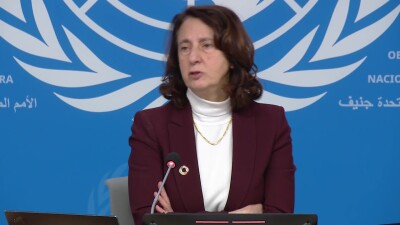
- Wide, UN Geneva Press room, podium speaker, remote speaker on TV screen.
- SOUNDBITE (English) – Juliette Touma, UNOPS: “While there are all these agreements on the shape and the form of reconstruction, the people of Gaza cannot wait. They need supplies at the same time; it's not just the services. This is why it's absolutely critical to unlock the congestion, if you wish, at crossing points and to reopen critical lifelines like the Jordan corridor, so, it's urgent action that is needed now.”
- Wide, journalists., TV screen showing external speaker.
- SOUNDBITE (English) – Jonathan Fowler, UNRWA: “We are the largest United Nations agency operating in the Gaza Strip. We have the knowledge, we have the trust of the community and we have the mandate from the United Nations General Assembly and we must remain and we must be able to continue doing our work; that's crystal clear. We have to be part of the reconstruction by definition, I mean, that's what we mandated to do.”
- Medium, journalist.
- SOUNDBITE (English) – Alessandra Vellucci, Director, UN Information Service, Geneva: “On the issue of the Board of Peace, what we can say is that we are very strongly committed to do whatever we can to ensure the full implementation of the Security Council Resolution 2803, which, as you recall, welcomed the creation of the Board for Gaza; and as you see, there is a role for the UN there about the UN leading on humanitarian aid delivery, which we have been doing for such a long time and we will continue to do the best of our capacities.”
- Wide, podium speaker, journalists, remote speaker on TV screen.
- SOUNDBITE (English) – Jonathan Fowler, UNRWA: “We remain a very, very significant healthcare provider in the Gaza Strip; primary healthcare, we have something in the order of 15,000 patients a day coming to our clinics; but of course, you know, the majority of our clinics are not able to operate.”
- Wide, control booths, technician.
- SOUNDBITE (English) – Jonathan Fowler, UNRWA: “This is a United Nations compound, so this is an attack on the United Nations; it's an attack on international law and it's something with potential implications globally, because what happens to UNRWA now could happen to another agency tomorrow in the Occupied Palestinian Territory or elsewhere. So, you know, this creates this kind of precedent and this is extremely dangerous.”
- Wide, control booths, journalists.
- SOUNDBITE (English) – Jonathan Fowler, UNRWA: “We had a visit by diplomats from donor governments that happened last week. It's on the same day that the compound in East Jerusalem was stormed and demolished and Israeli forces were outside the compound while the diplomats were in and they were firing tear gas. Now, clearly this is a sign of intent and really the international community needs to wake up and has to make clear that the Kalandia Training Centre must be able to continue operating.”
- Medium, journalist.
- SOUNDBITE (English) – Jonathan Fowler, UNRWA: “The point is that these students, this is a unique training centre. These students generally come from non-academic backgrounds, lower-income families, so this is a social justice issue. If the centre were to be forcibly closed - and we do fear that this could happen within days - there is no educational alternative for these students.”
- Wide of UNRWA compound with officials standing on roof next to Israeli flag.
- Wide of UNRWA compound, bulldozer at work dismantling structures amid other levelled facilities.
- Medium-wide, bulldozer at work taking down structures in UNRWA compound.
- Wide, destroyed buildings and bulldozer at work in UNRWA compound.
Similar Stories

1
1
1
Edited News | OCHA , UNICEF , WFP
Aid agencies warned on Friday of the fast-developing humanitarian emergency inside Taiz City in Yemen, which has been encircled by de facto Houthi forces fighting government troops along the country’s west coast.

2
17
1
2
Edited News , Press Conferences , Images | OCHA , WMO
Two UN agencies teamed up on Wednesday to issue an appeal for immediate assistance to help communities already being impacted by the strongest El Niño on record.

3
16
2
2
Edited News , B-roll , Conferences , Images | UNITED NATIONS , UNOG
Sixth Consultative Meeting on Enhancing Coordination of Peace Initiatives and Efforts for Sudan

1
1
1
Edited News | UNICEF , WHO , UNHCR
Yemen war continues to force families from homes amid hunger and disease
More than 250,000 people have now fled renewed fighting in Yemen, the UN said on Tuesday, citing particular concern for those sheltering in the southwestern city of Taiz and the wider governorate, where access is “essentially blocked”.

1
1
1
Edited News | UNICEF
A little over one year since a ceasefire agreement was announced between Hamas fighters and Israel, more than 340 children have been reported killed and hundreds more injured, the UN Children’s Fund, UNICEF, said on Friday.

1
1
1
Edited News | UNICEF , IFRC
Six weeks after Nepal’s deadly flooding disaster, communities are still struggling to rebuild their lives, but they will need sustained help as global warming increases the risk of another Himalayan catastrophe, the UN Children’s Fund (UNICEF) said on Friday.

1
1
1
Edited News | WHO
In suspected Russia plague death, testing and monitoring underway – WHO
The death of a lab worker in Russia’s Siberia region has sparked concerns about plague being the cause, the UN World Health Organization (WHO) said on Tuesday, adding that it was following the situation closely.

1
1
Edited News | OHCHR , UNOG
UN Human Rights Chief Volker Türk on Friday provided and oral update to the 63rd session of the Human rights Council on Ukraine.

1
1
1
Edited News | OHCHR , UNOG
UN Human Rights Chief Volker Türk on Friday provided and oral update to the 63rd session of the Human rights Council on the human rights situation in Haiti.

1
1
1
Edited News | WHO
Repeated delays in bringing lifesaving medicines, prosthetics and more from Israel into Gaza risk having devastating consequences on Palestinians who urgently need them in the wartorn enclave, the UN World Health Organization (WHO) said on Friday. “A truck full of non-priority supplies or the right supplies arriving too late, doesn't save lives. That's the question that actually matters," said Dr Reinhilde Van De Weerdt, WHO Representative in the OPT.

1
1
1
Edited News | WHO
DRC: Early access to care and oxygen decisive for Ebola patients’ survival – WHO
In the Democratic Republic of the Congo (DRC), health workers fighting the country’s largest-ever Ebola outbreak are struggling to overcome critical challenges to patient care, the UN World Health Organization (WHO) warned on Tuesday.

1
1
1
Edited News | OCHA , UN
Civilians in Iran are continuing to feel the consequences of months of conflict and military escalation, the UN’s top official in the country has said, as loss of life, damage to civilian infrastructure and mounting economic pressures leave many facing continued uncertainty.