

The United Nations Office at Geneva
Multimedia Newsroom
Mozambique floods heighten disease, malnutrition risks – UN agencies
Catastrophic flooding in Mozambique is causing massive disruption to lives and livelihoods across the country, increasing the risk of disease and exposing urban areas to crocodiles, UN humanitarians warned on Tuesday.
The head of the UN aid coordination office (OCHA) in the country, Paola Emerson, told reporters in Geneva that more than half a million people have been impacted by the floods, triggered by heavy rains in the first weeks of the new year.
“The numbers keep rising as extensive flooding continues and dams keep releasing water to avoid bursting,” she said.
Mozambique’s Gaza province is most affected along with Maputo and Sofala provinces.
Speaking from Xai-Xai, Gaza’s capital, Ms. Emerson stressed that 90 per cent of the country’s people live in adobe houses, which are earth-based structures “that basically melt after a few days’ rains”.
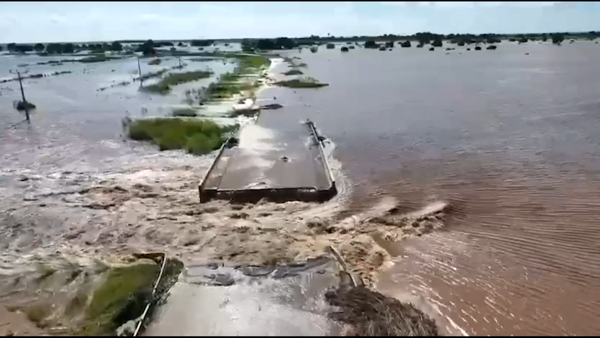
Health facilities, roads and critical infrastructure are also heavily impacted. Ms. Emerson said that some 5,000 kilometres of roads have been damaged across nine provinces, including the main road linking the capital Maputo to the rest of the country, which is currently inaccessible, resulting in major supply chain disruptions.
Meanwhile, dams continue to release water even as heavy rains subside.
“From just one dam, up to 10,000 cubic metres-worth of water were being discharged. That is approximately 25 times the amount of water that could be held in the press briefing room you are in today, every second,” Ms. Emerson told journalists, seated in a room with capacity for more than 100 people.
“You cannot imagine the strength of this water and the impact it has on people and the infrastructure.”
The Government of Mozambique has declared a national emergency and has established an emergency operations centre in Gaza province. Xai-Xai, which is near the Limpopo River, has been inundated, prompting evacuations. Ms. Emerson said that authorities have issued alerts for downtown Xai-Xai, “including warnings of crocodile risks in flooded areas”.
“River levels are rising and are reaching urban areas or heavily populated areas,” she said. “The crocodiles that are in the Limpopo River… are able to get into urban or populated areas that are now submerged underwater.”
Also speaking from Xai-Xai, the UN Children’s Fund (UNICEF)’s Chief of Communication in Mozambique, Guy Taylor, warned that flooding is “turning unsafe water, disease outbreaks and malnutrition into a deadly threat for children”.
The combination of waterborne diseases and malnutrition “can often prove lethal,” he said, stressing that even before the floods, four out of every 10 children in Mozambique experienced chronic malnutrition.
“This renewed disruption to food supplies, to health services and to care practices threatens to push the most vulnerable children into a dangerous spiral,” he insisted.
Mr. Taylor added that Mozambique is now entering into its annual cyclone season, creating the risk of a double crisis.
“We can prevent disease, deaths and irreversible losses to children, but we need to act fast,” he said.
The UNICEF spokesperson described Mozambique as “a country of children and young people”, with an average age of 17.
“When floods and cyclones strike, as they have repeatedly and with increasing frequency over recent years, it's the youngest and children who are hit hardest,” he concluded.
-ENDS-
STORY Mozambique floods – OCHA, UNICEF
TRT: 5:10”
SOURCE: UNTV CH AND UNICEF
RESTRICTIONS: NONE
LANGUAGE: ENGLISH/NATS
ASPECT RATIO: 16:9
DATELINE: 20 JANUARY 2026 GENEVA, SWITZERLAND; 19 JANUARY 2026, MOZAMBIQUE VARIOUS LOCATIONS – credit UNICEF
1. Exterior wide shot: Palais des Nations, Flag Alley.
2. Wide shot: Speakers at the podium of the press conference, speaker on screens; journalists in the Press room.
3. SOUNDBITE (English) – Paola Emerson, Head of Office, UN Office for the Coordination of Humanitarian Affairs (OCHA) Mozambique: “More than half a million people have been impacted by recent floods across southern and central Mozambique, particularly in Gaza - the Gaza in Mozambique, Maputo and Sofala provinces. The numbers keep rising as extensive flooding continues and dams keep releasing water to avoid bursting.”
4. Wide shot: Speaker on screens; journalists in the Press room.
5. SOUNDBITE (English) – Paola Emerson, Head of Office, UN Office for the Coordination of Humanitarian Affairs (OCHA) Mozambique: “90 per cent of the people in Mozambique live in adobe houses that basically melt after a few days’ rains. Health facilities, roads and critical infrastructure are also impacted. So far the most affected province is Gaza, where I am today, with 64 per cent of the affected people.”
6. Medium shot: Speakers at the podium of the press conference, speaker on screens.
7. SOUNDBITE (English) – Paola Emerson, Head of Office, UN Office for the Coordination of Humanitarian Affairs (OCHA) Mozambique: “Nearly 5,000 kilometers of roads have been damaged across nine provinces, including the main road linking the capital Maputo to the rest of the country, which is currently inaccessible. As a result, supply chains are severely disrupted.”
8. Medium-wide shot: Speakers at the podium of the press conference, speaker on screens; journalists in the Press room.
9. SOUNDBITE (English) – Paola Emerson, Head of Office, UN Office for the Coordination of Humanitarian Affairs (OCHA) Mozambique: “Continued water releases are expected to remain a threat even after heavy rains subside. From just one dam up to 10,000 cubic meters worth of water were being discharged. That is approximately 25 times the amount of water that could be held in the press briefing room you are in today, every second. You cannot imagine the strength of this water and the impact it has on people and the infrastructure.”
10. Medium shot: Journalists in the Press room.
11. SOUNDBITE (English) – Paola Emerson, Head of Office, UN Office for the Coordination of Humanitarian Affairs (OCHA) Mozambique: “The river levels are rising and are reaching urban areas or heavily populated areas. So the crocodiles that are in the Limpopo River in this case are able to get into areas, urban or populated areas that are now submerged underwater. That is the concern that has been expressed in downtown Xai-Xai.”
12. Medium shot: Speakers at the podium of the press conference, speaker on screens.
13. SOUNDBITE (English) – Guy Taylor, Chief of Communication, UN Children’s Fund (UNICEF) Mozambique: “Of particular concern are waterborne, always the combination of waterborne diseases and malnutrition, which can often prove lethal. Even before the recent floods here in Mozambique, four out of every 10 children were experiencing chronic malnutrition, and so this renewed disruption to food supplies, to health services and to care practices threatens to push the most vulnerable children into a dangerous spiral.”
14. Medium-wide shot: Speakers at the podium of the press conference, speaker on screens; journalists in the Press room.
15. SOUNDBITE (English) – Guy Taylor, Chief of Communication, UN Children’s Fund (UNICEF) Mozambique: “We can prevent disease, deaths and irreversible losses to children, but we need to act fast. Mozambique is really a country of children and young people. More than half its population, around 17 million people, are under the age of 18 and the average age is just 17. And when floods and cyclones strike, as they have repeatedly and with increasing frequency over recent years, it's the youngest and children who are hit hardest.”
16. Various shots of journalists in the Press room.
17. UNICEF B-Roll: 19 January 2026, Various shots, flooding in Mozambique Gaza province
and in Mozambique Buzi Sofala province– credit UNICEF.
Similar Stories

1
1
1
Edited News | UNICEF , WHO , UNHCR
Yemen war continues to force families from homes amid hunger and disease
More than 250,000 people have now fled renewed fighting in Yemen, the UN said on Tuesday, citing particular concern for those sheltering in the southwestern city of Taiz and the wider governorate, where access is “essentially blocked”.

1
1
1
Edited News | UNICEF
A little over one year since a ceasefire agreement was announced between Hamas fighters and Israel, more than 340 children have been reported killed and hundreds more injured, the UN Children’s Fund, UNICEF, said on Friday.

1
1
1
Edited News | UNICEF , IFRC
Six weeks after Nepal’s deadly flooding disaster, communities are still struggling to rebuild their lives, but they will need sustained help as global warming increases the risk of another Himalayan catastrophe, the UN Children’s Fund (UNICEF) said on Friday.

1
1
1
Edited News | WHO
In suspected Russia plague death, testing and monitoring underway – WHO
The death of a lab worker in Russia’s Siberia region has sparked concerns about plague being the cause, the UN World Health Organization (WHO) said on Tuesday, adding that it was following the situation closely.

1
1
Edited News | OHCHR , UNOG
UN Human Rights Chief Volker Türk on Friday provided and oral update to the 63rd session of the Human rights Council on Ukraine.

1
1
1
Edited News | OHCHR , UNOG
UN Human Rights Chief Volker Türk on Friday provided and oral update to the 63rd session of the Human rights Council on the human rights situation in Haiti.

1
1
1
Edited News | WHO
Repeated delays in bringing lifesaving medicines, prosthetics and more from Israel into Gaza risk having devastating consequences on Palestinians who urgently need them in the wartorn enclave, the UN World Health Organization (WHO) said on Friday. “A truck full of non-priority supplies or the right supplies arriving too late, doesn't save lives. That's the question that actually matters," said Dr Reinhilde Van De Weerdt, WHO Representative in the OPT.

1
1
1
Edited News | WHO
DRC: Early access to care and oxygen decisive for Ebola patients’ survival – WHO
In the Democratic Republic of the Congo (DRC), health workers fighting the country’s largest-ever Ebola outbreak are struggling to overcome critical challenges to patient care, the UN World Health Organization (WHO) warned on Tuesday.

1
1
1
Edited News | OCHA , UN
Civilians in Iran are continuing to feel the consequences of months of conflict and military escalation, the UN’s top official in the country has said, as loss of life, damage to civilian infrastructure and mounting economic pressures leave many facing continued uncertainty.
1
1
1
Edited News | WHO , UNICEF
Aid agencies in Yemen highlighted the growing hunger emergency sparked by renewed fighting between Houthi opposition forces and Government troops, after mobile health clinics reported that hundreds of children displaced by the violence are suffering from the most deadly form of malnutrition.
1
1
1
Edited News | UNHCR
Displacement on the rise in Yemen as fighting continues - UNHCR
As hostilities worsen in Yemen, more people have been fleeing their homes, further intensifying the humanitarian crisis within the region, the UN Refugee Agency (UNHCR) warned on Tuesday.
1
1
1
Edited News | IOM , OHCHR , UNFPA , UNOG , UNHCR , WHO
Yemen’s humanitarian crisis growing by the hour amid spike in displacement
Yemenis displaced by renewed fighting have described fleeing for their lives amid shelling and gunfire, aid agencies reported on Friday, while highlighting the dramatic increase in humanitarian needs in the country and in Djibouti, where thousands have sought shelter.