

The United Nations Office at Geneva
Multimedia Newsroom
UN GENEVA PRESS BRIEFING
26 August 2025
High Commissioner calls on Egypt to end “rotation practice”
Thameen Al-Kheetan, for the Office of the High Commissioner for Human Rights (OHCHR), said the United Nations High Commissioner for Human Rights Volker Türk had called on Egyptian authorities to put an end to a practice that allowed Government critics to be held arbitrarily and for prolonged periods, even after serving their sentences or completing maximum pretrial detention. Human rights defenders, activists, lawyers, journalists, peaceful protesters and political opponents had been targeted by the strategy, known as “rotation”. The practice entailed the authorities bringing new charges against individuals when they were about to complete their prison sentences or as they reached the maximum legal period of pretrial detention, thus preventing their release. These fresh charges, often under counter-terrorism laws, were usually similar to those for which they had already been charged or convicted, and often lacked substantive foundation.
The latest case concerned poet Galal El-Behairy, who was arbitrarily detained after completing a prison term on 31 July 2021 for writing songs and poetry critical of the Government. Since then, he faced similar charges in two different cases under the counter-terrorism law and the penal code. The latest charges were brought against him on 19 August 2025 and extended his detention for at least 15 more days. “The Egyptian Government must immediately stop this practice of ‘rotation’ and release all those who have been subjected to it,” Türk said. “This practice has become a tool by which the Egyptian Government represses those perceived to be critical of, or in opposition to, its policies.”
OHCHR was closely following a number of cases of “rotation”, including of several writers, activists and lawyers. All of them remained in arbitrary detention.
The full statement is available here.
Attack on Nasser Medical Complex in Gaza
Responding to questions from the media regarding yesterday’s attacks on the Nasser Medical Complex in Gaza where five journalists were killed, Thameen Al-Kheetan, for the Office of the High Commissioner for Human Rights (OHCHR), said the killing of journalists in Gaza should shock the world into action. In the case of the strike on the Nasser Medical Complex yesterday, the Israeli military reportedly launched multiple strikes, including two strikes within a short period of time. One of the five journalists appeared to have been killed in the first airstrike while three others appeared to have been killed in the second. This was unacceptable. The killing of all civilians must be thoroughly and independently investigated, and justice must follow.
OHCHR had seen and documented many attacks on journalists. At least 247 of them had been killed in Gaza since 7 October 2023. These journalists were the eyes and ears of the whole world and needed to be protected. All of these incidents needed to be investigated and those responsible held accountable. OHCHR colleagues were continuing to corroborate information about yesterday’s strikes. Targeting journalists and hospitals was forbidden. In the past, the Israeli authorities had announced investigations into such killings, but so far there had not been any results. OHCHR called for accountability and justice.
Alessandra Vellucci, for the United Nations Information Service (UNIS), said the Secretary-General’s statement yesterday had strongly condemned the killings of both medical personnel and journalists in yesterday’s attack, and extended condolences to the families and colleagues of those killed. The protection of journalists was clearly stated under Security Council Resolution 2222, and everyone was expected to abide by this resolution.
Announcements
Alessandra Vellucci for the United Nations Information Service (UNIS), said the Committee on the Rights of Persons with Disabilities (33rd session, 11-26 August) would conclude its 33rd session this afternoon, at 5.30pm, and issue its concluding observations on the countries reviewed during the session: the Democratic People’s Republic of Korea, Kiribati, Maldives and Finland.
Ms. Vellucci also said on Wednesday, 3 September at 10:30 a.m., the UN Human Rights Council would hold a press conference on the upcoming 60th regular session, with Council President, Ambassador Jürg Lauber.
On Wednesday, 3 September at 2:30 p.m., the United Nations High Commissioner for Refugees (UNHCR) would hold a press conference on asylum policy and law and UNHCR guidance to states, with Ruvendrini Menikdiwela, the Assistant High Commissioner for Protection.
***
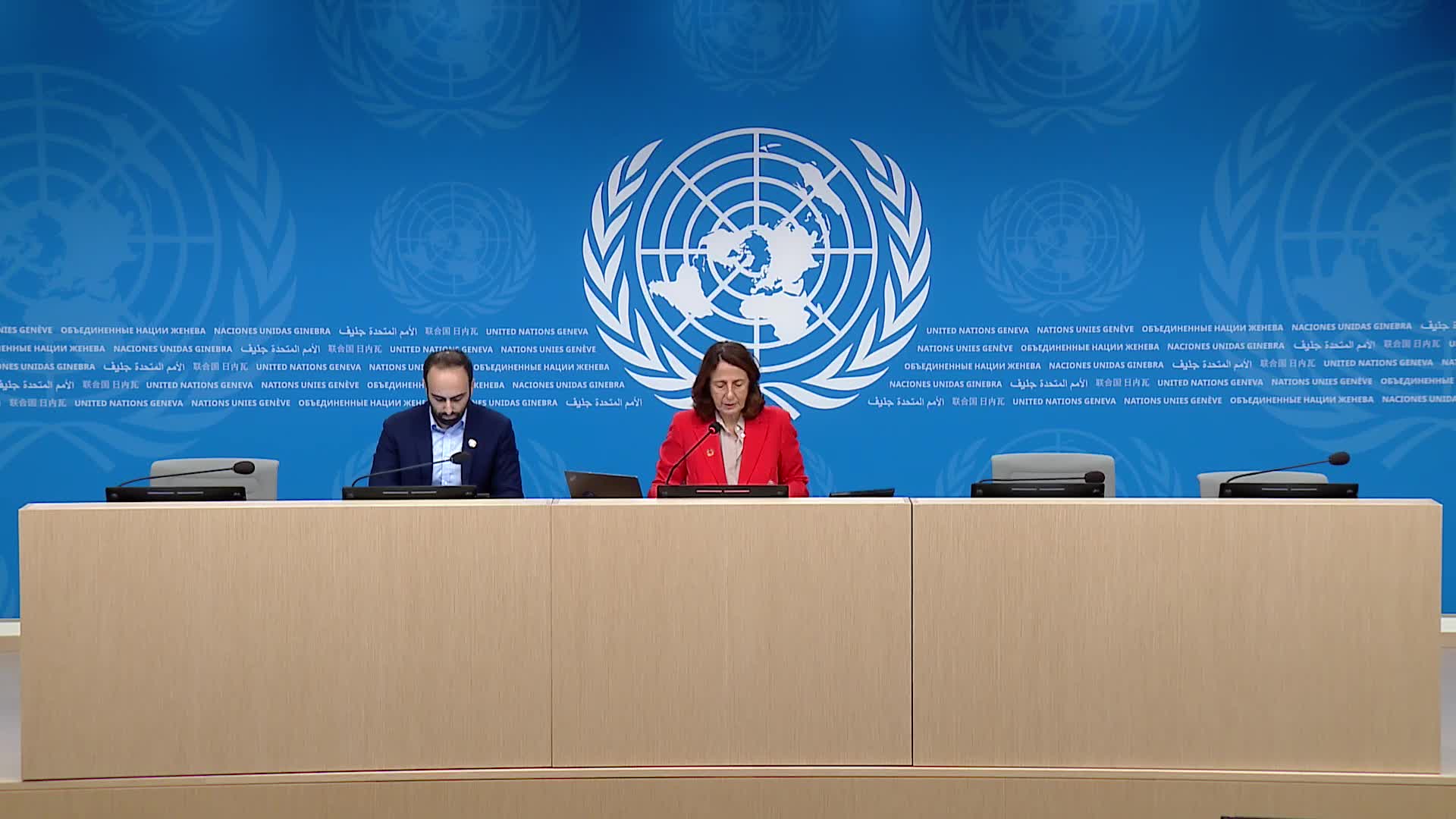
OHCHR Thameen Al-Kheetan, spokesperson of the Office of the High Commissioner for Human Rights (OHCHR)
Similar Stories
1
12
1
1
Press Conferences , Images | UNOG
Closing Press Conference following the Sixth Consultative Meeting on Enhancing Coordination of Peace Initiatives and Efforts in Sudan

2
17
1
2
Edited News , Press Conferences | OCHA , WMO
Two UN agencies teamed up on Wednesday to issue an appeal for immediate assistance to help communities already being impacted by the strongest El Niño on record.
1
1
1
Press Conferences | CITES
Wildlife trade and conservation policy discussions at the 81st meeting of the CITES Standing Committee (SC81)
1
1
1
Press Conferences | UNHCR , UNCTAD , WMO , OCHA , UNICEF , WHO
UNHCR Hungary’s 1956 Refugee Crisis: 70 Years On, UNCTAD World Investment Forum 2026, Doha, WMO Greenhouse Gas Bulletin and Climate Update for COP31, OCHA Afghanistan: Malnutrition, Girls’ Education and Recovery, UNICEF Yemen: Child Malnutrition and Unsafe Water in Taiz, WHO Inequalities in Noncommunicable Diseases and Risk Factors
1
1
1
Press Conferences | UNHCR
End of UNHCR's 77th Annual Executive Committee (ExCom) meeting week
1
1
1
Press Conferences | UNICEF , IOM , UNHCR
UN Special Assistant to the Personal Envoy Office (SUDAN): Peace Initiatives and Efforts in Sudan; UNICEF: Dire situation of children in Gaza; IOM: Damaged Homes and Energy Attacks Risk Displacing Ukrainians for this winter; UNHCR: update on EXCOM week
1
1
1
Press Conferences | IOM , UNDRR
UN stresses importance of household preparedness for disaster risk reduction.
1
1
1
Statements , Press Conferences | OHCHR
1
1
1
Press Conferences | UNHCR , UNICEF , IFRC , OHCHR , UN WOMEN , IOM , OCHA , WHO
UNHCR – ExCom Meeting, UNICEF – Nepal Recovery, IFRC – Flash Floods, WHO – Mental Health, IOM – South Sudan Floods, OCHA – DRC Humanitarian aid, UNHCR – Sahel Displacement, UNICEF – Yemen Update, IOM – Gaza Shelter, UN Women – Gaza Women, OHCHR – Arrests and detentions of Syrians by Israeli force
2
1
2
Press Conferences | UNCTAD
Presentation of the Trade and Developement Report 2026
Embargoed until 9 October 2026 at 11 a.m. (Geneva Time)
UNCTAD: UNCTAD’s flagship report finds that governments increasingly use industrial, trade, financial and technology policies to pursue economic and national security objectives. Market access and the ability to move into higher-value activities now depend more heavily on technology, finance and geopolitics.
1
1
1
Press Conferences | UPU
Release of the State of the Postal Sector Report 2026
1
1
1
Press Conferences | IOM , ITU , UNECE , UNICEF , WHO , WMO
UNICEF: Ebola, DRC - children orphans or separating them from parents and caregivers; IOM: Humanitarian needs in Djibouti amid arrivals from Yemen and increased migrant movements; WHO: Darfur, scale of health needs far exceeds available resources; WMO co-sponsored Global Heat Forum, Bangkok, monthly Global Seasonal Climate Update; UNECE: UN Forum of Mayors; ITU Plenipotentiary Conference 2026; WHO: child and adolescent obesity guidelines and new global roadmap to tackle pregnancy hypertension, a leading cause of maternal mortality