

The United Nations Office at Geneva
Multimedia Newsroom
UN INFORMATION SERVICE GENEVA PRESS BRIEFING
25 August 2026
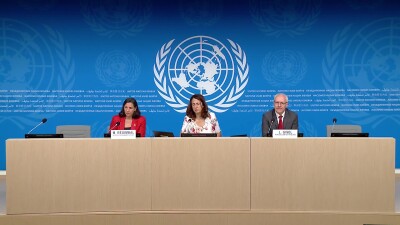
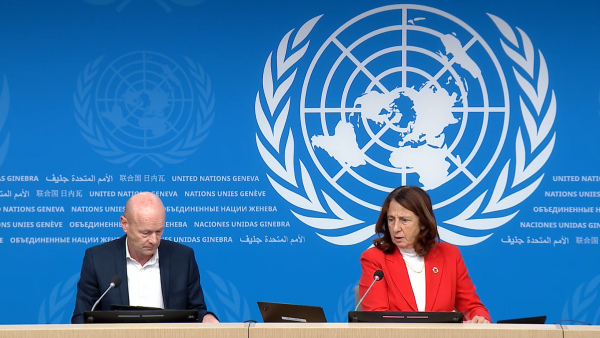
Alessandra Vellucci, Director of the United Nations Information Service in Geneva, chaired a hybrid press briefing, which was attended by the spokespersons and representatives of the United Nations Office of Disarmament Affairs, the International Committee of the Red Cross, the Office of the High Commissioner for Human Rights, the United Nations Children’s Fund, and the World Health Organization.
Call to adopt rules on autonomous weapon systems
Alessandra Vellucci, for the United Nations Information Service (UNIS), read the just issued renewed call by the United Nations Secretary-General and the President of the International Committee of the Red Cross to adopt rules on autonomous weapon systems:
“Three years ago, we called on States to establish specific prohibitions and restrictions on autonomous weapon systems. Today, we renew this call with even greater urgency. The fundamental concerns remain unchanged, but the risks have intensified. We are now dangerously close to crossing a moral red line: the autonomous targeting of humans by machines.
The development of weapon technology has advanced at record speed, placing increasing strain on legal frameworks. Since our previous appeal, the gap between technological capability and regulatory constraint has widened, with advanced technologies employed on the battlefield amplifying the risk of harming civilians and civilian infrastructure and aggravating civilian suffering in armed conflict.
The development and use of autonomous weapon systems represent a further escalation, reducing human control over the use of force. Autonomous weapon systems are not part of a distant future – a race towards greater autonomy in weapons systems is already well underway. At the same time, scientists and engineers developing these systems have themselves raised the alarm. When the architects of this technology are calling for limits, States cannot afford to remain passive.
This year must mark a turning point.
States have laid important groundwork through the United Nations General Assembly and the Group of Governmental Experts under the Convention on Certain Conventional Weapons. Significant progress has been made toward a shared understanding of the human judgment and control required, and of the measures necessary to ensure compliance with international humanitarian law, address ethical concerns, and reduce human suffering.
States must show political courage and move beyond incremental discussions towards decisive action. Negotiations must begin now to urgently adopt a legally binding instrument to regulate autonomous weapon systems with clear prohibitions and restrictions. A failure to act quickly and decisively will cost lives. It will leave future generations to inherit a world in which the absence of clear and specific prohibitions and restrictions on these weapons opens the door to practices that would erode the protections international humanitarian law is meant to guarantee. A world where accountability is increasingly elusive as responsibility for errors and breaches of applicable rules becomes harder to establish.
States have a responsibility to those already suffering the consequences of today’s conflicts, and to those who will inherit the world that is now being shaped. Future generations will ask whether leaders acted when there was still a chance to set limits before these weapons proliferated beyond control. The upcoming Seventh Review Conference of the Convention on Certain Conventional Weapons in November offers the clearest path available for States to decide to move to negotiate a legally binding instrument. The painstaking work undertaken over the past three years forms the ideal basis for such negotiations, and must not be lost.
We urge States to seize this moment.
Continuing to design weapon systems that make it easier to wage war will only undermine our collective efforts towards a more peaceful world.
The path is clear. The need is urgent. Innovation must serve humanity – not endanger it.”
The statement is also available here.
Carolyne Mélanie Régimbal, Chief of Service, UN Office for Disarmament Affairs (UNODA) - Geneva Branch, said that the renewed call came at the key moment, stressing the urgent need for negotiations on a legally binding instruments on lethal autonomous weapon systems (LAWS). Following over a decade of talks of governmental experts on this subject, the time had come to move on to the next stage. As recognized in the appeal, the 7th Review Conference of the United Nations Convention on Certain Conventional Weapons (CCW), in Geneva in November, would provide States with an opportunity to decide whether to launch negotiations on an instrument on LAWS. The gap between technological developments and regulatory restraints was rapidly increasing, warned Ms. Régimbal. Fundamental ethical concerns related to delegating life-and-death decisions to machines were of primary concern. Disarmament and weapons control were necessary before new harmful practices became entrenched, she said. The decision in November to set negotiations in motion would signal that CCW remained fit for purpose: to respond to developments in weapons technologies before they became entrenched. The Secretary-General had long warned about the dangers posed by these systems, calling them morally repugnant and stressing they should be prohibited under international law. Some decisions had to remain with human beings, and none more so than a decision on taking a human life. The 7th CCW Review Conference would be an opportunity for States to demonstrate political courage and move in the right direction.
Laurent Gisel, Head of Arms and Conduct of Hostilities Unit at the International Committee of the Red Cross (ICRC), said that ICRC delegates around the world were witnessing increasingly sophisticated weapons being used in various conflicts, leading to rapidly growing destruction and civilian harm. Once activated, LAWS would select targets without future human intervention, and the direction in which these weapons were moving was ever more concerning. At the core of the concern was the risk of decreasing human control over the use of force, which could lead to an increase in violations of international humanitarian law. IHL required humans to make decisions on whether, when and where to use force, stressed Mr. Gisel. The more complicated the scenarios were, the more difficult it would be for machines to decide on how to use force. ICRC had for a long time called for a legally binding instrument on certain types of LAWS. Such an instrument should set clear limits, including their geographical and temporal scopes, and the level of force they could deploy. Mr. Gisel said that the technology was developing quickly, and the international community now needed to move from discussions to action. The key message of the appeal was that the painstaking appeal undertaken over recent years should not be lost, and the upcoming conference in Geneva ought to be seized by States.
Answering numerous questions from the journalists, Laurent Gisel, for ICRC, said that the call was specific to prohibit certain, most dangerous LAWS, not all of them, and to put restrictions on others. States had to make it clear what was acceptable and not acceptable in the context of armed conflict. Carolyne Mélanie Régimbal, for UNODA, stressed that States were the main decision-makers, and they had not yet begun to negotiate a legally binding instrument. The joint appeal was intended to move the process forward, but ultimately the decision would be with the States themselves on what exactly those elements would entail. There had been numerous engagements with the industry, she added, and States had gathered information from the industry itself. On another question, Mr. Gisel said that currently there was no confirmed evidence that fully autonomous weapons had been used to target human beings, but that was the observed trajectory. Ms. Régimbal said that the Group of Governmental Experts (GGE) on emerging technologies in the area of LAWS, which would complete its task the following week, had agreed to identify elements to be included in a possible future legal instrument. The international community had put this at the forefront of the disarmament agenda, and there was a broad agreement to continue exploring these issues.
Regarding a specific reported case from Ukraine, in which three civilians had allegedly been killed by an AI-guided autonomous weapon, Ms. Régimbal explained that AI was a modality that could be used with autonomous weapons systems and did not equal them. Mr. Gisel added that AI was not necessary for autonomous systems to be autonomous. Neither speaker could comment on the specific case raised by the journalist. Mr. Gisel said that the prohibitions were being proposed for unpredictable autonomous weapons and anti-personnel autonomous weapons, i.e. those that specifically targeted human beings rather than objects and other weapons. There were a number of weapon systems which could be used with remote control or in an autonomous manner, complicating the matter further. Ms. Régimbal said that the GGE was looking at all the elements and various aspects that could be included in a future legal instrument. The risks of autonomous lethal weapons were not specific to any one ongoing conflict, but were global in nature, and not only among the most technologically advanced armies. Mr. Gisel emphasized that autonomous weapon systems had been used for a long time, for example defence weapons on ships, and they had led to combatant casualties. Ms. Régimbal said that States, should they agree to move forward, would decide on the framework of negotiations and the timeline. As urgent as the matter was, it was unlikely that those processes would happen overnight.
Human rights situation in Myanmar
Ravina Shamdasani, for the Office of the High Commissioner for Human Rights (OHCHR), stated that the new OHCHR report found that the human rights situation in Myanmar, in particular that of minority communities, had plummeted to a new low, from the ever-worsening brutal abuse of the Rohingya population to the devastating impact of illicit economies, notably illegal mining for rare earths. The report detailed how unrelenting violence and a conflict economy worked together to expose civilian populations to untold misery.
Highlighting acts of military violence against the civilian population, the report noted the persistent use of airstrikes, arson attacks, displacement and denial of assistance. It also detailed the commission – by both the Myanmar military and the Arakan Army – of widespread and systematic violations and abuses against the Rohingya, nine years since the terrible violence of 2017 that had forced hundreds of thousands of Rohingya to flee. Across northern Rakhine, the Arakan Army had perpetrated arbitrary arrests, torture, sexual and gender-based violence, instances of enforced disappearance, forced labour and recruitment, unlawful confiscation of land and residential property, and the destruction of villages, religious and cultural sites, caused renewed Rohingya displacement. Children were systematically used for labour, with witnesses describing workers as young as six years old clearing jungle, constructing buildings and doing menial work for Rakhine families. In one case, for example, a child had been forced to clear bones and skulls of victims of a massacre.
The absence of the rule of law across Myanmar had acted as an enabler for illicit economies in the country, helping to finance the conflict, worsen the crisis, and with impacts on the wider region. Economic collapse and conflict-induced displacement had also generated a labour market that was easy for economic actors and criminal organizations to exploit, finding that civilians were lured into a system marred by endless human rights violations and abuses. Unregulated exploitation of natural resources had destroyed the environment, livelihoods, and traditional community-based systems in a growing number of areas in the country, particularly minority areas. Findings indicated a peak in trade flows in 2023 amounting to USD 1.4 billion. Lack of economic opportunities, displacement and forced conscription have also triggered an influx of women into the mining sector, which aggravated risks of sexual violence and harassment by supervisors, guards, and militia members who operated with absolute impunity. OHCHR called on all States, companies and investors to undertake serious soul-searching with respect to their actions – or inaction; to ask: is this fair and just for the people of Myanmar? Their own reputations and their credibility were on the line.
The OHCHR statement is available here, while the full report can be read here.
James Rodehaver, Chief of the Myanmar Team at the Office of the High Commissioner for Human Rights (OHCHR), speaking from Vienna, said that today marked nine years since the operation in which over 10,000 Rohingya had been killed and displaced over 700,000 to Bangladesh. The Rohingya community was still being abused in numerous manners. Thus far, in the 5.5-year long ongoing conflict in Myanmar, over 8,300 civilians had been killed by the military, he said. Just in the last 100 days, at least 146 civilians had been killed in airstrikes. The Myanmar military had said that the past 100 days would be dedicated to bringing peace to Myanmar, but the period had instead seen increased airstrikes on civilians and other violations of international humanitarian law. Mr. Rodehaver said that the crisis deserved the world’s attention as it was only worsening and tearing civilian lives apart.
Answering questions from the media, Mr. Rodehaver said that almost all cases referred to in the report were on young Rohingya children being exploited and abused, but there were also cases of children from other ethnic minorities. The UN had still not recognized the Myanmar military as the legitimate government of the country, an action which would need to be taken by the UN Credentials Committee. Ms. Shamdasani added that the military’s persistent quest for legitimacy was deepening the crisis. Mr. Rodehaver said that rare earth materials were leaving Myanmar and going to other countries. OHCHR had reached out to both to the Myanmar military and the Arakan Army, for the purposes of this report, but it had not received responses from either. The figure of 140,000 put forward by UNHCR referred to the movement of Rohingya since January 2024. Regarding the scam centres in Myanmar, he said that thousands of people still remained in the clutches of the system, and oftentimes these did not shut down, but simply moved elsewhere within the country. Those centres were sometimes building local infrastructure as a way to endear themselves to local communities. Many scam centres were profitable for the military and border guards, he reminded. There was no progress in establishing who the individuals behind those centres were.
Alessandra Vellucci, for the United Nations Information Service (UNIS), referred to the Secretary-General’s Spokesman’ statement in which he called for renewed global attention and action to the plight of the Rohingya.
Child nutrition crisis in Afghanistan
Dr. Tajudeen Oyewale, Afghanistan Country Representative for the United Nations Children’s Fund (UNICEF), speaking from Kabul, said that 3.7 million children in the country suffered from wasting, including one million children suffering from life-threatening acute severe malnutrition; more than 80 percent of them were children under the age of two. More than half a million children had been accepted to hospitals since the beginning of the year because of a serious danger of wasting. In southern Afghanistan, some hospitals had reported having three or four severely malnourished children for every available bed. Dr. Oyewale spoke of what he had witnessed in a hospital in Kandahar: way too many young children being treated for complications of malnutrition. Children across the country were eating smaller meals and sometimes meals were skipped altogether. Half of the country’s children lived in poverty, not getting enough nutrients to grow and develop adequately. Child’s first food, other than breastmilk, was often just bread with water, which was far from enough. Such children had high chances to suffer from wasting, one of the most dangerous forms of malnutrition, with children becoming dangerously thin for their height. Without timely care, this could become life-threatening. A poorly nourished child with a diarrhea or respiratory infection could fall seriously ill very quickly.
Across the country, several years of drought and devastating floods had contributed to the dire situation. Regional instability was disrupting cross-border trade. Six million people had been returned to Afghanistan since 2023, putting additional pressures on jobs and livelihoods. Dr. Oyewale said that malnutrition treatments did save lives, but these were not enough, because when those children returned home, they still did not have nutritious food or have access to basic sanitation services. UNICEF’s efforts were thus looking at overall prevention as well. Pregnant women’s nutrition needed to be supported, while WASH services had to be reinforced. There was a contradiction that precisely at a moment the children’s needs were increasing, services available in Afghanistan and overall funding were decreasing. UNICEF’s nutrition programme in Afghanistan was only 22 percent funded, warned Dr. Oyewale. His closing message was that it was clear that an even more serious crisis was coming, and there was a chance to prevent it from becoming much worse. The time to act was now: UNICEF and partners needed flexible and sustainable funding for both prevention and treatment services.
Answering a question from the media, Dr. Oyewale reiterated that one million children were in severe acute malnutrition, and they were at risk of dying.
Question on Gaza
Responding a question on the rhetoric from the Israeli officials regarding children’s kites coming from Gaza, Ravina Shamdasani, for the Office of the High Commissioner for Human Rights (OHCHR), said that these latest threats were unacceptable and outrageous, showing utter contempt for international human rights law. Every day, Palestinians were bombed, struck and killed in Gaza, despite the so-called ceasefire. The suffering and misery imposed on the Palestinians could not be ignored, and OHCHR called on third States to do their part that the ceasefire be fully respected.
Question on Ebola
Answering a question on the vaccines for Ebola in the Democratic Repujblic of the Congo, Ricardo Pires, for the United Nations Children’s Fund (UNICEF), said that the clinical trial of Ervebo vaccines was expected to provide evidence essential for policy makers and inform the future use of vaccines. It was approved for the phase 3 trial and use for frontline workers. Those offered the vaccine should receive all the information about possible risks and benefits of getting it. Their informed consent was necessary, stressed Mr. Pires. Tarik Jašarević, for the World Health Organization (WHO), explained that the previous week, the Government of the Democratic Republic of the Congo had requested a release of Ervebo vaccines from the global Ebola virus disease vaccine stockpile, managed by the International Coordinating Group on Vaccine Provision (ICG). The request was for use of the vaccine in the current Bundibugyo virus disease outbreak. Ervebo vaccine was licensed and recommended for use in outbreaks of Ebola virus disease (previously called Zaire ebolavirus). The ICG informed the DRC government of an immediate initial release of 70 000 doses, of which 20,000 would go for the phase 3 trial, which should provide information on whether the vaccine was effective against the Bundibugyo strain. It was not yet known whether the vaccine was effective, and people receiving it had to be given all the necessary information about potential risks and benefits.
Announcements
Alessandra Vellucci, for the United Nations Information Service (UNIS), informed that today at 2:30 pm, the United Nations Institute for Disarmament Research (UNIDIR) would hold a press conference to launch the 2026 Arms Trade Treaty Monitor report. The report would be presented by Andrea Edoardo Varisco, Project Lead, Arms Trade Treaty Monitor, and others.
The Committee on the Elimination of Racial Discrimination (CERD) was going to close its 118th session at 12 noon today. The Committee would present its final observations on reports submitted by Finland, Honduras, India, and Kuwait, available on the Committee’s webpage. Further, the Committee would also publicly adopt its General Recommendation No. 40, regarding “reparations for the historical injustices from the chattel enslavement of Africans, and the ensuing harms and crimes to people of African descent”; the officially adopted text was going to be published here.
The Committee on the Rights of Persons with Disabilities (CRPD) would end its 35th session on 27 August at 3 pm. During this meeting, the Committee would present its concluding observations on reports submitted by Chili, Lithuania, Qatar, Slovakia, and Sri Lanka, to be published later on the Committee’s own webpage. The Committee would devote the rest of the meeting to a celebration of the twentieth anniversary of the adoption of the Convention on the Rights of Persons with Disabilities, in 2016.
***
UN/ICRC Launch of the Renewed Call from UN Secretary-General and ICRC President to Adopt Rules on Autonomous Weapon Systems
Speakers:
- Carolyne Mélanie Régimbal, Chief of Service, UN Office for Disarmament Affairs - Geneva Branch
- Laurent Gisel, Head of Arms and Conduct of Hostilities Unit, International Committee of the Red Cross
OHCHR Ravina Shamdasani with James Rodehaver, Chief of the Myanmar Team, UN Human Rights (from Vienna)
- Human rights situation in Myanmar new report
UNICEF Ricardo Pires with Dr Tajudeen Oyewale, UNICEF Afghanistan Country Representative (from Jalalabad)
- Worsening child nutrition crisis in Afghanistan
Similar Stories
1
1
1
Press Conferences | UN WOMEN , WFP , WHO
UN WOMEN: Sudan Women and girls one year after the fall of El Fasher; increasing drone attacks across the country; WFP: DRC - Ebola spreads to eighth DRC province as WFP delivers food, builds treatment centres and keeps supplies moving; WHO - Update on Ebola (Bundibugyo Virus Disease)
1
12
1
1
Press Conferences , Images | UNOG
Closing Press Conference following the Sixth Consultative Meeting on Enhancing Coordination of Peace Initiatives and Efforts in Sudan

2
17
1
2
Edited News , Press Conferences , Images | OCHA , WMO
Two UN agencies teamed up on Wednesday to issue an appeal for immediate assistance to help communities already being impacted by the strongest El Niño on record.
1
1
1
Press Conferences | CITES
Wildlife trade and conservation policy discussions at the 81st meeting of the CITES Standing Committee (SC81)
1
1
1
Press Conferences | UNHCR , UNCTAD , WMO , OCHA , UNICEF , WHO
UNHCR Hungary’s 1956 Refugee Crisis: 70 Years On, UNCTAD World Investment Forum 2026, Doha, WMO Greenhouse Gas Bulletin and Climate Update for COP31, OCHA Afghanistan: Malnutrition, Girls’ Education and Recovery, UNICEF Yemen: Child Malnutrition and Unsafe Water in Taiz, WHO Inequalities in Noncommunicable Diseases and Risk Factors
1
1
1
Press Conferences | UNHCR
End of UNHCR's 77th Annual Executive Committee (ExCom) meeting week
1
1
1
Press Conferences | UNICEF , IOM , UNHCR
UN Special Assistant to the Personal Envoy Office (SUDAN): Peace Initiatives and Efforts in Sudan; UNICEF: Dire situation of children in Gaza; IOM: Damaged Homes and Energy Attacks Risk Displacing Ukrainians for this winter; UNHCR: update on EXCOM week

1
1
1
Press Conferences | IOM , UNDRR
UN stresses importance of household preparedness for disaster risk reduction.

1
1
1
Statements , Press Conferences | OHCHR

1
1
1
Press Conferences | UNHCR , UNICEF , IFRC , OHCHR , UN WOMEN , IOM , OCHA , WHO
UNHCR – ExCom Meeting, UNICEF – Nepal Recovery, IFRC – Flash Floods, WHO – Mental Health, IOM – South Sudan Floods, OCHA – DRC Humanitarian aid, UNHCR – Sahel Displacement, UNICEF – Yemen Update, IOM – Gaza Shelter, UN Women – Gaza Women, OHCHR – Arrests and detentions of Syrians by Israeli force

2
1
2
Press Conferences | UNCTAD
Presentation of the Trade and Developement Report 2026
Embargoed until 9 October 2026 at 11 a.m. (Geneva Time)
UNCTAD: UNCTAD’s flagship report finds that governments increasingly use industrial, trade, financial and technology policies to pursue economic and national security objectives. Market access and the ability to move into higher-value activities now depend more heavily on technology, finance and geopolitics.

1
1
1
Press Conferences | UPU
Release of the State of the Postal Sector Report 2026