

The United Nations Office at Geneva
Multimedia Newsroom
Gaza: Aid insufficient to avert ‘widespread starvation’ as Israeli military ramp-up forces more people to flee
The small trickle of aid entering Gaza is totally insufficient to alleviate starvation and displacement in the Strip, UN humanitarians said on Tuesday.
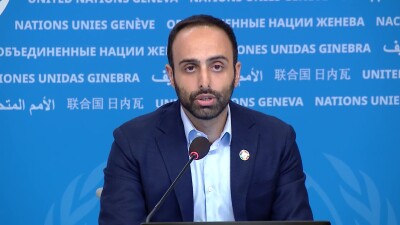
“The risk of starvation is everywhere in Gaza,” UN Human Rights Office spokesperson Thameen Al-Kheetan told reporters in Geneva.
“This is a direct result of the Israeli government's policy of blocking humanitarian aid,” he said.
Mr. Al-Kheetan insisted that in the past few weeks, Israeli authorities have only allowed aid to enter in quantities that remain “far below what would be required to avert widespread starvation”.
The UN said on Monday that hunger-related deaths continue to be reported in the Strip, including among children.
As the Israeli army intensified its attacks in the north of the enclave, it has continued to issue displacement orders for Palestinians, Mr. Al-Kheetan said.
He noted that Gazans have been told to move to the Al-Mawasi area, despite continuing airstrikes and disastrous conditions there.
“Hundreds of thousands of Palestinians displaced to Al-Mawasi have little or no access to essential services and supplies, including food, water, electricity and tents,” he warned.
The OHCHR spokesperson stressed that reaching humanitarian aid “can be a deadly pursuit” with latest data indicating that 1,857 Palestinians were killed while seeking food from 27 May, when the US and Israel-backed militarized aid distribution scheme known as the Gaza Humanitarian Foundation started its operations.
Out of that number, he said that 1,021 were killed in the vicinity of the Gaza Humanitarian Foundation sites and 836 on the routes of supply trucks.
“Most of these killings appear to have been committed by the Israeli military,” Mr. Al-Kheetan said.
Asked how the situation could get even worse, Jens Laerke, the spokesperson for the UN humanitarian affairs coordination office (OCHA), said that “it has already gotten worse”, insisting on the devastating effects of the Israeli ban on the entry of shelter materials into the enclave.
While the Israeli authorities recently announced that they would lift the ban on shelter supplies, Mr. Laerke said that “the United Nations and our partners have as of last night not been able to bring in shelter materials following the Israeli announcement.”
“There's a set of impediments that still needs to be addressed, including Israeli customs clearance,” he added.
The UN said on Monday that according to partners’ estimations at least 1.35 million people in Gaza need emergency shelter.
Aid agencies have warned that tents being used in Gaza are worn out from prolonged sun exposure and frequent displacement.
Asked about the reasons given for the ban on shelter items, Mr. Laerke explained that in a conflict, some shelter items such as tentpoles can fall under the “dual-use regime” as they could be used for both civilian and military purposes.
“Shelter has been banned entry for about five months and in that period over 700,000 people have been displaced or re-displaced,” he said.
People forced to flee time and again often have to leave behind the tents that they have been provided, Mr. Laerke explained, which creates a challenge for aid workers “trying to respond to people where they are”.
The looming expansion of Israel’s military activities in Gaza City is another major concern for UN humanitarians, as it would again push thousands of people into a severely overcrowded area in the south of the Strip.
Asked about the impact of Israel’s plans to occupy Gaza City, OHCHR’s Mr. Al-Kheetan underscored a “huge risk” for civilians.
“There are risks of mass displacement… more killings and more misery that we have already seen in the Gaza Strip,” he warned. “Among those who will be affected are the most vulnerable, people with disabilities, the injured, the children, women”, he concluded.
-Ends -
STORY Gaza aid blockages OHCHR – OCHA 19 August 2025
TRT: 3:06”
SOURCE: UNTV CH
RESTRICTIONS: NONE
LANGUAGE: ENGLISH/NATS
ASPECT RATIO: 16:9
DATELINE: 19 AUGUST 2025 GENEVA, SWITZERLAND
1. Exterior wide shot: Palais des Nations, Flag Alley.
2. Wide shot: Speakers at the podium of the press conference; speaker on screens; journalists in the Press room.
3. SOUNDBITE (English) – Thameen Al-Kheetan, spokesperson, UN Human Rights Office (OHCHR): “The risk of starvation is everywhere in Gaza. This is a direct result of the Israeli government's policy of blocking humanitarian aid.”
4. Wide shot: Speakers at the podium of the press conference; speaker on screens; journalists in the Press room.
5. SOUNDBITE (English) – Thameen Al-Kheetan, spokesperson, UN Human Rights Office (OHCHR): “Hundreds of thousands of Palestinians displaced to Al Mawasi have little or no access to essential services and supplies, including food, water, electricity and tents.”
6. Medium shot: Speakers at the podium of the press conference.
7. SOUNDBITE (English) – Thameen Al-Kheetan, spokesperson, UN Human Rights Office (OHCHR): “Since 27 May and up until 17 August, we have documented that 1,857 Palestinians were killed while seeking food, including 1,021 killed in the vicinity of the Gaza Humanitarian Foundation sites and 836 killed on the routes of supply trucks. Most of these killings appear to have been committed by the Israeli military.”
8. Wide shot: Speakers at the podium of the press conference; speaker on screens; journalists in the Press room.
9. SOUNDBITE (English) – Jens Laerke, spokesperson, UN Office for the Coordination of Humanitarian Affairs (OCHA): “We don't even need to look ahead of what, how possibly this could get worse. It has already gotten worse. As you know, shelter has been banned entry for about five months and in that period over 700,000 people have been displaced or re-displaced.”
10. Wide shot: Speakers at the podium of the press conference; speaker on screens.
11. SOUNDBITE (English) – Jens Laerke, spokesperson, UN Office for the Coordination of Humanitarian Affairs (OCHA): “What very often happens is that they have to leave their tents. They may have been provided with the with a tent and then they're displaced again and they have no possibility of taking a tent with them. So, there are lots of things that are very challenging with these repeat displacements when you are trying to respond to people where they are.”
12. Wide shot: Speakers at the podium of the press conference; speaker on screens.
13. SOUNDBITE (English) – Jens Laerke, spokesperson, UN Office for the Coordination of Humanitarian Affairs (OCHA): “We cannot speak for other actors, but the United Nations and our partners have as of last night not been able to bring in shelter materials following the Israeli announcement. There's a set of impediments that still needs to be addressed, including Israeli customs clearance.”
14. Close shot: Journalist in the Press room.
15. SOUNDBITE (English) – Thameen Al-Kheetan, spokesperson, UN Human Rights Office (OHCHR): “These plans have a huge risk for people, for civilians. There are risks of mass displacement and more and more killings and more misery that we have already seen in the Gaza Strip. And of course, among those who will be affected are the most vulnerable, people with disabilities, the injured, the children, women.”
16. Various shots of journalists in the Press room.
Similar Stories

2
17
1
2
Edited News , Press Conferences | OCHA , WMO
Two UN agencies teamed up on Wednesday to issue an appeal for immediate assistance to help communities already being impacted by the strongest El Niño on record.

3
16
2
2
B-roll , Conferences , Edited News | UNITED NATIONS , UNOG
Sixth Consultative Meeting on Enhancing Coordination of Peace Initiatives and Efforts for Sudan

1
1
1
Edited News | UNICEF , WHO , UNHCR
Yemen war continues to force families from homes amid hunger and disease
More than 250,000 people have now fled renewed fighting in Yemen, the UN said on Tuesday, citing particular concern for those sheltering in the southwestern city of Taiz and the wider governorate, where access is “essentially blocked”.

1
1
1
Edited News | UNICEF
A little over one year since a ceasefire agreement was announced between Hamas fighters and Israel, more than 340 children have been reported killed and hundreds more injured, the UN Children’s Fund, UNICEF, said on Friday.

1
1
1
Edited News | UNICEF , IFRC
Six weeks after Nepal’s deadly flooding disaster, communities are still struggling to rebuild their lives, but they will need sustained help as global warming increases the risk of another Himalayan catastrophe, the UN Children’s Fund (UNICEF) said on Friday.

1
1
1
Edited News | WHO
In suspected Russia plague death, testing and monitoring underway – WHO
The death of a lab worker in Russia’s Siberia region has sparked concerns about plague being the cause, the UN World Health Organization (WHO) said on Tuesday, adding that it was following the situation closely.

1
1
Edited News | OHCHR , UNOG
UN Human Rights Chief Volker Türk on Friday provided and oral update to the 63rd session of the Human rights Council on Ukraine.

1
1
1
Edited News | OHCHR , UNOG
UN Human Rights Chief Volker Türk on Friday provided and oral update to the 63rd session of the Human rights Council on the human rights situation in Haiti.

1
1
1
Edited News | WHO
Repeated delays in bringing lifesaving medicines, prosthetics and more from Israel into Gaza risk having devastating consequences on Palestinians who urgently need them in the wartorn enclave, the UN World Health Organization (WHO) said on Friday. “A truck full of non-priority supplies or the right supplies arriving too late, doesn't save lives. That's the question that actually matters," said Dr Reinhilde Van De Weerdt, WHO Representative in the OPT.

1
1
1
Edited News | WHO
DRC: Early access to care and oxygen decisive for Ebola patients’ survival – WHO
In the Democratic Republic of the Congo (DRC), health workers fighting the country’s largest-ever Ebola outbreak are struggling to overcome critical challenges to patient care, the UN World Health Organization (WHO) warned on Tuesday.

1
1
1
Edited News | OCHA , UN
Civilians in Iran are continuing to feel the consequences of months of conflict and military escalation, the UN’s top official in the country has said, as loss of life, damage to civilian infrastructure and mounting economic pressures leave many facing continued uncertainty.
1
1
1
Edited News | WHO , UNICEF
Aid agencies in Yemen highlighted the growing hunger emergency sparked by renewed fighting between Houthi opposition forces and Government troops, after mobile health clinics reported that hundreds of children displaced by the violence are suffering from the most deadly form of malnutrition.