

The United Nations Office at Geneva
Multimedia Newsroom
Gaza aid worker killings: one humanitarian still missing in shallow grave
UN humanitarians and partners on Tuesday expressed deep shock at the killing of 15 colleagues on duty in southern Gaza whose remains were recovered from a shallow grave after a week-long rescue operation, noting that one worker is still missing.
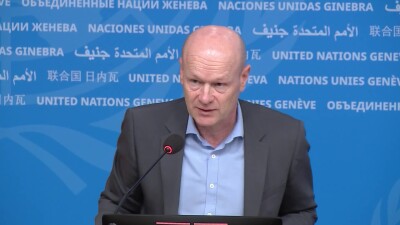
“This is a huge blow to us…These people were shot,” said Jens Laerke, spokesperson for the UN aid coordination office, OCHA.
“Normally we are not at a loss for words and we are spokespeople, but sometimes we have difficulty finding them. This is one of those cases,” he told journalists in Geneva, referring to video footage taken near Tal Al Sultan by an OCHA rescue party showing a crushed UN vehicle, ambulances and a fire truck that had been flattened and buried in the sand by the Israeli military.
The clearly identified humanitarian workers from the Palestine Red Crescent Society, Palestinian Civil Defence and the UN Palestine refugee agency, UNRWA, had been despatched to collect injured people on 23 March in the Rafah area.
They came under fire from Israeli forces who were advancing in the area, OCHA’s top official in the Palestinian Occupied Territory said, in a detailed post on X.
Jonathan Whittall explained that on the day of the attack, five ambulances, a fire truck – and a UN vehicle which arrived following the initial assault – were all hit by Israeli fire, after which contact was lost with teams.
One survivor said Israeli forces had killed both of the crew in his ambulance, Mr. Whittall said. “For days, OCHA coordinated to reach the site but our access was only granted five days later…After hours of digging, we recovered one body - a civil defence worker beneath his fire truck.”
The week-long rescue operation ended on Sunday 30 March with the recovery of the bodies of 15 humanitarian colleagues: eight from the Palestine Red Crescent Society (PRCS), six from the Palestinian Civil Defence (PCD) and the UNRWA worker.
The body of one more PRCS worker is still missing at the site, according to the International Federation of Red Cross and Red Crescent Societies (IFRC), which repeated its calls for information from the Israeli military.
Available information indicated that the first team had been killed by Israeli forces on 23 March; the other emergency and aid crews were struck one after another over several hours as they searched for their missing colleagues, OCHA said.
According to UNRWA, 408 aid workers including more than 280 UNRWA staff have been killed in Gaza since the war began on 7 October 2023.
Additional video footage released by OCHA taken from within a UN vehicle near the site of last Sunday’s incident also showed two people walking and then running to escape sniper fire. According to OCHA, a woman was shot in the back of the head and a young man trying to retrieve her was also shot. The OCHA team managed to recover her body in the UN vehicle.
Despite a demand for “answers and justice” from Israel by the UN’s emergency relief chief Tom Fletcher, no information has yet been provided, his office said.
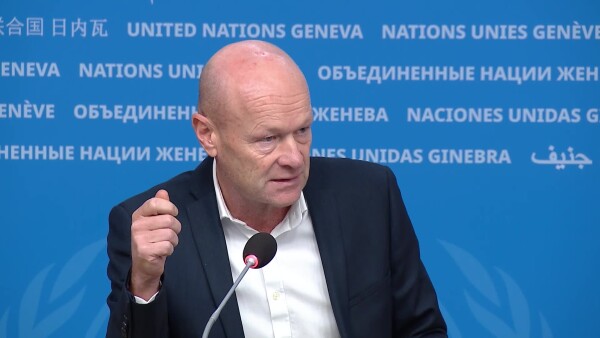
“We keep engaging with the Israeli authorities daily on this and on other burning matters including, importantly, the critical need to reopen crossings for supplies,” said Mr. Laerke. “Because while this is a huge blow to us on all levels, the crisis itself, just moves on and gets worse every day.”
The development comes days after the UN agency warned that acts of war in Gaza “bear the hallmarks of atrocity crimes”, with hundreds of children and other civilians killed in Israeli airstrikes in intensely populated areas and hospital patients “killed in their beds, ambulances shot at and first responders killed”.
James Elder, spokesperson for the UN Children’s Fund, UNICEF, condemned “unprecedented breaches” of international humanitarian law (IHL) in Gaza linked to the resumption of Israeli bombardment and ground operations inside the shattered enclave.
Every day since the ceasefire between Hamas and Israel broke down on 18 March with heavy Israeli strikes, “100 children have been killed and maimed every single day since that moment”, Mr. Elder insisted.
“Sheer will doesn't get you to survive when we see breach after breach of IHL, breach after breach of restricting aid,” the UNICEF spokesperson continued, four weeks since the Israeli authorities shut Gaza’s borders to all commercial and humanitarian aid.
Echoing those concerns, IFRC’s Mr. Della Longa reported that hospitals “are literally overwhelmed” and running out of medicine and medical equipment.
The IFRC spokesperson also warned that a lack of fuel or damage have put “more than half” of ambulance teams of the Palestine Red Crescent out of action. This is significant because these ambulances “are the ones answering the emergency number that Palestinians can call when they need help”, he explained.
ends
STORY: Gaza Update – OCHA, WHO, UN Women
TRT: 02’45”
SOURCE: UNTV CH
RESTRICTIONS: NONE
LANGUAGE: ENGLISH / NATS
ASPECT RATIO: 16:9
DATELINE: 1 April 2025 GENEVA, SWITZERLAND
Speakers:
- Jens Laerke, spokesperson, OCHA
- James Elder, spokesperson, UNICEF
- Tommaso Della Longa, spokesperson, IFRC
SHOTLIST
- Exterior medium shot: Palais des Nations, Flag Alley
- Wide shot of podium with speakers.
- SOUNDBITE (English) – Jens Laerke, spokesperson, OCHA: “It has been a very difficult weekend I think, for all of us. You have seen the videos that we put out, that…normally we are not at a loss for words, and we are spokespeople, but sometimes we have difficulty finding them. This is one of those cases. These people were shot.”
- Wide shot, Press room, TV screens, journalists.
- SOUNDBITE (English) – Jens Laerke, spokesperson, OCHA: “You will have seen what Under-Secretary-General Fletcher tweeted out as well, demanding justice and answers. And on that, I can say as of this morning we have not received the answers expected.”
- Wide, journalists, TV screen, control booths.
- SOUNDBITE (English) – Jens Laerke, spokesperson, OCHA: “We keep engaging with the Israeli authorities daily on this and on other burning matters including, importantly, the critical need to reopen crossings for supplies. Because while this is a huge blow to us on all levels, the crisis itself, just moves on and gets worse every day.”
- Wide, podium speakers, journalists, TV screens.
- SOUNDBITE (English) – James Elder, spokesperson, UNICEF: “Sheer will doesn't get you to survive when we see breach after breach of IHL, breach after breach of restricting aid. So, this can't fall from the world's attention and conscious[ness], because we are seeing unprecedented breaches across international humanitarian law.”
- Wide, Press room, journalists, TV screens showing speaker.
- SOUNDBITE (English) – Tommaso Della Longa, spokesperson, IFRC: “Just I would just like to echo what UN colleagues just said on the shocking, outrageous incident and what we saw last Sunday. I just want to add that one colleague of Palestinian Red Crescent is still missing and we continue calling to have more information about what is happening.”
- Wide, Press room, podium speakers, TV screens, control booths.
- SOUNDBITE (English) – Tommaso Della Longa, spokesperson, IFRC: “The ambulances of the Palestinian Red Crescent are the ones answering to the emergency number that Palestinians can call when they need help; more than half of them now are not working and continuing like this because of lack of fuel or because they were damaged. So, if this continues, it will mean that in the next future [days] Palestinians would not have any more ambulances to save lives.”
- Medium, TV journalist filming.
- Medium, journalist listening.
- Medium-wide, journalists.
Similar Stories
1
1
1
Edited News | OCHA , UNICEF , WFP
Aid agencies warned on Friday of the fast-developing humanitarian emergency inside Taiz City in Yemen, which has been encircled by de facto Houthi forces fighting government troops along the country’s west coast.

2
17
1
2
Edited News , Press Conferences , Images | OCHA , WMO
Two UN agencies teamed up on Wednesday to issue an appeal for immediate assistance to help communities already being impacted by the strongest El Niño on record.
3
16
2
2
Edited News , B-roll , Conferences , Images | UNITED NATIONS , UNOG
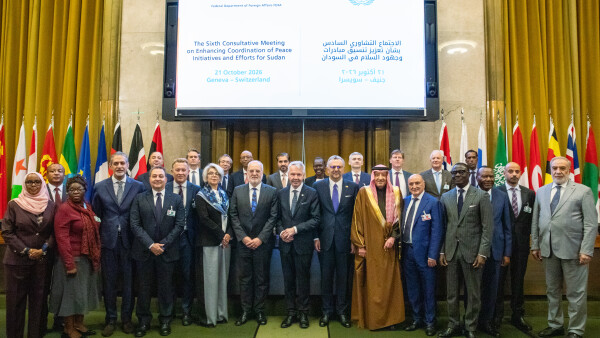
Sixth Consultative Meeting on Enhancing Coordination of Peace Initiatives and Efforts for Sudan

1
1
1
Edited News | UNICEF , WHO , UNHCR
Yemen war continues to force families from homes amid hunger and disease
More than 250,000 people have now fled renewed fighting in Yemen, the UN said on Tuesday, citing particular concern for those sheltering in the southwestern city of Taiz and the wider governorate, where access is “essentially blocked”.

1
1
1
Edited News | UNICEF
A little over one year since a ceasefire agreement was announced between Hamas fighters and Israel, more than 340 children have been reported killed and hundreds more injured, the UN Children’s Fund, UNICEF, said on Friday.

1
1
1
Edited News | UNICEF , IFRC
Six weeks after Nepal’s deadly flooding disaster, communities are still struggling to rebuild their lives, but they will need sustained help as global warming increases the risk of another Himalayan catastrophe, the UN Children’s Fund (UNICEF) said on Friday.

1
1
1
Edited News | WHO
In suspected Russia plague death, testing and monitoring underway – WHO
The death of a lab worker in Russia’s Siberia region has sparked concerns about plague being the cause, the UN World Health Organization (WHO) said on Tuesday, adding that it was following the situation closely.

1
1
Edited News | OHCHR , UNOG
UN Human Rights Chief Volker Türk on Friday provided and oral update to the 63rd session of the Human rights Council on Ukraine.

1
1
1
Edited News | OHCHR , UNOG
UN Human Rights Chief Volker Türk on Friday provided and oral update to the 63rd session of the Human rights Council on the human rights situation in Haiti.

1
1
1
Edited News | WHO
Repeated delays in bringing lifesaving medicines, prosthetics and more from Israel into Gaza risk having devastating consequences on Palestinians who urgently need them in the wartorn enclave, the UN World Health Organization (WHO) said on Friday. “A truck full of non-priority supplies or the right supplies arriving too late, doesn't save lives. That's the question that actually matters," said Dr Reinhilde Van De Weerdt, WHO Representative in the OPT.

1
1
1
Edited News | WHO
DRC: Early access to care and oxygen decisive for Ebola patients’ survival – WHO
In the Democratic Republic of the Congo (DRC), health workers fighting the country’s largest-ever Ebola outbreak are struggling to overcome critical challenges to patient care, the UN World Health Organization (WHO) warned on Tuesday.

1
1
1
Edited News | OCHA , UN
Civilians in Iran are continuing to feel the consequences of months of conflict and military escalation, the UN’s top official in the country has said, as loss of life, damage to civilian infrastructure and mounting economic pressures leave many facing continued uncertainty.