

The United Nations Office at Geneva
Multimedia Newsroom
STORYLINE
As the world confronts intertwined climate and finance crises while seeking to advance on the Sustainable Development Goals (SDGs), carbon markets are increasingly seen as key drivers of climate ambition and capital flow.
They enable countries to trade carbon credits – permits to offset a specific amount of emissions – allowing sellers to earn revenue and contribute to climate action.
The least developed countries (LDCs) are already engaged in carbon markets and among the early movers in emerging trading mechanisms under Article 6 of the Paris Agreement.
The Least Developed Countries Report 2024 examines how these markets could bridge gaps between economic growth and climate action in LDCs and mobilize capital for sustainable development.
It makes clear that while carbon markets offer promise, they are not a substitute for official development assistance or climate finance. Instead, they serve as one of many tools to support LDCs’ green structural transformations and global emissions goals.
Using data-driven analysis and case studies, the report provides a roadmap for LDCs and their development partners to unlock the potential of carbon markets for sustainable growth.
Full report: https://unctad.org/ldc2024
Production date: 04 November 2024
Creator: UNCTAD
Subject topical: ECONOMICS
Corporate name: UN TRADE AND DEVELOPMENT – UNCTAD
THE LEAST DEVELOPED COUNTRIES REPORT 2024 – Leveraging carbon markets for development
UN Trade and Development (UNCTAD) launched today the Least Developed Countries Report 2024 exploring how carbon markets can connect economic growth with climate action. By linking these goals, carbon markets offer a pathway to mobilize funds for sustainable development in the world’s most vulnerable economies.
DESCRIPTION
STORY: UNCTAD / Trade and Development Report
TRT: 03:09
SOURCE: UNCTAD
RESTRICTIONS: NONE
LANGUAGE: ENGLISH / NATS
WEBSITE: https://unctad.org/ldc2024
DATELINE: 04 NOVEMBER 2024, GENEVA, SWITZERLAND
SHOTLIST
1. Wide shot, exterior, Palais de Nations
2. Med shot, press room
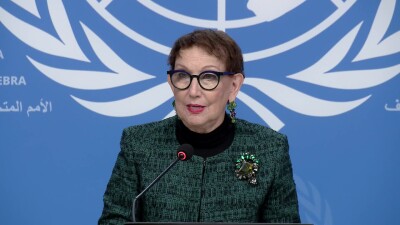
3. SOUNDBITE (English) Rebeca Grynspan, UN Trade and Development Secretary-General : « Of the 20 countries that are most vulnerable to climate change, according to different studies, 17 are least developed countries. »
4. Med shot, speaker on screen, journalist, photographer
5. SOUNDBITE (English) Rebeca Grynspan, UN Trade and Development Secretary-General : « Financial gaps in LDCs are widening, and the investment deficit in these countries keep s getting worse. »
6. Med shot, press room
7. SOUNDBITE (English) Rebeca Grynspan, UN Trade and Development Secretary-General: « In short, carbon markets seek to solve a concrete economic problem: how to assign a price to something of high value to the planet but low value in the market. »
8. Med shot, journalists
9. SOUNDBITE (English) Rebeca Grynspan, UN Trade and Development Secretary-General: “As we approach COP29 in Baku next week, with a primary focus on climate finance, this report serves as a wake-up call on carbon markets.”
10. Med shot, journalist
11. SOUNDBITE (English) Rebeca Grynspan, UN Trade and Development Secretary-General: « LDCs play a minimal role in global greenhouse gas emissions, contributing less than 4% of the total. Yet, as mentioned, they face some of the most severe impacts of climate change. There is significant untapped potential in LDCs, with ample opportunities to create carbon credits through projects in forestry, agriculture, and renewable energy. »
12. Med shot, control room
11. SOUNDBITE (English) Rebeca Grynspan, UN Trade and Development Secretary-General: « Unfortunately, global carbon markets are currently divided and unclear. Carbon markets are fragmented due to a multiplicity of regulatory frameworks, standards and institutions, leading to a wide variation in carbon prices across different market segments. »
13. Med shot, journalist
14. SOUNDBITE (English) Rebeca Grynspan, UN Trade and Development Secretary-General: « A crucial factor for LDCs is establishing a viable carbon price, and the price proposed by UNCTAD’s study is at least $100 per tonne. However, the current price stands at just $10 per tonne. »
15. Med shot, journalists
16. SOUNDBITE (English) Rebeca Grynspan, UN Trade and Development Secretary-General: « We need a stronger push for harmonization across different standards and regulations. LDCs cannot—and should not— be forced to navigate a spaghetti bowl of climate regulations. »
17. Various shots
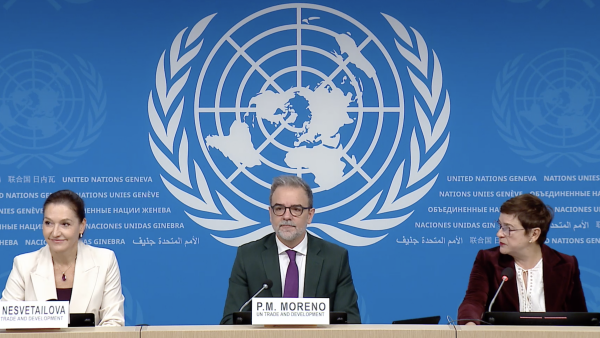
Presentation of the Least Developed Countries Report 2024: Leveraging Carbon Markets for Development
Speakers:
- Rebeca Grynspan, Secretary General of UN Trade and Development
- Rolf Traeger, UN Trade and Development, Chief, LDC Section Policy Analysis and Research Branch
Similar Stories
1
1
1
Press Conferences | WMO , UNHCR , WHO , ILO
WMO: Greenhouse Gas Bulletin; UNHCR: As attacks intensify UNHCR urges support for war ravaged Ukrainians; WHO: Clinical trials in DRC: vaccines and beyond; ILO: New global and regional estimates on domestic work, informality and working conditions
1
1
1
Press Conferences | UN WOMEN , WFP , WHO
UN WOMEN: Sudan Women and girls one year after the fall of El Fasher; increasing drone attacks across the country; WFP: DRC - Ebola spreads to eighth DRC province as WFP delivers food, builds treatment centres and keeps supplies moving; WHO - Update on Ebola (Bundibugyo Virus Disease)
1
12
1
1
Press Conferences , Images | UNOG
Closing Press Conference following the Sixth Consultative Meeting on Enhancing Coordination of Peace Initiatives and Efforts in Sudan

2
17
1
2
Edited News , Press Conferences , Images | OCHA , WMO
Two UN agencies teamed up on Wednesday to issue an appeal for immediate assistance to help communities already being impacted by the strongest El Niño on record.
1
1
1
Press Conferences | CITES
Wildlife trade and conservation policy discussions at the 81st meeting of the CITES Standing Committee (SC81)
1
1
1
Press Conferences | UNHCR , UNCTAD , WMO , OCHA , UNICEF , WHO
UNHCR Hungary’s 1956 Refugee Crisis: 70 Years On, UNCTAD World Investment Forum 2026, Doha, WMO Greenhouse Gas Bulletin and Climate Update for COP31, OCHA Afghanistan: Malnutrition, Girls’ Education and Recovery, UNICEF Yemen: Child Malnutrition and Unsafe Water in Taiz, WHO Inequalities in Noncommunicable Diseases and Risk Factors
1
1
1
Press Conferences | UNHCR
End of UNHCR's 77th Annual Executive Committee (ExCom) meeting week
1
1
1
Press Conferences | UNICEF , IOM , UNHCR
UN Special Assistant to the Personal Envoy Office (SUDAN): Peace Initiatives and Efforts in Sudan; UNICEF: Dire situation of children in Gaza; IOM: Damaged Homes and Energy Attacks Risk Displacing Ukrainians for this winter; UNHCR: update on EXCOM week
1
1
1
Press Conferences | IOM , UNDRR
UN stresses importance of household preparedness for disaster risk reduction.
1
1
1
Statements , Press Conferences | OHCHR
1
1
1
Press Conferences | UNHCR , UNICEF , IFRC , OHCHR , UN WOMEN , IOM , OCHA , WHO
UNHCR – ExCom Meeting, UNICEF – Nepal Recovery, IFRC – Flash Floods, WHO – Mental Health, IOM – South Sudan Floods, OCHA – DRC Humanitarian aid, UNHCR – Sahel Displacement, UNICEF – Yemen Update, IOM – Gaza Shelter, UN Women – Gaza Women, OHCHR – Arrests and detentions of Syrians by Israeli force
2
1
2
Press Conferences | UNCTAD
Presentation of the Trade and Developement Report 2026
Embargoed until 9 October 2026 at 11 a.m. (Geneva Time)
UNCTAD: UNCTAD’s flagship report finds that governments increasingly use industrial, trade, financial and technology policies to pursue economic and national security objectives. Market access and the ability to move into higher-value activities now depend more heavily on technology, finance and geopolitics.