

The United Nations Office at Geneva
Multimedia Newsroom
Story:
Ukraine: as birthrates plummet and population declines, a new strategy is announced
Since the full-scale Russian invasion of Ukraine in February 2022 world attention has focused largely on the military, political and humanitarian aspects of the war. Meanwhile, a silent emergency has been brewing: Ukraine's demographics.
Prior to the war, Ukraine already faced significant population challenges, common to much of the Eastern European region: it had one of the lowest birth rates in Europe, with people leaving the country in search of better opportunities, and an ageing population in overall decline.
Russia’s full-scale invasion — which has now lasted nearly 1,000 days — made things much worse, according to UN population expert Florence Bauer.
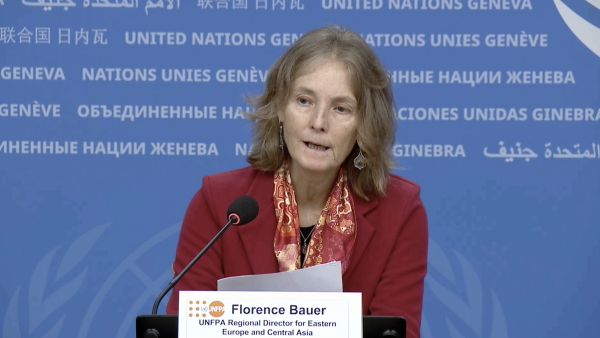
“The birth rate plummeted to one child per woman – the lowest fertility rate in Europe and one of the lowest in the world,” Ms. Bauer said, speaking to reporters in Geneva.
A Huge Loss in Human Capital
As a direct consequence of the war, millions of people have been displaced, both inside Ukraine’s borders and externally, with some 6.7 million earning refugee status. Further declines in population have been brought on by casualties from the conflict, and the exodus of young people from many regions in the country, with severe consequences for the economy.
“Overall, Ukraine’s population has declined by over 10 million since the beginning of the war in 2014 and by an estimated 8 million since the beginning of the full-scale invasion in 2022,” Ms. Bauer, the Regional Director for Eastern Europe and Central Asia of the United Nations Population Fund (UNFPA), explained.
“This also presents a huge loss in human capital – human capital that is urgently needed for recovery and for building Ukraine’s future,” she added.
A New Strategy for Ukraine’s population
To address these challenges, the government of Ukraine, with the support of UNFPA, has developed and recently adopted a new national demographic strategy. The plan focuses on building human capital, recognising the importance of socio-economic factors, and promoting gender equality.
“Ukraine has made progress, such as the 2021 law promoting shared caregiving roles by ensuring equal childcare responsibilities for fathers,” Ms. Bauer said in acknowledgement of past efforts by the Government of Ukraine. “But much more needs to be done,” she emphasised.
To help Ukraine recover UNFPA is recommending that a national population census be organised as soon as possible. Ukraine’s last population count was conducted in 2001, making much of the available data obsolete.
The UN Population Fund says it is recommending approaches aimed at achieving demographic sustainability in Ukraine, which would be based on gender inclusivity, overcoming stereotypes, and fostering economic opportunities. But none of these are likely to be achieved without peace in Ukraine, Ms. Bauer acknowledged.
-ends-
STORY: Ukraine's demographic crisis - UNFPA
TRT: 02’03’’
SOURCE: UNTV CH
RESTRICTIONS: NONE
LANGUAGE: ENGLISH / NATS
ASPECT RATIO: 16:9
DATELINE: 22 OCTOBER 2024 GENEVA, SWITZERLAND
1. Exterior wide shot: Palais des Nations, Flag Alley.
2. Wide shot: Speaker at the podium of the press conference; speaker on screens; journalists in the Press room.
3. SOUNDBITE (English) – Florence Bauer, UNFPA Regional Director for Eastern Europe and Central Asia: “The birthrate plummeted and is currently at around one child per woman, which is one of the lowest in the world.”
4. Wide lateral shot: Journalists in the Press room; speaker on screens.
5. SOUNDBITE (English) – Florence Bauer, UNFPA Regional Director for Eastern Europe and Central Asia: “We have millions of people who have been displaced. We know there is internally displaced people, and we have 6.7 million that are externally displaced refugees. Some regions have been mostly depopulated, with young people leaving this region and some old people staying, and a significant number of people have died due to the conflict and, of the war.”
6. Wide shot: Journalists in the Press room; speaker on screens.
7. SOUNDBITE (English) – Florence Bauer, UNFPA Regional Director for Eastern Europe and Central Asia: “Overall, what we can see is that the Ukrainian population has declined by over 10 million since the beginning of the war. It also represent a massive loss of human capital that, as we know, is so key for the recovery and for building Ukraine's future.”
8. Medium shot: Press briefing participants in the Press room.
9. SOUNDBITE (English) – Florence Bauer, UNFPA Regional Director for Eastern Europe and Central Asia: “The government of Ukraine has developed and recently adopted national demographic strategies to address these challenges. It's a strategy that takes into account experiences from other countries, that have been now really focusing on increasing birth rate and that have failed. And instead it's looking into a comprehensive approach and putting a human capital at the center.”
10. Medium shot: Journalist behind the camera in the Press Room.
11. SOUNDBITE (English) – Florence Bauer, UNFPA Regional Director for Eastern Europe and Central Asia: “Ukraine's path to demographic sustainability and resilience would be quite comprehensive approaches that focus as well on gender inclusivity and overcoming stereotypes and fostering economic opportunities for all citizens. And it will, of course, also be key to create environment for families and individuals so that they can navigate those demographic trends. And of course, above everything, a lot hinges on whether peace will return to Ukraine.”
12. Wide lateral shot: Journalists in the Press room; speaker on screens.
13. Medium shot: Journalists in the Press room.
Similar Stories

1
1
1
Edited News | OCHA , UNICEF , WFP
Aid agencies warned on Friday of the fast-developing humanitarian emergency inside Taiz City in Yemen, which has been encircled by de facto Houthi forces fighting government troops along the country’s west coast.

2
17
1
2
Edited News , Press Conferences , Images | OCHA , WMO
Two UN agencies teamed up on Wednesday to issue an appeal for immediate assistance to help communities already being impacted by the strongest El Niño on record.

3
16
2
2
Edited News , B-roll , Conferences , Images | UNITED NATIONS , UNOG
Sixth Consultative Meeting on Enhancing Coordination of Peace Initiatives and Efforts for Sudan

1
1
1
Edited News | UNICEF , WHO , UNHCR
Yemen war continues to force families from homes amid hunger and disease
More than 250,000 people have now fled renewed fighting in Yemen, the UN said on Tuesday, citing particular concern for those sheltering in the southwestern city of Taiz and the wider governorate, where access is “essentially blocked”.

1
1
1
Edited News | UNICEF
A little over one year since a ceasefire agreement was announced between Hamas fighters and Israel, more than 340 children have been reported killed and hundreds more injured, the UN Children’s Fund, UNICEF, said on Friday.

1
1
1
Edited News | UNICEF , IFRC
Six weeks after Nepal’s deadly flooding disaster, communities are still struggling to rebuild their lives, but they will need sustained help as global warming increases the risk of another Himalayan catastrophe, the UN Children’s Fund (UNICEF) said on Friday.

1
1
1
Edited News | WHO
In suspected Russia plague death, testing and monitoring underway – WHO
The death of a lab worker in Russia’s Siberia region has sparked concerns about plague being the cause, the UN World Health Organization (WHO) said on Tuesday, adding that it was following the situation closely.

1
1
Edited News | OHCHR , UNOG
UN Human Rights Chief Volker Türk on Friday provided and oral update to the 63rd session of the Human rights Council on Ukraine.

1
1
1
Edited News | OHCHR , UNOG
UN Human Rights Chief Volker Türk on Friday provided and oral update to the 63rd session of the Human rights Council on the human rights situation in Haiti.

1
1
1
Edited News | WHO
Repeated delays in bringing lifesaving medicines, prosthetics and more from Israel into Gaza risk having devastating consequences on Palestinians who urgently need them in the wartorn enclave, the UN World Health Organization (WHO) said on Friday. “A truck full of non-priority supplies or the right supplies arriving too late, doesn't save lives. That's the question that actually matters," said Dr Reinhilde Van De Weerdt, WHO Representative in the OPT.

1
1
1
Edited News | WHO
DRC: Early access to care and oxygen decisive for Ebola patients’ survival – WHO
In the Democratic Republic of the Congo (DRC), health workers fighting the country’s largest-ever Ebola outbreak are struggling to overcome critical challenges to patient care, the UN World Health Organization (WHO) warned on Tuesday.

1
1
1
Edited News | OCHA , UN
Civilians in Iran are continuing to feel the consequences of months of conflict and military escalation, the UN’s top official in the country has said, as loss of life, damage to civilian infrastructure and mounting economic pressures leave many facing continued uncertainty.