

The United Nations Office at Geneva
Multimedia Newsroom
Press Conferences | UNITED NATIONS
Press Briefing: Special Adviser on Solutions to Internal Displacement - 21 June 2024
Two years of the Action Agenda on Solutions to Internal Displacement
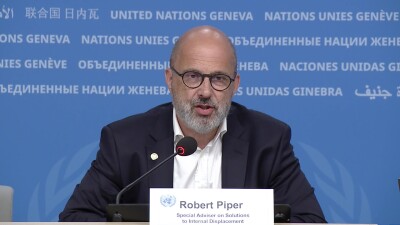
Robert Piper, Special Adviser to the UN Secretary-General on Solutions to Internal Displacement, said that 24 June would mark two years since the launch of the Secretary General’s Action Agenda on Solutions to Internal Displacement. Today, there were 76 million internally displaced people (IDPs) – people who had lost their homes, livelihoods, communities and sometimes also their legal identities. They were “internal” because they had not crossed international borders but had stayed withing their own countries. Some IDPs returned home relatively quickly, usually after natural disasters; others got stuck in protracted displacements of five, ten years or longer, usually displaced by conflicts, such as in Syria and Somalia. Those numbers were growing exponentially, and today there were twice as many IDPs as in 2014. The largest number of IDPs today were in Sudan, informed Mr. Piper.
In 2023, the United Nations had helped as many as 50 million IDPs. The Secretary-General’s Action Agenda aimed to break the long-term displacement pattern; it aimed to help IDPs find a durable solution to their displacement; better prevent new displacement crises from emerging; and ensure those facing displacement receive effective protection and assistance. The Agenda set out 31 concrete commitments, and numerous UN agencies had signed up for it. Mr. Piper was focused on building a coalition to break down the pattern of protracted displacement. Governments in several affected countries, from Colombia o Iraq, had really stepped forward to take the lead, he said. Those governments had introduced new approaches to dealing with internal displacement; they had put money behind their political commitments. In Nigeria, for example, the Borno State had pledged 15 percent of its revenue to this issue over the next four years.
Mr. Piper explained that there were fifteen pilot countries which would help identify the best solutions; there were already commitments to move 8.5 million IDPs to more permanent solutions, based on international standards, which included safe, dignified, and voluntary settlement. Globally, the UN and partners had made progress with supporting those governments; a new financing mechanism had been established, and relevant UN Resident Coordinator offices had been accordingly strengthened. The UN had made a big investment in data systems, which was of critical importance. The visibility of this issue had been lifted globally, stressed Mr. Piper. Several partnerships with regional development banks had been built. The humanitarian community had upgraded its own capacity to respond to the needs of the internally displaced people, from day one onwards. The major deficit today lay with prevention, as numbers of IDPs kept going up, partly caused by natural disasters, partly by conflict. UN was still working with various partners on finding the right level of financing; providing homes and livelihoods were expensive, and a breakthrough there was still needed. The whole of the UN and the whole of national governments needed to be fully engaged on this issue. There was still no forum that brought all relevant actors together and there was no adequate international architecture in place. He appealed to Member States to create a forum to comprehensively address this issue in a more coordinated, cross-sectorial way. All parts of the system ought to come together and establish an adequate governance structure.
More details are available in the June 2024 factsheet.
Responding to questions, Mr. Piper said that the UNHCR and the IOM were by far the two most active agencies dealing with displacement, but they also recognized that this issue demanded a much broader, coordinated action to find long-term solutions for internally displaced people. They could not do it alone, he stressed. An intergovernmental forum that would bring all actors together and meet periodically could be a good way forward, said Mr. Piper responding to another question. This process ought to be led by Member States.
Similar Stories
1
1
1
Press Conferences | IOM , ITU , UNECE , UNICEF , WHO , WMO
UNICEF: Ebola, DRC - children orphans or separating them from parents and caregivers; IOM: Humanitarian needs in Djibouti amid arrivals from Yemen and increased migrant movements; WHO: Darfur, scale of health needs far exceeds available resources; WMO co-sponsored Global Heat Forum, Bangkok, monthly Global Seasonal Climate Update; UNECE: UN Forum of Mayors; ITU Plenipotentiary Conference 2026; WHO: child and adolescent obesity guidelines and new global roadmap to tackle pregnancy hypertension, a leading cause of maternal mortality
1
1
1
Press Conferences | OCHA , UN WOMEN , UNHCR , WFP , WHO , WTO , UNEP
OCHA – $160M CERF allocation to 12 underfunded crises; UNHCR – 5.8M refugee children remain out of school amid funding cuts; UN Women – Middle East escalation and food security among women/girls; WHO – Gaza supplies and overall situation; WFP – Yemen food insecurity and impact on global hunger ; UNEP - First International Conference of the Global Framework on Chemicals in Geneva | 16-20 November 2026
1
1
1
Press Conferences | UNHCR , WHO
Yemen's health system nears collapse amid conflict, causing rising casualties and medicine shortages.
1
1
1
Press Conferences | HRC
Update by the Expert Mechanism to Advance Racial Justice and Equality in Law Enforcement
1
1
1
Press Conferences | WIPO , WHO , UNICEF , UNHCR , IOM , WFP , FAO
WIPO Global Innovation Index 2026 launch and press conference, WHO Composition of influenza vaccines for the 2027 Southern Hemisphere flu season, UNICEF Yemen hunger and malnutrition; UNHCR Sudan displacement into Chad; IOM Ebola and population movements in DRC; WFP emergency food assistance in Nepal; and FAO food loss and waste.
2
1
2
Press Conferences | UNCTAD
Gaza reconstruction needs reach $71.5 billion as Palestinian economy and public finances face severe strain. Latest UNCTAD report documents the loss of decades of development gains, economic collapse in Gaza and tightening economic constraints in the West Bank.
The report identifies three immediate priorities: transferring withheld Palestinian revenues, safeguarding the banking system and aligning reconstruction support with the documented scale of damage and economic losses.
1
1
1
Press Conferences | HRC
Press conference on the situation of human rights in Nicaragua by the UN Group of Human Rights Experts
1
1
1
Press Conferences | ITU , UNHCR , WHO , WMO
YEMEN - UNHCR: Escalating conflict in Yemen could fuel more displacement, refugee movement
CLIMATE - WHO / WMO: Health and Climate impact of El Niño
1
1
1
Press Conferences | HRC , OHCHR
Mariana Katzarova discusses human rights in Russia as a UN Special Rapporteur.
1
1
1
Press Conferences | IOM , OHCHR , UN WOMEN , UNFPA , UNHCR , UNOPS , WHO
UN Geneva briefing: Yemen crisis worsens, urgent aid needed across multiple sectors.
1
1
1
Press Conferences | HRC
Press conference on the latest report of the Independent International Fact-Finding Mission on the Bolivarian Republic of Venezuela to the UN Human Rights Council
1
1
1
Press Conferences | OHCHR
Victims Still Waiting: A Global Briefing on Transitional Justice Around the World