

The United Nations Office at Geneva
Multimedia Newsroom
Press Conferences
UNHCR: Press conference - Annual Report on Forced Displacement - 10 June 2024
UNHCR's Annual Report Global Trends in Forced Displacement 2024
Speakers:
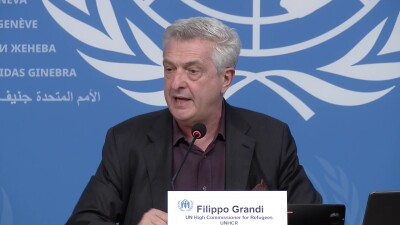
Filippo Grandi, UN High Commissioner for Refugees
Tarek Abou Chabake, UNHCR Chief statistician
Under strict embargo until 13 June 2024 05:01 CEST
TERMS OF USAGE OF THE EDITED STORY ONLY: Mandatory on-screen credit in the format '© UNHCR' is required for any and all usage of UNHCR footage and ‘© UNHCR’ is required for audio and multimedia unless stated otherwise.
TITLE: UNHCR warns against apathy and inaction amid spike in forced displacement COUNTRY: Switzerland
LOCATION: Palais des Nations
SHOOT DATE: 10 June 2024
RELEASE DATE: 13 June 2024
CREDITS: Linda Muriuki, Producer / Alex St-Denis, Editor / UNTV, Camera SOURCE: IUNTV - UNHCR
LANGUAGE: English
DURATION: 5:30 mins
LEDE-IN: Overall numbers of people forced to flee, rise to 120 million by May 2024 with conflicts from Sudan to Gaza to Myanmar creating new displacement and urgently require resolution.
BACKGROUND INFORMATION:
Forced displacement surged to historic new levels across the globe last year and this, according to the 2024 flagship Global Trends Report from UNHCR, the UN Refugee Agency.
The rise in overall forced displacement – to 120 million by May 2024 – was the 12th consecutive annual increase and reflects both new and mutating conflicts and a failure to resolve long-standing crises.
The figure would make the global displaced population equivalent to the 12th largest country in the world, around the size of Japan’s.
A key factor driving the figures higher has been the devastating conflict in Sudan: at the end of 2023, 10.8 million Sudanese remained uprooted. In the Democratic Republic of the Congo and Myanmar, millions were internally displaced last year by vicious fighting. UNRWA estimates that by the end of last year, up to 1.7 million people (75 per cent of the population) had been displaced in the Gaza Strip by the catastrophic violence, most of whom were Palestine refugees. Syria remains the world’s largest displacement crisis, with 13.8 million forcibly displaced in and outside the country.
The largest increase in displacement figures came from people fleeing conflict who remain in their own country, rising to 68.3 million people according to the Internal Displacement Monitoring Centre – up almost 50 per cent over five years.
The number of refugees, and others in need of international protection, climbed to 43.4 million when including those under UNHCR and UNRWA’s mandates. The vast majority of refugees are hosted in countries neighbouring their own, with 75 per cent residing in low- and middle-income countries that together produce less than 20 per cent of the world’s income.
The report showed that worldwide, more than 5 million internally displaced people and 1 million refugees returned home in 2023. These figures show some progress towards longer-term solutions. Positively, resettlement arrivals increased to almost 160,000 in 2023.
SHOTLIST:
00:00:00:00 - 00:00:28:14
-Filippo Grandi – UN High Commissioner for refugees (Man, English)
“We estimate that the most updated figure is now 120 million. So, it has gone up by another 6 million. These are refugees, asylum seekers, internally displaced people, people being forced by conflict, by persecution, by different and increasingly complex forms of violence. And they've had to flee their homes, either in their own country or crossing borders and becoming refugees. 120 million is a pretty high figure. And what is also very significant, most regrettably, it is that it is the 12th consecutive year in which this figure goes up and on this occasion, on this, June occasion, conflict remains a very, very big driver of displacement.”
00:01:04:09 - 00:01:38:21
-Filippo Grandi – UN High Commissioner for refugees (Man, English)
“I mean, many conflicts have driven this, growth in displacement. I would certainly single out Sudan because in Sudan, where the conflict has now been going on, this phase of the conflict has been going on for 14 months, almost 14 months. the number of people displaced is staggering. About 9 million either internally displaced or about 2 million that have crossed borders. Now, some of them
Page 2 of 2
13 Jun, 2024 12:24 PM
were already counted under last year's report, but that figure has kept growing in Chad alone. people are arriving in the hundreds every day.
00:01:50:23- 00:02:12:00
-Filippo Grandi – UN High Commissioner for refugees (Man, English)
The other crisis that I wanted to single out is Myanmar. Of course, not only because UNHCR remains deeply engaged with the Rohingya refugees that have fled from Myanmar, but also because since the coup d'état a few years back, violence has continued to grow inside the country.”
00:02:12:18 - 00:02:42:23
-Filippo Grandi – UN High Commissioner for refugees (Man, English)
“But this report says very clearly, once again, that 75% of those forcibly displaced, be they internally or externally forcibly displaced, live in countries that are either poor or middle income countries. So the big force displacement phenomenon is not in the rich country. In spite of the perception.”
00:02:42:28 - 00:03:18:02
-Filippo Grandi – UN High Commissioner for refugees (Man, English)
“Funding has remained extremely, extremely tight, as usual you may say, but with the increase in challenges, in numbers of people, in in different crisis with the strong attraction for funding represented by situations in the Middle East, Gaza in particular, or Ukraine, clearly some other operation, some other situations, Sudan in particular.”
00:03:18:04 - 00:03:31:00
-Filippo Grandi – UN High Commissioner for refugees (Man, English)
“Rohingya refugees in Bangladesh, the Afghan situation remain and many others, Congo remain severely underfund so that is an area that needs a lot of attention.”
00:03:31:13 - 00:04:02:01
-Filippo Grandi – UN High Commissioner for refugees (Man, English)
One should add, increasingly tight environment in which especially refugees move into, especially in rich countries, restrictive laws, constrains in some cases outright signal phobia and, and hostility often fueled by some politicians. All of this creates an extremely difficult environment, which, of course, we must meet. We must continue to work in.”
00:04:02:15 - 00:04:38:10
-Filippo Grandi – UN High Commissioner for refugees (Man, English)
“Unless there is a shift in international geopolitics, unfortunately, I actually see that figure continuing to go up, maybe not significantly. If we're lucky and we have no new conflicts, but even the non- resolution of the old ones means that, you know, also refugees increase in numbers. so. I hope still that there that somebody will see that there is a need for that light at the end of the tunnel. But at the moment I remain very, prudent in this respect.”
SHOTLIST:
Various of cut aways at Press Conferencee
June 10, 2024
RF1357013
Similar Stories
1
1
1
Press Conferences | UN WOMEN , WFP , WHO
UN WOMEN: Sudan Women and girls one year after the fall of El Fasher; increasing drone attacks across the country; WFP: DRC - Ebola spreads to eighth DRC province as WFP delivers food, builds treatment centres and keeps supplies moving; WHO - Update on Ebola (Bundibugyo Virus Disease)
1
12
1
1
Press Conferences , Images | UNOG
Closing Press Conference following the Sixth Consultative Meeting on Enhancing Coordination of Peace Initiatives and Efforts in Sudan

2
17
1
2
Edited News , Press Conferences , Images | OCHA , WMO
Two UN agencies teamed up on Wednesday to issue an appeal for immediate assistance to help communities already being impacted by the strongest El Niño on record.
1
1
1
Press Conferences | CITES
Wildlife trade and conservation policy discussions at the 81st meeting of the CITES Standing Committee (SC81)
1
1
1
Press Conferences | UNHCR , UNCTAD , WMO , OCHA , UNICEF , WHO
UNHCR Hungary’s 1956 Refugee Crisis: 70 Years On, UNCTAD World Investment Forum 2026, Doha, WMO Greenhouse Gas Bulletin and Climate Update for COP31, OCHA Afghanistan: Malnutrition, Girls’ Education and Recovery, UNICEF Yemen: Child Malnutrition and Unsafe Water in Taiz, WHO Inequalities in Noncommunicable Diseases and Risk Factors
1
1
1
Press Conferences | UNHCR
End of UNHCR's 77th Annual Executive Committee (ExCom) meeting week
1
1
1
Press Conferences | UNICEF , IOM , UNHCR
UN Special Assistant to the Personal Envoy Office (SUDAN): Peace Initiatives and Efforts in Sudan; UNICEF: Dire situation of children in Gaza; IOM: Damaged Homes and Energy Attacks Risk Displacing Ukrainians for this winter; UNHCR: update on EXCOM week

1
1
1
Press Conferences | IOM , UNDRR
UN stresses importance of household preparedness for disaster risk reduction.

1
1
1
Statements , Press Conferences | OHCHR

1
1
1
Press Conferences | UNHCR , UNICEF , IFRC , OHCHR , UN WOMEN , IOM , OCHA , WHO
UNHCR – ExCom Meeting, UNICEF – Nepal Recovery, IFRC – Flash Floods, WHO – Mental Health, IOM – South Sudan Floods, OCHA – DRC Humanitarian aid, UNHCR – Sahel Displacement, UNICEF – Yemen Update, IOM – Gaza Shelter, UN Women – Gaza Women, OHCHR – Arrests and detentions of Syrians by Israeli force

2
1
2
Press Conferences | UNCTAD
Presentation of the Trade and Developement Report 2026
Embargoed until 9 October 2026 at 11 a.m. (Geneva Time)
UNCTAD: UNCTAD’s flagship report finds that governments increasingly use industrial, trade, financial and technology policies to pursue economic and national security objectives. Market access and the ability to move into higher-value activities now depend more heavily on technology, finance and geopolitics.

1
1
1
Press Conferences | UPU
Release of the State of the Postal Sector Report 2026