

The United Nations Office at Geneva
Multimedia Newsroom
Press Conferences | HRC , UNCTAD , UNDP , UNHCR , UNICEF , WHO
Bi-weekly press briefing - 19 September 2023
PRESS BRIEFING BY THE UNITED NATIONS INFORMATION SERVICE
19 September 2023
Health crisis in Sudan
Dr. Allen Maina, Chief of Public Health at the United Nations Refugee Agency (UNHCR), said that more than 1,200 refugee children under five had died in refugee camps in the White Nile State between May and September, a combination of a measles outbreak and malnutrition. There were thousands of suspected cases of cholera in other parts of the country. Repeated attacks on health from the beginning of the conflict was impeding delivery of health services, despite heroic efforts of local clinics and humanitarian actors. Increasing numbers of children arriving to hospitals with measles and malnutrition was being reported. Children under five were most impacted, and they accounted for 70 percent of all measle cases and 76 percent of all deaths. Half of the affected children had been unvaccinated against measles. Across the border, in Chad, nearly 13,000 children under five had been found to be acutely malnourished, informed Dr. Maina.
More details are available here.
Dr. Ilham Noor, Sudan Health Operations Team Lead at the World Health Organization (WHO), said that, after five months, the conflict was not showing any signs of abating as fighting continued in hot spots - in Khartoum, Darfur and Kordufan regions, while many other states were burdened by millions of displaced people, with 11 million in need of health assistance further worsening the health situation.
A health system that had already been weak and struggling due to conflict, disease outbreaks and hunger, was now buckling under the enormous pressure caused by the conflict. Health was hanging on the balance in the face of mass displacement, injuries, hunger, floods, and disease outbreaks in a context of attacks on health care, scarcity of medical supplies and equipment, health workers, and cash to cover operational cost. About 70 to 80 percent of hospitals in conflict-affected states were non-functional. Some 3.4 million children under five were acutely malnourished, with close to 700,000 who were severely malnourished and 100,000 were with medical complications.
Dr. Noor informed that, since the start of the war, WHO had verified 56 attacks on health care with 11 deaths and 38 injuries. WHO was on the ground responding to the health needs of the people of Sudan and strengthening emergency health response. However, insecurity and operational hurdles continued to pose a challenge in the timely delivery of supplies and services. WHO remained committed to collaborating with partners and local authorities to guarantee the delivery of healthcare services and vital medical supplies to the Sudanese people everywhere. The revised 2023 Sudan Humanitarian Response Plan launched in May was only 30 percent funded and only 29 percent of WHO’s financial requirements had been covered by donor funding for the WHO’S emergency appeal launched in June.
James Elder, for the United Nations Children’s Fund (UNICEF), having just returned from Sudan, stated that UNICEF feared that many thousands of newborns would die between now and the end of the year. Those newborns and their mothers needed adequate care at a time when such care was becoming less likely by the day. Over 50,000 children required care for malnutrition, informed Mr. Elder. UNICEF feared that Sudan’s youngest citizens were entering a period of heightened mortality. Women and girls were continuously terrorized during their escapes, children were being recruited to armed groups, and Sudan remained one of the most dangerous places for humanitarian actors. UNICEF’s Sudan appeal for USD 837 million was currently less than 25 percent funded. Front line workers had not received their salaries in months, but they continued to turn up and put in long hours. UNICEF was very concerned about education as well: already seven million children had not been in school, and 12 more million were waiting to come back to classrooms. UNICEF and partners needed both financial support and safe and unimpeded access to those in need.
Responding to questions, Dr. Allen Maina, for the UNHCR, said that they feared that the numbers of children casualties would continue to rise in the absence of adequate resources. He said that malnutrition was an underlying cause of many children’s deaths. Malnutrition significantly reduced the ability of children to resist diseases, including measles. Dr. Noor stated that the official numbers of injured and killed were likely to be underestimates. Many deaths happened in communities without being reported to health authorities. Mr. Elder, for UNICEF, added that many thousand children had died in previous months, and there was a realistic concern that many more thousands would perish in the coming months. Both UNICEF and WHO depended on local responders in the areas of active fighting and with limited access, explained Dr. Noor. They were working under very difficult circumstances and without adequate supplies.
Humanitarian situation in Libya
Rana Ksaifi, Assistant Chief of Mission in Libya for the United Nations Refugee Agency (UNHCR), speaking from Benghazi, stated that the situation on the ground in Derna was catastrophic. Ms. Ksaifi, a humanitarian worker for 19 years, said that this was among the worst disasters that she had witnessed, with unfathomable levels of destruction. Approximately 50,000 refugees and asylum-seekers were registered with UNHCR in Libya, including over 1,000 living in the affected areas prior to the floods. Additionally, some 46,000 internally displaced persons had been hosted in eastern Libya before the floods, including 2,800 in Derna and 3,100 in Ajdabiya. This disaster had triggered new displacement; many of those affected had already been displaced and they, once again, found themselves left with nothing.
UNHCR led UN coordination for shelter, non-food items and protection; the immediate needs were for clean water, food, hygiene kits, medical assistance, and accommodation. UNHCR was providing core relief items including blankets, tarpaulin sheets, kitchen sets, medicine, and hygiene kits to help people with their most immediate needs. Today, an aircraft carrying 53 metric tons of relief items from UNHCR’s global stockpile in the UAE would be landing in Benghazi, with to be immediately distributed to over 10,000 people in the coming days.
Ms. Ksaifi stressed that much more needed to be done in the weeks and months to come to help them overcome this tragedy. UNHCR had announced urgent funding needs of USD 5 million for the OCHA-led Flash Appeal published on 14 September.
Christopher Laker, United Nations Development Programme (UNDP) Resident Representative in Libya, speaking from Tunis, said that Derna was facing an unprecedented humanitarian crisis following the devastating floods. The floods had resulted in significant loss of life, displacement, and widespread destruction of infrastructure and homes. The city of Derna was currently facing severe challenges, with limited access, as main entrances and bridges to the city had been destroyed by the floods. UNDP’s priority was the safety and well-being of the people of Derna and affected areas and providing basic services, through support to capacities enhancement and increased coordination with the local authorities.
Mr. Laker emphasized that the priority was to assess the most urgent needs of the affected communities, which included providing access to clean water, shelter and addressing immediate concerns. UNDP was also committed to supporting local authorities in the recovery efforts. Debris and rubble removal was essential for creating corridors to enable delivery of humanitarian assistance, essential for restoring infrastructure, creating safe living conditions, and enabling the community to rebuild and recover.
Moving forward, informed Mr. Laker, UNDP was taking steps to support the Benghazi and Derna Reconstruction Fund, assigned by the Tripoli-based Government to support the recovery and rehabilitation efforts in response to the flood. UNDP would support the Fund, through the provision of additional expertise on coordination, damage and needs assessments, debris removal, and emergency livelihoods. UNDP had requested for support for early recovery programming in the Flash Appeal by requesting for USD 3.4 million from development partners to support enhanced coordination by authorities at national and local level, undertaking gender sensitive assessments on damaged infrastructure especially electricity, telecommunications, housing and water, deployment of solar solutions for emergency needs in critical social services and public facilities, and for emergency livelihoods through rubble removal.
Tarik Jašarević, for the World Health Organization (WHO), said that the WHO was on the ground in Libya, working with the Ministry of Health and other partners. The priority was to restore the functionality of health services. It was important to strengthen surveillance as there was a heightened risk of water-borne diseases. Access to safe, clean water was among the priorities, he stressed.
Answering questions from the media, Christopher Laker, for the UNDP, said that the dams in the Derna area which had burst the night of the disasters had been constructed a long time ago, and it was likely that they had not been well maintained. UNDP was to partner with the local and international construction actors to work on rebuilding the dam and the reservoirs. On another question, Tarik Jašarević, for the WHO, said that the WHO casualty figures came from the Ministry of Health of Libya, which currently stood at 3,998 deaths, with 8,000 to 9,000 people missing. Some 450 survivors had been rescued in recent days. Some 30,000 to 35,000 people were estimated to have been displaced. Mr. Laker said that, while damage was immense, it was too early to make any predictions regarding possible costs of reconstruction; it was hoped that assessments would be done in the coming weeks, in cooperation with the authorities. On another question, Mr. Laker stated that unfreezing of Libya’s international funds would be an important issue to consider.
Human Rights Council
Pascal Sim, for the Human Rights Council (HRC), said that today at noon the HRC would hear from an expert on hazardous and toxic waste, to be followed by a discussion on mercenaries. On 20 September, the focus of the Council would be on the right to development. The following day, the Council would start a general debate on Item 3 – promotion and protection of all human rights, after which the HRC would discuss human rights situations in Ethiopia and Russia. Responding to a question, Mr. Sim said that there was still no draft resolution regarding a possible extension of the mandate of the Independent Expert Commission on Ethiopia.
Announcements
Catherine Huissoud, for the United Nations Conference on Trade and Development (UNCTAD), informed that UNCTAD would launch its Review of Maritime Transport 2023 on 27 September at 11:30 am Geneva time from London International Maritime Organization HQ, with UNCTAD Secretary-General Rebeca Grynspan and Shamika Sirimanne, Director of the Division on Technology and Logistics of UNCTAD. The report dealt with the decarbonization of the maritime sector and a just transition. The shipping industry accounted for over 80 percent of the world's trade volume and nearly 3 percent of global greenhouse gas emissions, with emissions escalating by 20 percent in just a decade. There would be costs associated with such transition, which was addressed in the upcoming report. Impact of the war in Ukraine on trade routes was also covered in the report.
Alessandra Vellucci, for the UN Information Service, informed that the world leaders assembled at the SDG Summit had adopted a political declaration. A general debate at the UNGA would commence today; the Secretary-General would speak around 3 pm Geneva time. On 20 September, the Climate Ambition Summit would be held, with the focus on “movers and doers”.
On 20 September at 2 pm, the Independent International Fact-Finding Mission on the Bolivian Republic of Venezuela would present its latest report.
On 21 September, from 4 to 6 pm, reminded Ms. Vellucci, 11th Geneva Peace Talks would take place in Room XVII at the Palais des Nations. The event would consist of several speakers sharing their inspirational stories of peace.
Similar Stories
1
1
1
Press Conferences | WMO , UNHCR , WHO , ILO
WMO: Greenhouse Gas Bulletin; UNHCR: As attacks intensify UNHCR urges support for war ravaged Ukrainians; WHO: Clinical trials in DRC: vaccines and beyond; ILO: New global and regional estimates on domestic work, informality and working conditions
1
1
1
Press Conferences | UN WOMEN , WFP , WHO
UN WOMEN: Sudan Women and girls one year after the fall of El Fasher; increasing drone attacks across the country; WFP: DRC - Ebola spreads to eighth DRC province as WFP delivers food, builds treatment centres and keeps supplies moving; WHO - Update on Ebola (Bundibugyo Virus Disease)
1
12
1
1
Press Conferences , Images | UNOG
Closing Press Conference following the Sixth Consultative Meeting on Enhancing Coordination of Peace Initiatives and Efforts in Sudan

2
17
1
2
Edited News , Press Conferences , Images | OCHA , WMO
Two UN agencies teamed up on Wednesday to issue an appeal for immediate assistance to help communities already being impacted by the strongest El Niño on record.
1
1
1
Press Conferences | CITES
Wildlife trade and conservation policy discussions at the 81st meeting of the CITES Standing Committee (SC81)
1
1
1
Press Conferences | UNHCR , UNCTAD , WMO , OCHA , UNICEF , WHO
UNHCR Hungary’s 1956 Refugee Crisis: 70 Years On, UNCTAD World Investment Forum 2026, Doha, WMO Greenhouse Gas Bulletin and Climate Update for COP31, OCHA Afghanistan: Malnutrition, Girls’ Education and Recovery, UNICEF Yemen: Child Malnutrition and Unsafe Water in Taiz, WHO Inequalities in Noncommunicable Diseases and Risk Factors

1
1
1
Press Conferences | UNHCR
End of UNHCR's 77th Annual Executive Committee (ExCom) meeting week

1
1
1
Press Conferences | UNICEF , IOM , UNHCR
UN Special Assistant to the Personal Envoy Office (SUDAN): Peace Initiatives and Efforts in Sudan; UNICEF: Dire situation of children in Gaza; IOM: Damaged Homes and Energy Attacks Risk Displacing Ukrainians for this winter; UNHCR: update on EXCOM week

1
1
1
Press Conferences | IOM , UNDRR
UN stresses importance of household preparedness for disaster risk reduction.
1
1
1
Statements , Press Conferences | OHCHR
1
1
1
Press Conferences | UNHCR , UNICEF , IFRC , OHCHR , UN WOMEN , IOM , OCHA , WHO
UNHCR – ExCom Meeting, UNICEF – Nepal Recovery, IFRC – Flash Floods, WHO – Mental Health, IOM – South Sudan Floods, OCHA – DRC Humanitarian aid, UNHCR – Sahel Displacement, UNICEF – Yemen Update, IOM – Gaza Shelter, UN Women – Gaza Women, OHCHR – Arrests and detentions of Syrians by Israeli force
2
1
2
Press Conferences | UNCTAD
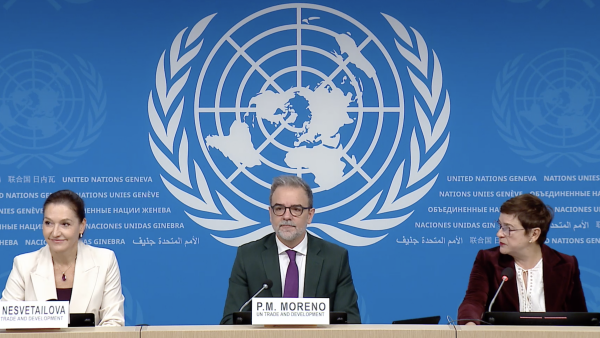
Presentation of the Trade and Developement Report 2026
Embargoed until 9 October 2026 at 11 a.m. (Geneva Time)
UNCTAD: UNCTAD’s flagship report finds that governments increasingly use industrial, trade, financial and technology policies to pursue economic and national security objectives. Market access and the ability to move into higher-value activities now depend more heavily on technology, finance and geopolitics.