

The United Nations Office at Geneva
Multimedia Newsroom
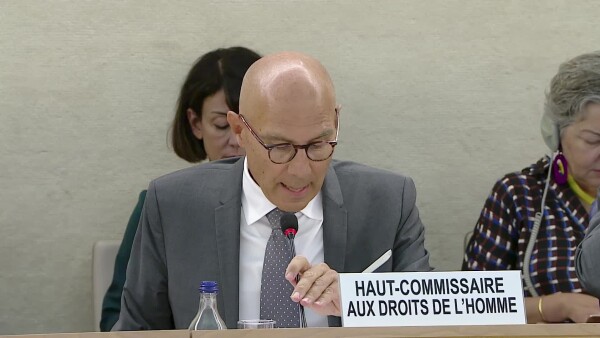
« Me entristece profundamente el continuo y generalizado deterioro de los derechos humanos en Nicaragua. Castigar y encerrar a quienes expresan sus opiniones, e intensificar aún más el aislamiento del país, son políticas que no sirven a los intereses del pueblo nicaragüense, ni siquiera de las autoridades », UN Human Rights Chief Volker Türk told the Human Rights Council today. (“I am deeply saddened by the continued and widespread deterioration of human rights in Nicaragua. Punishing and locking out those who voice their views, and further intensifying the country's isolation, are policies that do not serve the interests of the Nicaraguan people – or even the authorities,”)
“Since our report to the Council a year ago, individuals perceived as opponents or critics of the Government have continued to be persecuted, and subjected to measures that violate their human rights. These include long prison sentences handed down without trial, in the context of a justice system that lacks any independence; and the deportation, arbitrary deprivation of nationality and prohibition of Nicaraguans from returning to their own country,” he added.
As detailed in the report, the Nicaraguan government continues to impose severe restrictions on the civic and democratic space, closing down its people's individual and collective freedoms. It has also extended its control over civil society organizations, international NGOs, universities, and the media.
Poverty is high, but appears to be decreasing, from 14.2% in 2021 to 13.3% in 2022 according to the Government's figures.
Perceived critics of the authorities, and their relatives, are routinely harassed, persecuted and jailed. In February alone, 316 Nicaraguans perceived to oppose the Government were arbitrarily deprived of their nationality, their assets, and all civil and political rights. They included human rights defenders, journalists, activists, and social and political leaders – all of them, together with their families, forced to reinvent their lives from scratch in distant countries.
“Given the large number of people affected by this all-encompassing form of punishment, many people now say that they are frightened to leave the country, even briefly, for fear that they will be stripped forever of their right to return,” he said.
The report describes how organised civic activism and the defence of human rights have become almost impossible. Since August 2022, the legal status of 2020 civil society organizations has been cancelled, for a total of 3,394 organizations since 2018. In other words, almost half the civil society groups in Nicaragua have been closed down – and many others have been chilled into self-censorship. Twelve universities have also been closed over the past year. One, the Central American University was termed a "centre of terrorism to organize criminal groups." Closure of these universities, and the confiscation of some schools run by various Catholic congregations, limits access to the right to education and freedom of information, with damaging impact on freedom of expression and academic freedom.
“My Office also continues to document violations of freedom of religion and belief – mainly, but not exclusively, directed against the Roman Catholic church. They include coercive and arbitrary criminal and administrative sanctions, harassment, and detentions of both priests and worshippers,” Türk said.
To date, 71 people remain arbitrarily detained in Nicaragua, having been tried and sentenced without due process guarantees. One, Bishop Roland Alvarez was sentenced to 26 years in prison without any trial at all. We have also documented the incommunicado detention of numerous individuals for up to 18 months.
The report before you also documents patterns of torture. In July – after the reporting period ended – we documented a further seven cases of severe torture of detainees, including the use of electricity and the sexual abuse and rape of men. Women and girls are subjected to forced nudity, and humiliating and unnecessary genital searches, including prior to visits with detainees.
“Given this context, the expulsion from the country of all international bodies mandated to monitor detention conditions is alarming. It places people who are deprived of their liberty in a situation of extreme vulnerability. I call on the authorities to accept the return of independent and impartial international detention monitors; to eradicate torture and ill-treatment; and to reinstate due process guarantees and the rule of law,” he said.
Other issues of deep concern are the sharp and continued rise in violence in Indigenous and Afro-descendant territories over the past year. These murders and violent attacks, including the deliberate burning of homes and theft of land and assets, are conducted with impunity.
“I am also concerned by the high numbers of child marriages and teen pregnancies in Nicaragua, and by the country's total ban on abortion, which jeopardizes sexual and reproductive health, leading to unsafe abortions and the deaths of women and girls,” Türk said.
The Government's constant, unpredictable and arbitrary acts of persecution drive many people to flee. Between September 2022 and July 2023, 45,866 Nicaraguans applied for asylum in Costa Rica alone.
The High Commissioner urged the Government to demonstrate its service to its people by empowering them to meet, speak out and participate freely and fully in decisions. I appeal for the release of all people arbitrarily detained, as well as for the restoration, without discrimination, of the rights of individuals deprived of their nationality, as guaranteed in international instruments ratified by the State of Nicaragua.
ENDS
For more information and media requests, please contact:
In Geneva
Ravina Shamdasani - + 41 22 917 9169 / ravina.shamdasani@un.org or
Liz Throssell + 41 22 917 9296 / elizabeth.throssell@un.org or
Marta Hurtado - + 41 22 917 9466 / marta.hurtadogomez@un.org
Tag and share
Twitter @UNHumanRights
Facebook unitednationshumanrights
Instagram @unitednationshumanrights
STORY: 2023-09-12 "Continued and widespread deterioration of human rights in Nicaragua" Volker Türk at the 54th HRC
TRT: 02:59
SOURCE: UNTV / OHCHR
RESTRICTIONS: NONE
LANGUAGE: English/NATS
ASPECT RATIO: 16:9
DATELINE: 12-09-2023 GENEVA, SWITZERLAND
SHOTLIST
- Exterior shot: Palais des Nations, Geneva.
- Wide shot: wide shot room 20
- Soundbite (Spanish)— Volker Türk, UN High Commissioner for Human Rights, (OHCHR): «Me entristece profundamente el continuo y generalizado deterioro de los derechos humanos en Nicaragua. Castigar y encerrar a quienes expresan sus opiniones, e intensificar aún más el aislamiento del país, son políticas que no sirven a los intereses del pueblo nicaragüense, ni siquiera de las autoridades».
- Cut away: Room 20
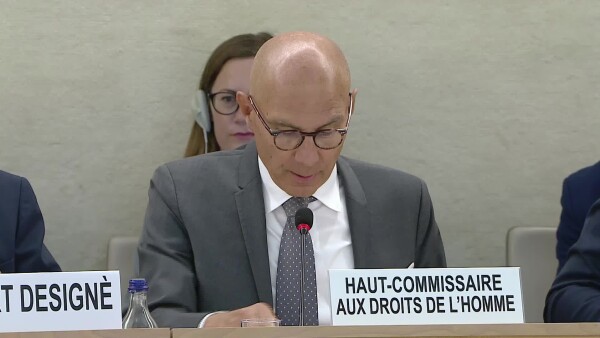
- Soundbite (English)— Volker Türk, UN High Commissioner for Human Rights, (OHCHR): “Since our report to the Council a year ago, individuals perceived as opponents or critics of the Government have continued to be persecuted, and subjected to measures that violate their human rights. These include long prison sentences handed down without trial, in the context of a justice system that lacks any independence; and the deportation, arbitrary deprivation of nationality and prohibition of Nicaraguans from returning to their own country.”
- Cut away: Room 20
- Soundbite (English)— Volker Türk, UN High Commissioner for Human Rights, (OHCHR): “Given the large number of people affected by this all-encompassing form of punishment, many people now say that they are frightened to leave the country, even briefly, for fear that they will be stripped forever of their right to return.”
- Cut away: Room 20
- Soundbite (English)— Volker Türk, UN High Commissioner for Human Rights, (OHCHR): “My Office also continues to document violations of freedom of religion and belief – mainly, but not exclusively, directed against the Roman Catholic church. They include coercive and arbitrary criminal and administrative sanctions, harassment, and detentions of both priests and worshippers.”
- Cut away: Room 20
- Soundbite (English)— Volker Türk, UN High Commissioner for Human Rights, (OHCHR): “Given this context, the expulsion from the country of all international bodies mandated to monitor detention conditions is alarming. It places people who are deprived of their liberty in a situation of extreme vulnerability. I call on the authorities to accept the return of independent and impartial international detention monitors; to eradicate torture and ill-treatment; and to reinstate due process guarantees and the rule of law.”
- Cut away: Room 20
- Soundbite (English)— Volker Türk, UN High Commissioner for Human Rights, (OHCHR): “I am also concerned by the high numbers of child marriages and teen pregnancies in Nicaragua, and by the country's total ban on abortion, which jeopardizes sexual and reproductive health, leading to unsafe abortions and the deaths of women and girls.”
- Cut away: Room 20
Similar Stories

1
1
1
Edited News | OCHA , UNICEF , WFP
Aid agencies warned on Friday of the fast-developing humanitarian emergency inside Taiz City in Yemen, which has been encircled by de facto Houthi forces fighting government troops along the country’s west coast.

2
17
1
2
Edited News , Press Conferences , Images | OCHA , WMO
Two UN agencies teamed up on Wednesday to issue an appeal for immediate assistance to help communities already being impacted by the strongest El Niño on record.

3
16
2
2
Edited News , B-roll , Conferences , Images | UNITED NATIONS , UNOG
Sixth Consultative Meeting on Enhancing Coordination of Peace Initiatives and Efforts for Sudan

1
1
1
Edited News | UNICEF , WHO , UNHCR
Yemen war continues to force families from homes amid hunger and disease
More than 250,000 people have now fled renewed fighting in Yemen, the UN said on Tuesday, citing particular concern for those sheltering in the southwestern city of Taiz and the wider governorate, where access is “essentially blocked”.

1
1
1
Edited News | UNICEF
A little over one year since a ceasefire agreement was announced between Hamas fighters and Israel, more than 340 children have been reported killed and hundreds more injured, the UN Children’s Fund, UNICEF, said on Friday.

1
1
1
Edited News | UNICEF , IFRC
Six weeks after Nepal’s deadly flooding disaster, communities are still struggling to rebuild their lives, but they will need sustained help as global warming increases the risk of another Himalayan catastrophe, the UN Children’s Fund (UNICEF) said on Friday.

1
1
1
Edited News | WHO
In suspected Russia plague death, testing and monitoring underway – WHO
The death of a lab worker in Russia’s Siberia region has sparked concerns about plague being the cause, the UN World Health Organization (WHO) said on Tuesday, adding that it was following the situation closely.

1
1
Edited News | OHCHR , UNOG
UN Human Rights Chief Volker Türk on Friday provided and oral update to the 63rd session of the Human rights Council on Ukraine.

1
1
1
Edited News | OHCHR , UNOG
UN Human Rights Chief Volker Türk on Friday provided and oral update to the 63rd session of the Human rights Council on the human rights situation in Haiti.

1
1
1
Edited News | WHO
Repeated delays in bringing lifesaving medicines, prosthetics and more from Israel into Gaza risk having devastating consequences on Palestinians who urgently need them in the wartorn enclave, the UN World Health Organization (WHO) said on Friday. “A truck full of non-priority supplies or the right supplies arriving too late, doesn't save lives. That's the question that actually matters," said Dr Reinhilde Van De Weerdt, WHO Representative in the OPT.

1
1
1
Edited News | WHO
DRC: Early access to care and oxygen decisive for Ebola patients’ survival – WHO
In the Democratic Republic of the Congo (DRC), health workers fighting the country’s largest-ever Ebola outbreak are struggling to overcome critical challenges to patient care, the UN World Health Organization (WHO) warned on Tuesday.

1
1
1
Edited News | OCHA , UN
Civilians in Iran are continuing to feel the consequences of months of conflict and military escalation, the UN’s top official in the country has said, as loss of life, damage to civilian infrastructure and mounting economic pressures leave many facing continued uncertainty.