

The United Nations Office at Geneva
Multimedia Newsroom
Edited News | IOM , UNICEF , WFP , WHO
Bi-Weekly Press Briefing: Update Turkiye/Syria earthquakes - WFP/UNICEF/IOM/WHO
UN humanitarian agencies on Tuesday welcomed the news that two more border crossings are to open into northwest Syria from Türkiye, to transport relief supplies for survivors of the earthquake disaster in both countries that have likely claimed tens of thousands of lives.
“We very, very much welcome this announcement that there are additional crossings now to get into northwest Syria from Türkiye,” said Kenn Crossley, WFP Country Director in Syria, after Syrian President Bashar al-Assad agreed to temporarily open the crossing points of Bab Al-Salam and Al Ra’ee for an initial period of three months.
Speaking from Damascus to journalists in Geneva via Zoom, Mr. Crossley insisted that humanitarian access needed reach people “wherever they are from, wherever we can get to them”.
Drawing on the existing partnerships, supply chains and food stocks, WFP began distributing hot-meals and ready to eat food in shelters with local partners within hours from the earthquake.
“Roughly 90,000 people within northwest Syria have been receiving specific food assistance related directly to the impact of the earthquake”, the WFP official said. “They've been also receiving regular assistance through our previous pipeline, another approximately 90,000 people.”
WFP’s logistics cluster is working with all humanitarian partners to boost aid access through the new entry points into northwest Syria. A WFP convoy of 18 trucks of food assistance, as well as other aid from multiple UN agencies is ready to bring assistance into northwest Syria.
"So, within northwest Syria, where a lot of the attention has been focused, we're confident that we've been able to work with partners to provide enough food for between 150,000 and 180,000 people as of today", said Mr. Crossley.
The International Organization for Migration (IOM) also announced earlier on Tuesday that an 11-truck convoy left the agency’s Gaziantep warehouse bound for about Bab Al-Salam, one of the reopened border crossings.
“In addition, four other trucks have also left from this sprawling IOM warehouse we operate in Gaziantep bound for Bab al-Hawa”, said Paul Dillon, IOM’s spokesperson, in reference to the existing cross-border entry point into largely opposition-held northwest Syria. “We're still waiting on confirmation that these two convoys have crossed.”
Eight days since the devastating earthquakes, the UN Children’s Fund (UNICEF) highlighted that youngsters are still extremely vulnerable in impacted areas: some 4.6 million lived in Türkiye before the disaster and another 2.5 million were known to be in Syria. The number of children killed and injured during the quakes and their aftermath has not yet been confirmed, but is likely to be in the many thousands, said UNICEF spokesperson James Elder.
“This is trauma on top of trauma”, the UNICEF spokesperson said. “I call it what you will compound trauma for these children is unyielding trauma. To give a quick sense of that psychological first aid, we've trained 70 additional trainers in Syria. We've released hundreds of recreational kits which bring basics of stimulation and learning, a little bit of normalcy”.
In both Türkiye and Syria, child protection is a high priority for UNICEF, including the identification and reunification of separated and unaccompanied children. Some of the children have been displaced five or six times.
Reiterating the importance of establishing cross-line movements into northwest Syria, Christian Lindmeier, spokesperson for the World Health Organization (WHO) said that the “the Government has just recently on 12 February given the recent blanket approval for cross-line movements for UN convoys. That's important to say.”. He added: “Again, this is not only from one side, this also needs the receiving side for convoys to be ready and to …receive convoys. This is why this is a constant back-and-forth negotiations. Every party has to agree to receive convoys to let them go unhindered and that is the biggest challenge.”
- Medium shot, UN Geneva flag alley.
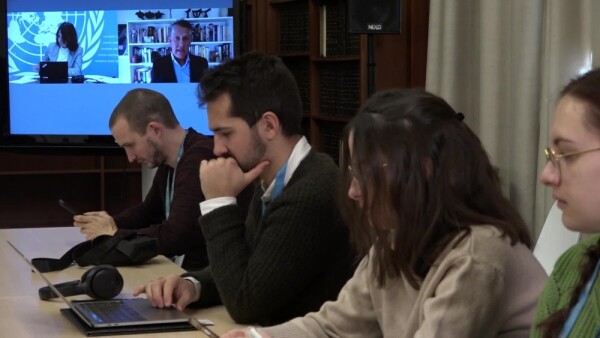
- Wide shot, press room with moderator and screens with speakers.
- SOUNDBITE (ENGLISH) – Kenn Crossley, WFP Country Director in Syria: “We very, very much welcome this announcement that there are additional crossings now to get into northwest Syria from Turkiye. We think it's extremely important that we have all possible humanitarian access to people wherever they are from wherever we can get to them.”
- Medium shot, journalists looking at screen to speaker
- SOUNDBITE (ENGLISH) – Kenn Crossley, WFP Country Director in Syria: “Roughly 90,000 people within northwest Syria have been receiving specific food assistance related directly to the impact of the earthquake. They've been also receiving regular assistance through our previous pipeline, another approximately 90,000 people”.
- Medium shot, background of podium + speaker on screen
- SOUNDBITE (ENGLISH) - Kenn Crossley, WFP Country Director in Syria: “So within northwest Syria, where a lot of the attention has been focused we're confident that we've been able to work with partners to provide enough food for between 150 and 180,000 people as of today”.
- Medium shot, journalists in press briefing room in front of screen with speakers
- SOUNDBITE (ENGLISH) - James Elder, spokesperson for UNICEF: “This is trauma on top of trauma. I call it what you will compound trauma for these children is unyielding trauma. To give a quick sense of that psychological first aid, we've trained 70 additional trainers in Syria. We've released hundreds of recreational kits which bring basics of stimulation and learning, a little bit of normalcy”.
- Wide shot, journalist taking a photo with journalists sitting behind
- SOUNDBITE (ENGLISH) - Paul Dillon, spokesperson for the International Organisation for Migration (IOM): ”In addition, four other trucks have also left from this sprawling IOM warehouse we operate in Gaziantep bound for Bab al-Hawa. We're still waiting on confirmation that these two convoys have crossed”.
- Medium shot, journalist looking at speaker on screen
- SOUNDBITE (ENGLISH) - Christian Lindmeier, spokesperson for the World Health Organization (WHO): “The government has just recently on the 12th of February given the recent blanket approval for cross line movements for U.N. convoys. That's important to say. But again, this is not only from one side. This also needs the receiving side for convoys to be ready and to exceed receive convoys. This is why this is a constant back and forth negotiations. Every party has to agree to receive convoys to let them go unhindered and that is the biggest challenge”.
- Close up, hands typing
- Wide shot, cameraman filming with journalists sitting in the background
- Wide shot, journalists taking notes
Similar Stories

2
17
1
2
Edited News , Press Conferences | OCHA , WMO
Two UN agencies teamed up on Wednesday to issue an appeal for immediate assistance to help communities already being impacted by the strongest El Niño on record.

3
16
2
2
B-roll , Conferences , Edited News | UNITED NATIONS , UNOG
Sixth Consultative Meeting on Enhancing Coordination of Peace Initiatives and Efforts for Sudan

1
1
1
Edited News | UNICEF , WHO , UNHCR
Yemen war continues to force families from homes amid hunger and disease
More than 250,000 people have now fled renewed fighting in Yemen, the UN said on Tuesday, citing particular concern for those sheltering in the southwestern city of Taiz and the wider governorate, where access is “essentially blocked”.

1
1
1
Edited News | UNICEF
A little over one year since a ceasefire agreement was announced between Hamas fighters and Israel, more than 340 children have been reported killed and hundreds more injured, the UN Children’s Fund, UNICEF, said on Friday.

1
1
1
Edited News | UNICEF , IFRC
Six weeks after Nepal’s deadly flooding disaster, communities are still struggling to rebuild their lives, but they will need sustained help as global warming increases the risk of another Himalayan catastrophe, the UN Children’s Fund (UNICEF) said on Friday.

1
1
1
Edited News | WHO
In suspected Russia plague death, testing and monitoring underway – WHO
The death of a lab worker in Russia’s Siberia region has sparked concerns about plague being the cause, the UN World Health Organization (WHO) said on Tuesday, adding that it was following the situation closely.

1
1
Edited News | OHCHR , UNOG
UN Human Rights Chief Volker Türk on Friday provided and oral update to the 63rd session of the Human rights Council on Ukraine.

1
1
1
Edited News | OHCHR , UNOG
UN Human Rights Chief Volker Türk on Friday provided and oral update to the 63rd session of the Human rights Council on the human rights situation in Haiti.

1
1
1
Edited News | WHO
Repeated delays in bringing lifesaving medicines, prosthetics and more from Israel into Gaza risk having devastating consequences on Palestinians who urgently need them in the wartorn enclave, the UN World Health Organization (WHO) said on Friday. “A truck full of non-priority supplies or the right supplies arriving too late, doesn't save lives. That's the question that actually matters," said Dr Reinhilde Van De Weerdt, WHO Representative in the OPT.

1
1
1
Edited News | WHO
DRC: Early access to care and oxygen decisive for Ebola patients’ survival – WHO
In the Democratic Republic of the Congo (DRC), health workers fighting the country’s largest-ever Ebola outbreak are struggling to overcome critical challenges to patient care, the UN World Health Organization (WHO) warned on Tuesday.

1
1
1
Edited News | OCHA , UN
Civilians in Iran are continuing to feel the consequences of months of conflict and military escalation, the UN’s top official in the country has said, as loss of life, damage to civilian infrastructure and mounting economic pressures leave many facing continued uncertainty.
1
1
1
Edited News | WHO , UNICEF
Aid agencies in Yemen highlighted the growing hunger emergency sparked by renewed fighting between Houthi opposition forces and Government troops, after mobile health clinics reported that hundreds of children displaced by the violence are suffering from the most deadly form of malnutrition.