

The United Nations Office at Geneva
Multimedia Newsroom
After a missile attack near the airport in Lviv in western Ukraine early on Friday, UN humanitarians warned that the situation across the country remains dire, following Russia’s invasion of its neighbour on 24 February.
“What happened in Lviv this morning, is nothing new, just as it was in other parts of the country, but it’s a strong reminder that this country is in war and the medical needs are increasing,” said Dr Jarno Habicht, representative of the World Health Organization (WHO) in Ukraine.
Now in its fourth week, the war in Ukraine has seen 44 attacks on health care throughout the country, including on buildings and a warehouse, patients, staff and supply chains, resulting in 12 confirmed deaths, according to WHO data.
Despite the dangers, the UN and its partners have continued to push for humanitarian access.
“On deliveries, we have up to 100 metric tonnes made available for Ukraine,” Dr Habicht said, speaking from Lviv, adding that “at least one-third” had been dispatched to health care facilities, including in the capital Kyiv.
Underscoring the deadly danger to civilians unable to escape Russian bombardment, the UN refugee agency (UNHCR) described the situation in cities such as Mariupol and Sumy as “extremely dire, with residents facing critical and potentially fatal shortages of food, water and medicine”.
That assessment followed the bombing of a theatre in Mariupol on Wednesday, targeted despite clearly visible lettering daubed on the ground outside the building, indicating that “Children” were sheltering inside.
In the country’s eastern regions, or oblasts, needs “are becoming even more urgent”, said UNHCR spokesperson Matthew Saltmarsh. “More than 200,000 people are now without access to water across several localities in Donetsk oblast, while the constant shelling in Luhansk region has destroyed 80 per cent of some localities, leaving 97,800 families without power.”
In Odessa, UNHCR reported that the authorities have appealed for support for general food assistance to cover the needs of 450,000 people in the city, as well as medicine.
“As of 17 March, a permanent consultation point for protection, legal, and social matters is functioning at the Odessa railway station where 600 to 800 individuals transit daily on their way from Mykolaiv to the western oblasts of Ukraine,” the UN agency reported.
According to UNHCR, more than 3.2 million people have now fled Ukraine, and millions more are internally displaced, some of the 13 million hardest-hit by the war.
Those who have left Ukraine have found shelter in Poland, Slovakia, Hungary, Romania, Moldova, Russia and to a much lesser extent, Belarus. Ninety per cent are women and children and 162,000 are third-country nationals.
“They don’t have a plan when they arrive,” said Mr. Saltmarsh. “So many of those in the first phase might have had friends, diaspora networks, contacts, a relative to whom they could go and stay with initially and then make a plan from there. That’s been less the case recently.”
To counter the risk of exploitation of these vulnerable new arrivals, UNHCR and UNICEF have set up safe spaces known as “Blue Dots” in six countries: Czech Republic, Hungary, Moldova, Poland, Romania and Slovakia.
These facilities are “one-stop-shops, and safe spaces which provide a minimum set of
protection services for children, families and others with specific needs, in support of
existing services and government efforts,” UNHCR explained.
Also providing help to victims of the conflict, UN migration agency IOM said that last year it identified and assisted over 1,000 victims of trafficking.
IOM spokesperson Paul Dillon added that a telephone hotline that the agency set up in the last nine days has so far received more than 10,000 phone calls, more than half of which were related to trafficking concerns.
“We’re working with our many partners on the ground to ensure that these protective messages and these efforts that are being made at the border to inform people are then structured in a coherent manner, not just for the people who are coming across the borders, but for border guards and for volunteers working at these border points in reception centres and indeed for IOM staff on the ground.”
With a solid agreement on continued and safe humanitarian access still proving elusive, Jens Laerke from the UN Office for the Coordination of Humanitarian Affairs (OCHA) urged both sides to the armed conflict “to agree with each other a mechanism of the modalities, standard operating procedures into actually minute detail how such safe passages - either for movement of humanitarian supplies, or on the other hand, for evacuation of civilians - how that can be established”.
ends
STORY: Ukraine Crisis Update – WHO, UNHCR, OCHA
TRT: 2 mins 32s
SOURCE: UNTV CH
RESTRICTIONS: NONE
LANGUAGE: ENGLISH
ASPECT RATIO: 16:9
DATELINE: 18 March 2022 GENEVA, SWITZERLAND
SHOTLIST
- Exterior wide shot, UN flag alley UN Geneva.
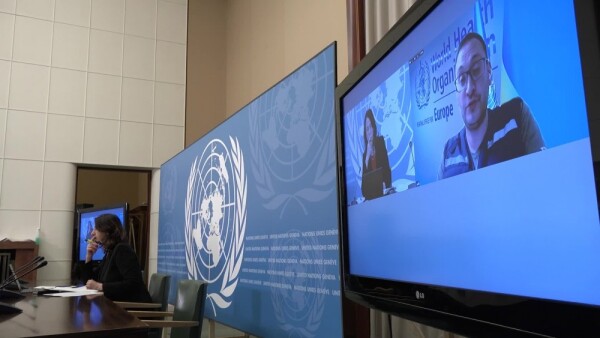
- Wide shot, Press room, UN Geneva, podium speakers and masked participants, seated.
- SOUNDBITE (ENGLISH), Dr Jarno Habicht, representative of the World Health Organization (WHO) in Ukraine, via Zoom from Lviv: “What happened in Lviv this morning, is nothing new, just as it was in other parts of the country, but it’s a strong reminder that this country is in war and the medical needs are increasing.”
- Close-up, TV screen showing speakers in foreground, TV lighting and masked participant wearing headphones to rear.
- SOUNDBITE (ENGLISH), Dr Jarno Habicht, representative of the World Health Organization (WHO) in Ukraine, via Zoom from Lviv: “On deliveries, we have up to 100 metric tonnes made available for Ukraine. From there, at least one-third is already on their way to the health care facilities, as well as some of them in the facilities available as in Kyiv.”
- Medium shot, journalists following proceedings.
- SOUNDBITE (ENGLISH): Matthew Saltmarsh, spokesperson, United Nations High Commissioner for Refugees (UNHCR): “The humanitarian situation in cities such as Mariupol and Sumy is extremely dire, with residents facing critical and potentially fatal shortages of food, water and medicine.”
- Medium shot, TV screen showing Dr Habicht in foreground with podium speaker to rear.
- SOUNDBITE (ENGLISH): Matthew Saltmarsh, spokesperson, United Nations High Commissioner for Refugees (UNHCR): “The humanitarian needs within the country and particularly in the east are becoming even more urgent. More than 200,000 people are now without access to water across several localities in Donetsk oblast, while the constant shelling in Luhansk region has destroyed 80 per cent of some localities, leaving 97,800 families without power.”
- Wide shot, UN Geneva press room.
- SOUNDBITE (ENGLISH): Matthew Saltmarsh, spokesperson, United Nations High Commissioner for Refugees (UNHCR): “They don’t have a plan when they arrive, so many of those in the first phase might have had friends, diaspora networks, contacts, a relative to whom they could go and stay with initially and then make a plan from there. That’s been less the case recently.”
- Medium shot, masked participants following the press conference.
- SOUNDBITE (ENGLISH): Jens Laerke, UN Office for the Coordination of Humanitarian Affairs (OCHA): “We need these two sides of the armed conflict to agree with each other a mechanism of the modalities, standard operating procedures into actually minute detail how such safe passages - either for movement of humanitarian supplies, or on the other hand, for evacuation of civilians - how that can be established.”
- Medium shot, photographer crouches to take a photo of podium speakers.
- Medium shot, TV screen showing participants and TV lighting panel to rear.
- Medium shot, masked participant with headphones.
Similar Stories

1
1
1
Edited News | OCHA , UNICEF , WFP
Aid agencies warned on Friday of the fast-developing humanitarian emergency inside Taiz City in Yemen, which has been encircled by de facto Houthi forces fighting government troops along the country’s west coast.

2
17
1
2
Edited News , Press Conferences , Images | OCHA , WMO
Two UN agencies teamed up on Wednesday to issue an appeal for immediate assistance to help communities already being impacted by the strongest El Niño on record.

3
16
2
2
Edited News , B-roll , Conferences , Images | UNITED NATIONS , UNOG
Sixth Consultative Meeting on Enhancing Coordination of Peace Initiatives and Efforts for Sudan

1
1
1
Edited News | UNICEF , WHO , UNHCR
Yemen war continues to force families from homes amid hunger and disease
More than 250,000 people have now fled renewed fighting in Yemen, the UN said on Tuesday, citing particular concern for those sheltering in the southwestern city of Taiz and the wider governorate, where access is “essentially blocked”.

1
1
1
Edited News | UNICEF
A little over one year since a ceasefire agreement was announced between Hamas fighters and Israel, more than 340 children have been reported killed and hundreds more injured, the UN Children’s Fund, UNICEF, said on Friday.

1
1
1
Edited News | UNICEF , IFRC
Six weeks after Nepal’s deadly flooding disaster, communities are still struggling to rebuild their lives, but they will need sustained help as global warming increases the risk of another Himalayan catastrophe, the UN Children’s Fund (UNICEF) said on Friday.

1
1
1
Edited News | WHO
In suspected Russia plague death, testing and monitoring underway – WHO
The death of a lab worker in Russia’s Siberia region has sparked concerns about plague being the cause, the UN World Health Organization (WHO) said on Tuesday, adding that it was following the situation closely.

1
1
Edited News | OHCHR , UNOG
UN Human Rights Chief Volker Türk on Friday provided and oral update to the 63rd session of the Human rights Council on Ukraine.

1
1
1
Edited News | OHCHR , UNOG
UN Human Rights Chief Volker Türk on Friday provided and oral update to the 63rd session of the Human rights Council on the human rights situation in Haiti.

1
1
1
Edited News | WHO
Repeated delays in bringing lifesaving medicines, prosthetics and more from Israel into Gaza risk having devastating consequences on Palestinians who urgently need them in the wartorn enclave, the UN World Health Organization (WHO) said on Friday. “A truck full of non-priority supplies or the right supplies arriving too late, doesn't save lives. That's the question that actually matters," said Dr Reinhilde Van De Weerdt, WHO Representative in the OPT.

1
1
1
Edited News | WHO
DRC: Early access to care and oxygen decisive for Ebola patients’ survival – WHO
In the Democratic Republic of the Congo (DRC), health workers fighting the country’s largest-ever Ebola outbreak are struggling to overcome critical challenges to patient care, the UN World Health Organization (WHO) warned on Tuesday.

1
1
1
Edited News | OCHA , UN
Civilians in Iran are continuing to feel the consequences of months of conflict and military escalation, the UN’s top official in the country has said, as loss of life, damage to civilian infrastructure and mounting economic pressures leave many facing continued uncertainty.