

The United Nations Office at Geneva
Multimedia Newsroom
Scale of violence in eastern part of DRC has continued to worsen”, UN Human Rights chief
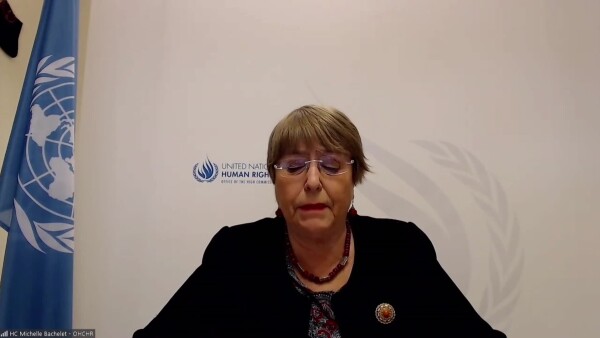
A shocking number of civilians – some three thousand -- were killed in the eastern part of the Democratic Republic of Congo (DRC) last year, UN High Commissioner Michelle Bachelet told the Human Rights Council in Geneva today.
The number of violent deaths verified by the United Nations was “at least 2,945”, and was only one indicator in the 21 per cent increase in documented human rights violations since 2019, according to figures published by the Office of the High Commissioner for Human Rights.
“The scale of the violence in the east of the DRC is alarming”, Ms. Bachelet told the UN Human Rights Council in Geneva, Switzerland.
“In 2020, the Office verified the killing of at least 2,945 civilians, including 553 women and 286 children. During 2020, 21 per cent more human rights violations were documented than in 2019,” Ms. Bachelet said.
”Violations were committed by a range of armed groups, operating in vast areas where there is little or no presence of Congolese authorities, as well as by the Congolese military and police force,” she added.
Over the last 12 months, the United Nations Joint Human Rights Office has issued five public reports on the deteriorating situation in DRC.
One recent report focused on the eastern province of Ituri and verified the killing of 647 civilians in intercommunal violence between May and December of last year. One culprit, experts say, has been the increase in hate speech.
“Given this context of escalating bloodshed, and the country's history of intercommunal violence, I am deeply concerned that the current widespread increase in hate speech could further inflame conflict”, Ms Bachelet said. “From May to December 2020, our Office documented hate speech and messages inciting hatred in 15 provinces, as we reported two weeks ago in a public report,” Ms Bachelet added.
In an update on a study of the area targeted by the Allied Democratic Forces (ADF) in the eastern DRC province of North Kivu, 468 civilians were reported killed between July and December 2020. The ADF were also responsible for at least 457 enforced disappearances last year.
Bintou Keita, the recently-nominated Special Representative of the Secretary-General and Head of the United Nations Stabilisation Mission in the Democratic Republic of the Congo (MONUSCO), noted that in recent months the situation in the Democratic Republic of the Congo (DRC) had been marked by political upheavals leading to major changes within the institutions of the country.
“I have just returned from a first visit of several days to Goma, Bukavu, Beni and Bunia, where I had direct exchanges with military and civilian authorities and members of civil society on the worrying deterioration of the security, humanitarian and human rights situation in the provinces affected by the armed conflict, where MONUSCO has documented a worrying increase in attacks by armed groups against the civilian population, in particular in the provinces of Ituri, North Kivu and South Kivu,” Ms Keita said.
Violence has plagued the eastern part of DRC for many years, but in 2020, fighting spread and intensified with the involvement of a several armed groups. In North Kivu and southern Ituri, military operations by the Government forces were followed by retaliatory attacks on civilians by the ADF that resulted in hundreds of deaths, abductions of children and the destruction of schools and hospitals. In South Kivu, dozens of civilians were killed, and a number of women and children raped by armed groups in intercommunal conflicts.
“In addition to strengthening the fight against impunity, a credible and holistic transitional justice process, a credible demobilisation programme, disarmament, community reintegration and stabilisation programme, and the adoption of socio-economic policies are essential to curb the violence and build lasting peace and security, ” MONUSCO’s chief Bintou Keita said.
Investigations into the violence in eastern DRC have to date failed in bringing accountability and justice for the summary executions of two United Nations investigators, Zaida Catalán and Michael Sharp, along with their Congolese interpreter Betu Tshintela, killed in 2017 while documenting rights abuses in the Kasai region.
Only last month, on February 23, world attention focused briefly on violence in eastern DRC as the Italian ambassador to the country, Luca Attanasio, his bodyguard Vittorio Iacovacci and their driver Mustapha Milambo were killed in the North Kivu region.
- Exterior wide shot, Palais des Nations flag alley, nations’ flags flying, a cloudy day.
- Wide shot, Assembly Hall in line with COVID-19 distancing measures, Palais des Nations.
- SOUNDBITE (English) — UN High Commissioner for Human Rights, Michelle Bachelet: “The scale of the violence in the east of the DRC is alarming. In 2020, the Office verified the killing of at least 2,945 civilians, including 553 women and 286 children. During 2020, 21 per cent more human rights violations were documented than in 2019. Violations were committed by a range of armed groups, operating in vast areas where there is little or no presence of Congolese authorities, as well as by the Congolese military and police force”.
- Medium shot, Vice-President of Human Rights Council
- SOUNDBITE (English) — UN High Commissioner for Human Rights, Michelle Bachelet: “Given the context of escalating bloodshed, and the country’s history of intercommunal violence, I am deeply concerned that the current widespread increase in hate speech could further inflame conflict. From May to December 2020, our Office documented hate speech and messages inciting hatred in 15 provinces, as we reported two weeks ago in a public report.”
- Medium-wide shot, podium with speakers, Assembly Hall, Palais des Nations.
- SOUNDBITE (French) —Représentante Spéciale du Secrétaire Général et Cheffe de la Mission des Nations Unies pour la stabilisation en République démocratique du Congo (MONUSCO), Bintou Keita: “Je reviens d’une première visite de plusieurs jours à Goma, Bukavu, Beni et Bunia où j’ai eu des échanges directs avec les autorités militaires et civils, les membres de la société civile sur la détérioration préoccupante de la situation sécuritaire, humanitaire et des droits de l’homme dans les provinces affectées par le conflit armé, où la MONUSCO a documenté une augmentation inquiétante des attaques des groupes armés contre la population civile, en particulier dans les provinces de l’Ituri, du Nord-Kivu et du Sud-Kivu ».
“I have just returned from a first visit of several days to Goma, Bukavu, Beni and Bunia, where I had direct exchanges with military and civilian authorities and members of civil society on the worrying deterioration of the security, humanitarian and human rights situation in the provinces affected by the armed conflict, where MONUSCO has documented a worrying increase in attacks by armed groups against the civilian population, in particular in the provinces of Ituri, North Kivu and South Kivu”.
8. Medium-wide shot, podium with speakers, Assembly Hall, Palais des Nations.
9. SOUNDBITE (French) —Représentante Spéciale du Secrétaire Général et Cheffe de la Mission des Nations Unies pour la stabilisation en République démocratique du Congo (MONUSCO), Bintou Keita: « Outre le renforcement de la lutte contre l’impunité, la mise en place d’un processus de justice transitionnelle crédible et holistique, d’un programme crédible de démobilisation, désarmement, réintégration communautaire et la stabilisation, ainsi que l’adoption de politiques socio-économiques, sont essentielles pour infléchir les violences et bâtir une paix et une sécurité durables.”
“In addition to strengthening the fight against impunity, a credible and holistic transitional justice process, a credible demobilisation programme, disarmament, community reintegration and stabilisation programme, and the adoption of socio-economic policies are essential to curb the violence and build lasting peace and security.”
10. Medium shot, podium with speakers, Assembly Hall, Palais des Nations
Similar Stories

1
1
1
Edited News | UNICEF
A little over one year since a ceasefire agreement was announced between Hamas fighters and Israel, more than 340 children have been reported killed and hundreds more injured, the UN Children’s Fund, UNICEF, said on Friday.

1
1
1
Edited News | UNICEF , IFRC
Six weeks after Nepal’s deadly flooding disaster, communities are still struggling to rebuild their lives, but they will need sustained help as global warming increases the risk of another Himalayan catastrophe, the UN Children’s Fund (UNICEF) said on Friday.

1
1
1
Edited News | WHO
In suspected Russia plague death, testing and monitoring underway – WHO
The death of a lab worker in Russia’s Siberia region has sparked concerns about plague being the cause, the UN World Health Organization (WHO) said on Tuesday, adding that it was following the situation closely.

1
1
Edited News | OHCHR , UNOG
UN Human Rights Chief Volker Türk on Friday provided and oral update to the 63rd session of the Human rights Council on Ukraine.

1
1
1
Edited News | OHCHR , UNOG
UN Human Rights Chief Volker Türk on Friday provided and oral update to the 63rd session of the Human rights Council on the human rights situation in Haiti.

1
1
1
Edited News | WHO
Repeated delays in bringing lifesaving medicines, prosthetics and more from Israel into Gaza risk having devastating consequences on Palestinians who urgently need them in the wartorn enclave, the UN World Health Organization (WHO) said on Friday. “A truck full of non-priority supplies or the right supplies arriving too late, doesn't save lives. That's the question that actually matters," said Dr Reinhilde Van De Weerdt, WHO Representative in the OPT.

1
1
1
Edited News | WHO
DRC: Early access to care and oxygen decisive for Ebola patients’ survival – WHO
In the Democratic Republic of the Congo (DRC), health workers fighting the country’s largest-ever Ebola outbreak are struggling to overcome critical challenges to patient care, the UN World Health Organization (WHO) warned on Tuesday.

1
1
1
Edited News | OCHA , UN
Civilians in Iran are continuing to feel the consequences of months of conflict and military escalation, the UN’s top official in the country has said, as loss of life, damage to civilian infrastructure and mounting economic pressures leave many facing continued uncertainty.
1
1
1
Edited News | WHO , UNICEF
Aid agencies in Yemen highlighted the growing hunger emergency sparked by renewed fighting between Houthi opposition forces and Government troops, after mobile health clinics reported that hundreds of children displaced by the violence are suffering from the most deadly form of malnutrition.
1
1
1
Edited News | UNHCR
Displacement on the rise in Yemen as fighting continues - UNHCR
As hostilities worsen in Yemen, more people have been fleeing their homes, further intensifying the humanitarian crisis within the region, the UN Refugee Agency (UNHCR) warned on Tuesday.
1
1
1
Edited News | IOM , OHCHR , UNFPA , UNOG , UNHCR , WHO
Yemen’s humanitarian crisis growing by the hour amid spike in displacement
Yemenis displaced by renewed fighting have described fleeing for their lives amid shelling and gunfire, aid agencies reported on Friday, while highlighting the dramatic increase in humanitarian needs in the country and in Djibouti, where thousands have sought shelter.
1
1
1
Edited News | OHCHR , UNOG
The UN Human Rights Office issued on Friday a report documenting a shocking pattern of sexual violence amid Russia’s full-scale armed attack on Ukraine.