

The United Nations Office at Geneva
Multimedia Newsroom
Press Conferences | WHO , UNOG , UNITED NATIONS , WIPO , ILO , WMO , ITU
UNOG Bi-weekly press briefing 1 December 2020
Alessandra Vellucci, Director of the United Nations Information Service, chaired the hybrid briefing, attended by spokespersons and representatives of the Office of the United Nations Special Envoy for Syria, the World Health Organization, the International Drug Purchase Facility - Unitaid, the United Nations Children’s Fund, the International Telecommunication Union, the World Intellectual Property Organization, the Office of the United Nations High Commissioner for Refugees and the World Meteorological Organization.
Office of the United Nations Special Envoy for Syria – Syrian Constitutional Committee
Jennifer Fenton, for the Office of the United Nations Special Envoy for Syria, said Session 4 of the Small Body of the Syrian Constitutional Committee would be meeting until next Friday, 4 December, to discuss the agenda of Session 3, on national foundations and principles. During Session 5, in January 2021, the Small Body would discuss the basic principles of the future constitution. In this regard, the UN Special Envoy for Syria, Geir O. Pedersen, had expressed the hope that “with the relative calm in Syria, it should be possible to focus more deeply on the political process and all the elements of Security Council resolution 2254 (2015)”.
Ms. Fenton added that the Office would make every effort to inform the press of developments in the talks and media opportunities. Answering questions, Ms. Fenton further explained that, in the present COVID-19 situation, the safety and security of the staff and the committee members were the Office’s top priority. The Office would look for availability of members of the Constitutional Committee to address the press later in the week.
Situation in Ethiopia
Babar Baloch, for the Office of the United Nations High Commissioner for Refugees (UNHCR), said that UNHCR had appealed to the federal authorities in Ethiopia for urgent access in order to reach Eritrean refugees in the Tigray region who were in desperate need of humanitarian assistance and services. Concerns were growing by the hour, with the camps having now run out of food supplies. UNHCH was also alarmed at unconfirmed reports of attacks, abductions and forced recruitment at the refugee camps. All parties must ensure that refugees, internally displaced persons, host communities and humanitarian workers were all kept out of harm’s way. UNHCR had also appealed to the Government of Ethiopia to continue to fulfill its responsibility in protecting Eritrean refugees.
In Sudan, nearly 46,000 Ethiopian refugees had arrived since the start of November – more than 2,500 since last Friday alone. Over the weekend, UNHCR had launched a humanitarian response plan bringing together 30 humanitarian partners, working together with the government, to provide urgent life-saving assistance to meet the needs of up to 100,000 refugees for the next six months, at a cost of US$147 million.
Answering journalists’ questions, Mr. Baloch explained that Eritrean refugees had been living in four camps in Ethiopia for at least 10 years. Around 96,000 refugees were living in these camps at the time being. When the present conflict started, UNHCR had lost contact with these camps. It was difficult to verify any information coming out of the region itself. These Eritrean refugees must have run out of food supplies since yesterday, according to the Office’s estimates, with other supplies severely curtailed. The lack of access by UNHCR meant that it was impossible to reach refugees and other persons in need.
Alessandra Vellucci, for the United Nations Information Service, added that the Secretary-General had spoken with Prime Minister Abiy of Ethiopia and underlined the need to ensure the protection of civilians, human rights, and access for humanitarian assistance to the affected areas.
New nationality law in Iran
Taking the floor again, Babar Baloch, for the United Nations Refugee Agency (UNHCR), said the Agency welcomed the Government of the Islamic Republic of Iran’s move to give nationality to thousands of children born to Iranian mothers and non-Iranian fathers. According to the Government of Iran, nearly 75,000 children at risk of becoming statelessness were eligible for Iranian citizenship under a new nationality law, which had been amended in 2019 to allow children under 18 years to apply for the identity documents. By allowing Iranian mothers to pass their nationality to their children, the law marked a ground-breaking step towards reducing the gender gap in Iran, where nationality used to be passed on mainly by fathers.
End of hurricane season and climate action
Clare Nullis, for the World Meteorological Organization (WMO), said the Atlantic hurricane season had officially ended yesterday. There were a record breaking 30 named storms and WMO had seen yet more examples of very rapid intensification and very slow-moving hurricanes, which experts say may be linked to climate change.
Also on the topic of climate, Alessandra Vellucci, for the United Nations Information Service, reminded that the Secretary-General would deliver a major address at Columbia University in New York, on the “State of the Planet” on 2 December, at 2:45 p.m. Geneva time (to be streamed live via UN WebTV: http://webtv.un.org). Ms. Nullis said that this address by the Secretary-General would be followed by a press conference in Geneva by Mr. Petteri Taalas, head of the World Meteorological Organization.
Also today, 1 December, at 2 p.m. Geneva time, ASG Selwin Hart, the Secretary-General’s Special Adviser on climate action, would be giving a background briefing to the media on the Secretary-General’s State of the Planet speech as well as the 12 December Climate Ambition Summit. ASG Hart’s briefing was embargoed until the Secretary-General’s speech was delivered.
Ms. Vellucci added that this Climate Ambition Summit on 12 December would be co-hosted by the UN, the UK and France, in partnership with Chile and Italy. The Summit would bring together global climate leaders to ramp up climate ambition and help deliver on the Paris Agreement.
Ms. Vellucci also reminded that the UN Environment Programme would issue its annual Emissions Gap Report on 9 December; and that the United Nations Development Programme (UNDP) would hold a press conference on 8 December to present the latest figures from the UNDP Climate Promise, covering 114 countries national determined contributions (NDCs).
1 December, World AIDS Day
Alessandra Vellucci, for the United Nations Information Service (UNIS), said that in a video message released on the occasion of World AIDS Days, the Secretary-General had said that wealth should not determine whether people got the health care they need. “Health is a human right. Health must be a top investment priority to achieve universal health coverage. On this World AIDS Day let us recognize that, to overcome COVID-19 and end AIDS, the world must stand in solidarity and share responsibility”, the Secretary-General had said in his message.
Dr. Meg Doherty, Director of Global HIV, Hepatitis and STIs Programmes at the World Health Organization (WHO), stated that the theme of World AIDS Day in 2020 – “Global solidarity, shared responsibility” – underscored four key messages: renewing the fight against AIDS; using innovation and HIV services to ensure continuity in HIV care; protecting nurses, midwives and healthcare workers; and prioritizing the vulnerable.
Dr. Doherty explained that WHO had conducted a survey of 127 countries regarding the extent of the disruption COVID-19 had caused to the integrated treatment of HIV/AIDS. The survey showed that, through the action of health workers, the number of countries currently reporting a disruption in HIV services had declined since last June. However, new data showed that there were still 26 million people on antiretroviral therapy, indicating that the international community needed “to get back on track to be able to end AIDS as a public health threat by 2030”.
Andrew Seale, also for the World Health Organization, stressed that the activity from the community level had “helped countries to roll out innovative ways of getting treatment to individuals in three- or six-month packs, so that they don’t have to visit health facilities so often”.
Hervé Verhoosel, Head of Communications and Senior Spokesperon for the International Drug Purchase Facility - Unitaid, also speaking for the Clinton Health Access Initiative, announced that a new HIV treatment designed specifically for children would now be available in low-and middle-income countries. This new strawberry-flavoured tablet would be more inviting to children, enabling them to successfully remain on medication and preventing thousands of premature deaths each year. Furthermore, a new price agreement with two generic manufacturers would significantly lower the cost for yearly paediatric HIV treatment from over $480 per child to under $120 per child.
Joint ITU-UNICEF report on children’s access to the Internet
Karen Avanesyan, data analyst and report author at the United Nations Children's Fund (UNICEF), and Martin Schaaper, Senior ICT Analyst at the International Telecommunication Union (ITU), presented a joint ITU-UNICEF report entitled How Many Children and Youth Have Internet Access at Home? (complementing ITU’s own very recent report on Measuring digital development. Facts and figures 2020). The report showed that 72 per cent of households in urban areas had access to the Internet at home, almost twice as much as in rural areas (38 per cent). This gap put almost 1.3 billion school-age children – mostly from low-income countries and rural regions – at risk of missing out on their education because they lacked access to the Internet at home. Even when children had a connection at home, they might not be able to access it because of the pressure to do chores or to work, lack of sufficient devices in the households, girls being permitted less or no Internet access, or a lack of understanding of how to access opportunities online.
Responding to journalists’ questions, Mr. Avanesian said more than 50 per cent of the school age population was connected to the Internet in Latin America. The situation in this region was marked by a rural-urban divide. However, accessibility of Internet at home did not necessarily mean a child benefitted from it. Mr. Schaaper added that, in Sub-Saharan African, the situation was critical, with only 28 per cent of households having access to the Internet in urban areas, and only 6 per cent in rural areas.
World Intellectual Property Indicators Report
Edward Harris, for the World Intellectual Property Organization (WIPO), announced that WIPO would issue a new report on World Intellectual Property Indicators, giving a global overview of patents, trademarks, industrial designs, geographical indications, certain creative industries in 2019 – the most comprehensive overview of its kind anywhere. A virtual launching press conference would take place on Friday, 4 December, at 2 p.m., with Daren Tang, WIPO Director General, and Carsten Fink, WIPO Chief Economist.
New ILO Global Wage Report
Sophy Fisher, for the International Labour Office (ILO), announced that ILO would be presenting tomorrow the latest edition of its Global Wage Report. The report looked at trends in wages over the last four years and examined how wages have been affected in 2020 by the COVID-19 pandemic. It included regional and country data and outlined several policy recommendations to reduce the negative impact on wages of the crisis. The ILO Director-General, Guy Ryder, would present the findings at an embargoed virtual press conference on Wednesday, 2 December, at 11 a.m. Geneva time.
Other Geneva announcements
Alessandra Vellucci, for the UN Information Service (UNIS), informed that the United Nations Office for the Coordination of Humanitarian Affairs (OCHA) had officially presented the Global Humanitarian Overview 2021 in Geneva earlier this morning. The UN Secretary-General had addressed the launch of the Overview via a pre-recorded video message to be watched on UN Web TV. This message had already been sent to journalists.
Ms. Vellucci also announced that, today, 1 December, the Secretary-General’s first biennial report From Promise to Action: The Global Compact for Safe, Orderly and Regular Migration would be launched in Geneva by the Director-General of the International Organization for Migration. A launching event would take place today at 7:30 p.m. Geneva time.
Finally, Ms. Vellucci reminded that 2 December was the International Day for the Abolition of Slavery; and 3 December the International Day of Persons with Disabilities. Messages from the Secretary-General regarding both events had already been sent to journalists.
Similar Stories
1
1
1
Press Conferences | WMO , UNHCR , WHO , ILO
WMO: Greenhouse Gas Bulletin; UNHCR: As attacks intensify UNHCR urges support for war ravaged Ukrainians; WHO: Clinical trials in DRC: vaccines and beyond; ILO: New global and regional estimates on domestic work, informality and working conditions
1
1
1
Press Conferences | UN WOMEN , WFP , WHO
UN WOMEN: Sudan Women and girls one year after the fall of El Fasher; increasing drone attacks across the country; WFP: DRC - Ebola spreads to eighth DRC province as WFP delivers food, builds treatment centres and keeps supplies moving; WHO - Update on Ebola (Bundibugyo Virus Disease)
1
12
1
1
Press Conferences , Images | UNOG
Closing Press Conference following the Sixth Consultative Meeting on Enhancing Coordination of Peace Initiatives and Efforts in Sudan

2
17
1
2
Edited News , Press Conferences , Images | OCHA , WMO
Two UN agencies teamed up on Wednesday to issue an appeal for immediate assistance to help communities already being impacted by the strongest El Niño on record.
1
1
1
Press Conferences | CITES
Wildlife trade and conservation policy discussions at the 81st meeting of the CITES Standing Committee (SC81)
1
1
1
Press Conferences | UNHCR , UNCTAD , WMO , OCHA , UNICEF , WHO
UNHCR Hungary’s 1956 Refugee Crisis: 70 Years On, UNCTAD World Investment Forum 2026, Doha, WMO Greenhouse Gas Bulletin and Climate Update for COP31, OCHA Afghanistan: Malnutrition, Girls’ Education and Recovery, UNICEF Yemen: Child Malnutrition and Unsafe Water in Taiz, WHO Inequalities in Noncommunicable Diseases and Risk Factors

1
1
1
Press Conferences | UNHCR
End of UNHCR's 77th Annual Executive Committee (ExCom) meeting week

1
1
1
Press Conferences | UNICEF , IOM , UNHCR
UN Special Assistant to the Personal Envoy Office (SUDAN): Peace Initiatives and Efforts in Sudan; UNICEF: Dire situation of children in Gaza; IOM: Damaged Homes and Energy Attacks Risk Displacing Ukrainians for this winter; UNHCR: update on EXCOM week

1
1
1
Press Conferences | IOM , UNDRR
UN stresses importance of household preparedness for disaster risk reduction.
1
1
1
Statements , Press Conferences | OHCHR
1
1
1
Press Conferences | UNHCR , UNICEF , IFRC , OHCHR , UN WOMEN , IOM , OCHA , WHO
UNHCR – ExCom Meeting, UNICEF – Nepal Recovery, IFRC – Flash Floods, WHO – Mental Health, IOM – South Sudan Floods, OCHA – DRC Humanitarian aid, UNHCR – Sahel Displacement, UNICEF – Yemen Update, IOM – Gaza Shelter, UN Women – Gaza Women, OHCHR – Arrests and detentions of Syrians by Israeli force
2
1
2
Press Conferences | UNCTAD
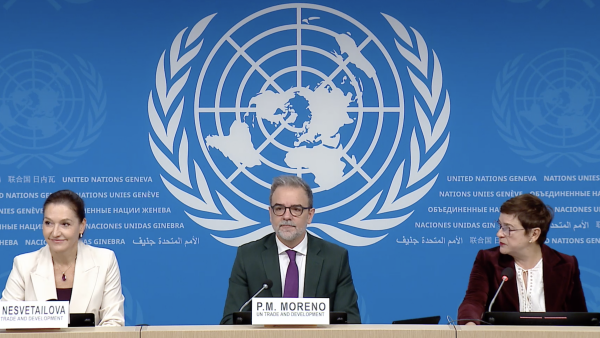
Presentation of the Trade and Developement Report 2026
Embargoed until 9 October 2026 at 11 a.m. (Geneva Time)
UNCTAD: UNCTAD’s flagship report finds that governments increasingly use industrial, trade, financial and technology policies to pursue economic and national security objectives. Market access and the ability to move into higher-value activities now depend more heavily on technology, finance and geopolitics.