

The United Nations Office at Geneva
Multimedia Newsroom
Press Conferences | UNECE , WHO , OCHA , UNHCR , UNICEF
UN Geneva Press Briefing - 30 September 2025
UN GENEVA PRESS BRIEFING
30 September 2025
UN Response to the Earthquake in Afghanistan
Indrika Ratwatte, United Nations Assistance Mission in Afghanistan (UNAMA) Humanitarian Coordinator, speaking from Kabul, said one month after the earthquake which had killed 2000 people, injuring 3600 and damaging 8500 homes, the humanitarian community had delivered to Kunar province, a remote part of Afghanistan, in coordination with the authorities and partners. The challenges were such that many of the families in the more remote villages had to come down to the valleys, creating informal settlements.
Some 3000 families were now being supported. The immediate challenge was preparing for the winter, including providing clothing and heating solutions. Other priorities were food, health, nutrition and psychosocial support to the affected populations. There were also challenges in female colleagues delivering assistance: the UN agencies were underscoring the point to the authorities that this remained quintessential for an effective response.
Regarding the initial response from the international community to earthquake, around 23.7 million USD had been contributed so far out of the 140 million asked. Food had been delivered to over 150,000 individuals.
This remained “a crisis within a crisis”: as of yesterday, almost 2.2 million Afghan refugees and undocumented individuals had returned to Afghanistan; at the same time, other parts of the country were affected by a drought. Furthermore, the UN agencies were informed yesterday that the telecommunications and fiber optic connectivity in Afghanistan would be suspended until further notice. This affected not just the UN and its partners in humanitarian assistance, but also health programs, banking services, financial services and air traffic, as flights could not land in the country. The UN agencies were negotiating to get a waiver from this suspension; in the meantime, they were striving to maintain essential support activities with the communications available.
Arafat Jamal, UN Refugee Agency Representative in Afghanistan, also speaking from Kabul, underscored that a large number of affected persons were doubly hurt: first they had been deported from their places of asylum, then they had suffered an earthquake.
Answering questions from journalists about the consequences of the suspension of communications, Mr. Ratwatte noted that there would be a fallout on critical medical services, supply chains and vaccinations. The running of basic essential services in the country would also be impacted. Even the authorities were having challenges in communicating between themselves, Mr. Ratwatte noted.
Situation in Gaza
Journalists inquired about the UN’s reaction to and involvement in US President Trump’s recently announced plan regarding the conflict in Gaza.
Jens Laerke, for the Office for the Coordination of Humanitarian Affairs (OCHA), noted that the plan was a proposal. In any event, aid was stockpiled in the region and ready to move in; this aid had already been paid for by donors who expected the UN to deliver it to people in need.
Questions were then raised regarding a potential involvement, under President Trump’s plan, of UNWRA to distribute aid. Mr. Laerke said that the United Nations Relief and Works Agency for Palestine Refugees in the Near East was and remained the backbone of aid infrastructure in Gaza and elsewhere.
Ms. Vellucci stressed that as the suffering of the Gaza people continue, we continue to advocate for the immediate end of the hostilities, the return of the hostage and the full access for humanitarian aid.
Regarding questions on the volume of aid and the number of trucks the OCHA was getting into Gaza, Mr. Laerke said the question was, rather, how much it was able to pick up and distribute: there was a constant back and forth toggle between whether the UN got permission to go and pick it up, and then whether it got permissions once it has been picked up to go and deliver it.
Ricardo Pires, for the United Nations Children’s Fund (UNICEF), added the Fund had some 11,000 tents not being allowed in, as well as other items that would support sheltering displaced families in the south. It was important to obtain a ceasefire so that aid could flow in, not only to prevent the famine that was moving to the south, but also to make sure that children and families had shelter before the onset of winter. Ms. Vellucci said that between mid-August and the end of last week, some 453,000 displacements had been recorded across the Gaza Strip, the majority originating from Gaza City.
Answering other questions on the political aspect of the situation, Ms. Vellucci reminded that the UN had constantly been involved in the peace process in the Middle East, and had been speaking to all the mediators as well everyone that can do something to end the suffering of the Palestinian people. She recalled the two-State solution that was discussed at the recent conference at UN Headquarters and that remained the only viable way forward. She also recalled yesterday’s briefing of the Deputy Special Coordinator for the Middle East Peace Process to the Security Council.
Announcements
Thomas Croll-Knight, for the United Nations Economic Commission for Europe (UNECE), said coming up next week would be the 5th UN Forum of Mayors (6-7 October, Tempus) preceding the Ministerial Meeting on Housing Affordability and Sustainability (8-10 October, Tempus). Under the theme Cities Shaping the Future, the Forum of Mayors would stress the crucial role of cities and local actors for sustainable development. The Forum would engage directly with the Ministerial meeting, as part of the 86th Session of the UNECE Committee on Sustainable Development, Housing and Land Management.
The Forum would be chaired by City Leader of Glasgow Council (United Kingdom), with Vice-Chairpersons the mayors of Novo Mesto (Slovenia) and Heidelberg (Germany), and the deputy mayor of Geneva (Switzerland). The keynote addresses would be delivered by the mayor of Paris, Anne Hidalgo, and Ruth Dreifuss, former President of Switzerland and the spokesperson of the 5th Forum of Mayors.
Tarik Jašarević, for the World Healh Organization (WHO), announced the release, today, of two reports on antibacterial agents. The first report was an analysis of antibacterial agents in clinical and clinical development, assessing whether current research and development efforts were keeping pace with the urgent need for new treatments against the most dangerous drug-resistant bacteria; the second report was an overview of commercially available diagnostics for bacterial priority pathogens. The WHO expert was ready to take interviews; the reports could be received under embargo. On another topic, the WHO Strategic Advisory Group of Experts on Immunization (Sage) would hold its press conference after the regular meeting today at 4:00 p.m.
Ms. Vellucci, on behalf of Office of the High Commissioner on Human Rights (UNHCHR), announced that on Thursday, 2 October, at 1:30 p.m., Yao Agbetse, Independent Expert on the Human Rights situation in the Central African Republic, would hold a press conference.
The Committee on Enforced Disappearances would close its 29th session also on 2 October. It would then issue its concluding observations on the three countries reviewed during the session: Montenegro, Benin and Sri Lanka
Finally, Ms. Vellucci reminded that a high-level Conference on the Situation of Rohingya Muslims and Other Minorities in Myanmar was taking take place today in New York. Its objective was – among others – to propose a concrete plan for a sustainable resolution of the crisis, including efforts to create a conducive environment for the voluntary and dignified return of Rohingya Muslims and other members of the minority group to Myanmar. The conference would be webcast by UNTV.
***
- WHO - Tarik Jašarević: Release of two reports on antibacterial agents in clinical and preclinical development
Similar Stories
1
1
1
Press Conferences | IOM , ITU , UNECE , UNICEF , WHO , WMO
UNICEF: Ebola, DRC - children orphans or separating them from parents and caregivers; IOM: Humanitarian needs in Djibouti amid arrivals from Yemen and increased migrant movements; WHO: Darfur, scale of health needs far exceeds available resources; WMO co-sponsored Global Heat Forum, Bangkok, monthly Global Seasonal Climate Update; UNECE: UN Forum of Mayors; ITU Plenipotentiary Conference 2026; WHO: child and adolescent obesity guidelines and new global roadmap to tackle pregnancy hypertension, a leading cause of maternal mortality
1
1
1
Press Conferences | OCHA , UN WOMEN , UNHCR , WFP , WHO , WTO , UNEP
OCHA – $160M CERF allocation to 12 underfunded crises; UNHCR – 5.8M refugee children remain out of school amid funding cuts; UN Women – Middle East escalation and food security among women/girls; WHO – Gaza supplies and overall situation; WFP – Yemen food insecurity and impact on global hunger ; UNEP - First International Conference of the Global Framework on Chemicals in Geneva | 16-20 November 2026
1
1
1
Press Conferences | UNHCR , WHO
Yemen's health system nears collapse amid conflict, causing rising casualties and medicine shortages.
1
1
1
Press Conferences | HRC
Update by the Expert Mechanism to Advance Racial Justice and Equality in Law Enforcement
1
1
1
Press Conferences | WIPO , WHO , UNICEF , UNHCR , IOM , WFP , FAO
WIPO Global Innovation Index 2026 launch and press conference, WHO Composition of influenza vaccines for the 2027 Southern Hemisphere flu season, UNICEF Yemen hunger and malnutrition; UNHCR Sudan displacement into Chad; IOM Ebola and population movements in DRC; WFP emergency food assistance in Nepal; and FAO food loss and waste.
2
1
2
Press Conferences | UNCTAD
Gaza reconstruction needs reach $71.5 billion as Palestinian economy and public finances face severe strain. Latest UNCTAD report documents the loss of decades of development gains, economic collapse in Gaza and tightening economic constraints in the West Bank.
The report identifies three immediate priorities: transferring withheld Palestinian revenues, safeguarding the banking system and aligning reconstruction support with the documented scale of damage and economic losses.
1
1
1
Press Conferences | HRC
Press conference on the situation of human rights in Nicaragua by the UN Group of Human Rights Experts
1
1
1
Press Conferences | ITU , UNHCR , WHO , WMO
YEMEN - UNHCR: Escalating conflict in Yemen could fuel more displacement, refugee movement
CLIMATE - WHO / WMO: Health and Climate impact of El Niño
1
1
1
Press Conferences | HRC , OHCHR
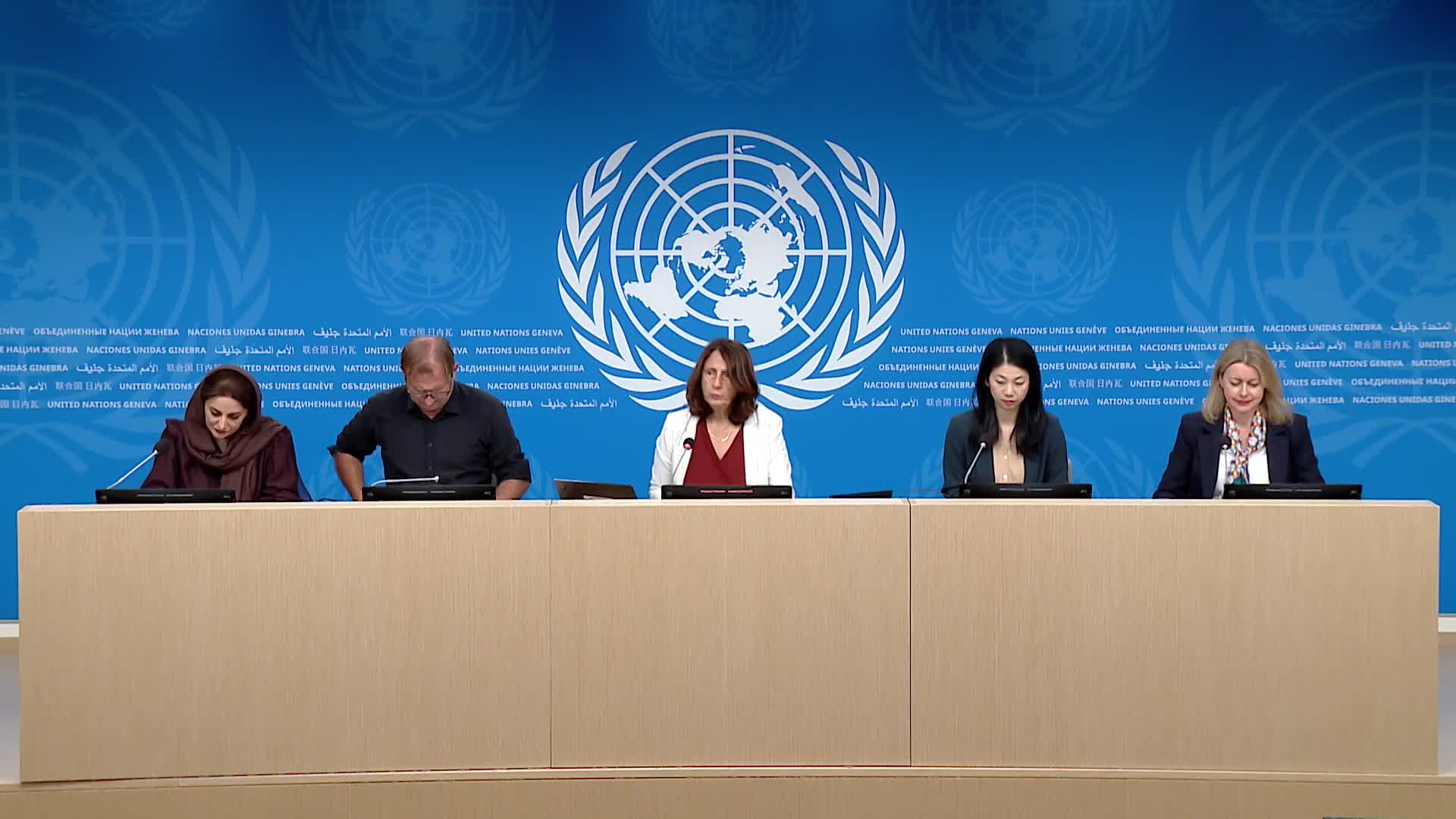
Mariana Katzarova discusses human rights in Russia as a UN Special Rapporteur.
1
1
1
Press Conferences | IOM , OHCHR , UN WOMEN , UNFPA , UNHCR , UNOPS , WHO
UN Geneva briefing: Yemen crisis worsens, urgent aid needed across multiple sectors.
1
1
1
Press Conferences | HRC
Press conference on the latest report of the Independent International Fact-Finding Mission on the Bolivarian Republic of Venezuela to the UN Human Rights Council
1
1
1
Press Conferences | OHCHR
Victims Still Waiting: A Global Briefing on Transitional Justice Around the World