

The United Nations Office at Geneva
Multimedia Newsroom
Press Conferences | WHO , WMO , OCHA , UNHCR , OHCHR , UNDRR
UN Geneva Press Briefing - 23 May 2025
23 May 2025
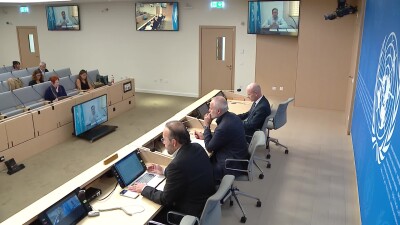
Michele Zaccheo, Chief, UNTV, Radio and Webcast Section, United Nations Information Service (UNIS) in Geneva, chaired the hybrid briefing, which was attended by spokespersons and representatives from the United Nations Office for the Coordination of Humanitarian Affairs, the World Health Organization, the Office of the United Nations High Commissioner for Human Rights, the United Nations High Commissioner for Refugees, and the United Nations Office for Disaster Risk Reduction.
UN Humanitarian Activities in Syria
Edem Wosornu, Director of Operations and Advocacy Division, United Nations Office for the Coordination of Humanitarian Affairs (OCHA), said she was currently finishing a mission in Syria, along with Altaf Musani of the World Health Organization. She had visited Damascus, Homs, Aleppo and Latakia, where she said she could feel the momentum for change. The people of Syria needed to be collectively supported in this moment. This needed to be done in close concert with the “humanitarian reset” announced by the UN Emergency Relief Coordinator, Under-Secretary-General Tom Fletcher, which put local response at the centre, empowered in-country leadership, and pushed for common services.
Syria continued to grapple with staggering needs, with 16.5 million people in need of humanitarian assistance and protection. Population movements and renewed displacement continued. While the level of hostilities had subsided, localised tensions and clashes made protection risks a major, and growing, concern.
During her visit to Latakia, Ms. Wosornu said she was confronted by the realities of worsening violence. The people she spoke with had experienced unimaginable loss, and yet some feared even worse was still to come. Their first and most important ask was security.
There was also an encouraging trend of returns since December, with over one million internally displaced people who had returned to their areas of origin and over half a million refugees returning from neighbouring countries, according to UNHCR’s latest figures. Insecurity, damaged homes, inadequate services, lack of livelihood opportunities and the threat of unexploded ordnance remained key barriers to return.
Humanitarian operations were continuing with the funding available. If OCHA had more, it could do more. The UN and partners were reaching an average of 2.4 million people each month through in-country and cross-border operations.
The people of Syria needed recovery, restoration of basic services and livelihoods. In this regard, OCHA hoped the United States’ announcement to lift sanctions on Syria, as well as the European Union’s recent decision to lift its economic sanctions, could facilitate relief, recovery and development. Ms. Wosornu said she was glad to witness the ongoing progress on the transition to a new unified and inclusive humanitarian coordination structure led by need. Colleagues in Syria would continue discussions on this structure in close concert with the interim authorities and looked forward to progress in this regard.
Ms. Wosornu concluded by reiterating the key asks for the authorities and the international community she heard from women she spoke with in a village in rural Aleppo. They said they needed recovery and reconstruction, basic services, and a return to their livelihoods, including tools for farming and irrigation.
Altaf Musani, Director of Health Emergencies Interventions, World Health Organization (WHO), said it was humbling to be able to interact with teams in Syria and see activities to help displaced people and the communities hosting them and to interact with health facilities. The interventions that had been conducted by teams on the ground were remarkable. Mr. Musani paid testament to the thousands of healthcare workers in Syria who had, over the past 14 years, battled disease outbreaks, climate change, malnutrition and conflict, despite the underinvestment in health.
In Syria, the risk of traumatic injuries remained high, with unexploded ordnances and the remnants of war continuing to cause injuries. WHO had recorded 909 casualties from unexploded ordnances, including almost 400 deaths and 500 injuries, the majority of which were women and children, who were typically injured while seeking water or shelter or trying to return to their place of residence.
The health sector needed to be present to provide support for both injuries and diarrhoea and cholera. Between August and December of last year, WHO recorded more than 1,444 suspect cases of cholera, associated with seven deaths. This was particularly in Latakia and Aleppo, around displacement camps. When cholera got hold in camps, it could serve as a brush fire, increasing both morbidity and mortality.
As reported by Save the Children, more than 50 per cent of children under five with severe acute malnutrition were not receiving the treatment they needed. Public health needed to be able to intervene to save those children. More than 416,000 children in Syria were now at significant risk of severe malnutrition. Some 50 per cent of maternity hospitals in northwest Syria had been suspended since September 2024 due to funding cuts globally.
The heartbeat of the nation needed to continue. Some 50 to 70 per cent of the Syrian health workforce had left the country, putting strain on the availability of services. Hospitals and other health facilities needed investment going forward, and the humanitarian community needed to address the acute needs of those returning. WHO welcomed the lifting of sanctions on Syria, which would improve the confidence of individuals wishing to return home. The UN’s focus was balancing support activities to promote reconciliation, reconstruction and recovery.
In response to questions, Ms. Wosornu said the UN and partners had appealed for two billion United States dollars to reach eight million people in the first half of this year. Thus far, only 10 per cent had been received. The UN was struggling, and was forced to do less with less. It was overstretched, under attack and underfunded. If it had more funding, the UN could do more. Last year, it asked for 4.2 billion and received 1.5 billion, with which it was able to reach millions of people. The people of Syria needed support to rebuild their lives – they needed funding.
The UN’s ability to bring in the latest medical equipment had been constrained by the sanctions on Syria, which had had an impact on the functionality of the healthcare system. The day the sanctions were lifted, the Syrian pound went up slightly. The removal of sanctions improved the daily lives of people. Time was needed to assess the full impact of the lifting of sanctions, but the hope in people’s eyes when the sanctions were lifted was clear. The lifting of sanctions would help to reduce the cost of humanitarian operations in the country.
Civil society organizations such as the Syrian Arab Red Crescent and local non-governmental organizations were doing tremendous work. They were the unsung heroes of the response. The UN was working to support local actors. Partners in Gaziantep were also doing fantastic work. Over 62,000 trucks with humanitarian supplies had been delivered to Syria since 2014 from Türkiye, including 1,000 this year. The UN would continue to collaborate with authorities in Türkiye.
Mr. Musani said the UN’s humanitarian appeals continued to be underfunded. Financing was needed for frontline partners and hospitals. Some 50 per cent of maternity hospitals in northwest Syria had been suspended. This left pregnant women facing the grim reality of giving birth without essential medical care. There were 4.1 million women of child-bearing age in Syria as of January 2025. WHO was working to ensure that the healthcare system provided comprehensive, vital services, despite the physical, financial and social barriers it faced.
WHO had tracked casualties from unexploded ordnances since December 2024. Frontline partners were supporting children who didn’t understand what unexploded ordnances looked like, conducting programmes on mine awareness and clearing mines. The health care system needed to be able to provide rehabilitative care for persons exposed to unexploded ordnances.
WHO did not have a mapping of unexploded ordnances, but was starting to see increases in admission rates to hospitals for casualties of unexploded ordnances. Investment in the health system in Syria was an investment in the people of Syria. WHO had witnessed tremendous resilience and opportunity, but humanitarian actors needed to act quickly.
South Sudan: Escalating Hostilities, Arbitrary Arrests and Hate Speech
Seif Magango for the Office of the United Nations High Commissioner for Human Rights (OHCHR) said OHCHR was today warning of a further deterioration in the human rights situation in South Sudan, following a sharp increase in hostilities in the country since February between the South Sudan People’s Defence Forces (SSPDF) and the Sudan People’s Liberation Army – In Opposition (SPLA-IO) and their respective allied armed groups, which had left at least 75 civilians killed and 78 others injured, and displaced thousands from their homes.
The latest armed violence erupted following a series of attacks and confrontations in February in Nasir County, in Upper Nile State, reportedly involving a militia group identified as the White Army.
Mr. Magango said that United Nations High Commissioner for Human Rights was urging all parties to urgently pull back from the brink and to uphold the 2018 peace agreement. He was also calling for protection of civilians and civilian objects and facilitation of humanitarian access in line with international law.
OHCHR was also concerned by the arbitrary detention of dozens of politicians linked to the Sudan People’s Liberation Movement – In Opposition (SPLM-IO), among them South Sudan’s first vice-president, ministers, members of parliament and military officers. Between 5 and 26 March, at least 55 high-ranking government officials affiliated with the SPLM-IO were arrested across the country, among them civilians.
All those arbitrarily detained needed to be immediately and unconditionally released. OHCHR also appealed to the authorities to take prompt, effective and meaningful steps to halt the spread of hate speech.
New Displacement and Funding Squeeze Intensify Mozambique Crisis
Xavier Creach, Mozambique Representative for the United Nations High Commissioner for Refugees (UNHCR) said Mozambique’s Cabo Delgado Province, home to significant gas reserves, was not only the base of multinational companies but also the epicentre of an ongoing conflict where internal displacement was growing. Over 25,000 people had been newly displaced in the region in a matter of weeks. They joined close to 1.3 million innocent people who had been uprooted by the armed conflict, back-to-back cyclones and drought.
Hostilities were now spilling over into new provinces. In Niassa Province, where displacement had previously been limited, more than 2,000 individuals have been forced to flee since 19 March.
These developments came at a moment of extreme strain on the humanitarian response in Mozambique. The organization faced shrinking budgets while needs continue to rise. The result was a dangerous equation: less funding and more people in need.
Mozambique was simultaneously grappling with a triple crisis: armed conflict and displacement, recurring extreme weather events, and months of post-electoral unrest. In March, Cyclone Jude made landfall in Nampula Province, marking the third major cyclone to hit the country in just three months. These storms devastated areas where families displaced by the armed conflict had sought refuge, compounding already dire humanitarian needs.
Previously, civil unrest in late 2024 led some Mozambicans to seek refuge in neighbouring Malawi. Most have since returned voluntarily, but the experience remained a stark reminder of how fragile the situation had become.
In this challenging environment, UNHCR’s ability to respond was severely constrained by a critical lack of funding. Protection needs, including support for survivors of gender-based violence, mental health services, and access to civil documentation, far exceeded available resources.
UNHCR was also concerned about the impact of funding cuts on the refugee response. Mozambique hosted approximately 25,000 refugees and asylum-seekers, primarily from the Democratic Republic of the Congo. In Maratane Refugee Settlement in Nampula Province, UNHCR could be forced to suspend its support for essential services such as health care and education due to the funding shortfall.
The Government and people of Mozambique had consistently shown commitment to hosting and supporting refugees and internally displaced people. But it was neither fair nor realistic to expect Mozambique to bear this burden alone.
The triple crisis was today fuelling a silent economic crisis. Food prices, already very high, had spiked in recent months, often by 10 to 20 per cent, while the incomes of the population continued to decline. The high level of public debt restricts the government's capacity to intervene.
A perfect storm was gathering. It was not the moment to turn away; it was the moment to support the people of Mozambique and protect the displaced population. It was not the moment to sit on our hands.
Read the full briefing note here.
Above-Normal Hurricane Activity Predicted for the Atlantic Basin in 2025
Clare Nullis for the World Meteorological Organization (WMO) said one of the biggest natural hazards was tropical cyclones/hurricanes. Forecasters within the United States’ National Oceanic and Atmospheric Administration (NOAA)’s National Weather Service had predicted above-normal hurricane activity in the Atlantic basin this year. The outlook for the 2025 hurricane season was a 60 per cent change for an above-average season, including three to five major hurricanes of category three or above. It only took one landfalling hurricane to wreck economies and roll back years of development. Last year, hurricanes caused significant damage in the Caribbean and the United States. Advanced forecasts were vital for saving lives and protecting property.
In response to questions on the impact of cuts to funding of NOAA, Ms. Nullis said NOAA was critical for the delivery of early and accurate forecasting and warnings and provided the scientific expertise needed to save lives. WMO was committed to continuing to collaborate very closely with NOAA and the United States. It was monitoring the funding situation and was not being complacent.
Announcements
Jenty Kirsch-Wood, Head of the Global Risk Analysis and Reporting Section, United Nations Office for Disaster Risk Reduction (UNDRR), said that UNDRR was launching on Tuesday, 27 May, its Global Assessment Report 2025: “Resilience Pays: Financing and Investing for our Future.” It highlighted the pressing risk of climate disasters. Persons born in 1990 had a 63 per cent percentage chance of experiencing a catastrophic flood, while children born in 2025 had an 86 per cent chance. Climate events were disproportionately affecting countries facing multiple crises.
The report showed we had been underestimating the cost of disasters. The direct costs of disasters had doubled in the last 20 years to around 200 billion United States dollars per year, but the report estimated that, factoring in indirect costs, the real cost of disasters was around 2,3 trillion per year. The tragedy was that most of these costs were preventable. The report analysed how we could better align financing systems and better use public and private investment to reduce the burden on disasters on governments.
The report outlined different spirals of unsustainable development which were contributing to increasing debt burdens and slower recovery, and contributing to an unsustainable and unsupportable humanitarian response-repeat cycle.
The report called for the international community, governments and communities to look at case studies of success around the world of where resilience building was able to reduce costs and create a funding environment that allowed countries to reduce their debt burden and continue on a path to more sustainable development.
Ms. Kirsch-Wood also announced that UNDRR would be showcasing its work at the Global Platform for Disaster Risk Reduction, which was being held from 2 to 6 June in Geneva, hosted by the government of Switzerland.
Amna Smalbegovic for the World Health Organization (WHO) said the World Health Assembly was on its fifth day. The Assembly had this morning presented awards to five individuals and entities who had made outstanding contributions to public health. Today, Committee A would take up the issue of mental health and social connection and would also consider a draft global strategy on traditional medicine. It was also expected to designate 17 November as World Cervical Cancer Elimination Day, and would address the topic of women, children and adolescent health, including the recognition of World Prematurity Day. Committee B would adopt an updated roadmap on the global response to the adverse health impacts of air pollution.
Tomorrow, the Assembly would meet for half a day. Committee B was scheduled to meet to adopt a global action plan on climate change and health and address other issues. On Monday, 26 May, the two committees would have a full working day, and address topics including antimicrobial resistance and the 2030 Agenda. Tuesday was the last day of the Assembly; media highlights would be sent after its conclusion.
Clare Nullis for the World Meteorological Organization (WMO) said WMO and the United Kingdom’s Met Office would release a report on global temperature predictions for next five years on Wednesday, 28 May. It focused on temperatures, precipitation patterns and predicted sea ice. An embargoed press conference would be held at 11:30 a.m. Geneva time on Tuesday, 27 May to announce the release.
Ms. Nullis also announced that WMO and the United Nations Educational, Scientific and Cultural Organization (UNESCO) were co-sponsoring an international conference on glaciers that would be held from 29 to 31 May in Tajikistan, which was significantly affected by glacier retreat. The WMO Secretary-General would attend the conference.
Michele Zaccheo, Chief, UNTV, Radio and Webcast Section, United Nations Information Service (UNIS) in Geneva, said the Ad Hoc Committee on Complementary Standards to the International Convention on the Elimination of All Forms of Racial Discrimination would hold the second segment of its 15th session from 26 to 30 May 2025. The session would be held at Palais Wilson.
UNESCO was inviting the public to visit an open-air poster exhibition at Quai Wilson, Geneva showcasing the organization’s International Bureau of Education (IBE), which was marking its 100th anniversary. The exhibition, which would be held from 2 to 30 June 2025, traced IBE’s global journey—from its 1925 origins to today’s pursuit of inclusive, resilient, and future-ready education. The opening of the exhibition would be marked on 3 June at 2 p.m. with a small inaugural ceremony at the “Buvette Trempette” at Quai Wilson.
The Committee on the Rights of the Child (99th session, 12-30 May, Palais Wilson) was concluding this morning its review of the report of Brazil.
The Conference on Disarmament will announce lately the date of its next public plenary meeting. The current presidency of the Conference was held by Kazakhstan, to be followed by Kenya (27 May to 20 June), Malaysia (23-27 June and 28 July to 15 August), and Mexico (18 August to 12 September). The current segment of the 2025 session of the Conference would continue until 27 June, and the final segment for the session would be held from 28 July to 12 September.
The United Nations Secretary-General António Guterres would today speak at the Security Council at 10:20 a.m. New York time (4:20 p.m. Geneva time) on topics including the situation in Gaza.
***
The webcast for this briefing is available here
The audio for this briefing is available here
Similar Stories
1
1
1
Press Conferences | UN WOMEN , WFP , WHO
UN WOMEN: Sudan Women and girls one year after the fall of El Fasher; increasing drone attacks across the country; WFP: DRC - Ebola spreads to eighth DRC province as WFP delivers food, builds treatment centres and keeps supplies moving; WHO - Update on Ebola (Bundibugyo Virus Disease)
1
12
1
1
Press Conferences , Images | UNOG
Closing Press Conference following the Sixth Consultative Meeting on Enhancing Coordination of Peace Initiatives and Efforts in Sudan

2
17
1
2
Edited News , Press Conferences , Images | OCHA , WMO
Two UN agencies teamed up on Wednesday to issue an appeal for immediate assistance to help communities already being impacted by the strongest El Niño on record.
1
1
1
Press Conferences | CITES
Wildlife trade and conservation policy discussions at the 81st meeting of the CITES Standing Committee (SC81)
1
1
1
Press Conferences | UNHCR , UNCTAD , WMO , OCHA , UNICEF , WHO
UNHCR Hungary’s 1956 Refugee Crisis: 70 Years On, UNCTAD World Investment Forum 2026, Doha, WMO Greenhouse Gas Bulletin and Climate Update for COP31, OCHA Afghanistan: Malnutrition, Girls’ Education and Recovery, UNICEF Yemen: Child Malnutrition and Unsafe Water in Taiz, WHO Inequalities in Noncommunicable Diseases and Risk Factors

1
1
1
Press Conferences | UNHCR
End of UNHCR's 77th Annual Executive Committee (ExCom) meeting week

1
1
1
Press Conferences | UNICEF , IOM , UNHCR
UN Special Assistant to the Personal Envoy Office (SUDAN): Peace Initiatives and Efforts in Sudan; UNICEF: Dire situation of children in Gaza; IOM: Damaged Homes and Energy Attacks Risk Displacing Ukrainians for this winter; UNHCR: update on EXCOM week

1
1
1
Press Conferences | IOM , UNDRR
UN stresses importance of household preparedness for disaster risk reduction.

1
1
1
Statements , Press Conferences | OHCHR

1
1
1
Press Conferences | UNHCR , UNICEF , IFRC , OHCHR , UN WOMEN , IOM , OCHA , WHO
UNHCR – ExCom Meeting, UNICEF – Nepal Recovery, IFRC – Flash Floods, WHO – Mental Health, IOM – South Sudan Floods, OCHA – DRC Humanitarian aid, UNHCR – Sahel Displacement, UNICEF – Yemen Update, IOM – Gaza Shelter, UN Women – Gaza Women, OHCHR – Arrests and detentions of Syrians by Israeli force

2
1
2
Press Conferences | UNCTAD
Presentation of the Trade and Developement Report 2026
Embargoed until 9 October 2026 at 11 a.m. (Geneva Time)
UNCTAD: UNCTAD’s flagship report finds that governments increasingly use industrial, trade, financial and technology policies to pursue economic and national security objectives. Market access and the ability to move into higher-value activities now depend more heavily on technology, finance and geopolitics.

1
1
1
Press Conferences | UPU
Release of the State of the Postal Sector Report 2026