

The United Nations Office at Geneva
Multimedia Newsroom
UN GENEVA PRESS BRIEFING
20 May 2025
Alessandra Vellucci, Director of the United Nations Information Service (UNIS) in Geneva, chaired the hybrid briefing, which was attended by spokespersons and representatives from the United Nations High Commissioner for Refugees, the United Nations Relief and Works Agency for Palestine Refugees in the Near East, the United Nations Office for the Coordination of Humanitarian Affairs and the World Health Organization.
Mass Returns Push Afghanistan to the Brink as International Support Declines
Arafat Jamal, United Nations High Commissioner for Refugees (UNHCR) Representative in Afghanistan, said three million Afghans had returned from neighbouring countries since September 2023. This year alone, 780,000 were estimated to have returned, including 351,600 who were deported. Their nation was welcoming them home but was dramatically unprepared to receive them.
Mr. Jamal said the host nation was embracing its brethren. These persons were exhausted. Many were deeply afraid, wondering how they could recover in a deeply unpredictable environment, in a nation that experienced severe human rights violations and climate shocks. Women and girls in particular experienced severe restrictions on their rights.
UNHCR was providing cash grants that enabled returnees to invest in their new lives. In returnees’ home districts, UNHCR had been able to support communities through interventions such as clinics, schools, housing and job creation.
It had supported the Afghan people for 40 years and was with them now as they made their journey home. This was one of the most serious displacement situations in the world. Disorganised return could lead to chaos and drained resources.
UNHCR was in a deeply troubling financial situation. The cash being provided to returnees at the border had been cut by a factor of seven. UNHCR was now providing only survival money. It was short-term and not transformational.
The budget cuts inhibited UNHCR’s ability to assist those who were taking great personal risks to help the women and girls of Afghanistan. Governors had confronted the morality police and others had maintained midwifery and weaving courses. UNHCR funds had helped these courageous actors to protect and safeguard valuable female-oriented projects. Dropping this assistance meant abandoning these people who stood against draconian conditions.
Even as many were forced to return to Afghanistan, others were preparing to leave the country again – for Iran, Türkiye and Europe. The choice in Afghanistan was flight or fight for survival, in the face of unscrupulous people wishing to exploit returnees.
The United Nations avoided all interventions that supported regimes. Its investments were in people and prosperity. At this difficult juncture, the international community still had the opportunity to support Afghans. Neighbouring countries needed to support safe and voluntary returns, and the international community needed to provide support to allow Afghans to build their futures at home.
UNHCR was staying the course. With less funding, it could save lives. But with more resources, it could do much more.
Read the full briefing note here.
Updates on Gaza and Occupied Palestinian Territory
Louise Wateridge, Senior Communications Officer and Spokesperson, United Nations Relief and Works Agency for Palestine Refugees in the Near East (UNRWA), said she was in a UNRWA warehouse in Amman, Jordan that was filled with aid supplies, a stark contrast to UNRWA’s warehouse in Gaza, which had been empty for weeks. There was enough food in the Amman warehouse to feed 200,000 people for an entire month; enough medicines to keep all UNRWA’s health centres and 38 medical points functioning – enough to care for 1.6 million people; and enough learning supplies for 375,000 children. This was just the supplies in Amman - there were also UNRWA supplies in Egypt. But nothing could be moved to Gaza.
The situation was absurd, appalling and unforgivable. The supplies were literally three hours away from the Gaza Strip. Yet, we continued to see images of malnourished children and hear stories of the absolute worst living conditions. These supplies needed to be in Gaza now; there was no time to waste. There had been 11 weeks of siege on the Gaza Strip. Efforts being made now were trying to undo the damage that had been done. For many, it was too late.
The ongoing starvation was only one part of the horror. Yesterday, a strike on an UNRWA facility killed seven people, including children and two teachers. This was one of the many attacks on facilities that had been seen in recent days and weeks.
One UNRWA colleague had described to Ms. Wateridge spending the last few days trying to dig the remains of his family members out of the rubble after a strike in Jabalia. He could not yet reach a ten-year-old and a seven-year-old children. Another colleague had seen a very young boy die in a strike before their eyes. She had simply said that “she could not take this anymore”.
No-one in the Gaza Strip could take this situation anymore. Yesterday in Khan Yunis, another large-scale displacement order was issued for an area covering 23 per cent of Gaza. People were trapped. There was no way out and no supplies getting in. People were being starved and bombed on a daily basis. How much more did the world need to see before there was action? UNRWA had been talking about these horrors for 19 months; there was nothing more to say. The situation was appalling and horrendous.
In response to questions, Ms. Wateridge said that only five trucks worth of aid had reached Gaza since the partial lifting of the blockade; this was not enough. More deliveries were urgently needed. In the ceasefire period, the UN had shown that it could deliver aid effectively if allowed.
Crossings were not functioning and UNRWA needed to continuously reinvent how it delivered aid. The international community needed to call for more crossings to be opened to allow supplies to get in. Over 70 per cent of Gaza was now under displacement orders, making it very difficult to deliver supplies. Political cooperation was needed for aid to be delivered.
Alessandra Vellucci, Director of the United Nations Information Service (UNIS) in Geneva, reiterated statements made by the United Nations Secretary-General António Guterres at his latest press conference in Iraq saying that nothing justified the horrific 7 October 2023 attack, but nothing justified the collective punishment of the Palestinian people, which needed to cease. We immediately needed a permanent ceasefire, the unconditional release of all hostages, the free flow of humanitarian aid and irreversible action towards a two-State solution.
Ms. Vellucci also cited a report from UN Women that estimated to more than 28,000 the number of women and girls who had been killed in Gaza since October 2023. One woman or girl on average was killed every hour in hostilities. Among those killed, thousands were mothers, leaving behind devastated children, families, and communities. These figures underscore the shattering human toll of the conflict, and of lives and futures lost too soon. UN Women estimates were available online.
Dr Akihiro Seita, Director of Health in Amman, United Nations Relief and Works Agency for Palestine Refugees in the Near East (UNRWA), said UNRWA’s Department of Health had published its annual report, which reported that, since the start of the war, UNRWA had been able to conduct 8.5 million health consultations, a work which had never stopped. Health centres in the West Bank and East Jerusalem were still functioning, providing care to those who needed it to the extent possible.
Dr. Seita said he was very proud of UNRWA’s achievements. UNRWA was staying and delivering, providing as much health care as it could. Almost 3,000 UNRWA health staff continued to work under extraordinary conditions. This was truly amazing.
Dr Seita said that each visit he made to Gaza, he found that the situation was worse than it was during the previous visit. Staff were thinking about only two things: how to survive and how to die. Data from the end of April showed that malnutrition was on the rise. If the current food shortage continued, malnutrition would also continue to rise exponentially. It was unthinkable that 10 per cent of children in Gaza were currently malnourished.
There were only seven health centres currently operating in Gaza. There were two main problems: restriction of movement and restrictions on medicines. Half of the medicines in Gaza would be out of stock by the end of the month. Without medicine, nothing could be done; people would suffer more, unnecessarily. There was plenty of medicine and food in Jordan that was ready to be brought in. It was very frustrating that nothing could be brought in. UNRWA was appealing to the world to allow these supplies to reach Gaza.
In response to questions, Dr Seita said there was a very well-functioning aid delivery system in place in Gaza. It needed to be revived. It was unacceptable that food and medicine sitting in trucks waiting to be delivered were expiring.
Staff was doing everything it could to prevent eyesight loss in Gaza, but did not have enough equipment. Eyesight loss was one of many problems that could be addressed if the medical system in Gaza was restored.
Dr Seita reiterated that UNRWA was facing an extraordinary financial crisis. It did not have sufficient funds to maintain its services fully for the second half of the year. Gaza and the West Back without UNRWA was unthinkable. The Commissioner-General was doing his best to raise funds, but the situation was very difficult.
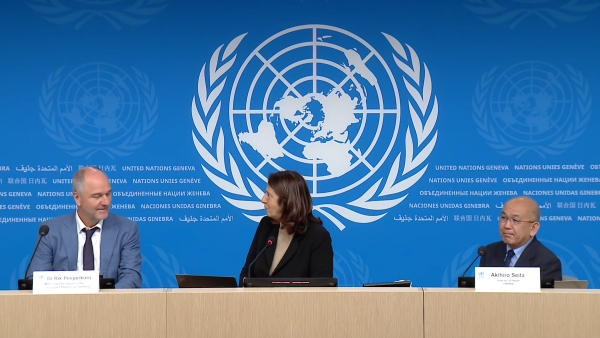
Dr Rik Peeperkorn, World Health Organization (WHO) representative in the occupied Palestinian territory, said he was on a mission in Gaza last week, and every time he entered Gaza, he thought it could not get worse – but it got worse.
Since 15 May, intense hostilities had displaced over 34,000 people. Overall, almost half a million people had been displaced across the Gaza Strip since mid-March. The bloodshed needed to stop.
The health system was being pushed to its limits. Everywhere there was the same message – a lack of trauma-related care items and of simple things like disinfectants and cleaning materials.
Since October 2023, WHO had documented 697 attacks on health facilities in Gaza. WHO urged for the active protection of health care. Hospitals must never be militarised or targeted.
In northern Gaza, there had been intense military activity around the Indonesian Hospital since 18 May. Most patients self-evacuated after hostilities intensified on 15 May, killing a staff member, injuring one patient, and damaging the facility. Only 15 people, including patients and staff, remained at the hospital, urgently in need of food and water. The hospital’s generator was reportedly hit yesterday, causing a blackout. WHO was planning a mission to transfer patients to other facilities for continued care.
Currently, the only hospital partially functional in North Gaza was Al Awda, which was acting as a trauma stabilisation point. It was overwhelmed with injuries and running low on supplies. Ongoing hostilities since 15 May had damaged the facility, disrupted access, and caused panic deterring people from seeking health care.
Kamal Adwan was slowly being rehabilitated after attacks left it non-operational. It was mostly focused on paediatric care but also providing some trauma stabilisation. A new structure had been setup in the hospital with a 20-bed capacity, of which five were for the treatment of malnutrition patients and four were for emergencies.
In southern Gaza, the European Hospital remained out of service after an attack on 13 May. This was the only hospital that provided neurosurgery, cardiac and cancer treatment in Gaza.
The Nasser Hospital was overwhelmed. Yesterday’s attack severely damaged a WHO-built warehouse, according to the hospital director. Around 30 per cent of the warehouse and critical WHO supplies were reportedly destroyed. An assessment by hospital management was underway to determine the full scale of the loss. An attack on the burn unit last week had destroyed 18 beds.
In Gaza City, expansion of services in the Shifa Hospital was ongoing – it was seeing over 500 patients a day and operating at 150 per cent capacity. The Al-Ahli Hospital had resumed functionality in the last 72 hours but only at a minimal capacity.
The mental health toll was immensurable. People in Gaza had lost loved ones over and over. Human beings were not bult for endless trauma, waking up every day without adequate food, shelter and health care. No-one should need to be this resilient to survive.
WHO was calling for the UN to be allowed to do its work. There was a plan to deliver aid, it had delivered and would continue to deliver if only it was allowed to do so.
In response to questions, Dr Peeperkorn said the UN welcomed that some aid was coming into Gaza, but this was a drop in the ocean and was absolutely insufficient to meet the immediate needs of over two million people. Global humanitarian principles needed to be respected, and aid needed to be provided to people wherever they were. The aid delivery system worked very well when the ceasefire was in place – it needed to be restored.
Despite resource cuts, which were affecting the organisation directly, WHO had delivered over the past 18 months. Crisis countries would be prioritised in budgeting WHO activities. In Gaza the health system was on the brink of collapse but was minimally functional thanks to the support of partners. This support needed to be strengthened.
During the period of food shortages in February 2024, when people thought there was food in trucks, they tried to loot them. There was no looting during the ceasefire period, when more aid was delivered. Some 38 per cent of the goods that came in during the ceasefire were linked to the UN. WHO directly brought health supplies to hospitals and health facilities. Israeli authorities knew this. The aid system needed to keep delivering and be allowed to expand.
WHO wanted to deliver essential medical equipment, such as mobile x-ray equipment. There was only one CT scan device currently working in Gaza. Even before the crisis, it was very difficult to bring this equipment in. WHO was forced to constantly reprioritise based on what was allowed to get into Gaza.
Jens Laerke for the United Nations Office for the Coordination of Humanitarian Affairs (OCHA) said that nine trucks were cleared for entry into Gaza yesterday, but only five were able to enter. Four were unable to enter for logistical reasons. The trucks passed through several levels of Israeli checks.
OCHA had requested and received permission to collect these five trucks from Gaza today and for more trucks to enter Gaza today. It expected that around 100 trucks would be able to enter Gaza to distribute aid soon. OCHA would do everything in its power to bring the aid in. The situation was developing, and OCHA had been disappointed in the past. It would announce when aid deliveries were completed.
Four of the five trucks that entered yesterday were administered by the World Food Programme and one by the United Nations Children's Fund, carrying food and nutritional supplements for children. The aid was being distributed based on need.
The less aid was distributed, the more desperation rose. Insufficient supplies led to a greater risk of looting. When aid was sparce, it was sold in what one could call not black market, but “markets of desperation”. By opening access for more aid, such markets disappeared and there was no need to loot trucks. The supplies that the UN sought to deliver were life-saving commodities, such as baby milk, baby shoes and nutritional supplies. There were babies in urgent need of supplements as their mothers were unable to feed them.
Announcements
Alessandra Vellucci, Director of the United Nations Information Service (UNIS) in Geneva, said the World Health Assembly was being held this week at the Palais des Nations.
On Wednesday, 21 May at 4 p.m. Geneva time, the United Nations Secretary-General António Guterres would present, together with Deputy Secretary-General Amina Mohammed and Oscar Fernandez-Taranco, Assistant Secretary-General for Development Coordination, the 2025 report of the Chair of the UN Sustainable Development Group. The report showed that the revitalised resident coordinator system delivered efficiency to improve lives. The event could be followed on UN Web TV.
The United Nations Special Envoy for Syria, Geir O. Pedersen, would brief the Security Council tomorrow, Wednesday 21 May, at 4 p.m. Geneva time. His statement would be distributed after he concluded.
The Committee on the Rights of the Child (99th session, 12-30 May, Palais Wilson) would begin this afternoon, at 3 p.m., its review of the report of Romania, to be followed by the reports of Qatar and Brazil.
Today, Tuesday, 20 May at 11:45 p.m., an in-person press briefing would be held in the United Nations Office at Geneva press briefing room by the Permanent Mission of France to the United Nations Office at Geneva on the pandemic treaty and French and European development policies.
A short hybrid press conference would subsequently be held in the press briefing room by Dr Tedros on the adoption of the pandemic treaty. It would feature several speakers involved in the accord [the spokesperson later said that the press conference would not be held].
***
The webcast for this briefing is available here
The audio for this briefing is available here
Similar Stories
1
1
1
Press Conferences | UN WOMEN , WFP , WHO
UN WOMEN: Sudan Women and girls one year after the fall of El Fasher; increasing drone attacks across the country; WFP: DRC - Ebola spreads to eighth DRC province as WFP delivers food, builds treatment centres and keeps supplies moving; WHO - Update on Ebola (Bundibugyo Virus Disease)
1
12
1
1
Press Conferences , Images | UNOG
Closing Press Conference following the Sixth Consultative Meeting on Enhancing Coordination of Peace Initiatives and Efforts in Sudan

2
17
1
2
Edited News , Press Conferences , Images | OCHA , WMO
Two UN agencies teamed up on Wednesday to issue an appeal for immediate assistance to help communities already being impacted by the strongest El Niño on record.
1
1
1
Press Conferences | CITES
Wildlife trade and conservation policy discussions at the 81st meeting of the CITES Standing Committee (SC81)
1
1
1
Press Conferences | UNHCR , UNCTAD , WMO , OCHA , UNICEF , WHO
UNHCR Hungary’s 1956 Refugee Crisis: 70 Years On, UNCTAD World Investment Forum 2026, Doha, WMO Greenhouse Gas Bulletin and Climate Update for COP31, OCHA Afghanistan: Malnutrition, Girls’ Education and Recovery, UNICEF Yemen: Child Malnutrition and Unsafe Water in Taiz, WHO Inequalities in Noncommunicable Diseases and Risk Factors
1
1
1
Press Conferences | UNHCR
End of UNHCR's 77th Annual Executive Committee (ExCom) meeting week
1
1
1
Press Conferences | UNICEF , IOM , UNHCR
UN Special Assistant to the Personal Envoy Office (SUDAN): Peace Initiatives and Efforts in Sudan; UNICEF: Dire situation of children in Gaza; IOM: Damaged Homes and Energy Attacks Risk Displacing Ukrainians for this winter; UNHCR: update on EXCOM week
1
1
1
Press Conferences | IOM , UNDRR
UN stresses importance of household preparedness for disaster risk reduction.
1
1
1
Statements , Press Conferences | OHCHR
1
1
1
Press Conferences | UNHCR , UNICEF , IFRC , OHCHR , UN WOMEN , IOM , OCHA , WHO
UNHCR – ExCom Meeting, UNICEF – Nepal Recovery, IFRC – Flash Floods, WHO – Mental Health, IOM – South Sudan Floods, OCHA – DRC Humanitarian aid, UNHCR – Sahel Displacement, UNICEF – Yemen Update, IOM – Gaza Shelter, UN Women – Gaza Women, OHCHR – Arrests and detentions of Syrians by Israeli force
2
1
2
Press Conferences | UNCTAD
Presentation of the Trade and Developement Report 2026
Embargoed until 9 October 2026 at 11 a.m. (Geneva Time)
UNCTAD: UNCTAD’s flagship report finds that governments increasingly use industrial, trade, financial and technology policies to pursue economic and national security objectives. Market access and the ability to move into higher-value activities now depend more heavily on technology, finance and geopolitics.
1
1
1
Press Conferences | UPU
Release of the State of the Postal Sector Report 2026