

The United Nations Office at Geneva
Multimedia Newsroom
Press Conferences | OSE , UNCTAD , WHO , UNICEF , IFRC , UNHCR
UN Geneva Press Briefing - 14 March 2025
UN GENEVA PRESS BRIEFING
14 March 2025
Humanitarian situation for children in Sudan
Lucia Elmi, Director of Emergency Operations at the United Nations Children’s Fund (UNICEF), speaking from New York, stated that children in Sudan were trapped in one of the world’s worst humanitarian crises. Ms. Elmi had returned from Sudan the previous week, where more than 16 million children in Sudan urgently needed aid. Nearly 17 million children had been out of school for two years. Girls faced grave risks, including sexual violence, trafficking, and forced marriage. Ms. Elmi stressed that children were being killed, maimed, and displaced, with grave violations reported daily. Many faced recruitment and use by armed actors, child labour, and early marriage. The psychological toll was devastating, and urgent action was needed to protect Sudan’s children, but reaching these children was becoming increasingly difficult. The needs were staggering, yet aid was not available at the scale and speed required. Ms. Elmi also spoke of displaced and host communities coming together to contribute their skills and capacities to deliver humanitarian services, and children eager to learn and play in temporary learning centres.
Delivery of humanitarian assistance continued to be inhibited by bureaucratic and administrative impediments in obtaining the necessary permits for the delivery of supplies in areas affected by armed conflict. Looting and violence had also forced operational suspensions in multiple areas. Nationally, 3.2 million children under five were expected to suffer from acute malnutrition this year, including 770,000 facing severe acute malnutrition. However, added Ms. Elmi, this crisis was not only about food. Without safe water, sanitation, and healthcare, children would not survive, and in famine-affected areas, basic services had collapsed. Sudan risked losing an entire generation. UNICEF called on all actors—governments, donors, and parties to the conflict—to act now to guarantee humanitarian access across conflict lines and borders; protect humanitarian workers and supplies; increase funding to match escalating needs; and end the violence. The children of Sudan could not wait.
More than 30 million people in Sudan, or two-thirds of Sudan’s population, needed humanitarian aid, added Michele Zaccheo, for the UN Information Service (UNIS), referring to UNICEF Executive Director’s briefing to the Security Council from the previous day.
Surge of measles in Europe
Dr Dragan Janković, technical lead for measles in the European Office of the World Health Organization (WHO), speaking from Copenhagen, informed that, according to an analysis by WHO and the United Nations Children’s Fund (UNICEF), 127,350 measles cases had been reported in the European region for 2024, the highest number since 1997. Children under five accounted for close to 50 percent of reported cases in the region, which comprised 53 countries in Europe and central Asia. A total of 38 deaths had been reported, based on preliminary data received as of 6 March 2025. In January 2025, there had been over 3,000 reported cases. The period from February to May was expected to see further increases. The region had a target of measles and rubella elimination; some 15 countries remained endemic for measles, while rubella remained to be eliminated from three countries.
Replying to questions, Dr. Janković said that the biggest caseloads were in Kyrgyzstan, Russia, Türkiye, Romania, and Bosnia-Herzegovina, but there were susceptible populations in most countries. It was impossible to control importations; France and Spain had recently reported imported cases of measles, he said. Break of routine medical services during the pandemic, population movements, and refusal to be vaccinated were among the reasons reported by countries.
Ebola outbreak in Uganda
Henry Mbatha Musembi, Public Health in Emergencies Coordinator at the International Federation of Red Cross and Red Crescent Societies (IFRC), speaking from Kampala, spoke about Uganda’s 8th outbreak since 2000. The current outbreak was caused by a Sudan Virus strain, causing viral hemorrhagic fevers, among other distressing side effects. The disease had a potential to strike fear in the population and to quickly spread, which was why community diplomacy was important. The virus should be taken very seriously while addressing the stigma which could affect reporting. The Uganda Red Cross had trained and deployed 320 volunteers, trusted members of their communities. Through its village” task forces”, the Red Cross was informing the population on where to get health and mental health support. Ambulances were on a standby to transport people showing symptoms of the disease.
At the start of the outbreak, people had been afraid that reporting cases would lead to forced quarantine, where people would die. Red Cross volunteers shared these concerns. Red Cross had supported the Ugandan Government with conducting dignified burials. Since the 2022 Ebola outbreak, Red Cross volunteers had worked with the local communities to find culturally acceptable ways to deal with the disease while keeping everyone safe, which had led to building community trust. Mr. Musembi informed that the IFRC was appealing for six million CHF to support the Ugandan Red Cross in strengthening its response to the ongoing outbreak; currently, this appeal was only five percent funded. Swift and coordinated action in response to this deadly virus was paramount to containing it, and that could only be achieved with more awareness and funding.
Answering questions from the media, Tommaso Della Longa, also for the IFRC, said that there was a global concern about cuts to the humanitarian sector. On a positive side, US authorities had confirmed their support to the IFRC’s epidemic programme, including the Ebola response. He specified that the US had reconfirmed its grants to the IFRC for activities in Uganda, Ukraine, Zimbabwe, and Armenia, while four other grants were also still active. It was too early to speak about the impact of US cuts on the IFRC’s workforce; the organization was still assessing the situation and discussing the way forward. IFRC was discussing support with various traditional and potential new donors.
Tanzania declares end of Marburg virus disease outbreak
Christian Lindmeier, for the World Health Organization (WHO), informed that on 13 March, Tanzania had declared the end of the Marburg virus disease outbreak, after recording no new cases over 42 days since the death of the last confirmed case on 28 January 2025.
The outbreak, in which two confirmed and eight probable cases had been recorded (all deceased), was the second the country has experienced. Both this outbreak, which was declared on 20 January 2025, and the one in 2023 occurred in the north-eastern Kagera region. In response to the latest outbreak, Tanzania’s health authorities set up coordination and response systems, with support from World Health Organization (WHO) and partners, at the national and regional levels and reinforced control measures to swiftly detect cases, enhance clinical care, infection prevention as well as strengthen collaboration with communities to raise awareness and help curb further spread of the virus. More information is available here.
Mr. Lindmeier quoted Dr. Tedros, who had stressed that the WHO was helping make Americans and everyone safer by working with all countries to stop infectious and deadly outbreaks, like Marburg and Ebola, at their source. Cutting ties would make Americans unsafe.
Michele Zaccheo, for the UN Information Service (UNIS), said that UN Office at Geneva had not received a questionnaire from the United States. He was aware of UNAIDS having received a questionnaire, but it was not clear that the same questionnaires went to all agencies. Each entity that received it would deal with it in their own way. Mr. Zaccheo referred to the Secretary-General’s UN80 Initiative, which had as its objectives identifying efficiencies and improvements, reviewing the implementation of mandates from Member States, and a strategic review of deeper, more structural changes and programme realignment.
Fourteen years of the conflict in Syria
Jenifer Fenton, for the Office of the Special Envoy for Syria (OSE), read a statement by the Special Envoy, in which he evoked that it was 14 years since Syrians had first taken to the streets in peaceful protest, demanding dignity, freedom, and a better future. Their calls had resonated across the country, sparking a movement that would shape Syria’s history. What had begun as a plea for reform was met with staggering brutality, leading to one of the most harrowing conflicts of our time. The conflict exposed the darkest depths of human cruelty. Families continued to mourn the loss of loved ones, communities remained fractured, millions remained uprooted from their homes, and far too many persist in their search for the missing. The pain and sacrifices of the Syrian people should never be forgotten.
The Special Envoy called for an immediate end to all violence and for protection of civilians in accordance with international law. He also called for a credible independent investigation into the recent killings and violence, and for the full cooperation of the caretaker authorities with the United Nations in this regard. A climate of distrust and fear could endanger the entire transition. Building on and beyond the recent National Dialogue, it was vital that there are concrete actions of genuine inclusion. The recent agreements reached between the caretaker authorities and the SDF were a positive reminder of how important it was that Syria came together in a manner that truly restored its sovereignty, unity, independence and territorial integrity.
Now was the time for bold moves to create a genuinely credible and inclusive transitional government and legislative body; a constitutional framework and process to draft a new constitution for the long term that is credible and inclusive too; and genuine transitional justice. Ms. Fenton stressed that the United Nations stood ready to work on these and all other aspects of a political transition in cooperation with the caretaker authorities and all Syrians and in line with the key principles of Security Council resolution 2254 (2015).
Announcements
Catherine Huissoud, for United Nations Trade and Development (UNCTAD), informed that UNCTAD was organizing on 17 March a three-day International Debt Management Conference whose work would set the tone for the financing for development agenda, of which debt was a critical element, and the Fourth International Conference on Financing for Development (FfD4). Ms. Huissoud said that many developing countries were sinking into a debt-driven development crisis. Their public debt was projected to hit a record USD 5.3 trillion in 2024 equivalent to 90 percent of their GDP. While public debt itself was not a problem, it could become a problem when debt servicing costs increased more than a country’s capacity to pay. Today, 3.3 billion people lived in countries that spent more on debt payments than on health or education, including three billion in middle-income countries. The upcoming conference would bring together senior debt managers, government officials and delegates, academics, and representatives of international organizations, civil society and the private sector.
Ms. Huissoud also informed that UNCTAD would publish soon its Global Trade Update March 2025. The value of global imports and exports had reached a new high in 2024 at USD 33 trillion growing by 3.7 percent (USD 1.2 trillion), but uncertainty clouded the outlook for 2025. Services and developing economies drove growth as global trade imbalances widened and trade policies redrew the map. Most regions saw growth, except for Europe and Central Asia. Merchandise trade imbalances widened as China’s surplus grew. Finally, the update would show that in 2024, global trade imbalances had returned to 2022 levels.
Responding to a question on the Secretary-General’s visit to Geneva the following week, Mr. Zaccheo said that there was no meeting scheduled between the Secretary-General and heads of UN agencies in Geneva to discuss budgetary cuts. The Secretary-General would be in Geneva to convene an informal, in-person meeting on Cyprus, in line with his commitment from 15 October 2024 to provide conditions for a meaningful discussion. Media could cover arrivals of delegations to the Palais des Nations, at Door A11 on 18 March around 11 am. Media pool would have access to the family photo and the start of the meeting, scheduled to take place in Room III. For the time being, no press conference or stakeout were foreseen. The meeting was supposed to last till the evening of 18 March. Media contacts of the participating delegations would be shared.
Michele Zaccheo, for the United Nations Information Service (UNIS), said that today, at 2 pm, the Independent International Fact-Finding Mission on the Islamic Republic of Iran would hold a press conference to present its latest report.
On 17 March at 2:30 pm, UN Special Rapporteur on the situation of human rights in Myanmar, Tom Andrews, would hold a press conference to provide an update.
On 19 March at 1 pm, the Independent International Commission of Inquiry on Ukraine would present its latest report.
On 20 March at 10:30 am, a press conference would be held by the Group of Independent Experts on the Human Rights Situation in Belarus to present its new report.
Mr. Zaccheo also informed that the Committee on the Rights of Persons with Disabilities was concluding this morning its review of the report of Palau.
The Committee on Enforced Disappearances would open on 17 March at 10 am its 28th session, during which it would hold dialogues with Serbia, Gambia, Central African Republic, Peru, Belgium, and Malta.
***
ANNOUNCEMENTS
* International Debt management Conference - 17-19 March Palais des Nations
TOPICS
- UNICEF - Lucia Elmi, UNICEF Director of Emergency Operations (From NY): Humanitarian situation for children in Sudan
Similar Stories
1
1
1
Press Conferences | IOM , ITU , UNECE , UNICEF , WHO , WMO
UNICEF: Ebola, DRC - children orphans or separating them from parents and caregivers; IOM: Humanitarian needs in Djibouti amid arrivals from Yemen and increased migrant movements; WHO: Darfur, scale of health needs far exceeds available resources; WMO co-sponsored Global Heat Forum, Bangkok, monthly Global Seasonal Climate Update; UNECE: UN Forum of Mayors; ITU Plenipotentiary Conference 2026; WHO: child and adolescent obesity guidelines and new global roadmap to tackle pregnancy hypertension, a leading cause of maternal mortality
1
1
1
Press Conferences | OCHA , UN WOMEN , UNHCR , WFP , WHO , WTO , UNEP
OCHA – $160M CERF allocation to 12 underfunded crises; UNHCR – 5.8M refugee children remain out of school amid funding cuts; UN Women – Middle East escalation and food security among women/girls; WHO – Gaza supplies and overall situation; WFP – Yemen food insecurity and impact on global hunger ; UNEP - First International Conference of the Global Framework on Chemicals in Geneva | 16-20 November 2026
1
1
1
Press Conferences | UNHCR , WHO
Yemen's health system nears collapse amid conflict, causing rising casualties and medicine shortages.
1
1
1
Press Conferences | HRC
Update by the Expert Mechanism to Advance Racial Justice and Equality in Law Enforcement
1
1
1
Press Conferences | WIPO , WHO , UNICEF , UNHCR , IOM , WFP , FAO
WIPO Global Innovation Index 2026 launch and press conference, WHO Composition of influenza vaccines for the 2027 Southern Hemisphere flu season, UNICEF Yemen hunger and malnutrition; UNHCR Sudan displacement into Chad; IOM Ebola and population movements in DRC; WFP emergency food assistance in Nepal; and FAO food loss and waste.
2
1
2
Press Conferences | UNCTAD
Gaza reconstruction needs reach $71.5 billion as Palestinian economy and public finances face severe strain. Latest UNCTAD report documents the loss of decades of development gains, economic collapse in Gaza and tightening economic constraints in the West Bank.
The report identifies three immediate priorities: transferring withheld Palestinian revenues, safeguarding the banking system and aligning reconstruction support with the documented scale of damage and economic losses.
1
1
1
Press Conferences | HRC
Press conference on the situation of human rights in Nicaragua by the UN Group of Human Rights Experts
1
1
1
Press Conferences | ITU , UNHCR , WHO , WMO
YEMEN - UNHCR: Escalating conflict in Yemen could fuel more displacement, refugee movement
CLIMATE - WHO / WMO: Health and Climate impact of El Niño
1
1
1
Press Conferences | HRC , OHCHR
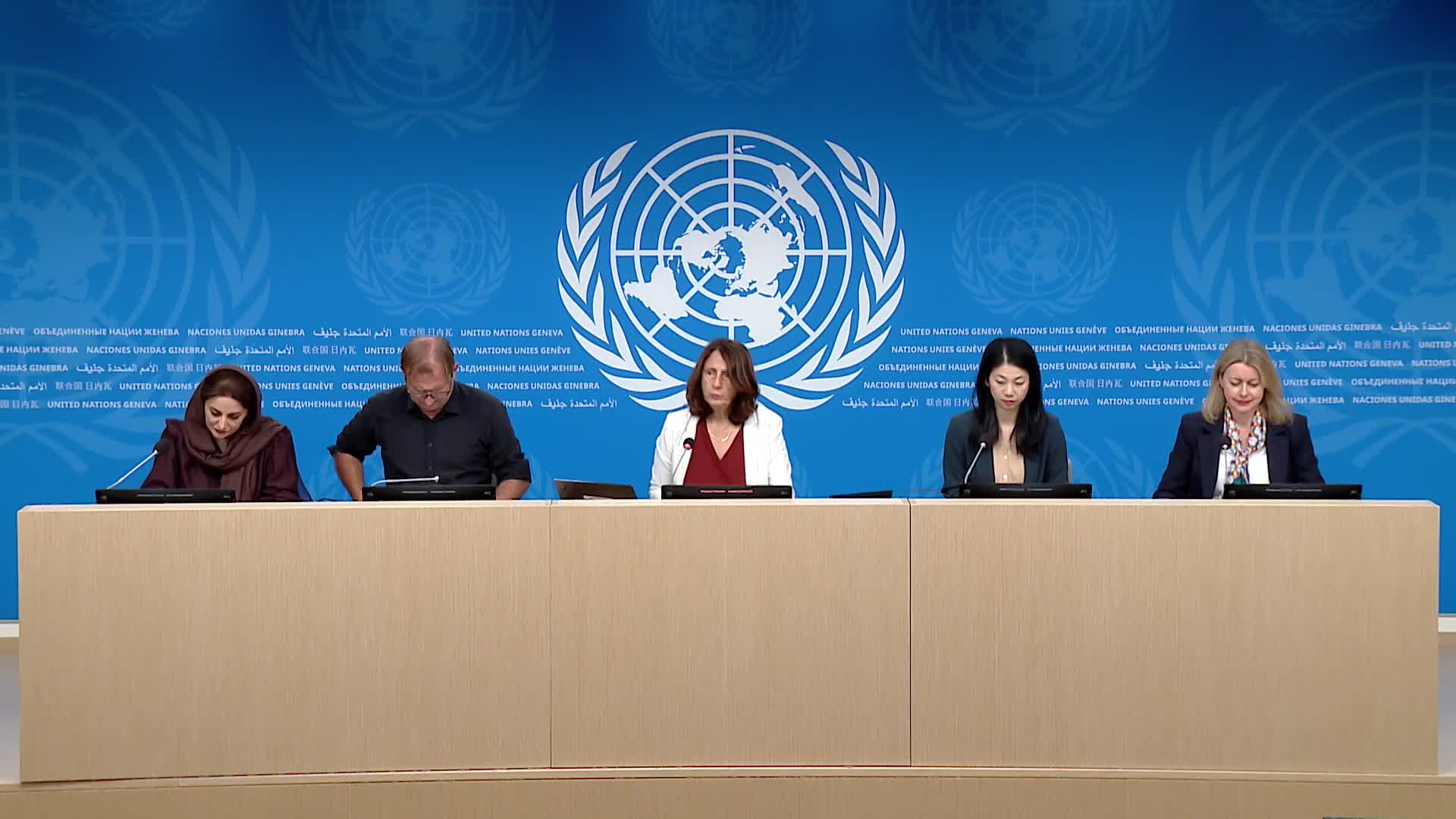
Mariana Katzarova discusses human rights in Russia as a UN Special Rapporteur.
1
1
1
Press Conferences | IOM , OHCHR , UN WOMEN , UNFPA , UNHCR , UNOPS , WHO
UN Geneva briefing: Yemen crisis worsens, urgent aid needed across multiple sectors.
1
1
1
Press Conferences | HRC
Press conference on the latest report of the Independent International Fact-Finding Mission on the Bolivarian Republic of Venezuela to the UN Human Rights Council
1
1
1
Press Conferences | OHCHR
Victims Still Waiting: A Global Briefing on Transitional Justice Around the World