

The United Nations Office at Geneva
Multimedia Newsroom
UN GENEVA PRESS BRIEFING
5 November 2024
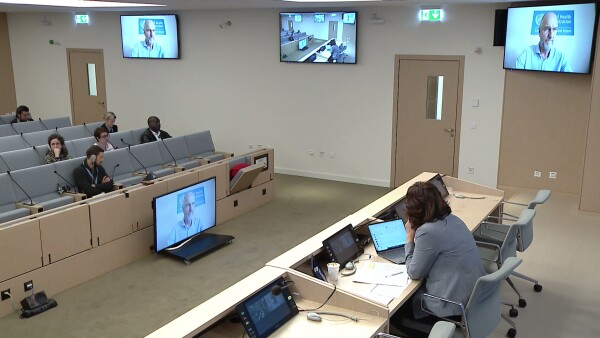
Alessandra Vellucci, Director of the United Nations Information Service in Geneva, chaired a hybrid briefing, which was attended by the representatives and the spokesperson of the World Health Organization.
Update on the health situation in Gaza
Dr. Richard Peeperkorn, World Health Organization (WHO) representative for the occupied Palestinian territories, speaking from Gaza, said that in October the WHO had planned numerous missions to the north of Gaza, many of which had been cancelled or impeded. Over the last three weeks, nonetheless, the WHO had managed to conduct seven missions to the northern areas. WHO missions had the same objectives: to deliver food and medical and surgical supplies and medications for patients. 109 critical patients had now been medically evacuated to the Al-Shifa Hospital and the south of Gaza. Over 100 patients were expected to be evacuated from Gaza the following day, informed Dr. Peeperkorn. The needs in the Kamal Adwan Hospital in the north were massive, with emergency wards flooded with trauma cases and casualties. The Al-Adha Hospital also urgently needed surgical and medical supplies as well as fuel, otherwise it would become non-functional in the coming weeks. There were currently no fully functional medical centres in the north of Gaza, where an estimated 75,000 people remained. Medical staff in the two partially functioning hospitals (Al-Shifa and Al-Adha) expected protection of their facilities and expected the WHO and partners to regularly visit and deliver life-saving supplies. This was a small ask with a massive impact, said Dr. Peeperkorn.
Regarding the polio vaccination campaign, out of the 591,000 children under ten that were targeted across Gaza, Dr. Peeperkorn said that the first two phases had been successfully implemented in the south and center of Gaza. In the north, however, the campaign had been compromised due to the lack of access and of humanitarian pauses. Over the last few days, some 150,000 people had been forced to evacuate from the north of Gaza to Gaza City, which had an adverse impact on the vaccination in the north. Between 2 and 4 November, nevertheless, over 105,000 children under the age of ten had been successfully vaccinated, 88 percent of the target, which was an exceptional achievement under such dire conditions. The polio vaccination continued today in four fixed sites (primary health centres) in the north, after which an evaluation would be conducted. Only in several months would it be known how successful the campaign had been. Dr. Peeperkorn also spoke of horrible shelter conditions in the north of Gaza, which had to be quickly improved. He emphasized the need for consistent access, especially to the north of Gaza. WHO was working to ensure that essential health services were functional.
Answering questions from the media, Dr. Peeperkorn said that the planned medical evacuation on 6 November should include over 100 patients, who were on the priority list of the Ministry of Health. Most patients would go to the United Arab Emirates and Romania. Since the closing of the Rafah crossing on 6 May, only 282 patients had been medically evacuated from Gaza, with the last medevac taking place about five weeks ago. The upcoming medevac was a welcome, but ad hoc intervention. What had been repeatedly requested was a sustained, organized medevac; an estimated 12,000 to 14,000 patients needed medical evacuation, for both trauma and chronic conditions. For this, medical corridors were needed, to the West Bank and Jordan. Dr. Peeperkorn reiterated that it was not within the mandate of the WHO to investigate destruction of medical facilities and polio vaccination sites. Specific humanitarian pauses had to be respected, he emphasized. Speaking of patients waiting to be evacuated the following day, he said that about half of them were trauma-related and others were chronically ill patients; about one-third of them were children.
WHO list of endemic pathogens for which new vaccines are needed
Mr. Mateusz Hasso-Agopsowicz, Technical Officer and Project Manager, Vaccine Product & Delivery Research at the World Health Organization (WHO), informed that the WHO had published today a major study identifying 17 bacteria, viruses, and parasites (pathogens) that frequently caused diseases as top priorities for new vaccine development. This study marked the first global effort to systematically prioritize endemic pathogens based on their impact on regional and global health. WHO was hoping to shift the focus in vaccine development away from commercial returns to regional and global health needs. Typically, in the past, vaccine research and development were influenced by the profitability of new vaccines, which could mean that diseases severely affecting low-income regions received less attention. This WHO study represented a critical shift, focusing on the actual health burden these diseases had.
Mr. Hasso-Agopsowicz explained that the WHO had used Multi-Criteria Decision Analysis, a systematic approach that asked experts about what they thought was important when prioritizing pathogens for vaccines research and development. The findings reconfirmed some long-standing vaccine priorities: HIV, malaria, and tuberculosis continued to top the list as major global threats, which collectively caused 2.5 million deaths a year. However, the study also raised attention to pathogens such as Group A streptococcus, which caused severe infections and contributed to 280 000 deaths from rheumatic heart disease, mainly in low-income countries. Another new priority was Klebsiella pneumoniae, a bacteria associated with 790 000 deaths in 2019, and responsible for 40 percent of neonatal deaths due to blood infection (sepsis) in low-income countries. In order to advance vaccine research and development, the WHO had categorized each pathogen based on the stage of vaccine development and the technical challenges involved in creating effective vaccines, ranging from Research, through Advance development, to Prepare to Implement.
Full press release is available here.
Responding to questions, Mr. Hasso-Agopsowicz said that some of the diseases were happening in both low- and high-income countries; one example was E.coli, which was a highly resistant pathogen. With the newly published list, the WHO was hoping to provide guidance to researchers and producers on which pathogens to focus. Same vaccines, with minor modifications, could be used for different scenarios in low- and high-income countries. For dengue, there were two licensed vaccines, from Japanese and Brazilian manufacturers, and the production was being scaled up. Regarding tuberculosis, there were two advanced vaccine candidates, one of which could be given to adults and adolescents already infected with tuberculosis, in trial until 2027, and the other targeting infants, which was also in phase 3 trial. Tuberculosis vaccines were among the priorities for Gavi, the Vaccine Alliance.
Announcements
Tarik Jašarević, for the World Health Organization (WHO), announced that the WHO would hold a press conference on 7 November, ahead of COP29 in Azerbaijan. Dr. Maria Neira and other speakers would present documents on new health initiatives to be launched at COP29. Health ought to be positioned in the center of all climate negotiations.
Alessandra Vellucci, for the United Nations Information Service (UNIS), informed that on 6 November at 11 am, there would be a virtual press conference at which Carsten Fink, Chief Economist at the World Intellectual Property Organization (WIPO) would present the World Intellectual Property Indicators report showing global intellectual property statistics from countries across the globe. The report would be under embargo until 7 November at 9:30 am.
On 7 November at 10 am, in a hybrid press conference, Andrea Cattaneo, Senior Economist at the Food and Agriculture Organization (FAO), would present State of Food and Agriculture 2024, under embargo until 8 November at 10 am.
Also on 7 November at 1:30 pm, UN Human Rights Committeewould close its 142nd session the same day and issue its concluding observations on the six countries reviewed during this session. In a hybrid press conference, the Committee would present findings on Ecuador, France, Greece, Iceland, Pakistan, and Türkiye.
The Committee Against Torture was beginning this morning the review of the report of Thailand.
On 6 November, at 4 pm Geneva time, an informal meeting of the General Assembly plenary would be held in New York to discuss UNRWA. The meeting would be webcast.
Finally, on 14 November, an event “Future en tous genres” would be organized at the Palais des Nations, and journalists could bring their children to work for a day of learning and fun activities. A mock-up press conference would be part of this event.
***
The webcast for this briefing is available here
The audio for this briefing is available here
Similar Stories
1
1
1
Press Conferences | UN WOMEN , WFP , WHO
UN WOMEN: Sudan Women and girls one year after the fall of El Fasher; increasing drone attacks across the country; WFP: DRC - Ebola spreads to eighth DRC province as WFP delivers food, builds treatment centres and keeps supplies moving; WHO - Update on Ebola (Bundibugyo Virus Disease)
1
12
1
1
Press Conferences , Images | UNOG
Closing Press Conference following the Sixth Consultative Meeting on Enhancing Coordination of Peace Initiatives and Efforts in Sudan

2
17
1
2
Edited News , Press Conferences , Images | OCHA , WMO
Two UN agencies teamed up on Wednesday to issue an appeal for immediate assistance to help communities already being impacted by the strongest El Niño on record.
1
1
1
Press Conferences | CITES
Wildlife trade and conservation policy discussions at the 81st meeting of the CITES Standing Committee (SC81)
1
1
1
Press Conferences | UNHCR , UNCTAD , WMO , OCHA , UNICEF , WHO
UNHCR Hungary’s 1956 Refugee Crisis: 70 Years On, UNCTAD World Investment Forum 2026, Doha, WMO Greenhouse Gas Bulletin and Climate Update for COP31, OCHA Afghanistan: Malnutrition, Girls’ Education and Recovery, UNICEF Yemen: Child Malnutrition and Unsafe Water in Taiz, WHO Inequalities in Noncommunicable Diseases and Risk Factors
1
1
1
Press Conferences | UNHCR
End of UNHCR's 77th Annual Executive Committee (ExCom) meeting week
1
1
1
Press Conferences | UNICEF , IOM , UNHCR
UN Special Assistant to the Personal Envoy Office (SUDAN): Peace Initiatives and Efforts in Sudan; UNICEF: Dire situation of children in Gaza; IOM: Damaged Homes and Energy Attacks Risk Displacing Ukrainians for this winter; UNHCR: update on EXCOM week
1
1
1
Press Conferences | IOM , UNDRR
UN stresses importance of household preparedness for disaster risk reduction.
1
1
1
Statements , Press Conferences | OHCHR
1
1
1
Press Conferences | UNHCR , UNICEF , IFRC , OHCHR , UN WOMEN , IOM , OCHA , WHO
UNHCR – ExCom Meeting, UNICEF – Nepal Recovery, IFRC – Flash Floods, WHO – Mental Health, IOM – South Sudan Floods, OCHA – DRC Humanitarian aid, UNHCR – Sahel Displacement, UNICEF – Yemen Update, IOM – Gaza Shelter, UN Women – Gaza Women, OHCHR – Arrests and detentions of Syrians by Israeli force
2
1
2
Press Conferences | UNCTAD
Presentation of the Trade and Developement Report 2026
Embargoed until 9 October 2026 at 11 a.m. (Geneva Time)
UNCTAD: UNCTAD’s flagship report finds that governments increasingly use industrial, trade, financial and technology policies to pursue economic and national security objectives. Market access and the ability to move into higher-value activities now depend more heavily on technology, finance and geopolitics.
1
1
1
Press Conferences | UPU
Release of the State of the Postal Sector Report 2026