

The United Nations Office at Geneva
Multimedia Newsroom
UN GENEVA PRESS BRIEFING
23 July 2024
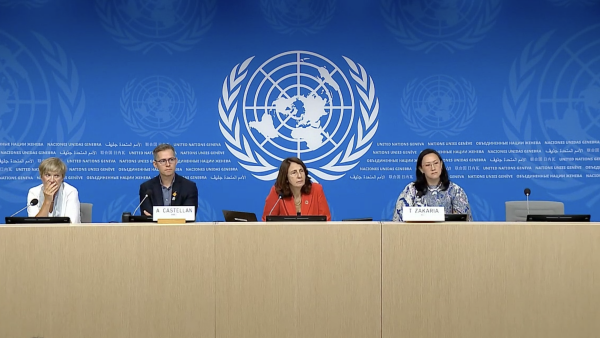
Rolando Gómez, Chief of the Press and External Relations Section at the United Nations Information Service in Geneva, chaired a hybrid briefing, which was attended by the spokespersons and representatives of the World Health Organization and the International Labour Organization.
Health situation in Gaza
Dr. Ayadil Saparbekov, Team Lead for Health Emergencies at the World Health Organization (WHO) in the occupied Palestinian territory, speaking from Jerusalem, said that almost 40,000 people had been reported killed and 90,000 injured, according to the Ministry of Health. Only 16 out of the 36 hospitals in Gaza were partially functioning; only 45 primary health centers were functioning, or less than 50 per cent of the total number. There were ten field hospitals in Gaza right now, eight of which were functioning, and only four of them fully functioning. The hospitals in Gaza were very much overwhelmed, said Dr. Saparbekov. Over the previous days, the hospitals had been receiving numerous casualties from the mass incident in Khan Younis. The bed capacity remained a challenge across Gaza. WHO and partners were working to bring in temporary structures, such as tents, and WHO’s health partners were now trying to restore in Al Shifa and Al Nasser medical complexes. It was hoped that emergency services, electrical systems and health supplies and logistics would all be revitalized. With that done, surgery rooms, first aid rooms and intensive care rooms would be operational again, explained Dr. Saparbekov. WHO was also supporting the Al Shifa hospital with hemodialysis machines.
Replying to questions, Dr. Saparbekov said that on 16 July, the Global Polio Lab Network had notified the WHO of several circulating variant type 2 poliovirus strains. Close genetic linkages had been established to a virus detected in Egypt in 2023. WHO and partners were looking to establish where exactly this strain had been imported from, after which it would conduct a risk assessment and make a decision on the type of vaccine needed and which age group should be included in the vaccination campaign. The risk of spreading the diseases across the Gaza Strip and beyond was very high, he warned. By the end of this week, a joint recommendation from the Global Polio Lab Network on how to proceed was expected. On another question, Dr. Saparbekov explained that it had taken him 12 hours from a bus station in Amman to his destination in Gaza. Every week, 50 humanitarian workers were allowed to come in and the same number were allowed out of Gaza.
Environmental samples were the samples collected from sewage, explained Dr. Saparbekov. This week, a WHO team coming into Gaza would bring up to 50 collection kits in order to collect samples from humans; until then it was difficult to confirm that there were people currently affected by the circulating polio strain. Once the decision on the vaccination campaign had been taken, the WHO would talk to a number of partners to conduct the campaign adequately. Dr. Saparbekov said that he was extremely worried about various disease outbreaks in Gaza, of polio, hepatitis A, and other communicable diseases. On another question, Dr. Saparbekov said that since the beginning of Rafah invasion on 7 May, medical evacuations through Rafah had been halted. There were as many as 14,000 people who might currently need to be medically evacuated from the Gaza Strip, he said.
COVID-19 and the Olympic Games
Responding to a question about COVID-19 and the upcoming Olympic Games, Margaret Harris, for the World Health Organization (WHO), said that the WHO had long-term arrangements with the International Olympic Committee (IOC), whom it supported for every Olympic Games, but it was the host country, France, which was responsible for assessing health risks and taking appropriate measures. France had seen an uptick in recent weeks, with 25 per cent positive cases in primary health care centers. The health system, nonetheless, was not reporting a heavy strain, said Ms. Harris. Anyone with symptoms was advised to stay at home and avoid contact with others. Ms. Harris said that there was still plenty of COVID-19 out there; people were still advised to use masks in crowded places and when visiting vulnerable persons.
Heat stress report
Zeina Awad, for the International Labour Organization (ILO), said that the ILO’s second report on heat and the world of work would come out on 25 July. ILO would be looking into workers’ exposure to heat stress in several regions of the world year-round, and not just during heatwaves. The report would share findings on the impact on workers’ health and financial costs as a result of injuries or diseases. The report would also include best practices and health management to better protect workers, said Ms. Awad. Rolando Gómez, for the United Nations Information Service (UNIS), added that the UN Secretary-General was expected to deliver a statement at the launch of the report in New York on the Call to Action on Extreme Heat at 12:30 p.m. New York time on 25 July.
Announcements
Rolando Gómez, for the United Nations Information Service (UNIS), informed that this morning, the Committee against Torture was holding a public meeting with Suzanne Jabbour, President of the Subcommittee on the Prevention of Torture. The Committee would also hold a meeting on follow-up to articles 19 and 22 and reprisals this afternoon at 3 pm. It would close it session on 26 July.
The Human Rights Committee would end its session at 4 pm today and publish its concluding observations regarding the country reports examined during the session: Croatia, Malta, Honduras, Maldives, Suriname, Syria, and India.
The Conference on Disarmament would start its third and final part of its 2024 session on 29 July, under the presidency of Ireland.
Mr. Gómez finally informed that Gabrielle Tétrault-Farber, a Reuters correspondent, would be leaving Geneva press corps. He thanked her for her cooperation and wished her the best of luck in her future endeavors.
***
The webcast for this briefing is available here: https://www.unognewsroom.org/story/en/2276 /un-geneva-press-briefing-23-july-2024/0/WjnegYbwZ1
The audio for this briefing is available here: https://www.unognewsroom.org/share/y5eVPj5bEP
Similar Stories
1
1
1
Statements , Press Conferences | OHCHR
1
1
1
Press Conferences | UNHCR , UNICEF , IFRC , OHCHR , UN WOMEN , IOM , OCHA , WHO
UNHCR – ExCom Meeting, UNICEF – Nepal Recovery, IFRC – Flash Floods, WHO – Mental Health, IOM – South Sudan Floods, OCHA – DRC Humanitarian aid, UNHCR – Sahel Displacement, UNICEF – Yemen Update, IOM – Gaza Shelter, UN Women – Gaza Women, OHCHR – Arrests and detentions of Syrians by Israeli force
2
1
2
Press Conferences | UNCTAD
Presentation of the Trade and Developement Report 2026
Embargoed until 9 October 2026 at 11 a.m. (Geneva Time)
UNCTAD: UNCTAD’s flagship report finds that governments increasingly use industrial, trade, financial and technology policies to pursue economic and national security objectives. Market access and the ability to move into higher-value activities now depend more heavily on technology, finance and geopolitics.
1
1
1
Press Conferences | UPU
Release of the State of the Postal Sector Report 2026
1
1
1
Press Conferences | IOM , ITU , UNECE , UNICEF , WHO , WMO
UNICEF: Ebola, DRC - children orphans or separating them from parents and caregivers; IOM: Humanitarian needs in Djibouti amid arrivals from Yemen and increased migrant movements; WHO: Darfur, scale of health needs far exceeds available resources; WMO co-sponsored Global Heat Forum, Bangkok, monthly Global Seasonal Climate Update; UNECE: UN Forum of Mayors; ITU Plenipotentiary Conference 2026; WHO: child and adolescent obesity guidelines and new global roadmap to tackle pregnancy hypertension, a leading cause of maternal mortality
1
1
1
Press Conferences | OCHA , UN WOMEN , UNHCR , WFP , WHO , WTO , UNEP
OCHA – $160M CERF allocation to 12 underfunded crises; UNHCR – 5.8M refugee children remain out of school amid funding cuts; UN Women – Middle East escalation and food security among women/girls; WHO – Gaza supplies and overall situation; WFP – Yemen food insecurity and impact on global hunger ; UNEP - First International Conference of the Global Framework on Chemicals in Geneva | 16-20 November 2026
1
1
1
Press Conferences | UNHCR , WHO
Yemen's health system nears collapse amid conflict, causing rising casualties and medicine shortages.
1
1
1
Press Conferences | HRC
Update by the Expert Mechanism to Advance Racial Justice and Equality in Law Enforcement
1
1
1
Press Conferences | WIPO , WHO , UNICEF , UNHCR , IOM , WFP , FAO
WIPO Global Innovation Index 2026 launch and press conference, WHO Composition of influenza vaccines for the 2027 Southern Hemisphere flu season, UNICEF Yemen hunger and malnutrition; UNHCR Sudan displacement into Chad; IOM Ebola and population movements in DRC; WFP emergency food assistance in Nepal; and FAO food loss and waste.
2
1
2
Press Conferences | UNCTAD
Gaza reconstruction needs reach $71.5 billion as Palestinian economy and public finances face severe strain. Latest UNCTAD report documents the loss of decades of development gains, economic collapse in Gaza and tightening economic constraints in the West Bank.
The report identifies three immediate priorities: transferring withheld Palestinian revenues, safeguarding the banking system and aligning reconstruction support with the documented scale of damage and economic losses.
1
1
1
Press Conferences | HRC
Press conference on the situation of human rights in Nicaragua by the UN Group of Human Rights Experts
1
1
1
Press Conferences | ITU , UNHCR , WHO , WMO
YEMEN - UNHCR: Escalating conflict in Yemen could fuel more displacement, refugee movement
CLIMATE - WHO / WMO: Health and Climate impact of El Niño