

The United Nations Office at Geneva
Multimedia Newsroom
Press Conferences , Edited News | HRC
Independent rights probe highlights Israeli army’s ‘dislocation and destruction’ tactics in Gaza
High-level independent human rights investigators reiterated serious concerns on Wednesday about the legality of the Israeli army's conduct in Gaza and pushed back at claims that their inquiry has done too little to highlight the ongoing ordeal of hostages captured by Palestinian militants.
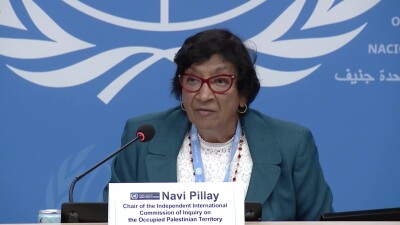
“People from the north of Gaza move south and suddenly they get attacked in the south. We read all those contrary instructions as pointing to an attitude of not caring for their lives, destruction and dislocation,” said Navi Pillay, Chair of the Commission of Inquiry on the Occupied Palestinian Territory including East Jerusalem and Israel.
Speaking on the sidelines of the Human Rights Council after presenting the Commission’s report on the initial months of the conflict, Ms. Pillay insisted that in accordance with the laws of war: “You cannot kill civilians, you have to protect them. With this occupation, based on all the information we gathered, it's pretty stark to us. There’s a very clear intention of forcible dislocation of people just to force them out.”
‘Third party’ support
Asked about the role of “third party” countries in both the large-scale bombing and the occupation of Gaza, Ms. Pillay replied that “again and again, thousands of people are telling us that had it not been for the help of powerful countries, Israel would not have been able to carry out this perpetual occupation”.
And in response to the discrepancy between the panel’s findings that war crimes have likely been committed by the Israeli Defense Forces and the current government’s representations of its soldiers as among the most "morally responsible" in the world, Ms. Pillay said that she remained extremely concerned about the widespread killing and destruction of public buildings including hospitals and one university “razed to the ground”.
“I don't know whether it's one of the most moral armies in the world or not, but what I do have expertise in and what I do have authority to do is make assessments of criminal conduct,” said fellow Commissioner Chris Sidoti. “And we've done that in relation to the recent events and you can see that in the report. And the only conclusion you can draw is that the Israeli army is one of the most criminal armies in the world.”
Massive human cost
Since Hamas-led terror attacks on multiple sites in southern Israel on 7 October claimed some 1,250 lives and left more than 250 captured as hostages, Mr. Sidoti noted that “thousands of children, women and men had been killed and injured - Palestinians, Israelis and citizens of other States”.
Responding to allegations that the Commission of Inquiry had done too little to investigate allegations of serious sexual abuse against hostages, Ms. Pillay highlighted the lack of cooperation and access by the Israeli authorities to victims of the 7 October attacks.
“They are denying the victims on the ground there from getting these voices, the authentic voices heard,” the independent rights investigator insisted, comments echoed by fellow Commissioner Mr. Sidoti: “There are hostages that have been released. We would like very much to talk to them when it's appropriate to do so, taking into account the physical and psychological conditions. I mean, our first rule in evidence-collecting is do no harm. So, at an appropriate time for them, we want to talk to them. We want to find out what happened.”
Hostage horror
Earlier in the Human Rights Council, the Commission asserted that the Israeli authorities had been responsible for war crimes and crimes against humanity and that Hamas militants had also carried out war crimes of intentionally directing attacks against civilians and “patterns” of sexual abuse, primarily against Israeli women.
A representative from Israel who also spoke at the Council introduced herself as the mother of 23-year-old Romi Gonen, whose car carrying three other passengers was shot at by Hamas fighters who captured her on 7 October.
“As the only survivor, she was brutally dragged by her long, beautiful hair from the car, along the road. I was a witness to this reality while speaking with her on the phone, hearing her helplessness and frustration…That was 257 days ago, and 119 hostages were still being held incommunicado in the Gaza Strip to this day.”
Accountability principle
The Commission of Inquiry's search for transparency is standard procedure in human rights investigations and rooted in a desire to address the causes of unresolved conflicts - like the one in Gaza and the wider Middle East – and pursue accountability for the sake of the victims, the Commissioners explained.
“We've got to understand why this has occurred if we are interested in stopping it from happening again and that that that to me is the key point here,” Mr. Sidoti said. “This has happened time and time and time again. And this is the worst ever. This is the highest death toll ever in this protracted period of warfare…there must be accountability for every specific act of criminality. But if we're going to stop it in the future, we also have to address the question of the context in which it has occurred.”
About the Commission of Inquiry
The Commission of Inquiry was established by the UN Human Rights Council to investigate all alleged violations of international humanitarian law and abuses of international human rights law leading up and since 13 April 2021.
Its members are not UN staff and do not draw a salary.
ends
STORY: Commission of Inquiry - Occupied Palestinian Territories
SOURCE: UNTV CH
LENGTH: 2’39”
LANGUAGE: ENGLISH / NATS
ASPECT RATIO: 16:9
RESTRICTIONS: NONE
DATELINE: 19 JUNE 2024 GENEVA, SWITZERLAND
SHOTLIST
1. Exterior medium-wide, UN Geneva flag alley.
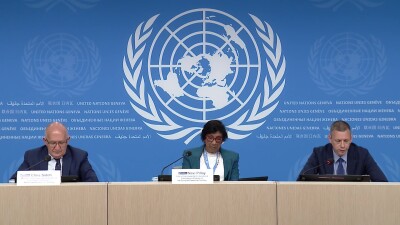
2. Wide, elevated camera shot of podium speakers and journalists.
3. SOUNDBITE (English) – Navi Pillay, Chair of the Commission of Inquiry on the Occupied Palestinian Territory including East Jerusalem and Israel: “People from the north of Gaza move south and suddenly they get attacked in the south. We read all those contrary instructions as pointing to an attitude of not caring for their lives, destruction and dislocation.”
4. Medium-wide of the Press room with journalists.
5. SOUNDBITE (English) – Navi Pillay, Chair of the Commission of Inquiry on the Occupied Palestinian Territory including East Jerusalem and Israel: “We adhere to the law; you cannot kill civilians, you have to protect them. With this occupation, based on all the information we gathered, it's pretty stark to us: there's a very clear intention of forcible dislocation of people just to force them out.”
6. Medium, speakers seated at podium.
7. SOUNDBITE (English) – Chris Sidoti, Member of the Commission of Inquiry: “I don't know whether it's one of the most moral armies in the world or not… But what I do have expertise in and what I do have authority to do is make assessments of criminal conduct. And we've done that in relation to the recent events and you can see that in the report. And the only conclusion you can draw is that the Israeli army is one of the most criminal armies in the world.”
8. Medium-wide, journalists and TV video journalists with cameras.
9. SOUNDBITE (English) – Navi Pillay, Chair of the Commission of Inquiry on the Occupied Palestinian Territory including East Jerusalem and Israel: “Thousands of people are telling us that had it not been for the help of powerful countries, Israel would not have been able to carry out this perpetual occupation.”
10. Medium-wide, press room showing rows of seats, journalists and podium.
11. SOUNDBITE (English) – Chris Sidoti, Member of the Commission of Inquiry: “There are hostages that have been released. We would like very much to talk to them when it's appropriate to do so, taking into account the physical and psychological conditions. I mean, our first rule in evidence collecting is do no harm. So, at an appropriate time for them, we want to talk to them. We want to find out what happened.”
12. Medium, journalists listening, taking notes in the Press room.
13. SOUNDBITE (English) – Chris Sidoti, Member of the Commission of Inquiry: “This has happened time and time and time again. And this is the worst ever. This is the highest death toll ever in this protracted period of warfare. And there must be accountability for every specific act of criminality. But if we're going to stop it in the future, we also have to address the question of the context in which it has occurred.”
14. Close, cameraman at work.
15. Wide, journalists and TV video journalists to rear.
16. Close, journalist taking notes.
17. Medium, journalists in press room.
Similar Stories

1
1
1
Press Conferences | UNHCR
End of UNHCR's 77th Annual Executive Committee (ExCom) meeting week

1
1
1
Edited News | UNICEF
A little over one year since a ceasefire agreement was announced between Hamas fighters and Israel, more than 340 children have been reported killed and hundreds more injured, the UN Children’s Fund, UNICEF, said on Friday.

1
1
1
Press Conferences | UNICEF , IOM , UNHCR
UN Special Assistant to the Personal Envoy Office (SUDAN): Peace Initiatives and Efforts in Sudan; UNICEF: Dire situation of children in Gaza; IOM: Damaged Homes and Energy Attacks Risk Displacing Ukrainians for this winter; UNHCR: update on EXCOM week

1
1
1
Press Conferences | IOM , UNDRR
UN stresses importance of household preparedness for disaster risk reduction.

1
1
1
Edited News | UNICEF , IFRC
Six weeks after Nepal’s deadly flooding disaster, communities are still struggling to rebuild their lives, but they will need sustained help as global warming increases the risk of another Himalayan catastrophe, the UN Children’s Fund (UNICEF) said on Friday.

1
1
1
Statements , Press Conferences | OHCHR
1
1
1
Press Conferences | UNHCR , UNICEF , IFRC , OHCHR , UN WOMEN , IOM , OCHA , WHO
UNHCR – ExCom Meeting, UNICEF – Nepal Recovery, IFRC – Flash Floods, WHO – Mental Health, IOM – South Sudan Floods, OCHA – DRC Humanitarian aid, UNHCR – Sahel Displacement, UNICEF – Yemen Update, IOM – Gaza Shelter, UN Women – Gaza Women, OHCHR – Arrests and detentions of Syrians by Israeli force
2
1
2
Press Conferences | UNCTAD
Presentation of the Trade and Developement Report 2026
Embargoed until 9 October 2026 at 11 a.m. (Geneva Time)
UNCTAD: UNCTAD’s flagship report finds that governments increasingly use industrial, trade, financial and technology policies to pursue economic and national security objectives. Market access and the ability to move into higher-value activities now depend more heavily on technology, finance and geopolitics.
1
1
1
Press Conferences | UPU
Release of the State of the Postal Sector Report 2026

1
1
1
Edited News | WHO
In suspected Russia plague death, testing and monitoring underway – WHO
The death of a lab worker in Russia’s Siberia region has sparked concerns about plague being the cause, the UN World Health Organization (WHO) said on Tuesday, adding that it was following the situation closely.
1
1
1
Press Conferences | IOM , ITU , UNECE , UNICEF , WHO , WMO
UNICEF: Ebola, DRC - children orphans or separating them from parents and caregivers; IOM: Humanitarian needs in Djibouti amid arrivals from Yemen and increased migrant movements; WHO: Darfur, scale of health needs far exceeds available resources; WMO co-sponsored Global Heat Forum, Bangkok, monthly Global Seasonal Climate Update; UNECE: UN Forum of Mayors; ITU Plenipotentiary Conference 2026; WHO: child and adolescent obesity guidelines and new global roadmap to tackle pregnancy hypertension, a leading cause of maternal mortality

1
1
Edited News | OHCHR , UNOG
UN Human Rights Chief Volker Türk on Friday provided and oral update to the 63rd session of the Human rights Council on Ukraine.