

The United Nations Office at Geneva
Multimedia Newsroom
PRESS BRIEFING BY THE UNITED NATIONS INFORMATION SERVICE
15 December 2023
Alessandra Vellucci, Director of the United Nations Information Service (UNIS) in Geneva, chaired the hybrid briefing, which was attended by spokespersons and representatives from the International Labour Organization, the United Nations Children's Fund, the World Health Organization, the Food and Agriculture Organization and the World Food Programme.
UNICEF’s Global Humanitarian Appeal for Children Affected by Conflict and Disaster
Ted Chaiban, United Nations Children's Fund (UNICEF) Deputy Executive Director, Humanitarian Action and Supply Operations, said that in the entirety of his more than 25-year career with UNICEF, it was hard to recall a year in which the situation facing children affected by conflict and disaster had been as dire as the one we were currently witnessing. Humanitarian organizations’ work had rarely been as important or more complex. The horrendous situation in Gaza, which shook us to the core of our humanity, exemplified this.
Earlier this week, UNICEF launched a 9.3 billion United States dollar (USD) emergency funding appeal to reach at least 93.7 million children in 155 countries. 2024 had an increasingly bleak funding forecast. Flexible funding was shrinking, restricting UNICEF’s ability to respond quickly and ensure principled action based on needs. Humanitarian actors’ ability to safely reach affected populations was also increasingly at risk, with continued attacks against humanitarian aid workers around the world.
Throughout the year, children around the world had faced rampant violations and denials of their rights. In November, Mr. Chaiban visited frontline areas in the Kharkiv and Zaporizhzhia regions of Ukraine, and stressed the urgent need for continued humanitarian response in conflict-affected areas. In October, he went into Gaza, where unprecedented numbers of children had reportedly killed in the continuing violence. In July, he met families in Sudan, where millions of children had been forced from their homes in what was now the largest child displacement crisis in the world.
Beyond these crises, there were other children suffering as well. This year he had met children in need in Jordan, Lebanon, Egypt, Chad and Mali. Such devastating conflicts, combined with a rise in climate-related disasters, disease outbreaks and displacement, meant children continued to endure the unimaginable impact of protracted crises and emerging threats.
In all of these contexts, UNICEF was on the ground, providing children and families with essential life-saving aid, and exploring innovative new solutions to challenges that had plagued humanity for centuries. But at a time when humanitarian and protection needs had never been greater, it was concerned that its ability to meet the needs of children was going to come under significant strain. Critically underfunded emergencies included Sudan, Burkina Faso, Democratic Republic of Congo, Myanmar, Haiti, Ethiopia, Yemen, Somalia, South Sudan and Bangladesh.
UNICEF and its partners were committed to providing a comprehensive response to the many humanitarian crises affecting children. Children should not be paying the price of our inaction with their lives and their futures. They needed continued access to essential services like health care, safe water, basic sanitation and education.
Children should not be going through crises like those in Gaza and Sudan. We needed to do everything possible, work with every fibre in our bodies so that children would not have to go through these kinds of situations.
In response to questions, Mr. Chaiban said the absolute amount of funding being provided for UNICEF was flat, but needs were rising. This year’s appeal of 9.3 billion USD was a 16 per cent decrease from the appeal from last year. UNICEF was focusing its efforts and working with partners to increase its efficiency and decrease the amount of funding it used. The UN continued to be a major conduit through which the world addressed crises. There had not been a marked shift in funding in the multilateral system.
UNICEF was working to reach 94 million children in 30 countries this year and was also conducting five regional appeals. It continued to work in fields that were essential for children, such as health, nutrition, water, sanitation and hygiene. It was still providing vaccines and treatment for malnutrition, psychosocial support for child victims of violence and sexual abuse; it was also addressing recruitment of children and providing education. However, there was a possibility that it would not be able to sustain programmes such as cash transfers for survivors of sexual and gender-based violence in 2024. Funding made a huge difference to the support that UNICEF could provide.
Global MPOX Situation, Outbreak in the Democratic Republic of the Congo
Dr. Rosamund Lewis, World Health Organization (WHO) Technical Lead for MPOX, said the global outbreak of MPOX, which started in May 2022, affected more than 92,000 people in 117 countries. Cambodia was the most recent country to report an outbreak, and an outbreak had been reported on a cruise ship in Southeast Asia and the Western Pacific.
WHO had undertaken a multi-party mission to the Democratic Republic of Congo (DRC). It assessed over three weeks the situation regarding MPOX in the country and reached quite concerning conclusions. The outbreak of MPOX in the country was rapidly expanding. From 1 January through mid-November 2023, the DRC had more than 13,000 suspected MPOX cases and more than 600 deaths. This was the highest number of annual cases reported compared to the prior peak of less than 6,000 cases reported in 2020.
The outbreak was expanding geographically, including to provinces not previously known to have MPOX. MPOX cases had been reported in 156 health zones from 23 out of 26 provinces (85 per cent).
In the Democratic Republic of the Congo, WHO had noted the first reported sexual transmission of the Clade I MPOX virus. This raised concerns for accelerated transmission of the virus. There were two clades of the virus. Clade II was the predominant strain associated with the global outbreak that began in 2022. Clade I had been circulating in DRC and neighbouring countries for years. In the DRC, Clade I was now moving through sexual networks that included male and female sex workers and their clients in areas with high population mobility. This was the first time that MPOX was being reported in more women than men.
In south Kivu, it was exclusively among adults, whereas in the endemic areas, large numbers of children were affected. 70 per cent of cases in the endemic areas remained in children under 15 and mostly in children under five.
The Clade I virus had been shown to be more virulent in animal studies and human populations than Clade II. In the DRC, its 4.6 per cent case fatality rate was substantially higher than the global rate of less than 1 per cent. In the most endemic areas, it was almost nine per cent. This represented a public health risk of the people of the DRC.
There was also concern about possible transmission in neighbouring countries through movement of sex workers. This also represented a risk for the rest of the world. The 2022 outbreak demonstrated what could happen when MPOX entered networks with frequent physical contact. There were some cases among men who had sex with men in the DRC, but WHO was primarily concerned about the major increase in cases in the endemic area, as well as among sex workers in previously unaffected areas.
Kinshasa had had an outbreak and there was concern that there would be continuing low-level transmission there. There was a lot of work ongoing in the DRC to raise awareness of MPOX among communities and to train health workers. WHO was concerned that the Clade I virus would continue to evolve.
There was an urgent need to invest in surveillance, laboratory capacity and rapid tests. Risk communication and community engagement was also critically important. This was a complex situation and there needed to be engagement of the different communities, including men who have sex with men, sex workers, migrant workers and those in endemic areas, especially children.
WHO was working with the Ministry of Health in all areas of the response, including working towards access to countermeasures such as vaccines and therapeutics. There were trials for therapeutics ongoing around the world, but they had slowed down because the number of cases had slowed down. The one trial that was continuing to recruit patients faster than expected was the trial in the DRC. WHO was looking forward to receiving results on tests of the therapeutic “tecovirimat” from the DRC early in the new year.
Vaccines had been made available to other populations around the world. The DRC did not have access to these vaccines yet, so work was being done with authorities to develop an immunisation strategy and approve importation of products into the country. It was very important to continue engaging with the affected communities in the DRC.
In response to questions, Dr. Lewis said that vaccine manufacturer Bavarian Nordic was interested in engaging with WHO to increase production of its MPOX vaccine. It had increased production capacity five-fold. WHO had secured licencing for that new process. WHO was looking forward to this development. It was also increasing access through regulatory procedures. Many countries around the world that did procure the vaccine were also ready to offer it to low- and middle-income countries. WHO was also working with Gavi, the Vaccine Alliance on assessing the situation.
There was a public health emergency declared for MPOX in 2022, and although that had since been lifted, the situation was still very serious. WHO was concerned that the outbreak in the Democratic Republic of the Congo could lead to further international transmission of the Clade I disease.
WHO had information that there was an outbreak on a cruise liner that had travelled to five countries in November. One person who had travelled on the cruise liner tested positive to the Clade II virus after returning to Europe. This was a themed cruise where men had sexual intercourses with men. WHO was calling for increased vigilance and awareness of MPOX.
Many countries had stopped reporting MPOX cases this year, but there were still outbreaks being reported, and WHO was calling for all countries to resume reporting cases.
Food Security Situation in Sudan
Adam Yao, Food and Agriculture Organization (FAO) Deputy Representative in Sudan, said today marked eight months since violence broke out in Sudan. The food security situation in the country was dire and had surged to extremely alarming levels, requiring our immediate and collective action.
According to the newly released Integrated Food Security Phase Classification (IPC) projections, 17.7 million people across the Sudan, accounting for 37 per cent of the analysed population, were facing high levels of acute food insecurity, classified as IPC Phase 3 or above (crisis or worse) between October 2023 and February 2024.
Compared to the previous second projection analysis in June 2023, around 1.7 million people (four per cent of the population) had shifted from IPC Phase 1 (none/minimal) to IPC Phase 2 (stressed). At the same time, the estimated populations facing high levels of acute food insecurity (IPC Phase 3 or above) increased from 15 million people to 17.7 million people.
The most acutely food insecure populations were located in states affected by high levels of violence, including Greater Darfur, Greater Kordofan and Khartoum – especially in the tri-city area of Khartoum, Bahri and Omdurman.
In Khartoum state, 3.9 million people – over half of the population - faced high levels of acute food insecurity (IPC Phase 3 or above). In Greater Darfur, about 5.3 million people - almost half of the total population in the Darfur region - were likely to be in IPC Phase 3 or above. In Greater Kordofan, about 2.7 million - 44 percent of the total population in Kordofan states – were in IPC Phase 3 or above. These figures were the highest ever recorded in Sudan’s harvesting season.
The food crisis was exacerbated by ongoing conflict, escalating violence, low agricultural production, high food prices, climate shocks and displacement. Factors such as the unstable rainfall conditions, the widespread plant pests, the unavailability and inaccessibility of agricultural inputs and the surge in their prices were collectively contributing to the decline of the seasonal agricultural performance, according to FAO’s recently released rapid assessment in November 2023. The assessment also indicated that the production of sorghum and millet, key staple cereals, was projected to decline by 24 per cent and 50 per cent, respectively, compared to the previous season.
While Sudan possessed sufficient land and water resources, the ongoing conflict impeded farmers’ ability to resume with their farming activities and produce enough food. The Sudanese people required support now more than ever and immediate action to preserve the lives and livelihoods of rural Sudanese communities was absolutely crucial.
The longer we took to respond, the more lives we exposed to the imminent threat of famine. Funding was of the essence, and swift action was our only shield against this looming danger.
FAO stood resolute in its support for Sudanese rural communities. Between July and September 2023, ahead of the critical planting season, FAO reached over 1 million farming households– or 5 million people – to support local food production and sustain rural livelihoods. However, instability and access challenges continued to threaten food security.
Leni Kenzli, World Food Programme (WFP) Spokesperson for Sudan, said today we marked a grim milestone: eight months since a horrific war erupted across Sudan. There had been eight months of terror, violence, displacement and immeasurable suffering that the Sudanese people had had to endure in what had become one of the world’s worst humanitarian crises. The suffering was unimaginable, yet the crisis had not been getting the international focus and attention that was warranted, as the conflict continued to upend millions of lives and worsen what was already a dire situation.
WFP was warning of a looming hunger catastrophe by next year’s lean season if it could not expand access and regularly deliver food assistance to people trapped in conflict hotspots such as Khartoum, the Darfur region in the west, and the south-central Kordofan region.
Families could not escape the capital Khartoum, unable to get past checkpoints to flee the violence. Amid ongoing airstrikes and shelling, they were risking their lives to go outside to purchase basic goods. Even now, they were struggling to put food on their plates – yet when the lean season would hit in May and food would become less available, they could be out of options unless WFP could get through and regularly deliver assistance.
The hunger crisis was deepening at an alarming rate, as the new IPC food security analysis presented today showed. The analysis had found the highest levels of hunger ever recorded during the current harvest season, typically a period where more food was available. If there was no significant increase in food assistance by the time the lean season arrived, conflict hotspots could see the emergence of catastrophic hunger – or level 5 out of 5 – the highest level on the IPC scale. Nearly 18 million people across Sudan were facing acute hunger right now – equivalent to the entire population of the Netherlands, and more than double the number at the same time a year ago.
Close to five million people were at an emergency level of food insecurity (IPC Phase 4), with over three-quarters of these people cornered in areas where humanitarian access had been intermittent and, in some areas, impossible due to ongoing fighting.
Since the start of the conflict, WFP had provided life-saving assistance to over five million people, preventing an even worse deterioration of food security, especially in eastern and northern Sudan. Yet this was only scratching at the surface of the immense needs on the ground.
Regular and safe humanitarian access to civilians in areas worst hit by violence had been inadequate. WFP had taken advantage of momentary lulls in fighting to reach families in greater Khartoum with food assistance but had only managed to reach the capital once in the last three months. Only one in five people who WFP had identified as most urgently in need of food assistance in the Khartoum area had received food aid since the conflict started.
Regular convoys of food assistance had travelled from Chad to West and Central Darfur since August, providing half a million people with food assistance. Yet, people in other parts of the Darfur region had not received any assistance since June, despite WFP’s repeated attempts to obtain safe access.
The situation was extremely dire, and WFP was urgently calling all parties to the conflict for a humanitarian pause and unfettered access to avert a hunger catastrophe in the upcoming lean season. Lives were depending on it.
In response to questions, Mr. Yao said the crisis was deepening, but the support that FAO had provided had reached more than one million farmers, who had produced two to three million tonnes of cereal. There was no way to reach certain regions. FAO was appealing for a ceasefire so humanitarian organisations could have access. It was supporting farmers in areas where it had access, and providing cash transfers to farmers it could not access. It needed a humanitarian corridor to provide support in hard-to-reach areas.
There needed to be more support for local Sudanese farmers to strengthen their production and resilience. FAO urgently needed 75 million USD to support its operations in Sudan. These operations would build synergy with WFP’s operations, better increasing local populations’ resilience and decreasing reliance on food assistance.
Ms. Kenzli, responding to questions, said right now was the harvest season and there was more food available, but there would be less available in the coming lean season. WFP had recently provided support to 100,000 people in one region of Khartoum for the first time since July but could not reach other regions. It was doing what it could to deliver support whenever and wherever feasible and needed a ceasefire to deliver more aid.
WFP was concerned for the safety and security of its staff. Humanitarian ceasefires had been broken within seconds in the past. It was continuing to push for a ceasefire. This was one of the most complex conflict environments in the world. WFP was working to ensure the safety of its workers while trying to deliver food.
There were just over 30,000 tonnes of food stock in Port Sudan, which was 850 kilometres away from Khartoum. This had to be delivered across different lines of control. WFP needed 252 million USD to help the millions of people at the highest level of food insecurity in Sudan. Sourcing food was not an operational issue for WFP.
WFP had been able to get food assistance to the Darfur region at the start of the conflict, and since then, had delivered 10 different convoys of food assistance, supporting half a million people. However, this was not enough, as it was unable to access certain areas of Darfur.
People were still fleeing Sudan. Around 6.7 million people had been displaced, of which 1.4 million had crossed Sudan’s borders, including into Chad. This was an active warzone and people were trying to find ways to survive. WFP’s mission in Chad was also short of funds and could be forced to scale back operations. Around 650 million USD was needed for WFP’s entire regional response.
Announcements
Alessandra Vellucci, Director of the United Nations Information Service (UNIS) in Geneva, said this afternoon, United Nations High Commissioner for Refugees Filippo Grandi was expected to hold an in-person stakeout at Palexpo. The stakeout, if happening, would be covered live and broadcast on UN Web TV [later on, it was announced that the stakeout would not be held].
On Tuesday, 19 December at 9:30 a.m., the World Health Organization (WHO) would hold a press conference addressing Ukraine’s second winter under war, health system challenges and the way forward. Speaking from Kyiv would be Dr. Jarno Habicht, WHO Representative in Ukraine.
Starting Wednesday, 20 December, the Palais des Nations would close for energy-saving measures, to be reopened on 8 January. Journalists would be able to access Building S-2, which would function normally, but the rest of the Palais would be closed, including the cafeteria. The last UNIS press briefing of the year would be held on Friday, 22 December, and it would be held virtually, as would the first briefing of 2024, to be held on 5 January.
Similar Stories
1
1
1
Press Conferences | OCHA , UN WOMEN , UNHCR , WFP , WHO , WTO , UNEP
OCHA – $160M CERF allocation to 12 underfunded crises; UNHCR – 5.8M refugee children remain out of school amid funding cuts; UN Women – Middle East escalation and food security among women/girls; WHO – Gaza supplies and overall situation; WFP – Yemen food insecurity and impact on global hunger ; UNEP - First International Conference of the Global Framework on Chemicals in Geneva | 16-20 November 2026
1
1
1
Press Conferences | UNHCR , WHO
Yemen's health system nears collapse amid conflict, causing rising casualties and medicine shortages.
1
1
1
Press Conferences | HRC
Update by the Expert Mechanism to Advance Racial Justice and Equality in Law Enforcement
1
1
1
Press Conferences | WIPO , WHO , UNICEF , UNHCR , IOM , WFP , FAO
WIPO Global Innovation Index 2026 launch and press conference, WHO Composition of influenza vaccines for the 2027 Southern Hemisphere flu season, UNICEF Yemen hunger and malnutrition; UNHCR Sudan displacement into Chad; IOM Ebola and population movements in DRC; WFP emergency food assistance in Nepal; and FAO food loss and waste.
2
1
2
Press Conferences | UNCTAD
Gaza reconstruction needs reach $71.5 billion as Palestinian economy and public finances face severe strain. Latest UNCTAD report documents the loss of decades of development gains, economic collapse in Gaza and tightening economic constraints in the West Bank.
The report identifies three immediate priorities: transferring withheld Palestinian revenues, safeguarding the banking system and aligning reconstruction support with the documented scale of damage and economic losses.
1
1
1
Press Conferences | HRC
Press conference on the situation of human rights in Nicaragua by the UN Group of Human Rights Experts
1
1
1
Press Conferences | ITU , UNHCR , WHO , WMO
YEMEN - UNHCR: Escalating conflict in Yemen could fuel more displacement, refugee movement
CLIMATE - WHO / WMO: Health and Climate impact of El Niño
1
1
1
Press Conferences | HRC , OHCHR
Mariana Katzarova discusses human rights in Russia as a UN Special Rapporteur.
1
1
1
Press Conferences | IOM , OHCHR , UN WOMEN , UNFPA , UNHCR , UNOPS , WHO
UN Geneva briefing: Yemen crisis worsens, urgent aid needed across multiple sectors.
1
1
1
Press Conferences | HRC
Press conference on the latest report of the Independent International Fact-Finding Mission on the Bolivarian Republic of Venezuela to the UN Human Rights Council
1
1
1
Press Conferences | OHCHR
Victims Still Waiting: A Global Briefing on Transitional Justice Around the World
2
1
2
Edited News , Press Conferences | WMO
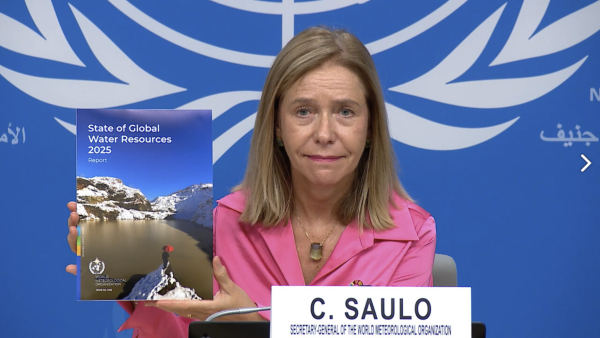
As world’s water reserves change, countries must prepare for a new reality: WMO
New data showing that rivers were at their lowest level for decades last year provides further evidence that the climate crisis is real and countries must act immediately to protect themselves from the increasing threat to communities and livelihoods, the UN World Meteorological Organization (WMO) said on Thursday.
The key findings from WMO’s State of Global Water Resources 2025 report covering the hydrological cycle and extreme events in the five-year period to last year:
- 2025 was one of driest years for river discharge in 35 years
- Past seven years have seen abnorfmal river flows
- Water storage on Earth’s land surface has decreased in past decade
- Widespread glacier loss across all regions for fourth consecutive year
- Asia and Africa are regions most affected by water-related disasters
- Water data availability has improved, but gaps remain in hard-hit areas
Highlighting the long-term decline in the Earth’s freshwater storage and glacier melt, WMO Secretary-General Celeste Saulo explained that the planet’s water reserves used to act as a planetary “savings account” that absorbed the occasional dry season, avoiding a water crisis. “One of the central stories of the 2025 report is what is happening to that savings account? And the simple answer is that we are depleting it,” she told journalists in Geneva.
Groundwater reserves are equally stretched and have been in decline since 2014, WMO’s report states, with nearly two-thirds of monitored wells worldwide showing levels lower than the historical norm and indicating a shift “further toward deficit…not recovery”.
“At the same time, we are seeing more water-related disasters,” Ms. Saulo said, while also stressing that the currently strengthening El Niño “will increase the risk of drought in some areas, and flooding in others”.
Glaciers disappearing
In 2025, for the fourth consecutive year, every major glaciated region on Earth lost ice mass, leading to short-term hazards including floods and long-term water insecurity, according to WMO.
Responding to a question about whether the changing global water cycle might have contributed to the deadly Nepal-China flooding disaster, Ms. Saulo explained that melting ice and rock was just one factor in the chain of events that ultimately sent a massive and deadly wall of water and debris downstream on 26 August, killing at least 1,367 people.
“You asked if it could happen again? Absolutely; the problem in this region is that there’s 63,700 glaciers at the last count,” she told a Press Conference in Geneva. “Even if you’re looking with remote sensing with satellites at these glaciers, you might see some faults, you might see some slight shifting, that does not mean necessarily catastrophic collapse. So, in order to plan for this, it’s very, very difficult. But the international community is looking very hard at ways in which we can bring people together to solve some of these monitoring issues.”
Data indicates that glaciers shrank between 2023 and 2025 with cumulative losses of 1,400 gigatonnes of water – or about one third of annual fresh water needs.
Every major glacier region on Earth lost ice for the fourth consecutive year.
“All 19 glacier regions around the globe lost ice; in Central Asia, Iceland, the Russian Arctic and western Canada and the United States, it was among the three worst years on record,” said Wayne Jenkinson, WMO’s Director of Hydrology and Cryosphere.
Some regions with smaller glaciers such as Central Europe, the Caucasus, the western Canada and the United States may already have reached “peak water”, Mr. Jenkinson warned.
“After this point, the glacier gives less meltwater each year simply because there is less ice left to melt. That matters for every community downstream that relies on water during hot, dry summers,” he explained.
Narelle van der Wel, WMO’s Head of Cryosphere Monitoring, Predictions and Services, stressed that while some further glacier loss is unavoidable, the eventual scale of the decline is not predetermined.
“Some glacier loss is inevitable, but total loss of glaciers is not yet inevitable,” she said, pointing to emissions reductions as central to limiting future losses.
Preparing for moving baselines
The report does not attribute every observed change to climate change alone. WMO says pressure on water resources and natural variability also contribute.
Mr. Jenkinson said governments need to prepare for “moving baselines” as historical patterns become less reliable.
“The situation 30 years ago is not where we are today,” he said. Countries, he added, need to prepare “for those changes that have really already arrived”.
ends