

The United Nations Office at Geneva
Multimedia Newsroom
PRESS BRIEFING BY THE UNITED NATIONS INFORMATION SERVICE
5 December 2023
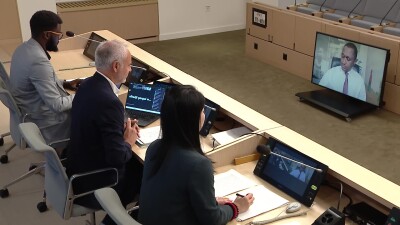
Rolando Gómez, Chief of the Press and External Relations Section at the United Nations Information Service in Geneva, chaired a hybrid briefing, which was attended by spokespersons and representatives of the Office of the High Commissioner for Human Rights, the World Health Organization, the United Nations Children’s Fund, and the General Fisheries Commission for the Mediterranean (GFCM) of the Food and Agricultural Organization (FAO).
Humanitarian situation in Gaza
Dr. Richard Peeperkorn, World Health Organization (WHO) Representative in the occupied Palestinian territory, speaking from Rafah in Gaza, said that the situation in Gaza was getting worse by the hour, with intensified bombing, including in southern areas. There was an increasing number of internally displaced persons, and people were desperate and in a permanent state of shock. Of the 16,000 people killed, more than 60 per cent were women and children. A child was killed every ten minutes in Gaza. We were close to the humanity’s darkest hour, and a sustained ceasefire was needed, stressed Dr. Peeperkorn.
WHO’s biggest concern was the vulnerability of the health infrastructure in Gaza, which was crippled. There was hardly any functional health facility in the north. What had happened in the north of Gaza ought not be a blueprint for the south, as the health needs were soaring. Dr. Peeperkorn spoke of witnessing horror scenes in hospitals, with patients on the floor not getting the treatments they needed, people yelling and crying. The two major hospitals in the south were severely overburdened. The health infrastructure had to be protected. The European Gaza Hospital had to be protected and its capacity expanded, and more medical supplies ought to be brought in. There were some 86,000 registered cases of diarrhea, as well as cases of chickenpox, skin rash, and meningitis, among other diseases.
Rolando Gómez, for the United Nations Information Service, reminded of the Secretary-General’s statement from the previous day, in which he reiterated his call for a sustained humanitarian ceasefire in Gaza and the unconditional and immediate release of all remaining hostages. For people ordered to evacuate, there was nowhere safe to go and very little to survive on. According to an update from UNRWA, at least 130 of their staff had been killed in Gaza since 7 October, said Mr. Gómez.
Responding to numerous questions from the media, Dr. Peeperkorn said that the WHO had secured two adjacent warehouses in Khan Younis in the first weeks of the conflict, preparing for the upcoming humanitarian catastrophe. Thanks to those warehouses, the WHO had managed to distribute medical supplies across the Strip. All movements had to be notified. On 4 December in the morning, the WHO had been advised by Israel to move as many of its supplies from the warehouses as possible, because those two warehouses were likely to be in an active combat area in the coming days. WHO had complied because it wanted to make sure that the existing essential medical supplies could be delivered. A smaller warehouse in Rafah had been quickly identified, and almost 90 per cent of WHO’s medical supplies had now been moved to it. Over the coming days, the WHO was planning to distribute the supplies to the medical facilities in the south and was also hoping to take some supplies to the north, conditions allowing. WHO needed both more warehouses and more supplies, he said.
Without UNRWA, the humanitarian situation in Gaza would be so much worse, stressed Dr. Peeperkorn, and UNRWA had to be supported. For this kind of humanitarian disaster, many more medical supplies, food, water, fuel and so much more was needed. What was available inside Gaza was way too little. What had happened in the north could not be allowed to happen in the south; the health system had to be supported as much as possible. Dr. Peeperkorn also spoke about the need to set up a functioning referral system under the current circumstances. Health infrastructure had to be protected. He repeated the concern over the vulnerability of the entire health system. WHO had a team of 26 national and 6 international staff in Gaza, who were all under immense pressure and some of them had lost family members.
Answering questions, James Elder, for the United Nations Children’s Fund (UNICEF), speaking from Cairo, said that the level of destruction and the death of women and children seen in the north was now recurring in the south. Israel had apparently chosen that its precautionary measures meant evacuation to so-called safe zones. Under international humanitarian law, places to which people were evacuated had to have conditions of food, water, medicine, and shelter. Mr. Elder witnessed himself that the evacuation areas in Gaza were woefully inadequate. Critically, there was no sanitation; in some places people had no toilets at all, and diseases were simply waiting to happen. Israel, as the occupying power, was under obligation to provide food, water, and medicine, reminded Mr. Elder. The only way to create truly safe places was to stop hell falling from the sky. A humanitarian ceasefire was the only way to protect civilians in Gaza, he reiterated. The indifference he had witnessed was heartbreaking.
Replying to a question, Tarik Jašarević, for the World Health Organization (WHO), said that the list of countries which had requested an emergency meeting of the WHO Executive Board on the situation in Gaza would be shared with the public once it had been shared with all Member States. Draft documents could be proposed for discussion until 8 December. The meeting, which would be held in a hybrid format on 10 December, was expected to be livestreamed, unless decided otherwise by the Board.
Human Rights 75: high-level event in Geneva on 11-12 December
Elizabeth Throssell, for the Office of the High Commissioner for Human Rights (OHCHR), informed that the OHCHR was organising a high-level event in Geneva on 11 and 12 December to mark the 75th anniversary of the Universal Declaration of Human Rights. The event would be the culmination of Human Rights 75 – a year-long initiative by the Office to reaffirm the values of the Universal Declaration and recommit to human rights as the pathway to address the challenges of today and the future.
Heads of State and Government, and other high-level State dignitaries would gather with human rights defenders, young people, civil society organisations, business, sportspeople, artists, economists, representatives from UN entities and regional organizations at the Palais des Nations. Among the key moments on 11 December, there would be two pledging sessions where States would announce tangible commitments to advance human rights protection. In two segments entitled Voices in defence of human rights, participants would share their testimonies and perspectives on the impact of the Universal Declaration. Panel discussions would be held with experts looking into challenges and the way forward on the universality and indivisibility of human rights and how to strengthen the human rights system.
Ms. Throssell said that the opening ceremony on 12 December would involve a discussion with Heads of State, moderated by the High Commissioner, which would be followed by four round tables on pressing human rights issues and the future of human rights: peace and security; digital technologies; climate and the environment; and development and the economy. The entire event, which was envisioned to be of global nature, would be accessible through a virtual human rights centre that will enable up to 3,000 people to take part online. All details are available here.
Rolando Gómez, for the United Nations Information Service, added that a note to correspondents with logistical details had been sent out today.
Responding to a question, Ms. Throssell confirmed that a number of Heads of State, Prime Ministers, and Foreign Ministers would be attending in person. She said that some 120 States were expected to present their pledges in person, in addition to pledges by civil society. Those pledges would cover a wide spectrum of human rights’ examples of pledges could include, for example, increasing budget for human rights, ratifying human rights conventions and their optional protocols, or making donations to the OHCHR. All pledges would be shared on the OHCHR website afterwards.
State of Mediterranean and Black Sea Fisheries 2023
Elisabetta Betulla Morello, Acting Fisheries Team Leader at the General Fisheries Commission for the Mediterranean (GFCM), speaking from Rome, said that the GFCM was a body of the Food and Agriculture Organization and the regional fisheries management organization for the Mediterranean and the Black Sea. It consisted of 23 member countries and its main objective was to ensure the conservation and the sustainable use of living marine resources, as well as the sustainable development of aquaculture.
Ms. Betulla Morello informed that the GFCM flagship publication - The State of Mediterranean and Black Sea Fisheries would be officially launched on 7 December. The Mediterranean and Black Sea was a region with high demand for aquatic foods and a long tradition for fish consumption, both from fisheries and aquaculture. It was characterised by a high diversity in terms of species harvested and in terms of fishing practices. It was also considered a hotspot for climate change impacts and nonindigenous species.
The flagship publication, published since 2016, was able to first identify a reversal in the trend in overexploitation in the region. It had reported the continuous improvement in the percentage of overexploited stocks in line with management efforts. For the first time this year it included an analysis of aquaculture showing the importance of aquaculture and fisheries combined. This year, it would be reporting the advances made from the application of the ten multiannual management plans and ten fisheries restricted areas adopted by the GFCM over the years, confirming that effective management paid off and was the path to secure sustainability of fisheries and aquaculture.
Responding to a question, Ms. Betulla Morello said that the management plans covered in the same way European Union and non-EU countries of the Mediterranean. They were based on scientific advice on what was needed to reach sustainability.
Announcements
Rolando Gómez, for the United Nations Information Service, reminded of several statements by the Secretary-General at COP28, which had been shared with the media.
He informed that the Committee on the Elimination of Racial Discrimination would close its 111th session on 8 December, at 4 pm, and issue concluding observations on the six countries reviewed: Bolivia, Morocco, Germany, South Africa, Bulgaria, and Vietnam.
The Committee on the Protection of the Rights of All Migrant Workers and Members of their Families would have a public meeting on 7 December, at 3 pm, on the OHCHR Program on the reinforcement of the Treaty bodies capacities devoted to the effects of climate change on the human rights of migrants. It would then close its 37th session on 8 December, at 5:30 pm, and issue concluding observations on the three countries reviewed: Uruguay, Kyrgyzstan, and Sao Tome and Principe.
A high-level pledging event for the Central Emergency Response Fund (CERF) would be held in New York on 6 December.
Finally, Mr. Gómez reminded that on 6 December at 11 am, the Human Rights High Commissioner, Volker Türk, would hold his end-of-year press conference, which would be webcast live at webtv.un.org.
Similar Stories
1
1
1
Press Conferences | UNHCR
End of UNHCR's 77th Annual Executive Committee (ExCom) meeting week
1
1
1
Press Conferences | UNICEF , IOM , UNHCR
UN Special Assistant to the Personal Envoy Office (SUDAN): Peace Initiatives and Efforts in Sudan; UNICEF: Dire situation of children in Gaza; IOM: Damaged Homes and Energy Attacks Risk Displacing Ukrainians for this winter; UNHCR: update on EXCOM week
1
1
1
Press Conferences | IOM , UNDRR
UN stresses importance of household preparedness for disaster risk reduction.
1
1
1
Statements , Press Conferences | OHCHR
1
1
1
Press Conferences | UNHCR , UNICEF , IFRC , OHCHR , UN WOMEN , IOM , OCHA , WHO
UNHCR – ExCom Meeting, UNICEF – Nepal Recovery, IFRC – Flash Floods, WHO – Mental Health, IOM – South Sudan Floods, OCHA – DRC Humanitarian aid, UNHCR – Sahel Displacement, UNICEF – Yemen Update, IOM – Gaza Shelter, UN Women – Gaza Women, OHCHR – Arrests and detentions of Syrians by Israeli force
2
1
2
Press Conferences | UNCTAD
Presentation of the Trade and Developement Report 2026
Embargoed until 9 October 2026 at 11 a.m. (Geneva Time)
UNCTAD: UNCTAD’s flagship report finds that governments increasingly use industrial, trade, financial and technology policies to pursue economic and national security objectives. Market access and the ability to move into higher-value activities now depend more heavily on technology, finance and geopolitics.
1
1
1
Press Conferences | UPU
Release of the State of the Postal Sector Report 2026
1
1
1
Press Conferences | IOM , ITU , UNECE , UNICEF , WHO , WMO
UNICEF: Ebola, DRC - children orphans or separating them from parents and caregivers; IOM: Humanitarian needs in Djibouti amid arrivals from Yemen and increased migrant movements; WHO: Darfur, scale of health needs far exceeds available resources; WMO co-sponsored Global Heat Forum, Bangkok, monthly Global Seasonal Climate Update; UNECE: UN Forum of Mayors; ITU Plenipotentiary Conference 2026; WHO: child and adolescent obesity guidelines and new global roadmap to tackle pregnancy hypertension, a leading cause of maternal mortality
1
1
1
Press Conferences | OCHA , UN WOMEN , UNHCR , WFP , WHO , WTO , UNEP
OCHA – $160M CERF allocation to 12 underfunded crises; UNHCR – 5.8M refugee children remain out of school amid funding cuts; UN Women – Middle East escalation and food security among women/girls; WHO – Gaza supplies and overall situation; WFP – Yemen food insecurity and impact on global hunger ; UNEP - First International Conference of the Global Framework on Chemicals in Geneva | 16-20 November 2026
1
1
1
Press Conferences | UNHCR , WHO
Yemen's health system nears collapse amid conflict, causing rising casualties and medicine shortages.
1
1
1
Press Conferences | HRC
Update by the Expert Mechanism to Advance Racial Justice and Equality in Law Enforcement
1
1
1
Press Conferences | WIPO , WHO , UNICEF , UNHCR , IOM , WFP , FAO
WIPO Global Innovation Index 2026 launch and press conference, WHO Composition of influenza vaccines for the 2027 Southern Hemisphere flu season, UNICEF Yemen hunger and malnutrition; UNHCR Sudan displacement into Chad; IOM Ebola and population movements in DRC; WFP emergency food assistance in Nepal; and FAO food loss and waste.