

The United Nations Office at Geneva
Multimedia Newsroom
Press Conferences | UNCTAD , WMO , WFP , UNHCR , UNICEF , UNAIDS
Bi-weekly press briefing - 24 November 2023
PRESS BRIEFING BY THE UNITED NATIONS INFORMATION SERVICE
24 November 2023
Alessandra Vellucci, Director of the United Nations Information Service in Geneva, chaired a hybrid briefing, which was attended by spokespersons and representatives of the United Nations Refugee Agency, the United Nations Children’s Fund, the World Meteorological Organization, UNAIDS, the World Food Programme, the United Nations Conference on Trade and Development, the World Health Organization, and the Office for the Coordination of Humanitarian Affairs.
Humanitarian toll on civilians in eastern Democratic Republic of the Congo
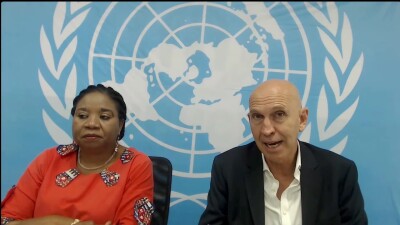
Angele Dikongue-Atangana, United Nations Refugee Agency (UNHCR) Representative for the Democratic Republic of the Congo, speaking from Kinshasa, said that the UNHCR and UNICEF were greatly alarmed by the escalating crisis unfolding once again in eastern Democratic Republic of the Congo (DRC). Violent clashes between non-state armed groups and government forces had forcibly displaced more than 450,000 people in the previous six weeks in Rutshuru and Masisi territories in North Kivu Province. The severity of the crisis was further exacerbated by the limited humanitarian access to those in dire need, primarily due to the obstruction of major routes. Cut off from essential humanitarian aid, approximately 200,000 internally displaced people were currently stranded. Tragically, an additional 100,000 people were anticipated to confront restricted access in the coming days if the current trends of conflict persisted.
The disruption of roads not only impeded the delivery of critical humanitarian aid but also heightened the vulnerability of displaced populations, leaving them without essential resources and protection. UN partners and humanitarian actors were urgently scaling up humanitarian and protection assistance to tackle urgent needs stemming from overcrowding and inadequate shelter in spontaneous sites in the eastern provinces, with limited access to food and clean water. Cholera outbreaks continued, signalling concerning limitations of the humanitarian aid currently available.
Grant Leaity, United Nations Children’s Fund (UNICEF) Representative for the Democratic Republic of the Congo, also speaking from rom Kinshasa, said that the intensification of violence was having a devastating impact on the lives of children, who were facing an alarming number of serious violations of their rights. The number of overall violations reported against children between July and September 2023, recorded by child protection partners, had seen a sharp increase of 130 per cent to 2018 cases on the already high number of violations reported for the first half of the year. Children were increasingly vulnerable to recruitment and use by armed groups, with more than 450 verified cases from July to September, a 50 per cent increase versus first half of the year.
Since June 2023, UNICEF had reached nearly 700,000 people with lifesaving and life-changing assistance, including clean water and sanitation, child protection, non-food items, health, nutrition and education. With the recent deterioration of the security situation in North Kivu, UNICEF and its partners had accelerated processes to identify, document, and support family tracing and reunification in Masisi and Rutshuru territories in October through the increased presence of trained staff and the setting up of listening centres providing vital psycho-social support.
UNHCR and UNICEF urgently called on all actors in eastern DRC to stop the violence that was taking an enormous toll on the civilian population. The two agencies stood united in their commitment to alleviate the suffering of those affected by the crisis, but the international community ad to act swiftly and generously to ensure that sufficient resources were mobilized.
The humanitarian response in the DRC was significantly underfunded. For 2023, the coordinated Humanitarian Response Plan, which included both UNHCR and UNICEF financial needs, was set at USD 2.3 billion, but as of today, it was only 37 per cent funded.
The only lasting solution was a return to peace, concluded Ms. Dikongue-Atangana.
Responding to questions from the journalists, Ms. Dikongue-Atangana said that the eastern part of the DRC had not known peace in decades. Between 10 and 12 million people were believed to have perished in this long-lasting conflict. Humanitarian actors were running after the symptoms and trying to alleviate the suffering of the people, but the underlying issue was the ongoing conflict. The region desperately needed peace, she stressed. Ms. Dikongue-Atangana emphasized the need for the world media to give more attention to what was happening in eastern DRC. She stressed the importance of the protection of civilians, but regrettably those pleas by humanitarian actors had often not been heeded. On another question, Mr. Leaity said that humanitarian agencies were focused on supporting local communities, especially in the upcoming period, which was likely to bring some upheaval with the impending departure of MONUSCO and several regional initiatives. It was important to avoid security vacuums. Given the underfunding, all humanitarian agencies had to make difficult choices on how to utilize their limited resources. At least 80 percent of affected children and families ought to be reached, but often not even 50 percent could be reached.
Afghanistan: WFP mounts response for families forced to return from Pakistan
Hsiao-Wei Lee, World Food Programme (WFP) Country Director in Afghanistan, speaking from Kabul, said that more than one million displaced Afghans would have to leave Pakistan and return to Afghanistan; some 370,000 had already done so. Most people were returning to little or no belongings; some women were returning on their own and without their husbands. It was the worst possible time to return to Afghanistan, with the harsh winter about to commence in the country. Local communities had very limited resources to share, stressed Ms. Lee. WFP provided returned families with food and cash, and so far, over 250,000 people had been assisted, but as many as one million needed to be reached. With the funding shortfalls, that was becoming ever more challenging. Women-led households, the elderly, and people with disabilities in particular continued to depend on WFP assistance to survive. Without urgent additional funding, WFP would not be able to continue its support to those families.
In a response to questions, Ms. Lee specified that the WFP needed USD 950 million for the coming six months; the current shortfall was USD 850 million. For the returnees specifically, during the upcoming winter and the spring, the needs stood at over USD 20 million. A large number of returnees were returning to Jalalabad and Kandahar provinces, but their destinations spanned across the country, including destinations which could not be reached before the spring. Many returnees had been out of Afghanistan for more than 30 years; therefore, they no longer had members of the family to rely on, or property in the country. Some 16 million people in Afghanistan were already acutely hungry, and it was difficult for them to absorb yet another one million people in need. Responding to a different question, Ms. Lee explained that India had provided 60 metric tons of wheat to the WFP in Afghanistan, which was very much appreciated.
World AIDS Day report
Ben Phillips, for UNAIDS, said that the World Aids Day would be marked on 1 December. Ahead of the Day, a report, “Let Communities Lead”, would be launched in London on 28 November, at 2:30 pm Geneva time. Links to join online would be shared. In addition, on 28 November, the UNAIDS Deputy Executive Director would speak at the UN Spokesman’s noon briefing in New York. Interviews with key leaders could be organized ahead of the report release.
Mr. Phillips informed that the key message of the report would be that despite the facts that every minute a life was lost to AIDS, and that 9.2 million HIV-infected people around the world still did not have access to anti-retroviral medicine, the end of AIDS as a public health crisis by 2030 was possible and achievable. One of the biggest challenges was that the most affected communities were not being involved in the HIV response: plans were made without them; resourcing in communities was incredibly low and often, communities were expected to work for free; and, furthermore, many communities were being under attack, sometimes because they were from marginalized groups, such as LGBT. Mr. Phillips said that the report “Let Communities Lead” included fact sheets and uplifting essays by community leaders, who shared their first-person stories.
Situation in Gaza
Responding to questions from the media, Jens Laerke, for the Office for the Coordination of Humanitarian Affairs (OCHA), confirmed that trucks with humanitarian supplies were continuing to cross into Gaza through the Rafah crossing. It was hoped that the humanitarian pause would lead to a longer humanitarian ceasefire for the benefit of all. The previous day, he informed, 80 trucks with humanitarian relief had crossed the border. UN had repeatedly stressed that the humanitarian agencies needed access all over the Strip, including in the north, where needs were the largest. It was expected that people in need would be reached wherever they were, but it was still too early to confirm when that would be possible. Mr. Laerke emphasized the importance of getting fuel in, which was necessary to operate the machinery needed to get people out from the rubble. He explained that the fuel was distributed by UNRWA. Alessandra Vellucci, for the UN Information Service (UNIS), reminded that the Secretary-General had welcomed the humanitarian pause. The United Nations was working to ensure that this pause would help expand UN operations on the ground. She reminded that the UN had been present and working in the Gaza Strip long before 7 October.
Christian Lindmeier, for the World Health Organization (WHO), said that the WHO also welcomed the humanitarian pause, but more was needed, and it was hoped that this pause would be extended into a ceasefire. On 22 November, in cooperation with the Palestine Red Crescent Society, a WHO-led joint UN mission had evacuated 151 patients, relatives and health workers accompanying them from Al-Shifa hospital in northern Gaza. The mission had been undertaken following specific requests from health authorities and hospital officials in Gaza. This was the third mission to Al-Shifa carried out by WHO and partners in less than a week; the first had been an assessment mission on 18 November and the second an evacuation mission to transport 31 infants on 19 November. WHO was working on further evacuations from hospitals.
Upsurge of respiratory illnesses among children in northern China
Responding to a question, Christian Lindmeier, for the World Health Organization (WHO), informed that since mid-October 2023, the WHO had been monitoring data from Chinese surveillance systems that had been showing an increase in respiratory illness in children in northern China. There was limited detailed information available to fully characterize the overall risk of these reported cases of respiratory illness in children. However, due to the arrival of the winter season, the increasing trend in respiratory illnesses was expected; co-circulation of respiratory viruses might increase burden on health care facilities.
According to surveillance data reported to WHO’s FluNet and published by the National Influenza Centre in China, ILI was above usual levels for this time of year and increasing in the northern provinces. Influenza detections were predominantly A(H3N2) and B/Victoria lineage viruses. WHO’s disease outbreak news can be found here. WHO recommended that people in China follow standard steps to avoid respiratory illnesses. Persons should avoid travel when experiencing symptoms. WHO did not recommend travel or trade restrictions.
Announcements
Catherine Huissoud, for the United Nations Conference on Trade and Development (UNCTAD), said that from 4 to 8 December, UNCTAD would organize UNCTAD eWeek, a week of debates on the digital economy, to be held at the CICG in Geneva. Key issues on the agenda would be platform governance, the impact of AI on economic development, environmentally friendly digital practices, women's access to digital entrepreneurship and inequalities in this field between countries and within economies between different population categories. The week was expected to bring together 3,000 participants from 130 countries for over 150 sessions.
Clare Nullis, for the World Meteorological Organization (WMO), said that she would soon be sending out a media advisory on WMO activities at the UN Climate Change Conference COP28, which would start in Dubai the following week. On 30 November, WMO would release a provisional report on the state of climate 2023; the press conference could be followed live online at 11:30 am Geneva time. Materials under embargo would be shared at the beginning of the following week, she informed. Interviews with the principal report author could be arranged. A report on global climate 2011-2020 would also be released, on 5 December.
Christian Lindmeier, for the World Health Organization (WHO), stated that on 27 November at 2 pm, there would be a virtual briefing on climate and health, which would focus on what to expect from COP28 in this regard. On 30 November, the World Malaria Report 2023 would be released; an embargoed version would be shared on 28 November.
Alessandra Vellucci, for the United Nations Information Service (UNIS), said that 25 November would be the International Day for the Elimination of Violence against Women. Violence against women was the most pervasive kind of violence worldwide. An estimated one in three women was subjected to physical and sexual violence by their partners during their lifetime The Secretary-General’s message on this occasion had been distributed; in his message the SG asked everyone to come together and stand up against gender-based violence. This Day marked the start of the 16 days of activism against gender-based violence, running until 10 December. On 26 November at 6 pm, at Bains des Pâquis in Geneva, there would be an event to pay tribute to the victims of femicide. The ceremony would include a launch of orange lanterns in memory of the victims. The following day, on 27 November at 12 noon, at Door 40 at the Palais des Nations, another event would bring together the international community to show solidarity with the victims of gender-based violence.
She also said that the Committee Against Torture was closing this morning its 78th session, at the end of which it would issue its concluding observations on the six reports reviewed during this session: Burundi, Costa Rica, Kiribati, Denmark, Egypt, and Slovenia.
The Committee on the Elimination of Racial Discrimination was concluding this morning its review of the report of Germany, part of its 111th session.
The Committee on the Protection of the Rights of All Migrant Workers and Members of their Families would open on 27 November its 37th session, during which it would review the reports of Uruguay, Kyrgyzstan, and Sao Tome and Principe.
Finally, Ms. Vellucci informed that, due to the ongoing financial liquidity crisis, the Palais des Nations would be closed from 20 December to 7 January. Staff would continue to work from home during this period. Press briefings on 22 December and 5 January would be virtual only. There would be no briefings on 26 and 29 December, and on 2 January. If needed, urgent press conferences could be organized at the Palais during the closure period. Annual renewal of media accreditations would open on 11 December; current badges would be valid until 31 January. A list of spokespersons on duty during the holiday period would be circulated by early December.
Similar Stories

1
1
1
Press Conferences | IOM , UNDRR
UN stresses importance of household preparedness for disaster risk reduction.

1
1
1
Statements , Press Conferences | OHCHR

1
1
1
Press Conferences | UNHCR , UNICEF , IFRC , OHCHR , UN WOMEN , IOM , OCHA , WHO
UNHCR – ExCom Meeting, UNICEF – Nepal Recovery, IFRC – Flash Floods, WHO – Mental Health, IOM – South Sudan Floods, OCHA – DRC Humanitarian aid, UNHCR – Sahel Displacement, UNICEF – Yemen Update, IOM – Gaza Shelter, UN Women – Gaza Women, OHCHR – Arrests and detentions of Syrians by Israeli force

2
1
2
Press Conferences | UNCTAD
Presentation of the Trade and Developement Report 2026
Embargoed until 9 October 2026 at 11 a.m. (Geneva Time)
UNCTAD: UNCTAD’s flagship report finds that governments increasingly use industrial, trade, financial and technology policies to pursue economic and national security objectives. Market access and the ability to move into higher-value activities now depend more heavily on technology, finance and geopolitics.

1
1
1
Press Conferences | UPU
Release of the State of the Postal Sector Report 2026
1
1
1
Press Conferences | IOM , ITU , UNECE , UNICEF , WHO , WMO
UNICEF: Ebola, DRC - children orphans or separating them from parents and caregivers; IOM: Humanitarian needs in Djibouti amid arrivals from Yemen and increased migrant movements; WHO: Darfur, scale of health needs far exceeds available resources; WMO co-sponsored Global Heat Forum, Bangkok, monthly Global Seasonal Climate Update; UNECE: UN Forum of Mayors; ITU Plenipotentiary Conference 2026; WHO: child and adolescent obesity guidelines and new global roadmap to tackle pregnancy hypertension, a leading cause of maternal mortality
1
1
1
Press Conferences | OCHA , UN WOMEN , UNHCR , WFP , WHO , WTO , UNEP
OCHA – $160M CERF allocation to 12 underfunded crises; UNHCR – 5.8M refugee children remain out of school amid funding cuts; UN Women – Middle East escalation and food security among women/girls; WHO – Gaza supplies and overall situation; WFP – Yemen food insecurity and impact on global hunger ; UNEP - First International Conference of the Global Framework on Chemicals in Geneva | 16-20 November 2026
1
1
1
Press Conferences | UNHCR , WHO
Yemen's health system nears collapse amid conflict, causing rising casualties and medicine shortages.
1
1
1
Press Conferences | HRC
Update by the Expert Mechanism to Advance Racial Justice and Equality in Law Enforcement
1
1
1
Press Conferences | WIPO , WHO , UNICEF , UNHCR , IOM , WFP , FAO
WIPO Global Innovation Index 2026 launch and press conference, WHO Composition of influenza vaccines for the 2027 Southern Hemisphere flu season, UNICEF Yemen hunger and malnutrition; UNHCR Sudan displacement into Chad; IOM Ebola and population movements in DRC; WFP emergency food assistance in Nepal; and FAO food loss and waste.
2
1
2
Press Conferences | UNCTAD
Gaza reconstruction needs reach $71.5 billion as Palestinian economy and public finances face severe strain. Latest UNCTAD report documents the loss of decades of development gains, economic collapse in Gaza and tightening economic constraints in the West Bank.
The report identifies three immediate priorities: transferring withheld Palestinian revenues, safeguarding the banking system and aligning reconstruction support with the documented scale of damage and economic losses.
1
1
1
Press Conferences | HRC
Press conference on the situation of human rights in Nicaragua by the UN Group of Human Rights Experts