

The United Nations Office at Geneva
Multimedia Newsroom
Edited News | OCHA , UNHCR , WHO
Bi-Weekly Press Briefing: Sudan Update - OCHA - WHO - ICRC - UNHCR
STORYLINE
“The people of Sudan, already deeply affected by humanitarian needs, are staring into the abyss,” says OCHA
The United Nations and humanitarian agencies today have confirmed their commitment to continue to deliver most essential relief items for the Sudanese population amid the ongoing fighting between the Sudanese Armed Forces and the paramilitary Rapid Support Forces (RSF).
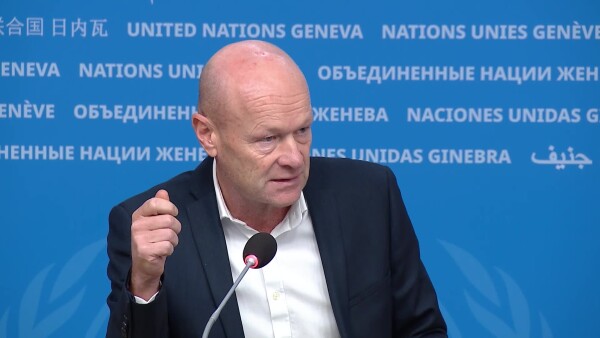
“In areas where intense fighting has hampered our humanitarian operations, we have been forced to reduce our footprint, but we are committed to continue to deliver for the people of Sudan,” stressed Jens Laerke, Spokesperson for the UN Office for the Coordination of Humanitarian Affairs (OCHA) when talking to the media at the United Nations in Geneva. Mr. Laerke said that a humanitarian hub is being established in Port Sudan.
“There are now acute shortages of food, water, medicines and fuel and limited communications and electricity,” Mr. Laerke said. “The price of essential items as well as transport are skyrocketing. The people of Sudan, already deeply affected by humanitarian needs, are staring into the abyss.”
Nearly 16 million people in Sudan were already in need of humanitarian assistance prior to the escalation of violence, owing to drought and malnutrition. Now humanitarian actors are deeply concerned about the impact of fighting that erupted 10 days ago in Sudan, amid reports of looting humanitarian supplies and warehouses.
Although Sudan’s warring factions agreed to a 72-hour ceasefire starting on Tuesday, fighting reportedly broke out in Geneina in West Darfur between the Sudanese Armed Forces and the paramilitary Rapid Support Forces (RSF).
“The news of the ceasefire is extremely encouraging as long as it holds, as you know, all initiatives of that sort are very, very much welcome in a context where we know that families that we have spoken to in Khartoum have not moved out of their house since the last 8 days and very, very few movements of population within the capital,” said Patrick Youssef, Regional Director for Africa of the International Committee of the Red Cross (ICRC).
The World Health Organization (WHO) has verified 14 attacks on health services since the violence began on 15 April, with 8 deaths and 2 injuries.
Speaking from Khartoum, Dr. Nima Saeed Abid, WHO representative in Sudan, said that civilian deaths and injuries continue to rise. “The casualties reported from the only 25 remaining functional facilities so far is 4,075 injuries, 459 deaths, but as I said this is really much under-reporting – the actual number is much higher than this number.”
The WHO representative quoted figures released by Sudan’s Federal Ministry of Health.
WHO and the government health authorities are disturbed about ongoing outbreaks of dengue and malaria, as well as a looming cholera alert amid damage to water infrastructure.
Dr. Abid shared his worries about the occupation of the National Public Health Laboratory by one of the parties involved in the fighting where trained laboratory technicians no longer have access to the laboratory. With power cuts, it is not possible to properly preserve the biological materials that are stored in the laboratory for medical purposes, the WHO official explained.
Condemning attacks on health centres, ICRC’s Patrick Youssef insisted that “international law is more practical than on paper and in the Geneva Conventions”. He said that “it is about giving very clear instructions to the field commanders on what needs to be preserved, and not what needs to be done, meaning a hospital in ‘location A’ has to be ‘preserved’, meaning it needs to be neutralized either by indicative signs like we put on our own ICRC offices and convoys for protection.”
The escalating violence also caused large population displacement. As thousands are fleeing the violence into safer zones and neighboring countries, the UN Refugee Agency (UNHCR) is working with partners and governments in the region to assess the news of the newly arrived and to prepare a joint response.
“So far the most significant cross-border movements in the region have been of Sudanese fleeing to Chad and South Sudanese refugees returning to South Sudan,” said UNHCR’s spokesperson Olga Sarrado. “While we have also received reports of people starting to arrive in Egypt, exact numbers are not available at this point.”
Speaking from Juba, UNHCR representative in South Sudan, Marie-Hélène Verney, said that “for the past few days, we have been seeing a marked increase in the number of South Sudanese mostly returning into South Sudan”. She added that “Four thousand is the number we have been able to interview and register but obviously there are much, much larger numbers of people who are just rushing through the border and trying to get into the country.”
Many of the new arrivals lack the means to continue their journey, which is why UNHCR is helping facilitate their onward travel, providing clean water and setting up reception centres. The agency said that overall, there are over 800,000 South Sudanese refugees in Sudan, a quarter of whom are in Khartoum and “directly affected by the fighting”.
“The needs are becoming overwhelming particularly in clean water, food, but also in telecommunication,” said Ms. Verney. “People are arriving and have been on the road from Khartoum for several days and most of them don’t have any means of communication. They want to reach their family. They want to know where to move onwards in the country.”
South Sudan is already suffering a major humanitarian crisis. The country has more than 2.3 million internally displaced people, almost 75 per cent of the population is in need of humanitarian assistance and 2,2 million South Sudanese are refugees in neighboring countries.
UNHCR’s Ms. Sarrado explained that “before this crisis, Sudan hosted more than one million refugees, and 3.7 million were internally displaced. Assistance programmes that were already overstretched, are now severely hampered.” The UNHCR official added that "all of the UN agency’s operations in Sudan’s neighbouring countries impacted by this new emergency, already have existing large refugee and IDP populations, and are also severely underfunded.
-ends-
STORY: Sudan Update: OCHA - WHO - ICRC - UNHCR
TRT: 04’04”
SOURCE: UNTV CH
LANGUAGE: ENGLISH/NATS
ASPECT RATIO: 16:9
RELEASE DATE: 25 April 2023
GENEVA, SWITZERLAND
SHOTLIST
- Exterior wide shot: UN flag alley UN Geneva.
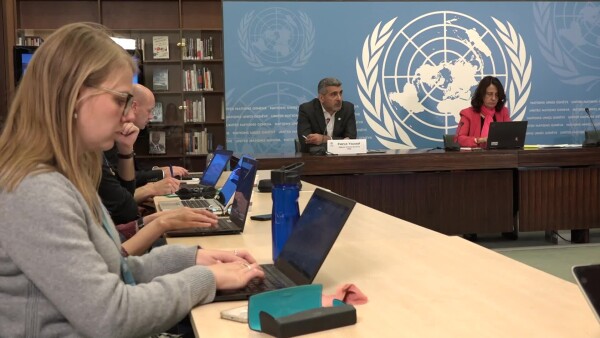
- Wide shot of journalists and speakers, conference room, Palais des Nations, Geneva
- SOUNDBITE (ENGLISH) Patrick Youssef, Regional Director for Africa, ICRC: “The news of the ceasefire is extremely encouraging as long as it holds, as you know, all initiatives of that sort are very, very much welcome in a context where we know that families that we have spoken to in Khartoum have not moved out of their house since the last 8 days and very, very few movements of population within the capital.”
- Wide shot, podium and speakers, conference room, Palais des Nations
- SOUNDBITE (ENGLISH) Jens Laerke, Spokesperson for the UN Office for the Coordination of Humanitarian Affairs (OCHA): “There are now acute shortages of food, water, medicines and fuel and limited communications and electricity. The price of essential items as well as transport are skyrocketing. The people of Sudan, already deeply affected by humanitarian needs, are staring into the abyss.”
- Medium shot: journalists with monitor in the background
- SOUNDBITE (ENGLISH) Jens Laerke, Spokesperson for the UN Office for the Coordination of Humanitarian Affairs (OCHA): “In areas where intense fighting has hampered our humanitarian operations, we have been forced to reduce our footprint, but we are committed to continue to deliver for the people of Sudan.”
- Medium shot: screen visible with speaker and moderator.
- SOUNDBITE (ENGLISH): Nima Saeed Abid, WHO representative in Sudan: “The casualties reported from the only 25 remaining functional facilities so far is 4,075 injuries, 459 deaths, but as I said this is really much under-reporting – the actual number is much higher than this number.”
- Wide shot: journalist, speaker in the background at the podium
- SOUNDBITE (ENGLISH) Patrick Youssef, Regional Director for Africa, ICRC: “International law is more practical than on paper and in the Geneva Conventions. It is about giving very clear instructions to the field commanders on what needs to be preserved, and not what needs to be done, meaning a hospital in ‘location A’ has to be ‘preserved’ meaning it needs to be neutralized either by indicative signs like we put on our own ICRC offices and convoys for protection.”
- Wide shot: journalists with laptops, with speaker on monitor in the background
- SOUNDBITE (ENGLISH) Olga Sarrado, UNHCR spokesperson: “So far the most significant cross-border movements in the region have been of Sudanese fleeing to Chad, and South Sudanese refugees returning to South Sudan. While we have also received reports of people starting to arrive in Egypt, exact numbers are not available at this point.”
- Close-up: journalists
- SOUNDBITE (ENGLISH) Marie-Hélène Verney, UNHCR representative in South Sudan: “For the past few days, we have been seeing a marked increase in the number of South Sudanese mostly returning into South Sudan. 4, 000 is the number we have been able to interview and register but obviously there are much, much larger numbers of people who are just rushing through the border and trying to get into the country.”
- Wide shot: cameraperson
- SOUNDBITE (ENGLISH) Marie-Hélène Verney, UNHCR representative in South Sudan: “The needs are becoming overwhelming particularly in clean water, food, but also in telecommunication. People are arriving and have been on the road from Khartoum for several days and most of them don’t have any means of communication. They want to reach their family. They want to know where to move onwards in the country.”
- Medium shot: journalists in the press room
- SOUNDBITE (ENGLISH) Olga Sarrado, UNHCR spokesperson: “Before this crisis, Sudan hosted more than one million refugees, and 3.7 million were internally displaced. Assistance programmes that were already overstretched, are now severely hampered. All UNHCR’s operations in Sudan’s neighbouring countries impacted by this new emergency, already have existing large refugee and IDP populations, and are also severely underfunded.”
- Wide shot: podium with speakers and UN logo in the background
- Close up: journalists
- Close up: journalist taking notes
Similar Stories
1
1
1
Edited News | OCHA , UNICEF , WFP
Aid agencies warned on Friday of the fast-developing humanitarian emergency inside Taiz City in Yemen, which has been encircled by de facto Houthi forces fighting government troops along the country’s west coast.

2
17
1
2
Edited News , Press Conferences , Images | OCHA , WMO
Two UN agencies teamed up on Wednesday to issue an appeal for immediate assistance to help communities already being impacted by the strongest El Niño on record.

3
16
2
2
Edited News , B-roll , Conferences , Images | UNITED NATIONS , UNOG
Sixth Consultative Meeting on Enhancing Coordination of Peace Initiatives and Efforts for Sudan

1
1
1
Edited News | UNICEF , WHO , UNHCR
Yemen war continues to force families from homes amid hunger and disease
More than 250,000 people have now fled renewed fighting in Yemen, the UN said on Tuesday, citing particular concern for those sheltering in the southwestern city of Taiz and the wider governorate, where access is “essentially blocked”.

1
1
1
Edited News | UNICEF
A little over one year since a ceasefire agreement was announced between Hamas fighters and Israel, more than 340 children have been reported killed and hundreds more injured, the UN Children’s Fund, UNICEF, said on Friday.

1
1
1
Edited News | UNICEF , IFRC
Six weeks after Nepal’s deadly flooding disaster, communities are still struggling to rebuild their lives, but they will need sustained help as global warming increases the risk of another Himalayan catastrophe, the UN Children’s Fund (UNICEF) said on Friday.

1
1
1
Edited News | WHO
In suspected Russia plague death, testing and monitoring underway – WHO
The death of a lab worker in Russia’s Siberia region has sparked concerns about plague being the cause, the UN World Health Organization (WHO) said on Tuesday, adding that it was following the situation closely.

1
1
Edited News | OHCHR , UNOG
UN Human Rights Chief Volker Türk on Friday provided and oral update to the 63rd session of the Human rights Council on Ukraine.

1
1
1
Edited News | OHCHR , UNOG
UN Human Rights Chief Volker Türk on Friday provided and oral update to the 63rd session of the Human rights Council on the human rights situation in Haiti.

1
1
1
Edited News | WHO
Repeated delays in bringing lifesaving medicines, prosthetics and more from Israel into Gaza risk having devastating consequences on Palestinians who urgently need them in the wartorn enclave, the UN World Health Organization (WHO) said on Friday. “A truck full of non-priority supplies or the right supplies arriving too late, doesn't save lives. That's the question that actually matters," said Dr Reinhilde Van De Weerdt, WHO Representative in the OPT.

1
1
1
Edited News | WHO
DRC: Early access to care and oxygen decisive for Ebola patients’ survival – WHO
In the Democratic Republic of the Congo (DRC), health workers fighting the country’s largest-ever Ebola outbreak are struggling to overcome critical challenges to patient care, the UN World Health Organization (WHO) warned on Tuesday.

1
1
1
Edited News | OCHA , UN
Civilians in Iran are continuing to feel the consequences of months of conflict and military escalation, the UN’s top official in the country has said, as loss of life, damage to civilian infrastructure and mounting economic pressures leave many facing continued uncertainty.