

The United Nations Office at Geneva
Multimedia Newsroom
Edited News , Press Conferences | UNDP
UNDP Press Conference: Climate Resilient Pakistan - 05 January 2023
Pakistan floods: nine million more people risk being pushed into poverty, warns UNDP
An additional nine million people risk being pushed into poverty on top of the 33 million affected by last summer’s devastating floods in Pakistan, the UN development agency, UNDP said on Thursday, ahead of next week’s International Conference on Climate Resilient Pakistan in Geneva.
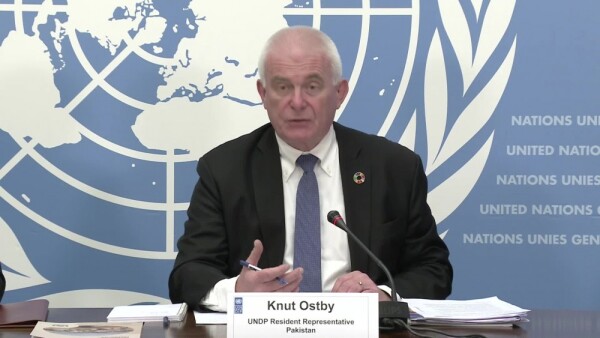
“We estimate that up to around nine million people - additional people - could be pushed into poverty due to the flood impact” said Knut Ostby, UNDP Resident Representative in Pakistan.
Although the Pakistan flooding was “unprecedented”, it could happen to other countries too, Mr. Ostby warned.
He explained that crops had been lost from the last harvest and from the missed planting season. “Agricultural prices - food prices - are therefore increasing and could push, double the amount of people into food insecurity, increasing that number from seven to 14.6 million,” he continued.
Echoing those concerns, Pakistan’s Permanent Representative to the UN in Geneva, Khalil Hashmi, said that some eight million of the 33 million affected by the emergency remain “acutely displaced”, as flood waters have still not receded in some areas.
Among the most urgent needs today, Ambassador Hashmi listed housing, agriculture and livelihoods. “That’s the immediate side of it and that’s the human side of it,” he insisted, ahead of the high-level conference Pakistan on Monday in the Swiss city, where Pakistan Prime Minister Shehbaz Sharif and UN Secretary-General António Guterres are expected to attend.
Concretely, the aim of the conference is to bring together public and private sectors leaders and generate financial and international support to communities impacted by last year’s devastating floods in Pakistan, and to rehabilitate and rebuild damaged infrastructure in a climate-resilient manner.
Some $16 billion is needed to help the country’s rehabilitation and reconstruction over the long-term. “It’s not just a one-year project,” said Syed Haider Shah, head of UN division in Pakistan’s Ministry of Foreign Affairs, speaking via Zoom. “The needs have been further classified into four strategic recovery objectives: and they deal with the Government’s capacity-building, inclusive reconstruction, gender issues and livelihoods.”
More than 1,700 people were killed in the monsoon flooding disaster, UNDP’s Mr. Ostby said, adding that at least two million homes were destroyed and damaged, along with “13,000 or more kilometres of roads, 3,000 kilometres or more of railway tracks, 439 bridges, 4.4 million acres of agricultural land”.
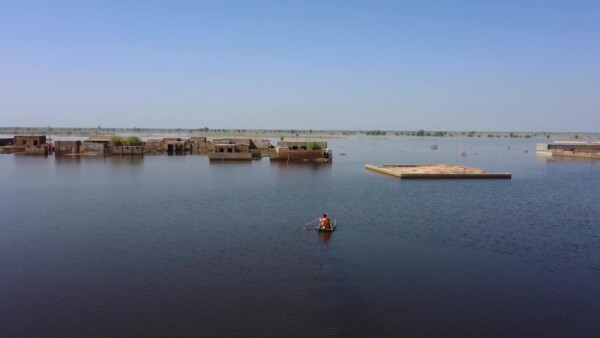
Over one million livestock were also lost, the UNDP official explained, before adding that because there is still standing water in several areas, “many people cannot get back to their regular livelihoods” and therefore remain reliant on humanitarian assistance”.
ends
STORY: Pakistan Floods - UNDPTRT: 2 min 59s
SOURCE: UNTV CH
RESTRICTIONS: NONE
LANGUAGE: ENGLISH/NATS
ASPECT RATIO: 16:9
DATELINE: 5 January 2023, GENEVA, SWITZERLAND
SHOTLIST
- Wide, UN Geneva flag alley.
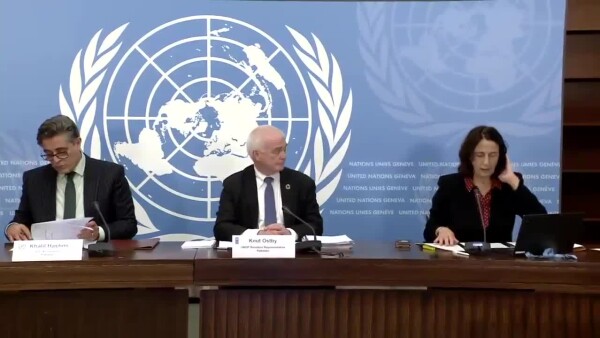
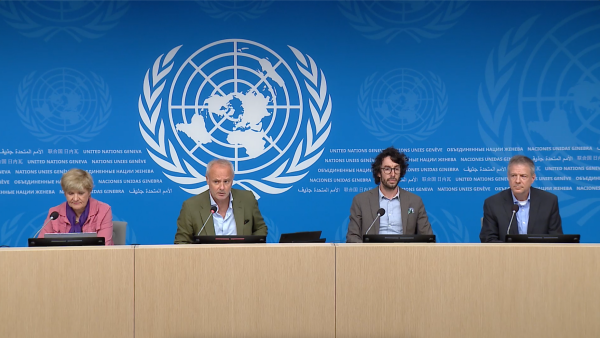
- Wide, press room, podium speakers seated and Zoom speaker shown on separate TV screens.
- SOUNDBITE (ENGLISH) Knut Ostby, UNDP Resident Representative, Pakistan: “We estimate that up to around nine million people - additional people - could be pushed into poverty due to the flood impact and there’s a fall in agricultural production; there was a loss of crops in the last season and a loss of planting in the next season and agricultural prices - food prices - are therefore increasing and could push, double the amount of people into food insecurity, increasing that number from seven to 14.6 million.”
- Wide, press conference room, UN Geneva.
- SOUNDBITE (ENGLISH) Khalil Hashmi, Permanent Representative of Pakistan to the UN in Geneva: “Private housing, agriculture, livelihoods, that’s the immediate side of it and that’s the human side of it; it’s the people, the fact that as Knut mentioned, there’s 33 million out of that more than eight million are acutely displaced and there’s still lot of people still working through the water that in some parts of the country still persists to this day.”
- Medium, journalist taking notes, laptop on lap.
- SOUNDBITE (ENGLISH) Knut Ostby, UNDP Resident Representative, Pakistan: “The floods impacted more than 33 million people with nearly eight million displaced and more than 1,700 people killed. Unfortunately, there is still standing water in several areas, although the water has receded in many places, so many people cannot get back to their regular livelihoods.”
- Medium, participant taking photographs with mobile phone.
- SOUNDBITE (ENGLISH) Knut Ostby, UNDP Resident Representative, Pakistan: “More than two million homes were destroyed and damaged, along with 13,000 or more kilometres of roads, 3,000 kilometres or more of railway tracks, 439 bridges, 4.4 million acres of agricultural land and over one million livestock were lost.”
- Medium, TV screen showing all speakers in foreground, participants to rear.
- SOUNDBITE (ENGLISH): Syed Haider Shah, head of UN division in Pakistan Ministry of Foreign Affairs by Zoom: “The needs have been further classified into four strategic recovery objectives: and they deal with the Government’s capacity-building, inclusive reconstruction, gender issues and livelihoods, and those objectives, these have different amounts envisaged for their reconstruction, and it is over a period of time, it’s not just a one-year project as such, we have an estimation of how to go about it.”
- Close, participants typing on laptop, checking mobile phones.
- Medium-wide, podium speakers, photographers and other participants.
- Medium, photographer crouching to take photo of speakers.
ends
STORY: Pakistan Floods – Archive B-roll Sep-Nov 2022 – Source: UNICEF
TRT: 2 min 19s
SOURCE: UNTV CH
RESTRICTIONS: NONE
LANGUAGE: NATS
ASPECT RATIO: 16:9
DATELINE: September – November 2022, Sindh, Balochistan, PAKISTAN
SHOTLIST
Date: 11 October
00:03 to 00:12: Aerial views, panning, flooded Sohbatpur district, Balochistan.
Date: 26 September
00:13 to 00:21: Villagers move through floodwaters on a truck pulled by a tractor in Dadu district, Sindh.
00:22 to 00:33: Views of flooded houses and fields in dadu District, Sindh.
00:34 to 00:41: A UNICEF-supported health worker arrives at a village that is isolated and doesn't have road access owing to flooding in Dadu district, Sindh.
00:41 to 00:45: Devastation caused by the floods in villages situated in Dadu District, Sindh.
Date: 3 November
00:45 to 01:14: Flooded villages in Jacobabad district, Sindh, children pushing raft carrying woman across flooded expanse, a woman walks across a flooded village carrying a baby.
Date: 27 September
01:14 to 01:18: Members of a UNICEF-supported mobile health and nutrition unit load supplies on a boat in Dadu district, Sindh.
01:18 to 01:26: Views of flooded villages in Dadu district, Sindh.
01:33 to 01:46: A woman bathes her son at a temporary camp set up for flood-affected people in Dadu district, Sindh.
01:46 to 01:53: Views of flooded villages and children wading into water in Dadu district, Sindh.
01:56 to 02:06: Roadside views of a temporary camp set up for flood-affected people on higher ground in Naseerabad district, Balochistan.
Date: 11 October
02:07 to 02:16: Drone footage of camp for displaced and flooded villages in Sohbatpur district, Balochistan where villagers cross water between houses on boat.
ends
Similar Stories

1
1
1
Edited News | UNICEF , IFRC
Six weeks after Nepal’s deadly flooding disaster, communities are still struggling to rebuild their lives, but they will need sustained help as global warming increases the risk of another Himalayan catastrophe, the UN Children’s Fund (UNICEF) said on Friday.

1
1
1
Statements , Press Conferences | OHCHR

1
1
1
Press Conferences | UNHCR , UNICEF , IFRC , OHCHR , UN WOMEN , IOM , OCHA , WHO
UNHCR – ExCom Meeting, UNICEF – Nepal Recovery, IFRC – Flash Floods, WHO – Mental Health, IOM – South Sudan Floods, OCHA – DRC Humanitarian aid, UNHCR – Sahel Displacement, UNICEF – Yemen Update, IOM – Gaza Shelter, UN Women – Gaza Women, OHCHR – Arrests and detentions of Syrians by Israeli force

2
1
2
Press Conferences | UNCTAD
Presentation of the Trade and Developement Report 2026
Embargoed until 9 October 2026 at 11 a.m. (Geneva Time)
UNCTAD: UNCTAD’s flagship report finds that governments increasingly use industrial, trade, financial and technology policies to pursue economic and national security objectives. Market access and the ability to move into higher-value activities now depend more heavily on technology, finance and geopolitics.
1
1
1
Press Conferences | UPU
Release of the State of the Postal Sector Report 2026

1
1
1
Edited News | WHO
In suspected Russia plague death, testing and monitoring underway – WHO
The death of a lab worker in Russia’s Siberia region has sparked concerns about plague being the cause, the UN World Health Organization (WHO) said on Tuesday, adding that it was following the situation closely.
1
1
1
Press Conferences | IOM , ITU , UNECE , UNICEF , WHO , WMO
UNICEF: Ebola, DRC - children orphans or separating them from parents and caregivers; IOM: Humanitarian needs in Djibouti amid arrivals from Yemen and increased migrant movements; WHO: Darfur, scale of health needs far exceeds available resources; WMO co-sponsored Global Heat Forum, Bangkok, monthly Global Seasonal Climate Update; UNECE: UN Forum of Mayors; ITU Plenipotentiary Conference 2026; WHO: child and adolescent obesity guidelines and new global roadmap to tackle pregnancy hypertension, a leading cause of maternal mortality

1
1
Edited News | OHCHR , UNOG
UN Human Rights Chief Volker Türk on Friday provided and oral update to the 63rd session of the Human rights Council on Ukraine.

1
1
1
Edited News | OHCHR , UNOG
UN Human Rights Chief Volker Türk on Friday provided and oral update to the 63rd session of the Human rights Council on the human rights situation in Haiti.

1
1
1
Edited News | WHO
Repeated delays in bringing lifesaving medicines, prosthetics and more from Israel into Gaza risk having devastating consequences on Palestinians who urgently need them in the wartorn enclave, the UN World Health Organization (WHO) said on Friday. “A truck full of non-priority supplies or the right supplies arriving too late, doesn't save lives. That's the question that actually matters," said Dr Reinhilde Van De Weerdt, WHO Representative in the OPT.
1
1
1
Press Conferences | OCHA , UN WOMEN , UNHCR , WFP , WHO , WTO , UNEP
OCHA – $160M CERF allocation to 12 underfunded crises; UNHCR – 5.8M refugee children remain out of school amid funding cuts; UN Women – Middle East escalation and food security among women/girls; WHO – Gaza supplies and overall situation; WFP – Yemen food insecurity and impact on global hunger ; UNEP - First International Conference of the Global Framework on Chemicals in Geneva | 16-20 November 2026

1
1
1
Edited News | WHO
DRC: Early access to care and oxygen decisive for Ebola patients’ survival – WHO
In the Democratic Republic of the Congo (DRC), health workers fighting the country’s largest-ever Ebola outbreak are struggling to overcome critical challenges to patient care, the UN World Health Organization (WHO) warned on Tuesday.