

The United Nations Office at Geneva
Multimedia Newsroom
Global cholera surge likely accelerated by climate change, warns UN health agency
Climate change has driven an “unprecedented” number of larger and more deadly cholera outbreaks around the world this year, the UN health agency, WHO, said on Friday.
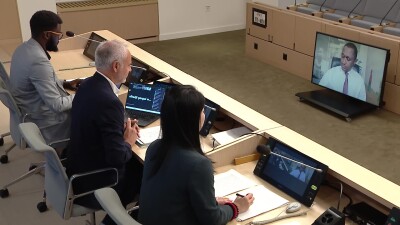
“The map is under threat (from cholera) everywhere,” said Dr. Philippe Barboza, from the World Health Organization, speaking in Geneva, via Zoom.
Available data points to cases of infection in around 30 countries, whereas in the previous five years, fewer than 20 countries reported infections, on average.
“The situation is quite unprecedented, for not only we are seeing more outbreaks, but these outbreaks are larger and more deadly than the ones we have seen in past years,” said Dr. Barboza, WHO Team Lead for Cholera and Epidemic Diarrhoeal Diseases. “This increasing number of cholera outbreaks is occurring after several years of regular reduction in the number of cases and deaths.”
Dr. Barboza explained that all the “usual factors” had played their part in the global uptick of cholera in 2022, not least conflict and mass displacement.
Added to this was the “very visible impact” of climate change, he insisted.
“Most of these larger outbreaks and the fact that they are simultaneously occurring - which makes the situation much more complex - is a direct impact of the increase in adverse climate troubles.”
The cholera crisis has been playing out across the Horn of Africa and the Sahel accompanied by “major floods, unprecedented monsoons (and) a succession of cyclones”, the WHO cholera expert said.
Many other countries have also been affected, including Haiti, Lebanon, Malawi and Syria, where there are large outbreaks. In Pakistan, where previous years have seen only sporadic cases of cholera, there have been more than 500,000 reported cases of watery diarrhoea this year, but “less than a few thousand” laboratory-confirmed cases of cholera.
Equally worrying is the WHO assessment that the situation is “not going to change quickly” in 2023, because meteorologists have forecast that the La Nina climatic phenomenon is likely to persist for a third successive year.
Natural disasters associated with La Nina are prolonged droughts and rains and an increase in cyclones, “so we are very likely to see exactly …(or a) similar situation that we saw at the beginning of 2022”, Dr. Barboza said, indicating that the worst-hit areas were likely to be in Eastern and Southern Africa, the Caribbean and Asia.
Although cholera is preventable, a global shortage of vaccines persists, with sole producers
South Korea and India already at “maximum production” of a reported 36 million vaccines per year.
A South African initiative to produce the vaccines there is underway, but this could take “a few years” to materialize, Dr. Barboza said. He explained that vaccines are so scarce, the International Coordinating Group (ICG) had to decide in October to reduce its global vaccination strategy from two doses to one, to tackle cholera outbreaks.
Despite vaccine shortages, the WHO official stressed that cholera “is easy to treat” in comparison with other illnesses which require ventilators or specialised intensive care units, but only if patients can be given intravenous fluids or antibiotics quickly.
According to WHO, every year, there are 1.3 to four million cases of cholera, and 21,000 to 143,000 deaths worldwide from the disease. The disease is an acute diarrhoeal infection caused by eating or drinking food or water that is contaminated with the bacterium Vibrio cholerae.
“Very clearly, cholera is a disease of poverty, of vulnerability, it’s the most fragile part of the population in any given country which are most at risk and for a very simple reason: it’s just because they don’t have access to safe water and to basic sanitation,” said Dr. Barboza.
ends
STORY: Global Cholera Update - WHOTRT: 2 min 05s
SOURCE: UNTV CH
RESTRICTIONS: NONE
LANGUAGE: ENGLISH/NATS
ASPECT RATIO: 16:9
DATELINE: 16 December 2022 GENEVA, SWITZERLAND
SHOTLIST
- Medium-wide, UN Geneva flag alley.
- Wide, press room, podium speaker seated.
- SOUNDBITE (ENGLISH) Philippe Barboza, Team Lead for Cholera and Epidemic Diarrhoeal Diseases, at the World Health Organization (WHO): “The situation is quite unprecedented, for not only we are seeing more outbreaks, but these outbreaks are larger and more deadly than the ones we have seen in the past years. And this increasing number of cholera outbreaks is occurring after several years of regular reduction in the number of cases and deaths.”
- Close, hands of journalists taking notes, microphone in foreground, TV screen to rear.
- SOUNDBITE (ENGLISH) Philippe Barboza, Team Lead for Cholera and Epidemic Diarrhoeal Diseases, at the World Health Organization (WHO): “What is again very new since the beginning of the year and the end of last year is a very visible impact of the climate change. Most of these larger outbreaks and the fact that they are simultaneously occurring - which makes the situation much more complex - is a direct impact of the increase in adverse climate troubles.”
- Medium, TV camera lens in foreground, podium speaker to rear with Dr. Barboza shown on TV screen.
- SOUNDBITE (ENGLISH) Philippe Barboza, Team Lead for Cholera and Epidemic Diarrhoeal Diseases, at the World Health Organization (WHO): “For example, in the Horn of Africa, in the Sahel, but also in other parts of the world, major floods, unprecedented monsoons, a succession of cyclones; so again, most these outbreaks have or are still being fuelled by the result of the climate change, and unfortunately things are not going to change quickly.”
- Close, TV screen showing speaker, press conference participant to rear.
- SOUNDBITE (ENGLISH) Dr. Philippe Barboza, Team Lead for Cholera and Epidemic Diarrhoeal Diseases, at the World Health Organization (WHO): “Very clearly, cholera is a disease of poverty, of vulnerability, it’s the most fragile part of the population in any given country which are most at risk and for a very simple reason: it’s just because they don’t have access to safe water and to basic sanitation.”
- Medium, press conference participant watching
- Medium-wide, press room, podium speaker seated, guest speaker shown on TV screen.
- Medium, participants, TV camera on tripod.
Similar Stories
1
1
1
Press Conferences | UNHCR
End of UNHCR's 77th Annual Executive Committee (ExCom) meeting week
1
1
1
Press Conferences | UNICEF , IOM , UNHCR
UN Special Assistant to the Personal Envoy Office (SUDAN): Peace Initiatives and Efforts in Sudan; UNICEF: Dire situation of children in Gaza; IOM: Damaged Homes and Energy Attacks Risk Displacing Ukrainians for this winter; UNHCR: update on EXCOM week
1
1
1
Press Conferences | IOM , UNDRR
UN stresses importance of household preparedness for disaster risk reduction.
1
1
1
Statements , Press Conferences | OHCHR
1
1
1
Press Conferences | UNHCR , UNICEF , IFRC , OHCHR , UN WOMEN , IOM , OCHA , WHO
UNHCR – ExCom Meeting, UNICEF – Nepal Recovery, IFRC – Flash Floods, WHO – Mental Health, IOM – South Sudan Floods, OCHA – DRC Humanitarian aid, UNHCR – Sahel Displacement, UNICEF – Yemen Update, IOM – Gaza Shelter, UN Women – Gaza Women, OHCHR – Arrests and detentions of Syrians by Israeli force
2
1
2
Press Conferences | UNCTAD
Presentation of the Trade and Developement Report 2026
Embargoed until 9 October 2026 at 11 a.m. (Geneva Time)
UNCTAD: UNCTAD’s flagship report finds that governments increasingly use industrial, trade, financial and technology policies to pursue economic and national security objectives. Market access and the ability to move into higher-value activities now depend more heavily on technology, finance and geopolitics.
1
1
1
Press Conferences | UPU
Release of the State of the Postal Sector Report 2026
1
1
1
Press Conferences | IOM , ITU , UNECE , UNICEF , WHO , WMO
UNICEF: Ebola, DRC - children orphans or separating them from parents and caregivers; IOM: Humanitarian needs in Djibouti amid arrivals from Yemen and increased migrant movements; WHO: Darfur, scale of health needs far exceeds available resources; WMO co-sponsored Global Heat Forum, Bangkok, monthly Global Seasonal Climate Update; UNECE: UN Forum of Mayors; ITU Plenipotentiary Conference 2026; WHO: child and adolescent obesity guidelines and new global roadmap to tackle pregnancy hypertension, a leading cause of maternal mortality
1
1
1
Press Conferences | OCHA , UN WOMEN , UNHCR , WFP , WHO , WTO , UNEP
OCHA – $160M CERF allocation to 12 underfunded crises; UNHCR – 5.8M refugee children remain out of school amid funding cuts; UN Women – Middle East escalation and food security among women/girls; WHO – Gaza supplies and overall situation; WFP – Yemen food insecurity and impact on global hunger ; UNEP - First International Conference of the Global Framework on Chemicals in Geneva | 16-20 November 2026
1
1
1
Press Conferences | UNHCR , WHO
Yemen's health system nears collapse amid conflict, causing rising casualties and medicine shortages.
1
1
1
Press Conferences | HRC
Update by the Expert Mechanism to Advance Racial Justice and Equality in Law Enforcement
1
1
1
Press Conferences | WIPO , WHO , UNICEF , UNHCR , IOM , WFP , FAO
WIPO Global Innovation Index 2026 launch and press conference, WHO Composition of influenza vaccines for the 2027 Southern Hemisphere flu season, UNICEF Yemen hunger and malnutrition; UNHCR Sudan displacement into Chad; IOM Ebola and population movements in DRC; WFP emergency food assistance in Nepal; and FAO food loss and waste.