

The United Nations Office at Geneva
Multimedia Newsroom
PRESS BRIEFING BY THE UNITED NATIONS INFORMATION SERVICE
18 October 2022
Devastating impact of continued hostilities on civilians in Ethiopia
Ravina Shamdasani, for the Office of the High Commissioner for Human Rights (OHCHR), informed that the new UN High Commissioner for Human Rights Volker Türk stated that the latest alarming airstrikes on the Tigray region risked seriously exacerbating the already devastating impact of hostilities on civilians.
“Since 31 August we have received numerous reports of civilian casualties and destruction of civilian objects due to airstrikes and artillery strikes in Tigray – disruptions to communication make it particularly difficult to verify reports, but it is clear that the toll on civilians is utterly staggering,” Türk said. The High Commissioner appealed to all parties to the conflict to immediately cease all hostilities and work towards a peaceful and lasting solution.
The High Commissioner also stressed the need to support all efforts towards ensuring accountability for gross violations and abuses of international human rights law and international humanitarian law committed during the conflict.
Full statement is available here.
Alessandra Vellucci, for the United Nations Information Service (UNIS), referred to the statement by the Secretary-General from the previous day, in which he emphasized the need for an urgent resumption of talks towards an effective, lasting political settlement. The international community had to rally together now for peace in Ethiopia.
Ms. Shamdasani, responding to questions, said that at least 31 civilians, including children, had been killed in air strikes by the Ethiopian air force in the Tigray region since 31 August. This was likely to be an underestimate, given the limitations of access. OHCHR maintained contact with the Government of Ethiopia and insisted on accountability for human rights violations, but progress had been slow. There was a concern that some of the airstrikes could be indiscriminate, given the number of civilian casualties.
Shabia Mantoo, for the United Nations Refugee Agency (UNHCR), commented that the escalation of conflict in Ethiopia was devastating. The situation in the refugee camps was calm at the moment, but UNHCR continued to observe the situation with concern and appealed for a cessation of hostilities.
Protests in Iran
Ravina Shamdasani, for the Office of the High Commissioner for Human Rights (OHCHR), said that a month after demonstrations had erupted across Iran, the unabated violent response by security forces against protesters, and reports of arbitrary arrests and the killing and detention of children were deeply worrying.
Some sources suggested that as many as 23 children had been killed and many others injured in at least seven provinces by live ammunition, metal pellets at close range, and fatal beatings.
Many human rights defenders, journalists, students, lawyers, opposition politicians and environmentalists were among those held at Evin prison in Tehran.
The continued unnecessary and disproportionate use of force against protesters had to stop, stressed Ms. Shamdasani. Arresting people solely for exercising their rights of peaceful assembly and freedom of expression constituted an arbitrary deprivation of liberty. OHCHR called for the immediate release of all those arbitrarily detained and reminded the authorities that under international law they had an obligation to protect inmates’ physical and mental health and well-being. OHCHR also called on the Iranian authorities to hold prompt, impartial and independent investigations into all alleged violations, including the killing of children, and to ensure those responsible were prosecuted.
Women should never be prosecuted for what they wore, stressed Ms. Shamdasani in a response to questions. OHCHR was following closely the case of Elnaz Rekabi, a female Iranian climber who had competed in Seoul without a hijab and had been reportedly detained since then.
OHCHR statement can be found here.
War in Ukraine
Replying to questions, Ravina Shamdasani, for the Office of the High Commissioner for Human Rights (OHCHR), said that the OHCHR was very concerned about the attacks against critical infrastructure, such as power plants and dams, in Ukraine.
Alessandra Vellucci, for the United Nations Information Service (UNIS), informed that at 4 pm today Geneva time, OCHA would hold a briefing on the humanitarian situation in Ukraine. Speakers would include Martin Griffiths, the UN Humanitarian Chief, and Denise Brown, the UN Resident Coordinator in Ukraine. The briefing would be webcast live at webtv.un.org.
Hunger in Somalia
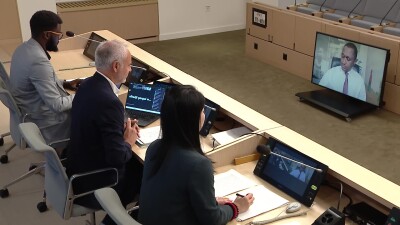
James Elder, for the United Nations Children’s Fund (UNICEF), connecting from Somalia, stated that he had witnessed severe acute malnutrition cases everywhere, which was backed by broader statistical data. Every single minute, a child was being admitted to a health facility to be treated for acute severe malnutrition. Severely malnourished children were up to 11 times more likely to die of diarrhea and measles than well-nourished children. With rates such as these, Somalia was on the brink of a tragedy at a scale not seen in decades.
In a country where access to the most vulnerable was continually hampered by terrorism and threats to aid workers, UNICEF feared that many thousands more children were not reaching the support they needed. UNICEF had already treated over 300,000 children for severe acute malnutrition this year, and UNICEF’s emergency water trucking had reached 500,000 people in just the last three months. Long-term funding was necessary if famine were to be prevented, stressed Mr. Elder. Everything indicated that the situation today was worse than during the last famine in 2011. Without greater action, Somalia was facing the death of children not seen in half a century.
Jens Laerke, for the Office for the Coordination of Humanitarian Affairs (OCHA), said that the Humanitarian Country Team for Somalia had revised upwards the response plan by over USD 800 million, a 55-percent increase compared to when the plan had been launched at the beginning of the year. The appeal now asked for USD 2.26 billion, 80 percent of which was for drought response. The plan targeted a total of 7.6 million people. After the revision, the plan was now 45 percent funded, said Mr. Laerke. Today, 7.8 million people were affected by the droughts, he said, with famine projected in two districts unless humanitarian aid urgently reached those in need. Somalia was experiencing drought not recorded in recorded history.
Announcements
Carla Drysdale, for the World Health Organization (WHO), informed that today was the World Menopause Day. A fact sheet would be sent out today. WHO believed that support during the menopausal transition and afterwards should be an integral part of health care.
Launch of the WHO Global Status Report on physical activity would take place on 19 October. The report showed that progress was slow and unequal, with the pandemic setting things back even further. A press conference would be held at 2 pm today, with the report under embargo until 21 October at 10 am.
Ms. Drysdale also informed that an update on the 13th International Health Regulations (IHR) Emergency Committee on COVID-19 would be shared within 24 hours.
The third Emergency Committee meeting on Monkeypox would be held on 19 October, and an update would be shared the following week.
Finally, Ms. Drysdale said that today donors, polio-affected countries and advocates were gathering in Berlin at the World Health Summit for the polio pledging moment – Investing in a Polio-free Future for More Resilient Health Systems – co-hosted by Germany’s Federal Ministry for Economic Cooperation and Development. Results of the pledging event would be communicated afterwards.
Karima Cherif, for the United Nations Research Institute for Social Development (UNRISD), informed about the launch on 21 October of UNRISD 2022 Flagship Report - Crises of Inequality: Shifting Power for a New Eco-Social Contract. The report looked into inequalities and suggested solutions on breaking the cycle through right policy choices. A hybrid press conference would be held on 19 October at 11 am. Speakers would be Paul Ladd, Director; Katja Hujo, Senior Research Coordinator; and Maggie Carter, Senior Research Analyst, all at UNRISD.
Alessandra Vellucci, for the United Nations Information Service (UNIS), informed that the World Food Forum (WFF), hosted by the Food and Agriculture Organization, had opened the previous day, in Rome and online, to last until 21 October. WFF aimed to galvanize youth engagement, science and innovation and investment in transforming agrifood systems.
The Committee on the Elimination of Discrimination against Women was beginning this morning its review of the report of Ukraine and would begin this afternoon the review of the report of Honduras.
The Human Rights Committee was concluding this morning the review of the report of Ethiopia, after which it would review Nicaragua and the Russian Federation.
Ms. Vellucci reminded that the Seminar on the Peace in the Middle East would be held at UN Geneva on 3 and 4 November, for which an invitation had been shared. The Seminar would be attended by Melissa Fleming, UN Under-Secretary-General for Global Communications, Tatiana Valovaya, UN Geneva Director-General, and Wolfgang Amadeus Brülhart, Swiss Envoy for the Middle East and North Africa.
Finally, today at 6:30 pm, at the Cinerama Empire in Geneva, there would be a Ciné-ONU event showing the documentary “Little Big Steve”, to be followed by a discussion on eradicating poverty with the main protagonist and UN Special Rapporteur on extreme poverty and human rights.
Similar Stories
1
1
1
Press Conferences | UNHCR
End of UNHCR's 77th Annual Executive Committee (ExCom) meeting week
1
1
1
Press Conferences | UNICEF , IOM , UNHCR
UN Special Assistant to the Personal Envoy Office (SUDAN): Peace Initiatives and Efforts in Sudan; UNICEF: Dire situation of children in Gaza; IOM: Damaged Homes and Energy Attacks Risk Displacing Ukrainians for this winter; UNHCR: update on EXCOM week
1
1
1
Press Conferences | IOM , UNDRR
UN stresses importance of household preparedness for disaster risk reduction.
1
1
1
Statements , Press Conferences | OHCHR
1
1
1
Press Conferences | UNHCR , UNICEF , IFRC , OHCHR , UN WOMEN , IOM , OCHA , WHO
UNHCR – ExCom Meeting, UNICEF – Nepal Recovery, IFRC – Flash Floods, WHO – Mental Health, IOM – South Sudan Floods, OCHA – DRC Humanitarian aid, UNHCR – Sahel Displacement, UNICEF – Yemen Update, IOM – Gaza Shelter, UN Women – Gaza Women, OHCHR – Arrests and detentions of Syrians by Israeli force
2
1
2
Press Conferences | UNCTAD
Presentation of the Trade and Developement Report 2026
Embargoed until 9 October 2026 at 11 a.m. (Geneva Time)
UNCTAD: UNCTAD’s flagship report finds that governments increasingly use industrial, trade, financial and technology policies to pursue economic and national security objectives. Market access and the ability to move into higher-value activities now depend more heavily on technology, finance and geopolitics.
1
1
1
Press Conferences | UPU
Release of the State of the Postal Sector Report 2026
1
1
1
Press Conferences | IOM , ITU , UNECE , UNICEF , WHO , WMO
UNICEF: Ebola, DRC - children orphans or separating them from parents and caregivers; IOM: Humanitarian needs in Djibouti amid arrivals from Yemen and increased migrant movements; WHO: Darfur, scale of health needs far exceeds available resources; WMO co-sponsored Global Heat Forum, Bangkok, monthly Global Seasonal Climate Update; UNECE: UN Forum of Mayors; ITU Plenipotentiary Conference 2026; WHO: child and adolescent obesity guidelines and new global roadmap to tackle pregnancy hypertension, a leading cause of maternal mortality
1
1
1
Press Conferences | OCHA , UN WOMEN , UNHCR , WFP , WHO , WTO , UNEP
OCHA – $160M CERF allocation to 12 underfunded crises; UNHCR – 5.8M refugee children remain out of school amid funding cuts; UN Women – Middle East escalation and food security among women/girls; WHO – Gaza supplies and overall situation; WFP – Yemen food insecurity and impact on global hunger ; UNEP - First International Conference of the Global Framework on Chemicals in Geneva | 16-20 November 2026
1
1
1
Press Conferences | UNHCR , WHO
Yemen's health system nears collapse amid conflict, causing rising casualties and medicine shortages.
1
1
1
Press Conferences | HRC
Update by the Expert Mechanism to Advance Racial Justice and Equality in Law Enforcement
1
1
1
Press Conferences | WIPO , WHO , UNICEF , UNHCR , IOM , WFP , FAO
WIPO Global Innovation Index 2026 launch and press conference, WHO Composition of influenza vaccines for the 2027 Southern Hemisphere flu season, UNICEF Yemen hunger and malnutrition; UNHCR Sudan displacement into Chad; IOM Ebola and population movements in DRC; WFP emergency food assistance in Nepal; and FAO food loss and waste.