

The United Nations Office at Geneva
Multimedia Newsroom
Press Conferences | OHCHR
UN Independent International Commission of Inquiry on Ukraine - Presser
Erik Møse, Chairperson of Commission of Inquiry on Ukraine
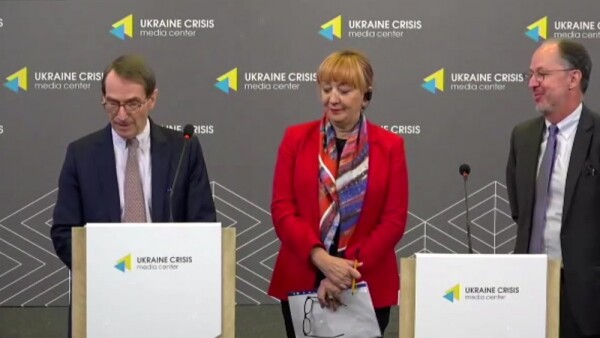
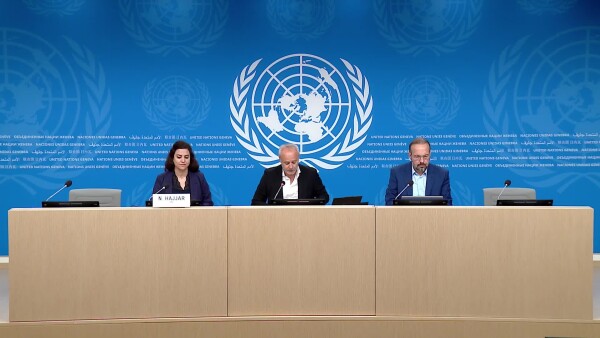
On behalf of the Commission of Inquiry for Ukraine, composed of Erik Møse (chair), Jasminka Džumhur and Pablo de Greiff, I want to welcome you to this press conference at the end of the Commission’s first visit to the country.
The Human Rights Council set up the Commission to investigate alleged violations and abuses of human rights and violations of international humanitarian law, and related crimes in the context of the Russian aggression against Ukraine, with a view to ensuring accountability. On 12 May 2022, the Human Rights Council also requested the Commission to address events that took place in late February and March in four specific regions of Ukraine. Consequently, the Commission has, during this ten-day long visit in Ukraine given priority to Kyiv city, Bucha, Irpin, Kharkiv and Sumy.
In Kyiv, we met with representatives of the Ukrainian parliament, of several ministries, and with the Prosecutor General, whom we had also met previously. The purpose of these encounters was to exchange information of relevance to the Commission’s mandate and to facilitate future investigations. We also met several Ukrainian NGOs that provided valuable inputs to our work.
During the visits to Bucha, Irpin, Kharkiv and Sumy, the Commission met with local authorities as well as civil society organizations, both of which provided significant assistance. Furthermore, the Commission received accounts from individuals who shared their painful stories.
Although far from fully staffed, the Commission’s first visit was very productive. At this stage we are not in a position to make any factual findings or pronounce ourselves on issues of the legal determination of events. However, subject to further confirmation, the information received and the visited sites of destruction may support claims that serious violations of international human rights law and international humanitarian law, perhaps reaching war crimes and crimes against humanity, have been committed in the areas.
In Bucha and Irpin, the Commission received information about arbitrary killing of civilians, destruction and looting of property, as well as attacks on civilian infrastructure, including schools. In Kharkiv and Sumy region, the Commission observed the destruction of large urban areas, allegedly as a consequence of aerial bombings, shelling, or missile strikes against civilian targets.
Jasminka Džumhur, Member of Commission of Inquiry on Ukraine
The Commission also had the opportunity to listen to internally displaced persons, including those coming from the East of Ukraine, who referred to displacement of people. Testimonies also included stories of destruction of civilian property; looting; the confinement, mistreatment, and disappearance of civilians, as well as reports about rapes and other forms of sexual abuse. The Commission will examine all these allegations further.
The Commission is concerned with the impact of the war on children. It considers it necessary to investigate further reports about the alleged transfer of children placed in institutions in the temporarily occupied territories to the Russian Federation as well as information about expedited citizenship and adoption processes for some of these children. In Ukraine, many displaced children have been separated from families. The physical destruction of schools and their use for the accommodation of IDPs raises challenges concerning the children’s access to education.
The Commission has previously stated that it would adopt a victim-centered perspective on its work, and that it would be faithful to its mandate, which asks it to make proposals regarding accountability. Criminal accountability is important, but so are other forms of accountability, including those that enhance the possibility that victims will be able to reconstruct their lives.
The Government of Ukraine is making efforts to meet the diverse needs of victims. While there are areas where greater institutional coordination is probably desirable, doing so while the conflict is ongoing poses particular challenges.
Pablo de Greiff, Member of Commission of Inquiry on Ukraine
The first visit of the Commission will be followed by visits to other parts of Ukraine before the Commission’s oral update to the Human Rights Council in September this year.
We will continue with the process of collecting evidence that may serve accountability purposes; whenever possible identifying individuals or entities, and will pay special attention to violations of a sexual nature, of the rights of children, the elderly, and other vulnerable populations.
The Commission will carry out its work independently, neutrally, and objectively, examining violations and abuses regardless of the identity of the perpetrator. We hope that all parties to the conflict will assist the Commission in its work.
Finally, we would like to express our gratitude to the Government of Ukraine for facilitating our mission, to Ukrainian civil society organisations, victims and witnesses, and to the various United Nations agencies for their kind collaboration. The Commission also wants to thank the Office of the High Commissioner for Human Rights and the United Nations Resident Coordinator in Ukraine for their indispensable collaboration to the visit.
We will be happy to take some questions now.
Similar Stories
1
1
1
Press Conferences | UN WOMEN , WFP , WHO
UN WOMEN: Sudan Women and girls one year after the fall of El Fasher; increasing drone attacks across the country; WFP: DRC - Ebola spreads to eighth DRC province as WFP delivers food, builds treatment centres and keeps supplies moving; WHO - Update on Ebola (Bundibugyo Virus Disease)
1
12
1
1
Press Conferences , Images | UNOG
Closing Press Conference following the Sixth Consultative Meeting on Enhancing Coordination of Peace Initiatives and Efforts in Sudan

2
17
1
2
Edited News , Press Conferences , Images | OCHA , WMO
Two UN agencies teamed up on Wednesday to issue an appeal for immediate assistance to help communities already being impacted by the strongest El Niño on record.
1
1
1
Press Conferences | CITES
Wildlife trade and conservation policy discussions at the 81st meeting of the CITES Standing Committee (SC81)
1
1
1
Press Conferences | UNHCR , UNCTAD , WMO , OCHA , UNICEF , WHO
UNHCR Hungary’s 1956 Refugee Crisis: 70 Years On, UNCTAD World Investment Forum 2026, Doha, WMO Greenhouse Gas Bulletin and Climate Update for COP31, OCHA Afghanistan: Malnutrition, Girls’ Education and Recovery, UNICEF Yemen: Child Malnutrition and Unsafe Water in Taiz, WHO Inequalities in Noncommunicable Diseases and Risk Factors
1
1
1
Press Conferences | UNHCR
End of UNHCR's 77th Annual Executive Committee (ExCom) meeting week
1
1
1
Press Conferences | UNICEF , IOM , UNHCR
UN Special Assistant to the Personal Envoy Office (SUDAN): Peace Initiatives and Efforts in Sudan; UNICEF: Dire situation of children in Gaza; IOM: Damaged Homes and Energy Attacks Risk Displacing Ukrainians for this winter; UNHCR: update on EXCOM week

1
1
1
Press Conferences | IOM , UNDRR
UN stresses importance of household preparedness for disaster risk reduction.

1
1
1
Statements , Press Conferences | OHCHR

1
1
1
Press Conferences | UNHCR , UNICEF , IFRC , OHCHR , UN WOMEN , IOM , OCHA , WHO
UNHCR – ExCom Meeting, UNICEF – Nepal Recovery, IFRC – Flash Floods, WHO – Mental Health, IOM – South Sudan Floods, OCHA – DRC Humanitarian aid, UNHCR – Sahel Displacement, UNICEF – Yemen Update, IOM – Gaza Shelter, UN Women – Gaza Women, OHCHR – Arrests and detentions of Syrians by Israeli force

2
1
2
Press Conferences | UNCTAD
Presentation of the Trade and Developement Report 2026
Embargoed until 9 October 2026 at 11 a.m. (Geneva Time)
UNCTAD: UNCTAD’s flagship report finds that governments increasingly use industrial, trade, financial and technology policies to pursue economic and national security objectives. Market access and the ability to move into higher-value activities now depend more heavily on technology, finance and geopolitics.

1
1
1
Press Conferences | UPU
Release of the State of the Postal Sector Report 2026