

The United Nations Office at Geneva
Multimedia Newsroom
PRESS BRIEFING BY THE UNITED NATIONS INFORMATION SERVICE
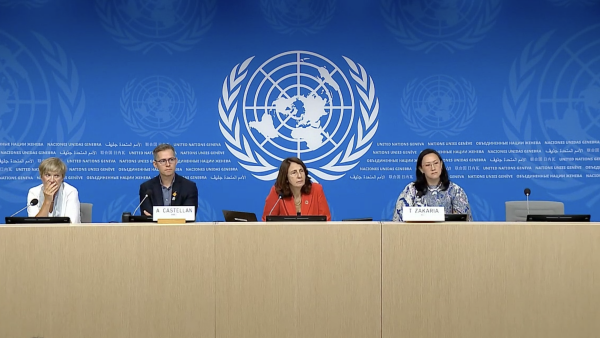
Alessandra Vellucci, Director of the United Nations Information Service (UNIS) in Geneva, chaired the virtual briefing, attended by the spokespersons and representatives of the United Nations Refugee Agency and the World Health Organization.
Pakistan issues smartcards to registered Afghan refugees
Babar Baloch, for the United Nations Refugee Agency (UNHCR), said that UNHCR welcomed the conclusion of the Government of Pakistan’s country-wide campaign to verify and update the data of some 1.4 million registered Afghan refugees and to issue them with smart identity cards. The data of 1.25 million Afghan refugees had been updated as a result of the campaign, among them 200,000 children under the age of 5. More than 700,000 new smart identity cards had been issued, and the remaining cards would be printed and distributed in early 2022.
The cards, which would be valid until 30 June 2023, contained biometric data and would give Afghan refugees faster and safer access to health and education facilities and financial services. The campaign had also provided an opportunity to flag any specific protection needs and vulnerabilities. More detailed information about the refugees’ socioeconomic situation would allow for better tailored assistance in Pakistan and support in case they decided to return home.
The full briefing note is available here.
Update on the Omicron variant of coronavirus disease (COVID-19)
Dr. Abdi Mahamud, Incident Manager, COVID-19 Incident Management Support Team, World Health Organization(WHO), said that as of 29 December 2021, some 128 countries had reported cases of the Omicron variant. In South Africa, which had seen a sharp increase in cases then a relatively rapid drop-off, hospitalization and death rates had remained low. However, that situation should not automatically be extrapolated to other countries. It would be worth looking at the situation in London, where hospitalizations since the onset of the Omicron variant were not much lower than they had been in the same period in 2020 when the population had been largely unvaccinated. While the latest studies all pointed to the fact that the Omicron variant affected the upper respiratory system rather than the lungs, which was good news, high-risk individuals and the unvaccinated could still get gravely ill from that variant. WHO requested the media’s help in tracking progress on achieving worldwide vaccination coverage of 70 per cent.
Replying to questions from journalists, Dr. Mahamud said that the year-end holidays had disrupted data flows, but it was clear that the Omicron variant could overtake other strains in a matter of weeks, especially in areas with a large number of susceptible people, primarily people who were unvaccinated. In Denmark, for example, it had taken two weeks for case numbers to double with the Alpha variant whereas, with the Omicron variant, it had taken two days. The surge was fluid but could conceivably hit Eastern Europe next. The world had never seen such a transmissible virus, so what would have the biggest impact was behaviour. Places such as London and New York, where restrictions on social interactions were in place, could see flatter, longer curves than what had been seen in South Africa.
WHO was very satisfied with how States and scientists were sharing data with it. The Strategic Advisory Group of Experts (SAGE) on Immunization would be meeting on 19 January to review data, including on the timing of boosters, the mixing of vaccines and the composition of future vaccines. As new variants were more likely to develop in overpopulated areas where people had yet to be vaccinated, it was in the global interest to reach the target of 70 per cent vaccination coverage rather than to give boosters.
Thus far, the Omicron variant had mostly spread to countries that used the best-known vaccines, but there was no indication that other vaccines, such as Sinovac and Sinopharm, were not effective against the variant. That was because T cells were activated regardless of what virus entered the body. He did not have a breakdown of hospitalizations by variant. However, whether a variant supplanted another was a matter of virus fitness. His intuition was that Omicron would replace Delta, but that Delta could resurge owing to portions of the population remaining susceptible. Hence the importance of vaccination. Moreover, even in countries with good vaccination rates, how high coverage was among vulnerable categories would have a bigger impact on the trajectory of the pandemic.
Also answering questions, Dr. Mahamud said that most people cleared the virus within 5 to 7 days of the onset of symptoms, depending on their immune health; however, WHO still recommended 14-day quarantine. States had to make decisions about the duration of quarantine based on their individual situations. It made sense to keep case numbers as low as possible in places where they were low to begin with, but in places with runaway cases, there were competing interests, including keeping the countries running, that might justify shorter quarantines.
It was possible to be infected by both influenza and COVID-19. However, the two were separate viruses that used different receptors in order to attack the body; therefore, there was little risk of them combining into a new virus. WHO had been monitoring the B.1.640 variant since November 2021. Though there had been a slight increase in adverse pregnancy outcomes, they were still within normal range, and further data was needed to determine whether there was a greater risk of miscarriage linked with COVID-19.
Also in response to journalists, Tarik Jašarević, for the World Health Organization (WHO), recalled that the status of all the products submitted for inclusion on the WHO emergency use listing was available online.
Alessandra Vellucci, for the United Nations Information Service (UNIS), recalling the Secretary- General’s new year message, said that all the tests, including unequal distribution of COVID-19 vaccines, were tests that humankind could pass if it committed to making 2022 a year of recovery for everyone and that moments of great difficulty were also moments of great opportunity to come together in solidarity and to unite behind solutions that could benefit all people.
Similar Stories
1
1
1
Statements , Press Conferences | OHCHR
1
1
1
Press Conferences | UNHCR , UNICEF , IFRC , OHCHR , UN WOMEN , IOM , OCHA , WHO
UNHCR – ExCom Meeting, UNICEF – Nepal Recovery, IFRC – Flash Floods, WHO – Mental Health, IOM – South Sudan Floods, OCHA – DRC Humanitarian aid, UNHCR – Sahel Displacement, UNICEF – Yemen Update, IOM – Gaza Shelter, UN Women – Gaza Women, OHCHR – Arrests and detentions of Syrians by Israeli force
2
1
2
Press Conferences | UNCTAD
Presentation of the Trade and Developement Report 2026
Embargoed until 9 October 2026 at 11 a.m. (Geneva Time)
UNCTAD: UNCTAD’s flagship report finds that governments increasingly use industrial, trade, financial and technology policies to pursue economic and national security objectives. Market access and the ability to move into higher-value activities now depend more heavily on technology, finance and geopolitics.
1
1
1
Press Conferences | UPU
Release of the State of the Postal Sector Report 2026
1
1
1
Press Conferences | IOM , ITU , UNECE , UNICEF , WHO , WMO
UNICEF: Ebola, DRC - children orphans or separating them from parents and caregivers; IOM: Humanitarian needs in Djibouti amid arrivals from Yemen and increased migrant movements; WHO: Darfur, scale of health needs far exceeds available resources; WMO co-sponsored Global Heat Forum, Bangkok, monthly Global Seasonal Climate Update; UNECE: UN Forum of Mayors; ITU Plenipotentiary Conference 2026; WHO: child and adolescent obesity guidelines and new global roadmap to tackle pregnancy hypertension, a leading cause of maternal mortality
1
1
1
Press Conferences | OCHA , UN WOMEN , UNHCR , WFP , WHO , WTO , UNEP
OCHA – $160M CERF allocation to 12 underfunded crises; UNHCR – 5.8M refugee children remain out of school amid funding cuts; UN Women – Middle East escalation and food security among women/girls; WHO – Gaza supplies and overall situation; WFP – Yemen food insecurity and impact on global hunger ; UNEP - First International Conference of the Global Framework on Chemicals in Geneva | 16-20 November 2026
1
1
1
Press Conferences | UNHCR , WHO
Yemen's health system nears collapse amid conflict, causing rising casualties and medicine shortages.
1
1
1
Press Conferences | HRC
Update by the Expert Mechanism to Advance Racial Justice and Equality in Law Enforcement
1
1
1
Press Conferences | WIPO , WHO , UNICEF , UNHCR , IOM , WFP , FAO
WIPO Global Innovation Index 2026 launch and press conference, WHO Composition of influenza vaccines for the 2027 Southern Hemisphere flu season, UNICEF Yemen hunger and malnutrition; UNHCR Sudan displacement into Chad; IOM Ebola and population movements in DRC; WFP emergency food assistance in Nepal; and FAO food loss and waste.
2
1
2
Press Conferences | UNCTAD
Gaza reconstruction needs reach $71.5 billion as Palestinian economy and public finances face severe strain. Latest UNCTAD report documents the loss of decades of development gains, economic collapse in Gaza and tightening economic constraints in the West Bank.
The report identifies three immediate priorities: transferring withheld Palestinian revenues, safeguarding the banking system and aligning reconstruction support with the documented scale of damage and economic losses.
1
1
1
Press Conferences | HRC
Press conference on the situation of human rights in Nicaragua by the UN Group of Human Rights Experts
1
1
1
Press Conferences | ITU , UNHCR , WHO , WMO
YEMEN - UNHCR: Escalating conflict in Yemen could fuel more displacement, refugee movement
CLIMATE - WHO / WMO: Health and Climate impact of El Niño