

The United Nations Office at Geneva
Multimedia Newsroom
Press Conferences | OHCHR , WHO , UNITED NATIONS , UNCTAD , IPU
Bi-Weekly Press Briefing 16 November 2021
Ethiopia: continued arrests and state of emergency
Elizabeth Throssell, for the Office of the High Commissioner for Human Rights (OHCHR), said it was concerning that arrests had been continuing over the last week in the Ethiopian capital, Addis Ababa, as well as in Gondar, Bahir Dar and other locations, as police invoked the excessively wide provisions of the state of emergency declared on 2 November to arrest, search and detain people. These developments were more disturbing given that most of those detained were reported to be people of Tigrayan origin, arrested often on suspicion of being affiliated to or supporting the Tigray People’s Liberation Front (TPLF). According to reports, at least 1,000 individuals were believed to have been detained over the past week or so – with some reports putting the figure much higher. Detention conditions were generally reported to be poor. There were worrying reports that many of those detained have not been informed of the reasons for their detention and had not been formally charged.
With specific regard to the situation of UN local staff, 10 were still being held as well as some 34 drivers subcontracted by the UN, and OHCHR called for all those still in detention to be immediately released. Otherwise, a court or other independent and impartial tribunal should review the reasons for their detention, or they should be formally charged. The state of emergency in force in Ethiopia risked compounding an already very serious human rights and humanitarian situation in the country. Under the state of emergency, judicial review of enforcement of the provisions was explicitly suspended, and there were sweeping powers of arrest and potentially indefinite administrative detention for the duration of the emergency measure, raising serious concerns of arbitrary detention.
As the High Commissioner had warned, there were grave risks that such measures, far from stabilizing the situation, would affect further the already compromised delivery of humanitarian aid, deepen divisions, endanger civil society and human rights defenders, provoke greater conflict and only add to the considerable human suffering in Ethiopia.
Responding to questions, Ms. Throssell said with regard to the blockade of Mekelle, there was a lack of specific information on the issue. The Ethiopian Government was still there and had certain obligations, as did others involved in the conflict, to not commit human rights abuses. It had been difficult to determine what was going on in detention: there were over 1,000 persons held in detention, generally in police stations. With regard to torture, there was no specific evidence, but there were concerning reports. In the context of the state of emergency, there were rights that could not be suspended, and that included the right to not be tortured, and to be told why an individual was being detained. The situation was challenging and OHCHR personnel were able to do their work, but it was very difficult, Ms. Throssell said.
Responding to a question on the situation in Cuba and the lack of a guarantee for the right of peaceful demonstration, Ms. Throssell said there had been organized protests in the past. Exercising one’s rights to freedom of expression, opinion and assembly were fundamental cornerstone rights. Any restrictions placed on these had to comply with proportionality. All those detained for exercising these rights must be released, with access to a lawyer and application of habeus corpus.
Licensing agreement for COVID-19 oral antiviral treatment candidate signed to expand generic access in low- and middle-income countries
Hervé Verhoosel, for Unitaid, said today the Medicines Patent Pool (MPP), which was created by Unitaid to increase access to life-saving medicines for low- and middle-income countries, was announcing a voluntary license agreement for Pfizer’s COVID-19 oral antiviral treatment candidate, which was administered in combination with low dose ritonavir. The agreement would enable MPP to facilitate additional production and distribution of the investigational antiviral, pending regulatory authorization or approval, by granting sub-licenses to qualified generic medicine manufacturers, with the goal of facilitating greater access to the global population.
Under the terms of the head license agreement between Pfizer and MPP, qualified generic medicine manufacturers worldwide that are granted sub-licenses will be able to supply the new drug in combination with ritonavir to 95 countries, covering up to approximately 53% of the world’s population. This includes all low- and lower-middle-income countries and upper-middle-income countries in Sub-Saharan Africa as well as upper-middle-income countries that have transitioned to upper-middle-income status in the past five years. Pfizer will not receive royalties on sales in low-income countries and will further waive royalties on sales in all countries covered by the agreement while COVID-19 remains classified as a Public Health Emergency of International Concern by the World Health Organization.
Responding to questions, Mr. Verhoosel said Pfizer would be providing information to manufacturers so they could make generic versions of the medicine. On whether this oral treatment was suitable for strong or mild cases, Mr. Verhoosel said this would probably only be used for people at risk. The goal was for people to avoid coming to hospital, and thus for them to take the medicine within the first few days of symptoms. The MPP would select the companies, not Pfizer, and it would review their submissions. In terms of royalties, figures would be available in the press release to be issued later. No region or company was excluded from applying to manufacture the medicine.
WHO’s Fourth Global Trends Report on Tobacco
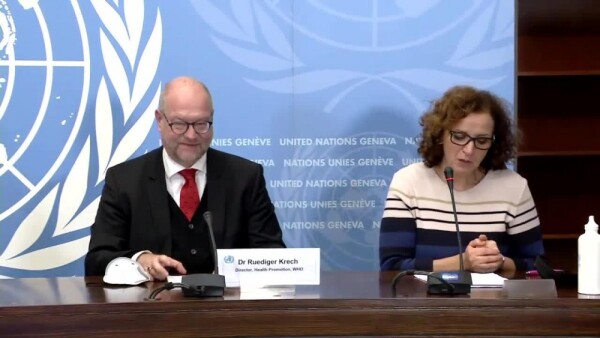
Dr Ruediger Krech, Director, Health Promotion, World Health Organisation, said WHO was happy today, as there was a global shift in the global tobacco epidemic. Countries were continuing to successfully tackle the tobacco epidemic, and had made strong headway in protecting their people from the harms thereof. Six months ago, 146 countries had at least one strong policy in place. Today the report showed that 150 countries were seeing tobacco use rates decline. The evidence was clear: tobacco control worked. The momentum could continue by closing the remaining gaps in tobacco control. Tobacco control policies needed to address the different types of tobacco consumed within countries. Millions of lives could be saved, contributing to countries’ long-term economic growth.
Dr Alison Commar, Technical Officer, Tobacco Free Initiative, WHO, said there was a great improvement since the last report two years ago. In Europe, around 87% of countries were seeing tobacco use go down, but only 11 countries were on track to reach the 30% reduction target by 2025. The steepest decline was being seen in the Americas region. Twenty-five countries in the African region were on track to reduce by 30% by 2025, but urgent action was required to reduce the number of men using tobacco. The South-East Asian region had the world’s highest usage figures, but was also the region where usage was declining fastest. The Western Pacific region witnessed the slowest declines, and was projected to register the highest figures of usage among men in 2025. There were now 190 countries monitoring tobacco use. The COVID-19 pandemic had affected reporting, and the next report would cover the impact of COVID-19.
Responding to questions, the WHO representatives said that one of the impacts of the COVID-19 pandemic had been to encourage people to quit smoking. Women in Europe were not on track to decrease their smoking habit, and more efforts were needed in the region to stop them from starting to smoke. The efforts of the tobacco countries to influence children, in particular girls, needed to be countered by strong governmental measures. These efforts needed to be reversed as the tobacco industry was helping to kill people. Research was underway to understand the effects of emerging products including e-cigarettes. So far findings were not conclusive. The matter would continue to be examined, as more and more effects were found. Work was continuing to ensure that the Framework Convention included all new products.
Geneva announcements
Thomas Fitzsimmons, for the International Parliamentary Union (IPU), said the Organization would be holding its 143rd Assembly in Madrid from 26 to 30 November 2021, hosted by the Parliament of Spain. The theme of the Assembly would be “Contemporary challenges to democracy: Overcoming division and building community”.
In partnership with UN Women, the IPU was publishing a new handbook for Parliamentarians called a Handbook on gender-responsive law making. The handbook was timely as countries put in place COVID-19 recovery plans and worked to rebuild more equitable and inclusive societies, serving as a guide for reforming existing laws and enacting new legislation to ensure the rights of women and girls are protected, resourced and implemented.
In response to questions on the participation of the Tunisian and Afghanistan Parliaments in the Madrid meeting, Mr. Fitzsimmons said that, for the moment, Tunisia had not registered, but would be able to as well as to attend in person. No arrangements had been made for a hybrid Assembly or for a virtual link-up. As to Afghanistan, it was still a member of the IPU, and there was a list of Afghan MPs registered to come to Madrid, and they were welcome to do so. This included women MPs.
Catherine Huissoud, for United Nations Conference Trade And Development (UNCTAD), said there was a press conference at 2 p.m. on the Review of Maritime Transport 2021. UNCTAD Secretary-General Rebeca Grynspan would be speaking.
Fadela Chaib, for the World Health Organisation (WHO), said the only press conference this week would be on Wednesday 17th on the topic of cervical cancer in women, welcoming new initiatives to combat this disease. Some First Ladies from various countries would be attending virtually. Responding to questions about COVID-19 pills being developed, she said a press conference could be arranged with an expert to discuss the technical issues, if there was sufficient interest.
Rhéal LeBlanc, speaking on behalf of the Food and Agricultural Organisation (FAO), said the International Year of Artisanal Fisheries and Aquaculture 2022 (IYAFA) would be officially launched on 19 November at 1 p.m. CET with a virtual event. IYAFA 2022 was an important recognition of the millions of small-scale fishers, fish farmers and fish workers who provide healthy and nutritious food to billions of people and contribute to achieving Zero Hunger. The World Antimicrobial Awareness Week would be held from 18-24 November 2021. Without a coordinated One Health approach, rising levels of antimicrobial resistance (AMR) could lead to 10 million deaths each year and hundreds of billions of dollars lost in annual economic growth. More information on FAO’s work on AMR here.
Speaking as Chief of the Press and External Relations Section at the United Nations Information Service in Geneva, Mr. LeBlanc said today was the International Day for Tolerance. He added that the Security Council was holding an open debate today on the maintenance of international peace and security: Peace and security through preventive diplomacy. The Secretary-General remarks at that meeting would be webcast.
Mr. LeBlanc also announced that the UN Annual International Media Seminar on Peace in the Middle East, held virtually, would be held today and tomorrow, and include a pre-recorded video message from the Secretary-General.
The Committee against Torture was beginning this morning the review of the implementation of the Convention against Torture in Nigeria in absence of the initial report of the country. It would conclude the review tomorrow.
The Committee on the Elimination of Racial Discrimination would begin this afternoon (at 3 p.m.) its review of the report of Switzerland and would conclude it tomorrow morning.
Similar Stories
1
1
1
Press Conferences | UNHCR
End of UNHCR's 77th Annual Executive Committee (ExCom) meeting week
1
1
1
Press Conferences | UNICEF , IOM , UNHCR
UN Special Assistant to the Personal Envoy Office (SUDAN): Peace Initiatives and Efforts in Sudan; UNICEF: Dire situation of children in Gaza; IOM: Damaged Homes and Energy Attacks Risk Displacing Ukrainians for this winter; UNHCR: update on EXCOM week

1
1
1
Press Conferences | IOM , UNDRR
UN stresses importance of household preparedness for disaster risk reduction.
1
1
1
Statements , Press Conferences | OHCHR
1
1
1
Press Conferences | UNHCR , UNICEF , IFRC , OHCHR , UN WOMEN , IOM , OCHA , WHO
UNHCR – ExCom Meeting, UNICEF – Nepal Recovery, IFRC – Flash Floods, WHO – Mental Health, IOM – South Sudan Floods, OCHA – DRC Humanitarian aid, UNHCR – Sahel Displacement, UNICEF – Yemen Update, IOM – Gaza Shelter, UN Women – Gaza Women, OHCHR – Arrests and detentions of Syrians by Israeli force
2
1
2
Press Conferences | UNCTAD
Presentation of the Trade and Developement Report 2026
Embargoed until 9 October 2026 at 11 a.m. (Geneva Time)
UNCTAD: UNCTAD’s flagship report finds that governments increasingly use industrial, trade, financial and technology policies to pursue economic and national security objectives. Market access and the ability to move into higher-value activities now depend more heavily on technology, finance and geopolitics.
1
1
1
Press Conferences | UPU
Release of the State of the Postal Sector Report 2026
1
1
1
Press Conferences | IOM , ITU , UNECE , UNICEF , WHO , WMO
UNICEF: Ebola, DRC - children orphans or separating them from parents and caregivers; IOM: Humanitarian needs in Djibouti amid arrivals from Yemen and increased migrant movements; WHO: Darfur, scale of health needs far exceeds available resources; WMO co-sponsored Global Heat Forum, Bangkok, monthly Global Seasonal Climate Update; UNECE: UN Forum of Mayors; ITU Plenipotentiary Conference 2026; WHO: child and adolescent obesity guidelines and new global roadmap to tackle pregnancy hypertension, a leading cause of maternal mortality
1
1
1
Press Conferences | OCHA , UN WOMEN , UNHCR , WFP , WHO , WTO , UNEP
OCHA – $160M CERF allocation to 12 underfunded crises; UNHCR – 5.8M refugee children remain out of school amid funding cuts; UN Women – Middle East escalation and food security among women/girls; WHO – Gaza supplies and overall situation; WFP – Yemen food insecurity and impact on global hunger ; UNEP - First International Conference of the Global Framework on Chemicals in Geneva | 16-20 November 2026
1
1
1
Press Conferences | UNHCR , WHO
Yemen's health system nears collapse amid conflict, causing rising casualties and medicine shortages.
1
1
1
Press Conferences | HRC
Update by the Expert Mechanism to Advance Racial Justice and Equality in Law Enforcement
1
1
1
Press Conferences | WIPO , WHO , UNICEF , UNHCR , IOM , WFP , FAO
WIPO Global Innovation Index 2026 launch and press conference, WHO Composition of influenza vaccines for the 2027 Southern Hemisphere flu season, UNICEF Yemen hunger and malnutrition; UNHCR Sudan displacement into Chad; IOM Ebola and population movements in DRC; WFP emergency food assistance in Nepal; and FAO food loss and waste.