

The United Nations Office at Geneva
Multimedia Newsroom
Press Conferences | OHCHR , WHO , UNOG , WFP , FAO
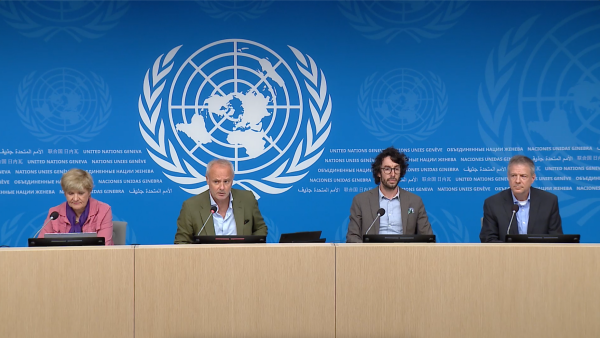
UNOG Bi-Weekly Press Briefing 05 November 2021
Human Rights Council’s special session on Sudan
Rolando Gomez, for the Human Rights Council (HRC), informed that today from 12:30 p.m. the Council would hold a special session on the human rights situation in Sudan. It would be a hybrid meeting largely, with in-person participation from the members of the Council expected when the time came to take action on the draft resolution. The UN Human Rights High Commissioner would deliver her remarks, followed by Victor Madrigal-Borloz, the chairperson of the Special Procedures Coordination Committee. A long list of speakers from States and NGOs will follow opening remarks. An updated draft resolution would be shared with the media shortly. Action on the draft resolution was likely to be taken after 4 p.m.
Meanwhile, Tanzania was under review today during the Universal Periodic Review; more reviews were scheduled for the following week, for a total of 13 this cycle.
Responding to questions, Mr. Gomez said the draft resolution contained the call to appoint a special rapporteur on Sudan. Anyone listed in the Blue Book was authorized to speak at the meeting, explained Mr. Gomez. The Permanent Representative of Sudan to the United Nations in Geneva, according to Protocol, was still Ambassador Ali Ibn Abi Talib Abdelrahman Mahmoud.
More information on today’s special session is available here. Live webcast will be available at UNTV.
Rhéal LeBlanc, for the United Nations Information Service (UNIS), recalled that the UN Secretary-General had had a phone call with Lt. Gen. Abdel Fattah al-Burhan, Commander of the Armed Forces of the Republic of the Sudan. He encouraged all efforts toward resolving the political crisis in Sudan and urgently restoring the constitutional order and Sudan’s transitional process. The Secretary-General had also reiterated his call for the release of Prime Minister Abdalla Hamdok and other civilians arbitrarily detained in Sudan.
Food Price Index October 2021
Abdolreza Abbassian, Senior Economist at the Food and Agriculture Organization (FAO) and G-20 AMIS Secretary, said the new monthly FAO Food Price Index report confirmed that the prices of basic food commodities had surged to a new peak reaching its highest level since July 2011. The FAO Food Price Index, which tracked monthly changes in the international prices of a basket of food commodities, averaged 133.2 points in October, up 3 per cent from September. Inflation, which could be caused by this spike in food-importing countries, should not be ignored.
Mr. Abbassian also explained that the Agricultural Market Information System (AMIS) was an inter-agency platform, an “agricultural hand of G20”, to enhance food market transparency and policy response for food security. It brought together the principal trading countries of agricultural commodities, assessed global food supplies (focusing on wheat, maize, rice and soybeans) and provided a platform to coordinate policy action in times of market uncertainty. The AMIS Market Monitor, published on 4 November, also confirmed that markets were quite tight for certain food commodities, especially those covered by AMIS.
He also informed that the Global Grain Conference would be held in Geneva on 17-18 November, and would be attended by the FAO. Responding to questions, Mr. Abbassian explained that multiple indices were in use, including a consumption index, a cereal price index, etc. The Food Price Index, which was just one of these many indices, looked into what was happening with the basic staples in food markets around the world. It was using export prices from around the world to come up with general overviews every month; there was no need to use extrapolation and make estimations. More information is available here.
Use of unmanned aircraft systems in World Food Programme disaster responses
Patrick Mackay, World Food Programme southern Africa Regional Unmanned Aircraft Systems Coordinator, said that cyclones and hurricanes were happening more frequently than ever before because of climate change. In South Africa today, the WFP, together with government and partners, was launching a drone hub focusing on building capacity with the aim of using drones for humanitarian purposes. WFP had started using drones in 2017 and had gained a lot of experience over the last few years, experience that subsequently proved invaluable in Mozambique, especially during cyclone Idai in March 2019. In Mozambique just now, the WFP was using drones to observe water flooding, make projections and help survivors better.
Mr. Mackay also informed that in Mozambique the following week, the largest ever drone search and rescue operation would take place, including 40 drones of different types. Ultimately the aim was to replace the use of helicopters in the search phase of search and rescue, to identify with drones the location of people needing rescue, and to use boats and helicopters only to go directly to the person needing rescue. Drones could also be used to increase connectivity and improve internet access to affected communities on the ground. Drones helping with connectivity could also provide useful imagery. There were drones that could fly on a power cable, operating 24 hours a day, seven days a week. Putting a high-power Wi-Fi antenna on such a drone could provide internet connection to a community in a 3.2 square kilometre area. Such drones could traverse an entire city in a day.
Responding to questions, Mr. Mackay said the WFP needed to work with host governments; it was not sending drones to the countries or regions without permissions. Drones would be carrying large banners to inform the people on the ground that free, password-less internet was available. WFP was focusing on post-disaster connectivity, where there was no existing infrastructure such as telecommunications towers. Helicopters were much more expensive to use than drones, stressed Mr. Mackay. A fleet of drones could be deployed to identify survivors in the aftermath of a natural disaster, after which helicopters could be sent to exact points where survivors were identified. Airship based connectivity tests would be held in South Africa in the second half of November or early December.
More information can be found here and here.
Polio vaccination in Afghanistan
Responding to questions, Fadéla Chaib, for the World Health Organization (WHO), said that now was the critical time for Afghanistan to stop polio and not lose the hard gained achievements of the past 20 years. Afghanistan was one of the only two countries in the world where polio remained endemic. With only one case of wild poliovirus reported from Afghanistan this year, compared to 56 in 2020, there was an unprecedented opportunity to stop wild poliovirus. A nationwide polio vaccination campaign was expected to begin on 8 November, said Ms. Chaib.
Geneva announcements
Rhéal LeBlanc, for the UN Information Service (UNIS), informed that on 8 November at 10:30 a.m., there would be a hybrid press conference to launch the World Intellectual Property Indicators Report, which would be under embargo until 8 November at 12:30 p.m. Speakers would be Marco Aleman, Assistant Director General, IP and Innovation Ecosystems Sector; and Carsten Fink, WIPO Chief Economist.
On 10 November at 10 a.m., there would be a hybrid press conference by the United Nations Institute for Disarmament Research to launch the Landmine Monitor 2021 Report. Speakers would be Mark Hiznay, Ban Policy Editor and Human Rights Watch Arms Division Associate Director; Loren Persi, Impact Editor; Ruth Bottomley, Impact Editor; and Marion Loddo, Monitor Editorial Manager.
Mr. LeBlanc also announced that the Human Rights Committee would close its 133rd session at 3 p.m. today, when it would issue its concluding observations on the reports of the four countries reviewed during the session: Germany, Armenia, Botswana, and Ukraine. [In fact, it was later discovered that the 133rd session had closed at 10 a.m. in the morning.]
The Committee on the Elimination of Discrimination against Women was reviewing today the report of South Africa.
The Committee against Torture would open on 8 November at 10 a.m. its 72nd session, during which it would review the reports of Sweden, Kyrgyzstan, Lithuania, Serbia, and Bolivia. The Committee would also review Nigeria in absence of the initial report of the country.
Mr. LeBlanc spoke about the ongoing campaign All United for Earth: From Geneva to Glasgow. On 9 November at 6 p.m., there would be a march from Place des Nations to the Natural History Museum to raise awareness of climate change and call everyone to action.
Finally, on 12 November, there would be a half-day event in Room XIX at the Palais des Nations, called “Effective Participation of Minorities in Economic Life as a Strategy for Conflict Prevention”. The main objectives of the event were to draw attention to the link between peace and stability and the effective inclusion of minorities in public and economic life; to raise awareness about the work of the OSCE High Commissioner and the UN on effective participation of national minorities; to better understand challenges for developing inclusive social and economic recovery policies in the aftermath of COVID-19 that take into consideration social and economic vulnerabilities of national minorities; and to enhance OSCE – UN collaboration on the issue of national minorities. The UN Human Rights High Commissioner and the UN Geneva Director-General would speak at the event. Registration is possible here.
Similar Stories
1
12
1
1
Press Conferences , Images | UNOG
Closing Press Conference following the Sixth Consultative Meeting on Enhancing Coordination of Peace Initiatives and Efforts in Sudan
2
17
1
2
Edited News , Press Conferences | OCHA , WMO
Two UN agencies teamed up on Wednesday to issue an appeal for immediate assistance to help communities already being impacted by the strongest El Niño on record.
1
1
1
Press Conferences | CITES
Wildlife trade and conservation policy discussions at the 81st meeting of the CITES Standing Committee (SC81)
1
1
1
Press Conferences | UNHCR , UNCTAD , WMO , OCHA , UNICEF , WHO
UNHCR Hungary’s 1956 Refugee Crisis: 70 Years On, UNCTAD World Investment Forum 2026, Doha, WMO Greenhouse Gas Bulletin and Climate Update for COP31, OCHA Afghanistan: Malnutrition, Girls’ Education and Recovery, UNICEF Yemen: Child Malnutrition and Unsafe Water in Taiz, WHO Inequalities in Noncommunicable Diseases and Risk Factors
1
1
1
Press Conferences | UNHCR
End of UNHCR's 77th Annual Executive Committee (ExCom) meeting week
1
1
1
Press Conferences | UNICEF , IOM , UNHCR
UN Special Assistant to the Personal Envoy Office (SUDAN): Peace Initiatives and Efforts in Sudan; UNICEF: Dire situation of children in Gaza; IOM: Damaged Homes and Energy Attacks Risk Displacing Ukrainians for this winter; UNHCR: update on EXCOM week
1
1
1
Press Conferences | IOM , UNDRR
UN stresses importance of household preparedness for disaster risk reduction.
1
1
1
Statements , Press Conferences | OHCHR
1
1
1
Press Conferences | UNHCR , UNICEF , IFRC , OHCHR , UN WOMEN , IOM , OCHA , WHO
UNHCR – ExCom Meeting, UNICEF – Nepal Recovery, IFRC – Flash Floods, WHO – Mental Health, IOM – South Sudan Floods, OCHA – DRC Humanitarian aid, UNHCR – Sahel Displacement, UNICEF – Yemen Update, IOM – Gaza Shelter, UN Women – Gaza Women, OHCHR – Arrests and detentions of Syrians by Israeli force
2
1
2
Press Conferences | UNCTAD
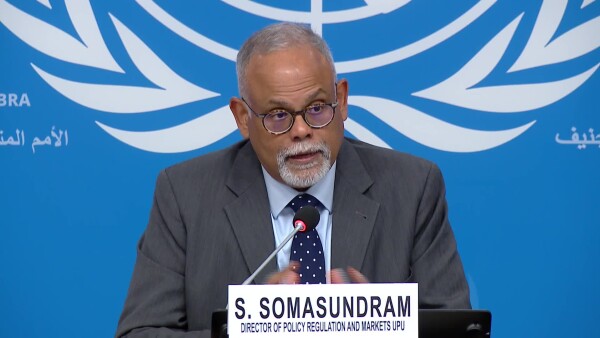
Presentation of the Trade and Developement Report 2026
Embargoed until 9 October 2026 at 11 a.m. (Geneva Time)
UNCTAD: UNCTAD’s flagship report finds that governments increasingly use industrial, trade, financial and technology policies to pursue economic and national security objectives. Market access and the ability to move into higher-value activities now depend more heavily on technology, finance and geopolitics.
1
1
1
Press Conferences | UPU
Release of the State of the Postal Sector Report 2026
1
1
1
Press Conferences | IOM , ITU , UNECE , UNICEF , WHO , WMO
UNICEF: Ebola, DRC - children orphans or separating them from parents and caregivers; IOM: Humanitarian needs in Djibouti amid arrivals from Yemen and increased migrant movements; WHO: Darfur, scale of health needs far exceeds available resources; WMO co-sponsored Global Heat Forum, Bangkok, monthly Global Seasonal Climate Update; UNECE: UN Forum of Mayors; ITU Plenipotentiary Conference 2026; WHO: child and adolescent obesity guidelines and new global roadmap to tackle pregnancy hypertension, a leading cause of maternal mortality