

The United Nations Office at Geneva
Multimedia Newsroom
Press Conferences | OHCHR , UNHCR , WHO , UNOG , UNITED NATIONS
Bi-weekly Press Briefing 21 September 2021
Human Rights Council update
Rolando Gomez, for the Human Rights Council, said that the Council’s programme for that day included an interactive discussion with the Working Group on Enforced or Involuntary Disappearances, whose report focused on enforced disappearance in the context of transnational transfers; the report of the Working Group on the use of mercenaries (noon); an address by the Minister for Foreign Affairs of Paraguay Acevedo (3 p.m.); the report of the Special Rapporteur on toxics and human rights; the annual briefing by the President of the Economic and Social Council; and reports by the Office of the United Nations High Commissioner for Human Rights. The general debate on item 3 would begin late that day and continue throughout the next day. Time permitting, the Special Rapporteur on the situation of human rights in Myanmar would give an oral update on 22 September. Country-specific reports, including on South Sudan, Syria, Burundi and Venezuela, would be presented on 23 and 24 September.
Replying to a journalist, Mr. Gomez said that the report of the fact-finding mission to the Bolivarian Republic of Venezuela was scheduled to be presented at noon on 24 September, with the members of the mission physically present. It was unclear who would represent the Member State.
Situation in Yemen
Alessandra Vellucci, for the United Nations Information Service, recalled that the Secretary-General had strongly condemned the execution by the Houthis of nine individuals following judicial proceedings that did not meet fair trial or due process requirements. He was also concerned about the killing of civilians in an air strike by the Saudi-led coalition in Shabwa. He urged all actors to cease the violence and encouraged the Yemeni parties to engage with the United Nations in good faith and without preconditions to reinvigorate the political dialogue to find a peaceful negotiated settlement that met the legitimate demands and aspirations of the Yemeni people.
Marta Hurtado, for the Office of the United Nations High Commissioner for Human Rights (OHCHR), said that OHCHR was very concerned by the situation in Yemen, where civilians were paying a heavy price for all the parties’ continued violations of international human rights and humanitarian law. For example, on 18 September, following a flawed judicial process, the Houthis publicly executed nine men, including one who had reportedly been a minor at the time of his detention, accused of involvement in the assassination of Saleh Ali Al-Samad, president of the Supreme Political Council of the de facto authorities in Sanaa. OHCHR opposed the imposition of the death penalty in all circumstances. In the context of an armed conflict, moreover, carrying out executions in the absence of judicial guarantees was a violation of international humanitarian law and amounted to a war crime.
Another source of concern were the repeated drone and missile attacks by both the Houthis and the Saudi-led coalition, which had resulted in civilian casualties and damage to civilian objects in Yemen and Saudi Arabia. On 18 September, in Shabwa governorate, an air strike allegedly launched by the Saudi-led coalition hit a vehicle, killing five civilians, including two children. On 11 September, a drone and missile attack allegedly launched by the Houthis on the Al Makha seaport damaged several warehouses containing humanitarian supplies, as well as houses and medical facilities.
OHCHR recalled that any attack directed at civilian objects or civilians not directly taking part in the hostilities could amount to a war crime and called on all parties to abide by their obligations under international humanitarian law and to conduct investigations with a view to holding accountable those responsible for any violations.
The full briefing note is available here.
Alessandra Vellucci, for the United Nations Information Service, added that the new Special Envoy for Yemen, Hans Grundberg, during a visit to Riyad the previous week, had met with the President, Vice-President, Speaker of the Parliament, Prime Minister and Minister for Foreign Affairs of Yemen. He had welcomed the clear engagement by his interlocutors to actively support his mission and their willingness to work together to support a Yemeni-led political process.
Situation in Afghanistan
In response to questions by journalists, Marta Hurtado, for the Office of the United Nations High Commissioner for Human Rights (OHCHR), said that, as in all cases of civilian deaths, OHCHR deplored the outcome of the air strike carried out by the United States in Afghanistan in late August. In that case, the human rights section of the United Nations Assistance Mission in Afghanistan had shared information with the United States authorities. OHCHR called on those authorities to remain transparent and to put in place or improve mechanisms to prevent such incidents. The determination as to whether an attack against civilian objects or civilians amounted to a war crime should be made by the courts. Those with influence over the parties should ensure that the parties followed international human rights and humanitarian law. OHCHR engaged with representatives of the parties in Geneva and on the ground.
Expulsion of Haitian migrants from the U.S.A.
In response to a question, Marta Hurtado, for the Office of the United Nations High Commissioner for Human Rights (OHCHR), said that OHCHR was seriously concerned that the recent expulsions of Haitian migrants by U.S. authorities appeared to have been carried out without any individual assessment of the persons’ cases.
Shabia Mantoo, for the United Nations Refugee Agency (UNHCR), said that some among the group of expelled individuals might have well-founded grounds to request international protection and that the situation in Haiti called for a coordinated regional response to ensure effective and legal stay arrangements. UNHCR was closely monitoring both sides of the United States-Mexico border and was engaging with the authorities and NGO partners in the area. The Agency recalled that anyone who claimed to have a well-founded fear of being persecuted in their country of origin should have access to asylum and should see their claim assessed before being expelled or deported. It had long been calling on the United States to lift restrictions on asylum under Title 42. It was possible to manage public health and national security concerns while respecting asylum rights.
UNHCR welcomes U.S. plan to increase refugee resettlement
Shabia Mantoo, for the United Nations Refugee Agency (UNHCR), said that UNHCR welcomed President Biden’s proposal to raise the target for refugee resettlement in the United States in the coming fiscal year to 125,000 people. The plan sent a clear signal to the world about the importance of all countries doing their part and working together to share the responsibility of responding to the needs of refugees through concrete, strong and compassionate action. UNHCR applauded the call for action and urged all countries to make more resettlement places available for the refugees who needed them most.
The full briefing note can be found here.
Replying to journalists, Ms. Mantoo said that refugee resettlement saved lives, especially since 90 per cent of the world’s refugees were hosted in some of the poorest countries; therefore, relevant programmes should be applauded. That did not prevent the Agency from engaging in dialogue on how to implement resettlement or encouraging best practices. A projected 1.47 million refugees would be in need of resettlement in 2021.
Coronavirus disease (COVID-19)
In response to questions about the vaccines and the virtual COVID-19 summit being organized by the United States on the sidelines of the General Assembly, Margaret Harris, for the World Health Organization (WHO), said that WHO Director General would be taking part. It was important to underline that only 15 per cent of pledges to the vaccination effort had been disbursed and that the 10 per cent vaccination target for the end of September 2021 had been met only in richer countries. Recalling that they were designed to prevent hospitalization, severe illness and death, the vaccines were working very well. Having access to the vaccine was a great gift and privilege not to be squandered. Individuals who had questions or were reluctant to vaccination should turn to trusted sources, such as the WHO and local government websites, not to social media. WHO would not comment on the efficacy and safety of the Pfizer vaccine for children under 12 until it had examined all the data.
Tribute to John Ruggie
Marta Hurtado, for the Office of the United Nations High Commissioner for Human Rights (OHCHR), said that OHCHR expressed its deep sadness at the passing of John Ruggie, whose drive and commitment had been central to the development of the Guiding Principles on Business and Human Rights. As the first Special Representative of the Secretary-General on business and human rights, Mr. Ruggie had researched and advocated for new ways of thinking and working to prevent and mitigate human rights risks related to business. The Guiding Principles were firmly anchored in international human rights norms and standards and provided a clear common framework for addressing risks to human rights and contributing to a more equitable and sustainable global economy. Despite undeniable progress over the past 10 years, much remained to be done to fulfil Mr. Ruggie’s vision of the Guiding Principles.
The full text of the tribute can be found here.
Rolando Gomez, for the Human Rights Council, echoed the sentiments of the President of the Human Rights Council on the passing of Mr. Ruggie, a towering figure in the human rights community and a cornerstone of many of the activities that continued to that day, he said.
Announcements
Alessandra Vellucci, for the United Nations Information Service (UNIS), said that the high-level debate segment of the General Assembly would run from 21 to 27 September on the theme “Building resilience through hope”.
The General Assembly would hold a high-level meeting on the twentieth anniversary of the Durban Declaration and Programme of Action on 22 September, under the theme of reparation, racial justice and equality for people of African descent. A political declaration was expected to be adopted. In connection with the anniversary, UNOG was holding a conference on reggae as an instrument of collective memory of slavery at the Musée d'ethnographie de Genève on 23 September, at 7.30 p.m.
The Food Systems Summit would take place virtually on 23 September to call for urgent collective action to radically change the way food was produced, processed and consumed. The Secretary-General would be issuing a statement of action.
The Secretary-General had also convened a high-level dialogue on energy on 22 to 24 September. It would be the first energy-focused international conference in 40 years and aimed to advance action towards net-zero emissions and universal access to energy and to promote the key message that the shift to sustainable energy was crucial in addressing climate change and poverty.
In response to a question on antisemitism and the commemoration of the Durban Declaration, Ms. Vellucci said that the scope of the event on the Declaration was clear and that it was not helpful to speculate about whether the focus would be diverted to other issues.
Margaret Harris, for the World Health Organization (WHO), said that the Air Quality Guidelines, which had not been updated in 15 years and would benefit from the huge increase in scientific data, would be presented on the side of the General Assembly on 22 September, at 3 p.m.
Alessandra Vellucci, for the United Nations Information Service (UNIS), said that the Committee on the Rights of the Child would be meeting in private until the closure of its eighty-eighth session at 5 p.m. on 24 September, when it would adopt its concluding observations on Poland, the Czech Republic, Eswatini and Switzerland.
The Committee on Enforced Disappearances would also be meeting in private until the closure of its session at 5 p.m. on 24 September, when it would adopt its concluding observations on Brazil, Panama, Spain and France.
Similar Stories
1
1
1
Press Conferences | IOM , UNDRR
UN stresses importance of household preparedness for disaster risk reduction.

1
1
1
Statements , Press Conferences | OHCHR
1
1
1
Press Conferences | UNHCR , UNICEF , IFRC , OHCHR , UN WOMEN , IOM , OCHA , WHO
UNHCR – ExCom Meeting, UNICEF – Nepal Recovery, IFRC – Flash Floods, WHO – Mental Health, IOM – South Sudan Floods, OCHA – DRC Humanitarian aid, UNHCR – Sahel Displacement, UNICEF – Yemen Update, IOM – Gaza Shelter, UN Women – Gaza Women, OHCHR – Arrests and detentions of Syrians by Israeli force
2
1
2
Press Conferences | UNCTAD
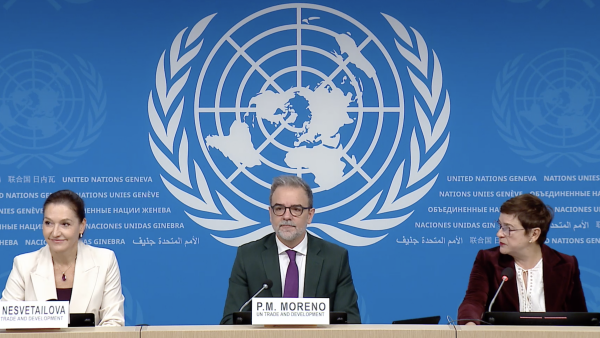
Presentation of the Trade and Developement Report 2026
Embargoed until 9 October 2026 at 11 a.m. (Geneva Time)
UNCTAD: UNCTAD’s flagship report finds that governments increasingly use industrial, trade, financial and technology policies to pursue economic and national security objectives. Market access and the ability to move into higher-value activities now depend more heavily on technology, finance and geopolitics.
1
1
1
Press Conferences | UPU
Release of the State of the Postal Sector Report 2026
1
1
1
Press Conferences | IOM , ITU , UNECE , UNICEF , WHO , WMO
UNICEF: Ebola, DRC - children orphans or separating them from parents and caregivers; IOM: Humanitarian needs in Djibouti amid arrivals from Yemen and increased migrant movements; WHO: Darfur, scale of health needs far exceeds available resources; WMO co-sponsored Global Heat Forum, Bangkok, monthly Global Seasonal Climate Update; UNECE: UN Forum of Mayors; ITU Plenipotentiary Conference 2026; WHO: child and adolescent obesity guidelines and new global roadmap to tackle pregnancy hypertension, a leading cause of maternal mortality
1
1
1
Press Conferences | OCHA , UN WOMEN , UNHCR , WFP , WHO , WTO , UNEP
OCHA – $160M CERF allocation to 12 underfunded crises; UNHCR – 5.8M refugee children remain out of school amid funding cuts; UN Women – Middle East escalation and food security among women/girls; WHO – Gaza supplies and overall situation; WFP – Yemen food insecurity and impact on global hunger ; UNEP - First International Conference of the Global Framework on Chemicals in Geneva | 16-20 November 2026
1
1
1
Press Conferences | UNHCR , WHO
Yemen's health system nears collapse amid conflict, causing rising casualties and medicine shortages.
1
1
1
Press Conferences | HRC
Update by the Expert Mechanism to Advance Racial Justice and Equality in Law Enforcement
1
1
1
Press Conferences | WIPO , WHO , UNICEF , UNHCR , IOM , WFP , FAO
WIPO Global Innovation Index 2026 launch and press conference, WHO Composition of influenza vaccines for the 2027 Southern Hemisphere flu season, UNICEF Yemen hunger and malnutrition; UNHCR Sudan displacement into Chad; IOM Ebola and population movements in DRC; WFP emergency food assistance in Nepal; and FAO food loss and waste.
2
1
2
Press Conferences | UNCTAD
Gaza reconstruction needs reach $71.5 billion as Palestinian economy and public finances face severe strain. Latest UNCTAD report documents the loss of decades of development gains, economic collapse in Gaza and tightening economic constraints in the West Bank.
The report identifies three immediate priorities: transferring withheld Palestinian revenues, safeguarding the banking system and aligning reconstruction support with the documented scale of damage and economic losses.
1
1
1
Press Conferences | HRC
Press conference on the situation of human rights in Nicaragua by the UN Group of Human Rights Experts