

The United Nations Office at Geneva
Multimedia Newsroom
Press Conferences | OHCHR , UNICEF , UNHCR , UNOG , UNITED NATIONS , WFP
Bi-weekly Press Briefing 9 September 2021
Afghanistan
Alessandra Vellucci, for the United Nations Information Service (UNIS), reminded that the United Nations Secretary-General had called on the international community to join him in Geneva, in person and virtually, on 13 September to express solidarity with the people of Afghanistan and pledge tangible support to address their critical humanitarian needs. This high-level event, from 3 to 5 pm Geneva time, would be moderated by Melissa Fleming, the UN Under-Secretary-General for Global Communications. A press conference would follow the event and be held in Room XVIII. The event and press conference would both be webcast live on UN web tv. Photos from the event would be available on UNOG Flickr page. Freely available stock photos from Afghanistan from OCHA can be found here.
On behalf of FAO, Ms. Vellucci also informed that the Director-General of the Food and Agriculture Organization, Qu Dongyu, would be among UN principals that would address the upcoming event on Afghanistan. FAO remained on the ground in Afghanistan, and millions of people in rural areas depended on agriculture for their livelihoods and food security.
Anthea Webb, Deputy Regional Director for the World Food Programme (WFP), speaking from Bangkok, stated that a massive 93 percent of households in Afghanistan were not consuming sufficient food according to randomized phone surveys carried out from 21 August to 5 September in all 34 provinces.
Three in four families were already reducing portion sizes or borrowing food. They were also buying cheaper food, foregoing more nutritious foods such as meat, dairy and vegetables. Parents were skipping meals entirely to allow their children to eat. Ms. Webb said that food insecurity had already been widespread before 15 August, with 81 percent of households reporting insufficient food consumption. One in three Afghans had been acutely food insecure.
Food shortages and job loss were now the primary cause of concern for families surveyed. With winter fast approaching and the economy collapsing, their worries were justified. It was now a race against time to deliver lifesaving assistance to the Afghan people who needed it the most before roads were cut off by snow. WFP needed to reach 9 million people a month by November, if it was to meet its planned target of 14 million by the end of the year. WFP had appealed for USD 200 million and several countries had offered to help; USD 7 million had been confirmed thus far.
Responding to questions, Ms. Webb informed that the WFP had been working in Taliban-controlled areas for a long time, so negotiating access with the group was nothing new. Ms. Webb specified that the survey had taken place between 17 June and 5 September, with a marked deterioration registered after 15 August. The survey sample size had been 1,600 respondents per month. Negative copying mechanisms with food shortages had almost doubled since mid-August, she said. The main reason the situation had gotten so much worse in over the past month was that many Afghan people simply did not have access to the money they needed to buy enough food. There were more than 10 international and 430 national WFP staff in Afghanistan at the moment. The current situation was not unlike that of September 2001, noted Ms. Webb, when the WFP had brought in or purchased 200,000 metric tons of food.
On another question, Ms. Vellucci confirmed that Melissa Fleming would moderate both the high-level event on Afghanistan and the press conference. The press conference would be held in room XVIII, reiterated Ms. Vellucci.
Ravina Shamdasani, for the Office of the High Commissioner for Human Rights (OHCHR), stated that peaceful protesters across various provinces in Afghanistan over the past four weeks had faced an increasingly violent response by the Taliban, including the use of live ammunition, batons and whips. On 8 September, the Taliban had issued an instruction prohibiting unauthorized assemblies. On 9 September, they had ordered telecommunications companies to switch off internet on mobile phones in specific areas of Kabul.
OHCHR called on the Taliban to immediately cease the use of force towards, and the arbitrary detention of, those exercising their right to peaceful assembly and the journalists covering the protests. Protests had been taking place since 15 August and had been increasing in number until the 8 September instruction on the prohibition of unlawful assemblies. Reports indicated a growing resort by the Taliban to the use of force against those involved in or reporting on the demonstrations.
Ms. Shamdasani recalled that peaceful protests were protected under international human rights law, including under Article 21 of the International Covenant on Civil and Political Rights, to which Afghanistan was a State Party. Authorities had to ensure a safe, enabling and non-discriminatory environment for the exercise of human rights, including freedom of expression and peaceful assembly. Blanket restrictions on peaceful assemblies constituted a violation of international law, as did blanket internet shutdowns which usually violate the principles of necessity and proportionality. Journalists involved in reporting on assemblies should not face reprisals or other harassment. Rather than banning peaceful protests, the Taliban should cease the use of force and ensure the freedom of peaceful assembly and expression, including as a means for people to voice their concerns and exercise their right to participate in public affairs.
OHCHR briefing note can be found here.
Responding to questions, Ms. Shamdasani stated that a lot of protests were currently being seen in Afghanistan, including by courageous women and men standing up for their human rights. There had been reports of severe beatings and house-to-house searches. OHCHR was calling on the Taliban to abide by the international norms that Afghanistan was obliged to respect. An inclusive approach, which would allow the Taliban to listen to people’s grievances, was needed. OHCHR’s account of numbers of people killed – four - was by no means exhaustive, explained Ms. Shamdasani. Journalists had also been under attack during the protests; at least 19 journalists had been detained on 7 and 8 September and many of them had been beaten. She informed that UN High Commissioner for Human Rights Michelle Bachelet would speak on Afghanistan to the Human Rights Council in Geneva in the morning of 13 September.
Ms. Vellucci emphasized that the UN believed that the Afghan Government had to be inclusive and representative of the population as a whole. For the moment, UN Geneva would not require COVID certificates to attend meetings at the Palais des Nations, said she in a response to a question, but the UN would continue to follow the situation and Swiss guidance.
Jens Laerke, for the Office for the Coordination of Humanitarian Affairs (OCHA), said that the UN and the wider humanitarian community were grateful for all offers of support to help with aid or bringing aid into Afghanistan. In a response to a question, Mr. Laerke stated that there were over 40 ministers registered to participate in the high-level event on 13 September; several of them, including foreign ministers, would be physically present in Geneva. Mr. Laerke said that this week, the UN Relief Coordinator Martin Griffiths had addressed the UN Spokesman’s noon briefing, the recording of which was available here.
Human rights report on Tigray
Ravina Shamdasani, for the Office of the High Commissioner for Human Rights (OHCHR), informed that the joint investigation by the UN Human Rights Office and the Ethiopian Human Rights Commission into alleged violations of human rights, humanitarian and refugee law committed by all parties to the conflict in Tigray had concluded its field work phase, with a final report to be published on 1 November 2021. UN High Commissioner for Human Rights Michelle Bachelet would deliver an update to the UN Human Rights Council on 13 September 2021 on the situation of human rights in the Tigray region and on progress made in the context of the joint investigation
More information is available here.
Millions in need of urgent humanitarian assistance in eastern DR Congo
Boris Cheshirkov, for the United Nations Refugee Agency (UNHCR), informed that UNHCR was alarmed by violence committed against civilians by armed groups in eastern Democratic Republic of the Congo that continued to cost lives and drive people from their homes.
UNHCR and its partners had recorded more than 1,200 civilian deaths and 1,100 rapes this year in the two most affected provinces of North Kivu and Ituri. UNHCR had also recorded 25,000 human rights abuses this year. In total, more than a million Congolese had been internally displaced in the east of the country in 2021.
Ms. Cheshirkov said that attacks attributed to the Allied Democratic Forces (ADF) armed group had increased in brutality since late 2020, and the frequency of killings of civilians had not abated despite the state of siege declared in early May 2021 to counter the activities of those armed groups. Following the state of siege, North Kivu and Ituri Provinces were now led by military governments, under which the national army had ramped up its operations and military tribunals had replaced civil courts.
UNHCR reiterated its call for urgent measures to protect civilians; it supported local authorities and civil society groups who responded repeatedly to recurrent forced displacement, and continued to provide lifesaving aid, psychosocial and other support to people in need. UNHCR was further calling on the international community for more support. Less than four months from the end of the year, UNHCR had received just 51 per cent of the USD 205 million required in 2021 for the operation in DRC.
UNHCR briefing note is here.
Announcements
Alessandra Vellucci, for the UN Information Service (UNIS), reminded that on the 75th anniversary of the UN, Member States had pledged to strengthen global governance for the sake of present and coming generations. They had requested the Secretary-General to report back with recommendations to advance our common agenda and to respond to current and future challenges. The Secretary-General would present his Our Common Agenda report to the General Assembly at UN Headquarters in New York today at 4 pm Geneva time. The event would be livestreamed on UN WebTV: https://media.un.org/en/asset/k1i/k1ios29mjc. Following the presentation, the Secretary-General would speak to the media about the report at 6:30 pm Geneva time, as part of his pre-General Assembly press conference.
Rolando Gomez, for the Human Rights Council, informed that the Human Rights Council would open on 13 September in Geneva its 48th regular session, which would last until 8 October. The session would open at 10 am hearing from the President of the Councill, to be followed by a global update by the High Commissioner for Human Rights. The High Commissioner would also provide oral updates on Afghanistan, Sri Lanka, Venezuela, and Nicaragua. The meetings would be webcast in six languages, and all statements would be made available on the extranet. Mr. Gomez noted that, due to the COVID situation, most interventions would be delivered virtually.
Dan Teng’o, for the United Nations Conference on Trade and Development (UNCTAD), informed that UNCTAD would release the 40th anniversary edition of its annual Trade and Development Report under embargo until 15 September at 3 pm Geneva time. A press conference on the report would take place on 14 September at 3 pm. UNCTAD’s new Secretary-General Rebeca Grynspan would address the media. A press release would be made available today, under embargo, in UNCTAD’s virtual room.
On 14 September at 1:30 pm, the Commission of Inquiry on the Syrian Arab Republic would hold a press conference to launch a mandate report on latest investigations. Speakers would be Paulo Sérgio Pinheiro, Chair; Hanny Megally and Karen Koning AbuZayd, Commissioners.
On 15 September at 10 am, the United Nations Institute on Disarmament Research (UNIDIR) would present the Cluster Munition Monitor 2021 Report. Speakers would be Mary Wareham, Human Rights Watch Arms Advocacy Director; Loren Persi, Monitor Impact research team editor; and Ruth Bottomley, Monitor Impact research team editor.
The Committee in the Rights of the Child would begin the review of the report of Poland on 13 September at 3 pm and finish it the day after at 10 am. The Committee would also review reports of Eswatini (15 September) and Switzerland (20 September). It had already reviewed the report of the Czech Republic.
The Conference on Disarmament would officially close today its 2021 session. The CD was expected to adopt its draft annual report for this year session.
The Committee on Enforced Disappearances would open on 13 September its 21st session, during which it would review the initial reports of Panama and Brazil, and also review additional information by Spain and France.
Similar Stories
1
1
1
Press Conferences | UNHCR
End of UNHCR's 77th Annual Executive Committee (ExCom) meeting week
1
1
1
Press Conferences | UNICEF , IOM , UNHCR
UN Special Assistant to the Personal Envoy Office (SUDAN): Peace Initiatives and Efforts in Sudan; UNICEF: Dire situation of children in Gaza; IOM: Damaged Homes and Energy Attacks Risk Displacing Ukrainians for this winter; UNHCR: update on EXCOM week
1
1
1
Press Conferences | IOM , UNDRR
UN stresses importance of household preparedness for disaster risk reduction.
1
1
1
Statements , Press Conferences | OHCHR
1
1
1
Press Conferences | UNHCR , UNICEF , IFRC , OHCHR , UN WOMEN , IOM , OCHA , WHO
UNHCR – ExCom Meeting, UNICEF – Nepal Recovery, IFRC – Flash Floods, WHO – Mental Health, IOM – South Sudan Floods, OCHA – DRC Humanitarian aid, UNHCR – Sahel Displacement, UNICEF – Yemen Update, IOM – Gaza Shelter, UN Women – Gaza Women, OHCHR – Arrests and detentions of Syrians by Israeli force
2
1
2
Press Conferences | UNCTAD
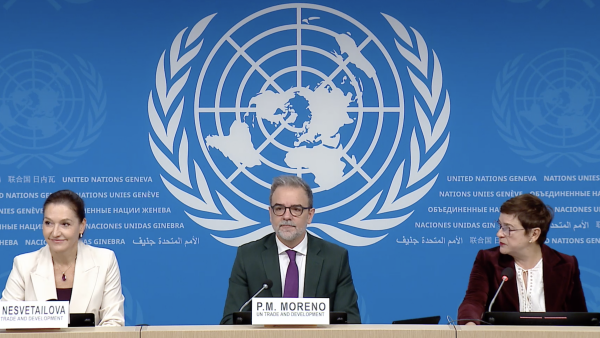
Presentation of the Trade and Developement Report 2026
Embargoed until 9 October 2026 at 11 a.m. (Geneva Time)
UNCTAD: UNCTAD’s flagship report finds that governments increasingly use industrial, trade, financial and technology policies to pursue economic and national security objectives. Market access and the ability to move into higher-value activities now depend more heavily on technology, finance and geopolitics.
1
1
1
Press Conferences | UPU
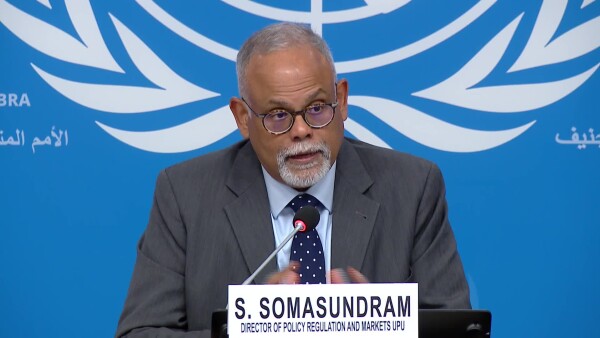
Release of the State of the Postal Sector Report 2026
1
1
1
Press Conferences | IOM , ITU , UNECE , UNICEF , WHO , WMO
UNICEF: Ebola, DRC - children orphans or separating them from parents and caregivers; IOM: Humanitarian needs in Djibouti amid arrivals from Yemen and increased migrant movements; WHO: Darfur, scale of health needs far exceeds available resources; WMO co-sponsored Global Heat Forum, Bangkok, monthly Global Seasonal Climate Update; UNECE: UN Forum of Mayors; ITU Plenipotentiary Conference 2026; WHO: child and adolescent obesity guidelines and new global roadmap to tackle pregnancy hypertension, a leading cause of maternal mortality
1
1
1
Press Conferences | OCHA , UN WOMEN , UNHCR , WFP , WHO , WTO , UNEP
OCHA – $160M CERF allocation to 12 underfunded crises; UNHCR – 5.8M refugee children remain out of school amid funding cuts; UN Women – Middle East escalation and food security among women/girls; WHO – Gaza supplies and overall situation; WFP – Yemen food insecurity and impact on global hunger ; UNEP - First International Conference of the Global Framework on Chemicals in Geneva | 16-20 November 2026
1
1
1
Press Conferences | UNHCR , WHO
Yemen's health system nears collapse amid conflict, causing rising casualties and medicine shortages.
1
1
1
Press Conferences | HRC
Update by the Expert Mechanism to Advance Racial Justice and Equality in Law Enforcement
1
1
1
Press Conferences | WIPO , WHO , UNICEF , UNHCR , IOM , WFP , FAO
WIPO Global Innovation Index 2026 launch and press conference, WHO Composition of influenza vaccines for the 2027 Southern Hemisphere flu season, UNICEF Yemen hunger and malnutrition; UNHCR Sudan displacement into Chad; IOM Ebola and population movements in DRC; WFP emergency food assistance in Nepal; and FAO food loss and waste.