

The United Nations Office at Geneva
Multimedia Newsroom
Press Conferences | UNHCR , OCHA , WHO , UNITED NATIONS , WFP , FAO
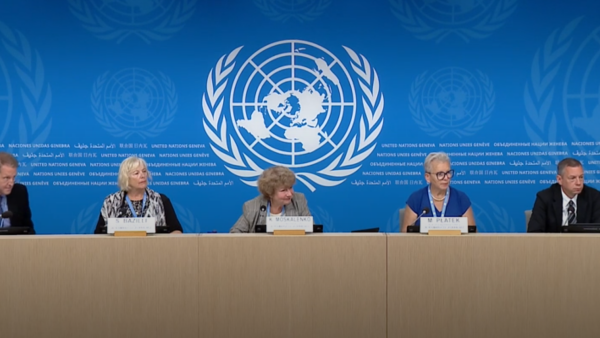
Bi-weekly Press Briefing 7 September 2021
Situation in Afghanistan
Alessandra Vellucci, for the United Nations Information Service (UNIS), confirmed that the Secretary-General would travel to Geneva to convene a high-level humanitarian meeting to address the growing needs in Afghanistan. An appeal would be made for a full and unimpeded humanitarian access, in the situation when nearly half of the population needed aid. The United Nations remained committed to delivering humanitarian assistance to millions of people in need.
The event in Geneva, from 3 to 5 pm on 13 September, would be of hybrid nature, and would include remarks of the UN Relief Coordinator and the Head of the United Nations Population Fund, among others. The event would be broadcast live on UNTV, while the capacity in Room XVIII would be limited due to the COVID-19 restrictions [later on, it was communicated that the conference would take place in Room XIX instead of XVIII].
Jens Laerke, for the Office for the Coordination of Humanitarian Affairs (OCHA), stated that the previously announced Flash Appeal for Afghanistan had now been posted online. The Flash Appeal was consolidated by OCHA on behalf of the Humanitarian Country Team to address the immediate response gaps in Afghanistan.
It sought USD 606 million to assist nearly 11 million people in the four remaining months of 2021, which included two million people not previously covered in the Humanitarian Response Plan. If properly funded, the appeal would deliver, inter alia, critical food and livelihood assistance to nearly 11 million people; essential health services to 3.4 million people; treatment for acute malnutrition for more than a million children and women; water, sanitation and hygiene interventions for 2.5 million people, etc.
Humanitarian organizations had decades of experience in delivering relief in Afghanistan, and this year alone, eight million people had received assistance. Basic services in Afghanistan were collapsing, and food and other life-saving aid was about to run out. The event on 13 September would be one opportunity to pledge support.
Rein Paulsen, Director of the Office of Emergencies and Resilience at the Food and Agriculture Organization, connecting from Islamabad, stated that the food insecurity in Afghanistan had been a concern for a while. For the second time in four years, Afghanistan was facing a drought; even before the August events, one out of three Afghans had been food insecure. There were an estimated four million people in the Integrated Phase Classification IPC 4 situation, with high levels of malnutrition and significant challenges with excess mortality.
FAO had remained on the ground for over four decades. FAO and partners were now focused on a narrow window of opportunity to start wheat planting in the coming weeks. The winter wheat campaign had resources to support over one million people; wheat was the most significant crop in Afghanistan, stressed Mr. Paulsen. FAO was procuring wheat seeds within Afghanistan, he explained. An equal focus had to be placed on livestock, which needed to be supported throughout the winter so it would survive and strive. FAO representatives continued to be in the country and deliver. Even in August, amidst the turmoil, the FAO had been able to support over 100,000 people. There was an urgent need for USD 15 million, which were part of the overall Flash Appeal, to support a number of critical activities.
Responding to questions, Ms. Vellucci said that a press conference was expected after the conference on Afghanistan; all details would be shared with the press corps as soon as they were available. Mr. Paulsen stated that FAO had an extensive network of partners, and the experience built over time helped ensure that the aid reached those communities which needed it the most. FAO carried out its work in line with the well-known humanitarian principles; that also meant that FAO would engage with all stakeholders with the view of delivering aid to those who needed it. The vast majority of the FAO staff remained in the country. Mr. Laerke informed that the head of OCHA, Martin Griffiths, was in Kabul and had met with the Taliban leadership in order to secure unrestricted access for humanitarian aid. The verbal commitments by the Taliban now needed to be converted into practical actions, stressed OCHA.
On another question, Mr. Laerke said that at the beginning of the year, OCHA had issued a humanitarian plan for the entire year 2021; that plan was now 40 percent funded. The current flash appeal of USD 606 million focused on what was needed right now and until the end of the year. The conference on 13 September would be a great opportunity for donors to pledge support.
Fadéla Chaib, for the World Health Organization (WHO), specified that, as part of the flash appeal, the WHO and its partners were requesting a total of USD 66 million to deliver life-saving health services to 3.5 million people until the end of the year.
Babar Baloch, for the United Nations Refugee Agency (UNHCR), speaking from Quetta, stated that UNHCR had been able to get some aid from Pakistan into Afghanistan, with the assistance of the Pakistani authorities and the assurances of the authorities inside Afghanistan. Answering another question, Mr. Baloch said that over 600,000 Afghans had been displaced internally this year; most of the displaced people were women and children. Asylum ought to be possible for those who needed it and crossed international borders; most Afghan refugees were in Pakistan and Iran.
James Elder, for the United Nations Children’s Fund (UNICEF), added that UNICEF continued to focus on water, sanitation, psychosocial support. More than 100 children who had left Afghanistan had been resettled; the priority was to reunite those children with their families.
Tomson Phiri, for the World Food Programme (WFP), said that the race was on to get food into the country, as winter was approaching. In just a few weeks, WFP’s food supplies would run out. Some USD 200 million were needed to feed people between now and the year’s end; this was part of the overall Flash Appeal presented by OCHA. WFP engaged with all parties, guided by the humanitarian principles, all with the goal of having access to people in need.
Northern Ethiopia
Tomson Phiri, for the World Food Programme (WFP), said that, as conflict spilled across Northern Ethiopia, forcing 300,000 people from their homes and 1.7 million into hunger in Afar and Amhara provinces, the WFP had announced an unprecedented funding gap of USD 426 million across its operation in Ethiopia and appealed for funds to meet the needs of up to 12 million people this year.
In Tigray, food security continued to worsen as the WFP and its partners struggled to scale up and meet the urgent food needs of 5.2 million people across the region. Food stocks held by WFP and partners had been almost entirely depleted until this week, when the first convoy for over two weeks had entered the region.
Mr. Phiri said that 335 trucks that had been able to be deployed represented less than ten percent of needed supplies. An estimated 100 trucks were needed to enter the region every day in order to meet the needs of people in Tigray. WFP was calling for an additional USD 426 million to expand its emergency food assistance response over the next six months as well as provide long-term food security solutions for people as they entered the yearly ‘hunger season.’
Full WFP press release is here.
Responding to questions, Mr. Phiri explained that trucks were delayed by checkpoints, bureaucracy, and occasional attacks. What was needed was regular, unimpeded, smooth and predictable access. Once in Mekelle, shipments were moved into secondary transport to reach other parts of the region.
Geneva announcements
Alessandra Vellucci informed that on 8 September at 10 am, there would be a press conference on the forty-eighth Human Rights Council regular session. The speaker would be Ambassador Nazhat Shameem Khan, President of the Human Rights Council, 2021.
Also on 8 September, at 3 pm, the Group of Eminent International and Regional Expert on Yemen would present its fourth report in a hybrid press conference. Speakers would be Kamel Jendoubi, Chair, and Melissa Parke and Ardi Imseis, members of the Group.
The Committee in the Rights of the Child had opened on 6 September its eighty-eighth session, the first “in person” session since the beginning of the pandemic. Today, at 10 am, the Committee would complete the review of the report of the Czech Republic. The Committee would also review the reports of Poland (13-14 September), Eswatini (15 September), and Switzerland (20 September).
The Committee on Enforced Disappearances would open on 13 September at 10 am its twenty-first session, during which it would review the initial reports of Panama and Brazil, and review additional information by Spain and France.
The Conference on Disarmament was meeting this morning, and possibly this afternoon, to review its draft annual report for its 2021 session. The 2021 session of the CD was officially to end on 10 September.
Finally, Ms. Vellucci informed that today was the International Day of Clean Air for Blue Skies. In his message, the Secretary-General warned that as many as 90 percent of people were breathing polluted air and said that “today and every day, let us work together to clean the air that we breathe so we may protect both people and the planet”. The message could be found here.
Similar Stories
1
1
1
Press Conferences | WIPO , WHO , UNICEF , UNHCR , IOM , WFP , FAO
WIPO Global Innovation Index 2026 launch and press conference, WHO Composition of influenza vaccines for the 2027 Southern Hemisphere flu season, UNICEF Yemen hunger and malnutrition; UNHCR Sudan displacement into Chad; IOM Ebola and population movements in DRC; WFP emergency food assistance in Nepal; and FAO food loss and waste.
2
1
2
Press Conferences | UNCTAD
Gaza reconstruction needs reach $71.5 billion as Palestinian economy and public finances face severe strain. Latest UNCTAD report documents the loss of decades of development gains, economic collapse in Gaza and tightening economic constraints in the West Bank.
The report identifies three immediate priorities: transferring withheld Palestinian revenues, safeguarding the banking system and aligning reconstruction support with the documented scale of damage and economic losses.
1
1
1
Press Conferences | HRC
Press conference on the situation of human rights in Nicaragua by the UN Group of Human Rights Experts
1
1
1
Press Conferences | ITU , UNHCR , WHO , WMO
YEMEN - UNHCR: Escalating conflict in Yemen could fuel more displacement, refugee movement
CLIMATE - WHO / WMO: Health and Climate impact of El Niño
1
1
1
Press Conferences | HRC , OHCHR
Mariana Katzarova discusses human rights in Russia as a UN Special Rapporteur.
1
1
1
Press Conferences | IOM , OHCHR , UN WOMEN , UNFPA , UNHCR , UNOPS , WHO
UN Geneva briefing: Yemen crisis worsens, urgent aid needed across multiple sectors.
1
1
1
Press Conferences | HRC
Press conference on the latest report of the Independent International Fact-Finding Mission on the Bolivarian Republic of Venezuela to the UN Human Rights Council
1
1
1
Press Conferences | OHCHR
Victims Still Waiting: A Global Briefing on Transitional Justice Around the World
2
1
2
Edited News , Press Conferences | WMO
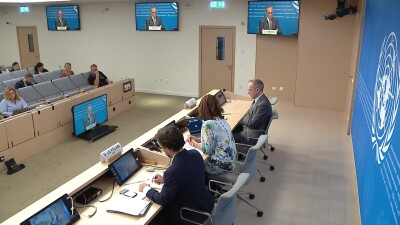
As world’s water reserves change, countries must prepare for a new reality: WMO
New data showing that rivers were at their lowest level for decades last year provides further evidence that the climate crisis is real and countries must act immediately to protect themselves from the increasing threat to communities and livelihoods, the UN World Meteorological Organization (WMO) said on Thursday.
The key findings from WMO’s State of Global Water Resources 2025 report covering the hydrological cycle and extreme events in the five-year period to last year:
- 2025 was one of driest years for river discharge in 35 years
- Past seven years have seen abnorfmal river flows
- Water storage on Earth’s land surface has decreased in past decade
- Widespread glacier loss across all regions for fourth consecutive year
- Asia and Africa are regions most affected by water-related disasters
- Water data availability has improved, but gaps remain in hard-hit areas
Highlighting the long-term decline in the Earth’s freshwater storage and glacier melt, WMO Secretary-General Celeste Saulo explained that the planet’s water reserves used to act as a planetary “savings account” that absorbed the occasional dry season, avoiding a water crisis. “One of the central stories of the 2025 report is what is happening to that savings account? And the simple answer is that we are depleting it,” she told journalists in Geneva.
Groundwater reserves are equally stretched and have been in decline since 2014, WMO’s report states, with nearly two-thirds of monitored wells worldwide showing levels lower than the historical norm and indicating a shift “further toward deficit…not recovery”.
“At the same time, we are seeing more water-related disasters,” Ms. Saulo said, while also stressing that the currently strengthening El Niño “will increase the risk of drought in some areas, and flooding in others”.
Glaciers disappearing
In 2025, for the fourth consecutive year, every major glaciated region on Earth lost ice mass, leading to short-term hazards including floods and long-term water insecurity, according to WMO.
Responding to a question about whether the changing global water cycle might have contributed to the deadly Nepal-China flooding disaster, Ms. Saulo explained that melting ice and rock was just one factor in the chain of events that ultimately sent a massive and deadly wall of water and debris downstream on 26 August, killing at least 1,367 people.
“You asked if it could happen again? Absolutely; the problem in this region is that there’s 63,700 glaciers at the last count,” she told a Press Conference in Geneva. “Even if you’re looking with remote sensing with satellites at these glaciers, you might see some faults, you might see some slight shifting, that does not mean necessarily catastrophic collapse. So, in order to plan for this, it’s very, very difficult. But the international community is looking very hard at ways in which we can bring people together to solve some of these monitoring issues.”
Data indicates that glaciers shrank between 2023 and 2025 with cumulative losses of 1,400 gigatonnes of water – or about one third of annual fresh water needs.
Every major glacier region on Earth lost ice for the fourth consecutive year.
“All 19 glacier regions around the globe lost ice; in Central Asia, Iceland, the Russian Arctic and western Canada and the United States, it was among the three worst years on record,” said Wayne Jenkinson, WMO’s Director of Hydrology and Cryosphere.
Some regions with smaller glaciers such as Central Europe, the Caucasus, the western Canada and the United States may already have reached “peak water”, Mr. Jenkinson warned.
“After this point, the glacier gives less meltwater each year simply because there is less ice left to melt. That matters for every community downstream that relies on water during hot, dry summers,” he explained.
Narelle van der Wel, WMO’s Head of Cryosphere Monitoring, Predictions and Services, stressed that while some further glacier loss is unavoidable, the eventual scale of the decline is not predetermined.
“Some glacier loss is inevitable, but total loss of glaciers is not yet inevitable,” she said, pointing to emissions reductions as central to limiting future losses.
Preparing for moving baselines
The report does not attribute every observed change to climate change alone. WMO says pressure on water resources and natural variability also contribute.
Mr. Jenkinson said governments need to prepare for “moving baselines” as historical patterns become less reliable.
“The situation 30 years ago is not where we are today,” he said. Countries, he added, need to prepare “for those changes that have really already arrived”.
ends
1
1
1
Press Conferences | WMO , OCHA , WHO , UNICEF , UN WOMEN , OHCHR , IOM , UNHCR
Update on Ebola from WHO and OCHA, update on the situation of children with the beginning of school in Ukraine from UNICEF, UN Women on the impact of the settlers and restrictions on women and girls in West Bank, OHCHR on the recovery of extensive human remains in Gaza, IOM and UNHCR on the new wave of displacement in Yemen
2
1
2
Press Conferences , Edited News | WFP
‘Super El Niño’ and converging crises worsen hunger in South Sudan and across the region - WFP
South Sudan’s hunger crisis is becoming increasingly catastrophic as violence, extreme weather and dwindling aid leave millions without enough food, the UN World Food Programme (WFP) warned on Tuesday.
1
1
1
Press Conferences | HRC
Update on the human rights situation in Belarus by the UN Group of Independent Experts on the Human Rights Situation in Belarus