

The United Nations Office at Geneva
Multimedia Newsroom
Food situation in Afghanistan
Anthea Webb, World Food Programme (WFP) Deputy Regional Director for the Asia-Pacific, said that WFP was warning that a humanitarian catastrophe awaited the people of Afghanistan that winter unless the global community made their lives a priority. WFP was usually busy prepositioning food stocks in warehouses and with communities across Afghanistan, which were then distributed to needy families before they were cut off by brutal winter snows. That year, however, with funding levels tight and needs escalating, WFP risked running out of its core supply of wheat flour as early as October. Any further delay in its preparations could be deadly for the people of Afghanistan. Once the snow set in, communities were completely cut off, and WFP food assistance was their only lifeline. The situation in 2021 had been compounded by several years of severe drought, conflict and the socioeconomic impacts of COVID-19.
Having worked in Afghanistan since 1963, including under the previous Taliban regime, WFP knew how to prevent a hunger emergency and needed US$ 200 million to deliver life-saving assistance before it was too late. Over the past tumultuous week, WFP had reached 80,000 people across Afghanistan – in addition to the more than 5 million people it had already helped since the beginning of the year. It had been able to bring 600 metric tons of food and 16 new trucks into Afghanistan in the past week alone and stood ready to scale-up operations.
Countries near and far were nervous at the prospect of a much greater refugee outflow. While United Nations agencies had solid plans to respond if people did begin to cross borders, the most urgent step that donors could take immediately was to fund existing programmes in Afghanistan, Pakistan, Tajikistan and Iran.
Special session of the Human Rights Council on the situation in Afghanistan
Alessandra Vellucci, for the United Nations Information Service, drew attention to the statement made by the United Nations High Commissioner for human rights at the special session of the Human Rights Council, in which she had said that the people of Afghanistan were looking to the Human Rights Council to defend and protect their rights. The rapid seizure of much of the country by the Taliban had raised grave fears of a return to past patterns of human rights violations, stoking desperation among many Afghans. In recent weeks, the High Commissioner’s Office had received credible harrowing reports of the impact of human rights violations and abuses and violations of international humanitarian law on civilians. The United Nations was committed to staying and delivering aid to those in greatest need, supporting efforts to restore peace and stability and promoting the rights and dignity of all Afghans.
The High Commissioner had strongly urged the Taliban to adopt norms of responsive governance and human rights and to work to re-establish social cohesion and reconciliation. She had called on all States to create safe pathways for Afghan refugees and migrants, broaden asylum and resettlement programmes and immediately halt the deportation of Afghans who sought protection. She had also asked States to use their influence with the Taliban to encourage respect for the human rights of all. United and unequivocal action by Member States would be an important signal to the Taliban that the international community would not accept a return to past practices.
The full text of the High Commissioner’s statement is available here.
Shelter needs soar for newly displaced in Marib, Yemen
Aikaterini Kitidi, for the United Nations Refugee Agency (UNHCR), said that as fighting in the Marib governorate of Yemen forced more people to flee, UNHCR was warning of alarming levels of humanitarian needs among displaced communities. Since the beginning of 2021, close to 24,000 people had been uprooted by armed clashes, shelling and air strikes in a region that was already hosting a quarter of the country’s four million internally displaced people. They had sought safety in urban centres and some 150 informal settlements, whose capacity had been exceeded and where conditions were deplorable. Inadequate shelters had been further damaged by recent floods and fires, and clean water, latrines, electricity and health facilities were in short supply. Only 21 per cent of residents could be reached owing to the prevailing insecurity.
With nine in 10 of the settlements built on private land without occupancy agreements, residents greatly feared eviction. A striking 85 per cent of displaced families, consisting mostly of women and children, were unable to pay rent on a regular basis. Further displacement due to eviction would only deplete their resources and increase their needs. With its partner, the Society for Humanitarian Solidarity, UNHCR was providing basic household items, legal assistance and psychosocial support in seven settlements in the Sirwah district of Marib. It had also distributed cash for rent to over 2,800 families as part of a plan to assist some 6,000 families at risk of eviction.
UNHCR reiterated its call to all parties to the conflict to take the necessary measures to protection civilians and public infrastructure from the impact of the conflict and to provide safe passage for civilians fleeing conflict areas.
The full text of the briefing is available here.
Haiti
Alessandra Vellucci, for the United Nations Information Service, on behalf of the Office for the Coordination of Humanitarian Affairs (OCHA), said that under the leadership of the Government of Haiti, national and international humanitarian partners were scaling up multi-sectoral response efforts in all quake-affected areas. The number of critically injured people continued to grow, stretching the health system’s already limited capacity. Many of those who had survived the quake now found themselves homeless, without access to safe water and sanitation and at greater risk of violence and abuse. Meanwhile, tension was mounting on the ground, as aid trickled into the hardest-hit communities. Additional human and financial resources were needed to respond to the crisis, with organizations stretched thin from responding to multiple simultaneous crises in the country. A flash appeal would be issued on Wednesday, 25 August.
Announcements
Isabel Piquer, for the International Labour Organization (ILO), said that on Wednesday, 1 September, ILO would issue its World Social Protection Report 2020-2022: Social protection at the crossroads – in pursuit of a better future. The flagship report provided a global overview of progress made around the world in extending social protection in the last decade, including during the COVID-19 pandemic. Based on new data, it offered a broad range of global, regional and country statistics on social protection coverage and related expenditures. It also identified social protection gaps and set out key policy recommendations. An embargoed virtual press briefing – with ILO Director General, Guy Ryder, and Shahra Razavi, Director of the Social Protection Department – would be held on 1 September, from 11 a.m. to 12 p.m.
On behalf of the Office of the Special Envoy of the Secretary-General for Syria, Special Envoy Geir Pedersen would brief the Security Council on Tuesday, 24 August, at 4 p.m. CEST. The briefing would be carried live on UN TV and the transcript of his remarks distributed to the press.
Alessandra Vellucci, for the United Nations Information Service, added that the Committee on the Rights of Persons with Disabilities would be conducting its virtual review of the report of Djibouti on 27 and 30 August and 1 September, from 12.30 p.m.
Similar Stories
1
1
1
Press Conferences | UN WOMEN , WFP , WHO
UN WOMEN: Sudan Women and girls one year after the fall of El Fasher; increasing drone attacks across the country; WFP: DRC - Ebola spreads to eighth DRC province as WFP delivers food, builds treatment centres and keeps supplies moving; WHO - Update on Ebola (Bundibugyo Virus Disease)
1
12
1
1
Press Conferences , Images | UNOG
Closing Press Conference following the Sixth Consultative Meeting on Enhancing Coordination of Peace Initiatives and Efforts in Sudan

2
17
1
2
Edited News , Press Conferences , Images | OCHA , WMO
Two UN agencies teamed up on Wednesday to issue an appeal for immediate assistance to help communities already being impacted by the strongest El Niño on record.
1
1
1
Press Conferences | CITES
Wildlife trade and conservation policy discussions at the 81st meeting of the CITES Standing Committee (SC81)
1
1
1
Press Conferences | UNHCR , UNCTAD , WMO , OCHA , UNICEF , WHO
UNHCR Hungary’s 1956 Refugee Crisis: 70 Years On, UNCTAD World Investment Forum 2026, Doha, WMO Greenhouse Gas Bulletin and Climate Update for COP31, OCHA Afghanistan: Malnutrition, Girls’ Education and Recovery, UNICEF Yemen: Child Malnutrition and Unsafe Water in Taiz, WHO Inequalities in Noncommunicable Diseases and Risk Factors
1
1
1
Press Conferences | UNHCR
End of UNHCR's 77th Annual Executive Committee (ExCom) meeting week
1
1
1
Press Conferences | UNICEF , IOM , UNHCR
UN Special Assistant to the Personal Envoy Office (SUDAN): Peace Initiatives and Efforts in Sudan; UNICEF: Dire situation of children in Gaza; IOM: Damaged Homes and Energy Attacks Risk Displacing Ukrainians for this winter; UNHCR: update on EXCOM week
1
1
1
Press Conferences | IOM , UNDRR
UN stresses importance of household preparedness for disaster risk reduction.
1
1
1
Statements , Press Conferences | OHCHR
1
1
1
Press Conferences | UNHCR , UNICEF , IFRC , OHCHR , UN WOMEN , IOM , OCHA , WHO
UNHCR – ExCom Meeting, UNICEF – Nepal Recovery, IFRC – Flash Floods, WHO – Mental Health, IOM – South Sudan Floods, OCHA – DRC Humanitarian aid, UNHCR – Sahel Displacement, UNICEF – Yemen Update, IOM – Gaza Shelter, UN Women – Gaza Women, OHCHR – Arrests and detentions of Syrians by Israeli force
2
1
2
Press Conferences | UNCTAD
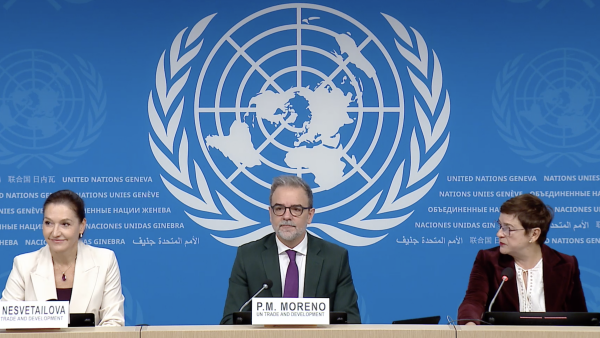
Presentation of the Trade and Developement Report 2026
Embargoed until 9 October 2026 at 11 a.m. (Geneva Time)
UNCTAD: UNCTAD’s flagship report finds that governments increasingly use industrial, trade, financial and technology policies to pursue economic and national security objectives. Market access and the ability to move into higher-value activities now depend more heavily on technology, finance and geopolitics.
1
1
1
Press Conferences | UPU
Release of the State of the Postal Sector Report 2026