

The United Nations Office at Geneva
Multimedia Newsroom
Rhéal LeBlanc, Chief of the Press and External Relations Section of the United Nations Information Service (UNIS) in Geneva, chaired the hybrid briefing, attended by the spokespersons and representatives of the World Food Programme, the Office of the United Nations High Commissioner for Human Rights and the Intergovernmental Panel on Climate Change.
Situation in Lebanon
Rhéal LeBlanc, for the United Nations Information Service (UNIS), said that 4 August marked the first anniversary of the explosion at the Port of Beirut. Commemorations would include the observance of a minute’s silence at ground zero and a message of mourning. Furthermore, an international conference in support of the people of Lebanon, co-chaired by France and the United Nations, would be held on 4 August. The Deputy Secretary-General of the United Nations, Amina Mohammed, was expected to speak at the conference.
Tomson Phiri, for the World Food Programme (WFP), said that since the explosion at the Port of Beirut, the living conditions of millions of Lebanese citizens had deteriorated, and WFP was now assisting more people in the country than ever before. Half of the Lebanese people and almost the entire Syrian refugee population were now classified as living in deep poverty. The impact of the explosion, a weakening local currency and the effects of the coronavirus disease (COVID-19) pandemic had plunged many people into poverty and food insecurity. The Lebanese currency had plunged to one fifteenth of its former value, and inflation had put food out of reach for much of the population. Moreover, Lebanon had the highest refugee-to-host population ratio in the world, with refugees making up a quarter of the population. Over 90 per cent of the Syrian refugee population were currently food insecure and unable to survive without WFP food assistance.
WFP was scaling up its assistance to provide food and cash support to 1.4 million people. In June, it had assisted almost 400,000 vulnerable Lebanese, approximately 987,000 Syrian refugees and nearly 21,000 refugees of other nationalities. In the immediate aftermath of the Beirut blast, WFP had given out food parcels to 11,000 people and had supported communal kitchens through local partners and non-governmental organizations. It had also imported 12,500 metric tons of wheat flour to boost food security, had provided cash assistance to 90,000 people, and had supported over 200 businesses. WFP required USD 107.4 million to continue its assistance activities in Lebanon from August 2021 to January 2022.
The full WFP news release can be found here.
Marta Hurtado, for the Office of the United Nations High Commissioner for Human Rights (OHCHR), said that according to official figures, the explosion in Beirut had left more than 200 people dead and more than 6,000 injured. The explosion had caused appalling devastation and had changed the lives of thousands of people forever. Initially, a powerful spirit of national solidarity had emerged as society had come together and the Government had initiated judicial proceedings. But 12 months on, the victims and their loved ones were still fighting for truth and justice. Investigations appeared to have stalled amid a worrying lack of transparency and accountability.
Amid deepening despair and mounting anger, the United High Commissioner for Human Rights, Michelle Bachelet, had stressed the urgent need for the Lebanese Government to ensure a transparent, effective, thorough and impartial investigation into the cause of the explosion and to hold those responsible accountable. She was also calling on the authorities to uphold the right of victims to effective remedies and reparations. One victim, who had lost her husband, her brother and a cousin in the blast, had said that she would keep seeking the truth to her last breath. The authorities should pursue the investigations with similar resolve.
UNAMI-OHCHR report on torture in detention in Iraq
Marta Hurtado, for OHCHR, said that the United Nations Assistance Mission for Iraq (UNAMI) and OHCHR had published a report entitled Human Rights in the Administration of Justice in Iraq: legal conditions and procedural safeguards to prevent torture. The report highlighted the need to translate the country’s legal framework for preventing ill-treatment into effective measures to tackle torture in detention centres. According to the report, torture and ill-treatment remained a problem in the country, despite the explicit criminalization of torture and the adoption of procedural safeguards to prevent it.
The report, which covered the period from 1 July 2019 to 30 April 2021, was based on interviews conducted with 235 people deprived of their liberty, as well as with prison staff, judges, lawyers and the families of detainees, among others. Besides providing an analysis of the main risk factors leading to ill-treatment, the report described how interrogations by security forces were generally aimed at eliciting confessions, while those undertaken by investigative judges often focused on confirming the statements made to security forces, without examining whether were obtained under duress.
The report stated that legal procedures designed to bring interrogations and detention under judicial control within 24 hours of the initial arrest were not respected and that access to a lawyer was systematically delayed until after interrogation by the security forces. Medical screening of detainees on arrival at detention centres was not standard practice and there were often significant delays before detainees were permitted to call a person of their choice. In addition, the locations of official detention sites remained opaque. The report also raised concerns that the authorities ignored complaints and signs of torture and that the systems established to address official complaints were neither fair nor effective.
The full press release can be found here.
Replying to questions from journalists, Ms. Hurtado said that more than half of the interviewees had provided credible accounts of being subjected to torture or ill-treatment while in custody in 17 different governorates. Sadly, it appeared therefore that torture and ill-treatment were occurring in detention facilities throughout Iraq, including the Kurdistan Region. It did not appear that a specific group of people were being targeted.
OHCHR had noted some encouraging developments. The Government had passed laws that in theory should prevent torture and it had established a mechanism for victims to file complaints. Only last week, the authorities had launched a five-year human rights plan. Unfortunately, the new legal framework was not being implemented. OHCHR called on the Iraqi authorities to prevent violations and impunity and stood ready to assist them in the implementation of the human rights framework.
IPCC Sixth Assessment Report
Jonathan Lynn, for the Intergovernmental Panel on Climate Change (IPCC), said that the Panel’s role was to examine the scientific research that had been published on climate change and to provide Governments with a picture of the state of knowledge on climate change. Since its establishment in 1988, it had published five comprehensive assessment reports and it was currently working on its Sixth Assessment Report. One contribution to that report, prepared by the Panel’s Working Group I and entitled Climate Change 2021: The Physical Science Basis, was due to be released next week. All the contributions to the Sixth Assessment Report would be brought together in a Synthesis Report, to be released in September 2022.
The Working Group I contribution would be comprised of 12 chapters and an interactive atlas. It would include new information about the attribution and causes of climate change, including chapters on human influence and the extent to which climate change contributed to extreme weather events. The authors had also focused on regional information, which was particularly relevant and useful for policymakers at the local level. The interactive atlas would allow users to enter different parameters to look at changing climate conditions in different regions of the world.
The contribution had been drafted by 234 authors from 66 countries and it contained over 14,000 citations. During the drafting process, the authors had addressed over 78,000 comments from experts and Governments. The contribution included several novel aspects. It considered the scientific advances made since the publication of the Fifth Assessment Report, including better historic data, better climate models and better ways of combining different lines of evidence. It used five new emissions scenarios and provided improved timelines for future warming.
IPCC was currently holding a virtual approval session that was due to run from 26 July until 6 August. In that context, the authors of the contribution were working with Governments on a high-level summary for policymakers, based on the contribution.
A virtual press conference for the launch of the Working Group I contribution was scheduled for 10 a.m. CEST on 9 August. The launch would be accompanied by a press release in all six official languages. Media registration had opened and would give journalists access to embargoed materials. An advisory had been issued on how journalists could request interviews with the authors. Outreach materials, including statistical information, a brochure and a video had already been published on the IPCC website.
In response to journalists, Mr. Lynn said that it was unlikely that many substantive changes would be made to the contribution during the approval process. Governments were now focusing on the summary for policymakers. The participants in the discussion were working by consensus – all Governments had to agree to changes to the draft. The authors retained overall responsibility for the scientific accuracy of the summary and its consistency with the underlying report.
Mr. Lynn explained that the approval session was taking place in closed meetings because Governments preferred to hold free and frank discussions. However, the process was highly transparent. Everybody was entitled to register as an expert reviewer, in which case they would be given access to the draft. Moreover, after the release of the final text, earlier drafts, together with the comments received and the authors’ responses, would also be published.
Announcements
Rhéal LeBlanc, for the United Nations Information Service (UNIS), said that on the occasion of World Breastfeeding Week, the heads of the United Nations Children’s Fund and the World Health Organization had issued a joint statement in which they noted that the COVID-19 pandemic had highlighted the fragility of the gains realized in breastfeeding rates in past decades. Both organizations were calling for measures to prioritize breastfeeding-friendly environments for mothers and babies.
Mr. LeBlanc also said that the Conference on Disarmament would hold a plenary meeting on Thursday, 5 August at 10 a.m. The Conference would discuss a linguistic and technical update of its rules of procedure to reflect the equality of men and women.
Similar Stories
1
1
1
Press Conferences | UN WOMEN , WFP , WHO
UN WOMEN: Sudan Women and girls one year after the fall of El Fasher; increasing drone attacks across the country; WFP: DRC - Ebola spreads to eighth DRC province as WFP delivers food, builds treatment centres and keeps supplies moving; WHO - Update on Ebola (Bundibugyo Virus Disease)
1
12
1
1
Press Conferences , Images | UNOG
Closing Press Conference following the Sixth Consultative Meeting on Enhancing Coordination of Peace Initiatives and Efforts in Sudan

2
17
1
2
Edited News , Press Conferences , Images | OCHA , WMO
Two UN agencies teamed up on Wednesday to issue an appeal for immediate assistance to help communities already being impacted by the strongest El Niño on record.
1
1
1
Press Conferences | CITES
Wildlife trade and conservation policy discussions at the 81st meeting of the CITES Standing Committee (SC81)
1
1
1
Press Conferences | UNHCR , UNCTAD , WMO , OCHA , UNICEF , WHO
UNHCR Hungary’s 1956 Refugee Crisis: 70 Years On, UNCTAD World Investment Forum 2026, Doha, WMO Greenhouse Gas Bulletin and Climate Update for COP31, OCHA Afghanistan: Malnutrition, Girls’ Education and Recovery, UNICEF Yemen: Child Malnutrition and Unsafe Water in Taiz, WHO Inequalities in Noncommunicable Diseases and Risk Factors

1
1
1
Press Conferences | UNHCR
End of UNHCR's 77th Annual Executive Committee (ExCom) meeting week

1
1
1
Press Conferences | UNICEF , IOM , UNHCR
UN Special Assistant to the Personal Envoy Office (SUDAN): Peace Initiatives and Efforts in Sudan; UNICEF: Dire situation of children in Gaza; IOM: Damaged Homes and Energy Attacks Risk Displacing Ukrainians for this winter; UNHCR: update on EXCOM week

1
1
1
Press Conferences | IOM , UNDRR
UN stresses importance of household preparedness for disaster risk reduction.

1
1
1
Statements , Press Conferences | OHCHR
1
1
1
Press Conferences | UNHCR , UNICEF , IFRC , OHCHR , UN WOMEN , IOM , OCHA , WHO
UNHCR – ExCom Meeting, UNICEF – Nepal Recovery, IFRC – Flash Floods, WHO – Mental Health, IOM – South Sudan Floods, OCHA – DRC Humanitarian aid, UNHCR – Sahel Displacement, UNICEF – Yemen Update, IOM – Gaza Shelter, UN Women – Gaza Women, OHCHR – Arrests and detentions of Syrians by Israeli force
2
1
2
Press Conferences | UNCTAD
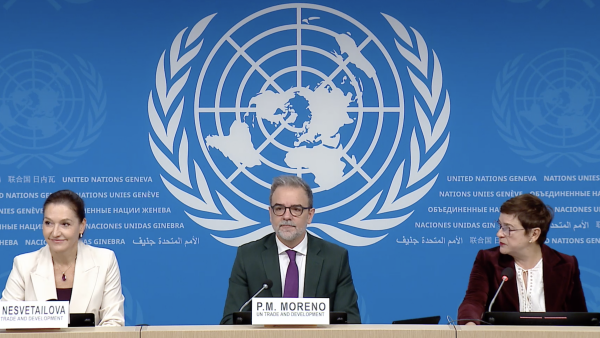
Presentation of the Trade and Developement Report 2026
Embargoed until 9 October 2026 at 11 a.m. (Geneva Time)
UNCTAD: UNCTAD’s flagship report finds that governments increasingly use industrial, trade, financial and technology policies to pursue economic and national security objectives. Market access and the ability to move into higher-value activities now depend more heavily on technology, finance and geopolitics.
1
1
1
Press Conferences | UPU
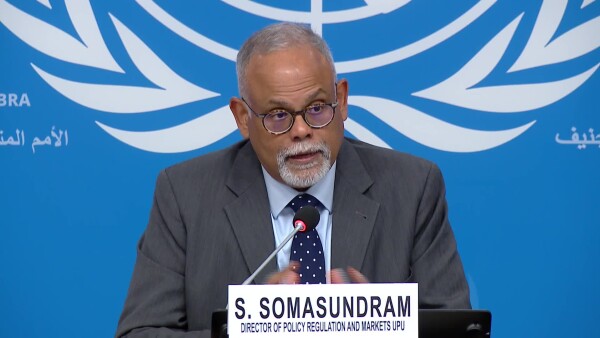
Release of the State of the Postal Sector Report 2026